
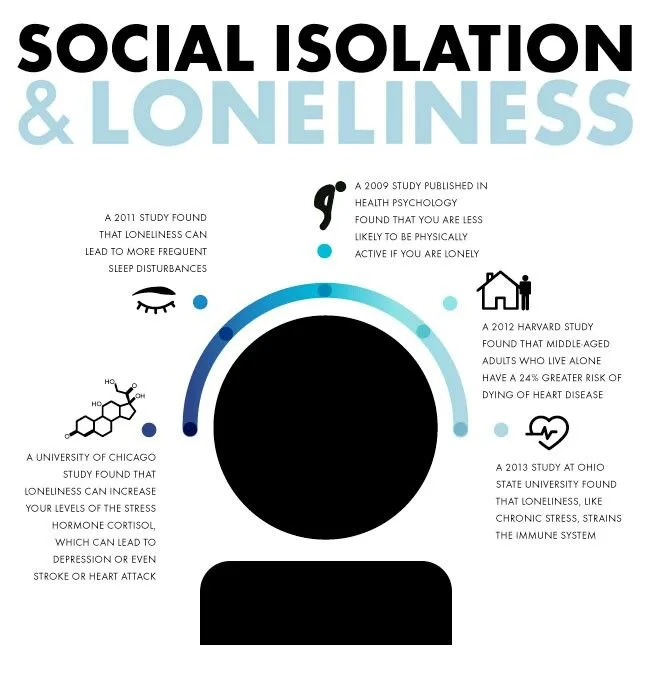
Why loneliness is deadly is that perceived social disconnection and objective isolation each predict worse health and earlier death through partly distinct pathways. Loneliness is not merely being alone; it is the feeling that relationships do not meet one's needs. Research links social exclusion to pain-related brain activity and chronic disconnection to physiological stress, making meaningful connection more protective than simply increasing contact.
Loneliness is a subjective feeling of social disconnection - the painful perception that one's relationships are insufficient in quantity or quality to meet fundamental human needs. It is not the same as being alone.
Chronic loneliness increases all-cause mortality risk by 26%, comparable to smoking 15 cigarettes per day, according to a landmark 2010 meta-analysis of 148 studies covering 308,849 participants published in PLoS Medicine.
This article explains the biological mechanisms behind loneliness's lethality, the neuroscience of social pain, the epidemiological scale of the problem, and the interventions that actually work.
In the years following the American Civil War, an unusual medical observation began circulating in military records.
Soldiers in prisoner-of-war camps who were separated from their comrades - placed in isolation as punishment - showed dramatically higher mortality rates than those kept in group confinement, even when the physical conditions of isolation were objectively better.
The doctors recording these deaths had no framework for understanding them. They attributed the cause of death to "nostalgia," a medical diagnosis of the era meaning something close to acute homesickness.
They were not wrong. They simply lacked the biological vocabulary to describe what they were observing: that human beings, deprived of social connection, die.
"The experience of loneliness is just as important to our evolutionary survival as the experience of physical pain." - John Cacioppo, Loneliness: Human Nature and the Need for Social Connection (2008)
John Cacioppo, the University of Chicago social neuroscientist who spent three decades studying loneliness before his death in 2018, called it "the most pressing issue in medicine."
His work, alongside that of Julianne Holt-Lunstad at Brigham Young University, Steve Cole at UCLA, Naomi Eisenberger at UCLA, and Matthew Lieberman, built the biological case for something humans have intuited since antiquity: we are profoundly social animals, and the deprivation of social connection is not merely unpleasant.
It is physiologically toxic.
The data are remarkable in their magnitude. Holt-Lunstad's 2010 meta-analysis found that adequate social relationships were associated with a 50% increased likelihood of survival. Chronic loneliness increases mortality risk by approximately 26%.
Social isolation increases it by 29%. These effect sizes are comparable to smoking 15 cigarettes a day, and larger than obesity.
A subsequent 2015 meta-analysis by Holt-Lunstad, this time covering 70 studies and 3.4 million participants, confirmed these findings and found that loneliness, social isolation, and living alone each independently predicted early death.
The Distinction Between Loneliness and Social Isolation
Understanding why loneliness kills requires first understanding what loneliness is - and what it is not.
Loneliness is the subjective experience of social isolation: the painful perception that one's social needs are unmet by the quantity or quality of one's social relationships. It is a psychological state, not an objective circumstance.
A person surrounded by colleagues, family members, and acquaintances can be profoundly lonely if those relationships lack genuine depth, reciprocity, or emotional resonance. Conversely, a person who lives alone and sees few people may experience no loneliness at all if their existing relationships feel meaningful and sufficient.
Social isolation is the objective lack of social contact - few or no social relationships, limited interaction with others. Social isolation predicts poor health outcomes through multiple mechanisms, but its effect on health is partly independent of subjective loneliness. The two are related but distinct constructs, and both matter.
This distinction is critical because it explains why some intuitive interventions fail. Placing a lonely person in a room full of strangers does not resolve loneliness. The problem is not the absence of bodies but the absence of felt connection.
As Robert Weiss, the sociologist who pioneered loneliness research in the 1970s, put it: loneliness is not about being alone but about being without the particular kind of relationship one needs.
How the Brain Processes Social Pain
Eisenberger's Cyberball Experiment (2003)
In 2003, Naomi Eisenberger and colleagues at UCLA published a study in Science that permanently changed the conversation about social pain.
Using functional magnetic resonance imaging (fMRI) while subjects played Cyberball - a simple virtual ball-tossing game in which participants were surreptitiously excluded after several rounds - she found that social exclusion activated the same brain regions as physical pain.
Specifically, the dorsal anterior cingulate cortex (dACC) and anterior insula, both core components of the brain's pain matrix, showed elevated activity during social exclusion. The degree of activation correlated with self-reported distress.
In subsequent studies, Eisenberger demonstrated that the overlap between social and physical pain networks was not incidental: people with the most interconnected social and pain circuits felt exclusion most acutely, and over-the-counter painkillers like acetaminophen actually reduced the distress of social rejection (DeWall et al., 2010, published in Psychological Science).
The Social Brain Hypothesis
The overlap is not coincidental or metaphorical. Matthew Lieberman's social brain hypothesis, detailed in his 2013 book Social: Why Our Brains Are Wired to Connect, proposes that social connection is as evolutionarily fundamental as physical safety - perhaps more so, because a solitary hominid on the African savanna was a dead hominid, while one embedded in a cooperative group could withstand many individual vulnerabilities.
The human brain therefore evolved to treat threats to social connection with essentially the same neural apparatus as physical threats.
This is why rejection hurts. Not because the brain misclassifies social pain as physical pain, but because social pain is implemented in the same neural circuitry precisely because it is as serious a survival threat as physical pain. The practical implication is profound: the damage from chronic loneliness is not primarily psychological.
It is physiological. The brain detecting persistent social threat activates the same stress cascades as persistent physical threat. The body prepares for danger that never arrives. The stress response stays permanently on.
The Biology of Chronic Loneliness
The CTRA Gene Expression Profile
Cacioppo and Steve Cole at UCLA conducted a remarkable series of studies mapping the molecular biology of loneliness. Their key finding, published across multiple papers beginning in 2007 in Genome Biology: loneliness is written into gene expression.
Comparing transcriptional profiles of lonely and non-lonely individuals, they identified what Cole termed the Conserved Transcriptional Response to Adversity (CTRA) - a gene expression profile characterizing the cellular response to threat.
The CTRA involves upregulation of pro-inflammatory genes and downregulation of genes involved in antiviral immune response. This pattern was chronically activated in lonely people, persisting after controlling for objective social isolation, depression, health behaviors, and demographic factors.
Loneliness - the subjective experience - independently predicted a molecular signature of sustained threat response.
The CTRA pattern is evolutionarily logical. A socially isolated individual in an ancestral environment faces elevated risk of physical attack and wound infection.
The appropriate biological preparation: increase the inflammatory response (prepare to heal wounds) and reduce investment in antiviral defense (viruses spread through social contact, which is less frequent for an isolated individual).
The catastrophic problem is that this ancient logic, applied to the circumstances of modern chronic loneliness, produces sustained inflammatory activation with no adaptive benefit - and considerable cardiovascular and neurological damage.
Cardiovascular Effects
Lonely individuals show elevated resting blood pressure, elevated heart rate, impaired heart rate variability (HRV), and higher systemic vascular resistance. Louise Hawkley and Cacioppo published a landmark 2010 study in Psychology and Aging following participants over 10 years.
They found that loneliness at baseline predicted increased systolic blood pressure equivalent to clinical hypertension at follow-up, controlling for all other variables including age, BMI, smoking, alcohol use, and depression.
The mechanism involves sustained sympathetic nervous system activation, elevated cortisol, and chronic low-grade inflammation - all converging on the cardiovascular risk profile.
A 2016 meta-analysis by Valtorta and colleagues in Heart found that loneliness and social isolation were associated with a 29% increase in coronary heart disease risk and a 32% increase in stroke risk. These are not small numbers. They are comparable to well-established cardiovascular risk factors.
Immune System Dysfunction
Lonely individuals produce weaker antibody responses to vaccines (Pressman et al., 2005, Psychosomatic Medicine). They show reduced natural killer (NK) cell activity, heal wounds more slowly, and have elevated baseline inflammatory markers including interleukin-6 (IL-6) and C-reactive protein (CRP).
Janice Kiecolt-Glaser's work at Ohio State University demonstrated that lonely older adults showed impaired wound healing and elevated inflammatory cytokines compared to socially connected controls, even after controlling for health behaviors and depression.
These immune deficits are not explained by differences in diet, exercise, smoking, or other confounders. They are independent effects of perceived social isolation operating through the CTRA pathway and the chronic activation of the hypothalamic-pituitary-adrenal (HPA) axis.
Sleep Disruption
Loneliness disrupts sleep quality in ways distinct from insomnia per se. Lonely individuals spend more time in bed but have more fragmented sleep - more micro-arousals, less slow-wave sleep, less REM sleep.
Cacioppo's analysis of daily diary data, published in Health Psychology (2002), found that daily loneliness predicted nighttime fragmented sleep on a day-by-day basis.
The mechanism: the threat-detection system maintains heightened vigilance during sleep, monitoring the environment for social threat cues.
The result is lighter, less restorative sleep that compounds the inflammatory and cognitive damage of loneliness over time.
Cognitive Decline and Dementia Risk
Cacioppo and colleagues found that loneliness accelerated cognitive decline in older adults independently of depression, social network size, and health behaviors.
A 2007 study by Wilson and colleagues published in Archives of General Psychiatry, following 823 older adults over four years, found that lonely individuals had a 64% increased risk of developing clinical dementia compared to non-lonely individuals.
The probable mechanisms are multiple and reinforcing: chronic inflammation damages hippocampal and prefrontal structures, cortisol excess directly damages the hippocampus, impaired sleep prevents memory consolidation, and reduced social stimulation reduces the cognitive reserve that buffers against neurodegeneration.
Telomere Shortening
Multiple studies find shorter telomeres - the protective caps at the ends of chromosomes that serve as markers of biological aging - in lonely individuals. A 2019 study by Campisi and colleagues found effects on telomere length comparable in magnitude to those of smoking and obesity.
The mechanism involves elevated oxidative stress and chronic inflammatory damage to telomeric DNA, accelerating the biological clock independently of chronological age.
Health Effects of Loneliness: Summary
| Health Domain | Effect | Key Mechanism | Magnitude |
|---|---|---|---|
| All-cause mortality | 26% increased risk | Multiple converging pathways | Comparable to smoking 15 cigarettes/day |
| Cardiovascular disease | 29% increased CHD, 32% increased stroke | Sympathetic activation, cortisol, inflammation | Comparable to hypertension |
| Immune function | Reduced NK activity, weaker vaccine response | CTRA: upregulated inflammation, reduced antiviral genes | Measurable in controlled studies |
| Sleep quality | More fragmented, less restorative | Threat-monitoring hypervigilance during sleep | Daily dose-response relationship |
| Cognitive decline | 64% increased dementia risk | Inflammation, cortisol damage, reduced cognitive reserve | Independent of depression |
| Telomere length | Shorter (accelerated biological aging) | Oxidative stress, inflammatory DNA damage | Comparable to obesity effect |
| Mental health | Elevated depression, anxiety, suicidality | Bidirectional reinforcement between loneliness and mood | Strong and consistent association |
Why Loneliness Perpetuates Itself: The Hypervigilance Trap
One of the most important and clinically relevant features of loneliness, documented extensively by Cacioppo across two decades of research, is its self-perpetuating quality.
Loneliness is not simply a state that causes damage - it actively creates the conditions for its own continuation through a mechanism Cacioppo called hypervigilance to social threat.
People experiencing chronic loneliness develop heightened attentional sensitivity to negative social cues: hostile facial expressions, ambiguous statements, signs of rejection.
Primed for rejection by the chronic experience of social inadequacy, the lonely brain finds rejection evidence everywhere - in neutral or ambiguous social signals that non-lonely people interpret as benign or even friendly.
Cacioppo's experimental work documented this directly. Lonely and non-lonely individuals were shown identical social scenes.
Lonely individuals identified more hostile facial expressions, attributed more hostile intent to ambiguous social behaviors, and recalled more negative details from social interactions. The attentional bias was measurable, consistent, and operated below conscious awareness.
This distorted social perception then produces behavioral responses - withdrawal, reduced risk-taking in social situations, reduced investment in social connections - that reduce social contact and confirm the fears driving the withdrawal. The perception of rejection increases.
Actual social connection decreases. Loneliness intensifies. This is a classic positive feedback loop: the condition generates the very conditions that sustain it.
This explains one of the most counterintuitive findings in loneliness research: simply creating social contact opportunities for chronically lonely individuals often fails. A lonely person placed in a social environment reads it through a filter of anticipated rejection.
They may find confirmation of their fears even in neutral or welcoming interactions, because their attentional system is calibrated to detect threat rather than opportunity.
The implication for intervention is that addressing the cognitive distortions - the hypervigilance, the hostile attribution bias, the negative expectation - is as important as addressing the objective social isolation.
Without cognitive change, more social exposure can actually reinforce the lonely person's belief that connection is unavailable to them.
The Loneliness Epidemic: Scale and Structural Causes
The Numbers
The epidemiological picture of loneliness in the contemporary developed world is striking and alarming:
- A 2018 Cigna survey of 20,000 American adults using the UCLA Loneliness Scale found that 54% reported that no one knew them well, 40% felt isolated, and 43% felt their relationships lacked meaning.
- Counterintuitively, the loneliest age group was young adults (18-22), not the elderly, who score lowest on loneliness measures in most surveys - despite the cultural stereotype.
- The U.S. Surgeon General's 2023 Advisory on the Epidemic of Loneliness and Isolation declared loneliness a public health crisis, estimating that approximately half of American adults experience measurable loneliness.
- UK surveys consistently find 20-35% of adults reporting significant loneliness. Japan has appointed a Minister of Loneliness (2021), as has the United Kingdom (2018).
- Multiple national surveys across Australia and European countries find similar prevalence rates, with variation by demographic group: younger adults, lower socioeconomic status, urban residents, and recent immigrants report the highest rates.
Structural Contributors
The rising prevalence of loneliness is not primarily a story of individual failure. It reflects structural changes in how modern societies are organized:
Decline of communal institutions: Church attendance, union membership, civic club participation, and neighborhood association engagement have all declined substantially in the US and UK over the past 50 years.
Robert Putnam documented this systematically in Bowling Alone (2000), showing that Americans' participation in nearly every form of civic and social organization declined between the 1960s and the 1990s.
These institutions provided regular, low-stakes social contact with people outside one's close network - exactly the kind of peripheral social connection that buffers against loneliness.
Geographic mobility: People increasingly move for work, education, and housing affordability, disrupting long-term local social networks. While American geographic mobility rates have actually declined since the 1980s, the weakening of place-based community ties preceded and enabled this shift.
Social media and the displacement hypothesis: Smartphone use and passive social media consumption may be displacing the in-person social contact that provides genuine connection.
Jean Twenge's analysis, published in iGen (2017), found a significant inflection point in 2012 - precisely when smartphone ownership became widespread among teenagers - in measures of loneliness, depression, and social isolation among adolescents.
Jonathan Haidt's subsequent work in The Anxious Generation (2024) built on these findings, arguing that the phone-based childhood has restructured adolescent social development in ways that increase loneliness.
The COVID-19 pandemic: COVID-19 enforced acute social isolation globally. Surveys across multiple countries documented significant increases in loneliness during lockdowns.
A 2021 meta-analysis by Ernst and colleagues in Psychiatry Research found a substantial increase in loneliness prevalence during the pandemic, with younger adults and those living alone most affected. Whether these effects have fully recovered remains an active area of research.
"Loneliness is not just a personal failing or a matter of introversion. It is a public health crisis with structural causes that require structural responses - in urban design, in work policies, in how we build communities." - Vivek Murthy, U.S. Surgeon General, Together (2020)
What Actually Reduces Loneliness: Evidence-Based Interventions
The Most Important Finding
Interventions that merely increase the quantity of social contact without addressing the cognitive distortions that maintain loneliness have limited effectiveness.
A 2011 meta-analysis by Christopher Masi and colleagues, published in Personality and Social Psychology Review, examined the effectiveness of four types of loneliness interventions: improving social skills, enhancing social support, increasing opportunities for social contact, and addressing maladaptive social cognition.
The cognitive intervention - addressing the distorted thinking patterns of lonely individuals - was the most effective by a significant margin.
Cacioppo's Three-Component Protocol
Cacioppo's most effective protocol for chronic loneliness combined three components:
Cognitive retraining: Reducing hypervigilance to social threat. Practicing recognizing and challenging hostile attributions in social situations. Reducing rumination about past rejection experiences. This is essentially cognitive-behavioral therapy adapted for the specific cognitive distortions of loneliness.
Behavioral activation: Increasing approach behavior toward social opportunities despite fear of rejection. Graduated exposure to social situations, beginning with low-risk encounters and building toward more meaningful connection. The behavioral component addresses the withdrawal that maintains loneliness.
Self-regulation training: Reducing the defensive withdrawal and excessive social monitoring that preserve the sense of safety but impair actual connection. Learning to tolerate the vulnerability inherent in genuine social engagement.
Quality Over Quantity
Research consistently shows that the health benefits of social connection come primarily from high-quality relationships - characterized by mutual support, genuine disclosure, and felt closeness - rather than from large social networks or frequent interaction.
Two or three high-quality relationships protect health more than a large network of superficial contacts. This finding, replicated across multiple studies and populations, has important implications: the goal of loneliness intervention is not to maximize social contacts but to develop and deepen meaningful connections.
Volunteering and Purpose
Volunteering and activities that provide a sense of contribution to others reduce loneliness through multiple mechanisms: social contact with shared purpose, a sense of mattering and being valued, and the positive emotion of meaningful engagement.
A 2020 systematic review by Jenkinson and colleagues found that the effect on loneliness from volunteering was larger than most social contact interventions, likely because volunteering addresses both the social contact deficit and the meaning deficit that characterize chronic loneliness.
Social Prescribing
The United Kingdom has developed a network of "link workers" who connect lonely individuals with community activities, interest groups, and social resources.
Early evidence is promising - a 2020 evaluation by the National Academy for Social Prescribing found reduced loneliness and improved wellbeing among participants - though rigorously controlled trials remain limited.
Digital Contact: The Nuance
Video calling and voice calls with people one knows provide measurable social connection benefit. Passive social media consumption does not, and may worsen loneliness through upward social comparison.
The medium of digital contact matters enormously: active, reciprocal communication with known individuals approximates the benefits of in-person contact, while scrolling through curated images of others' lives does not.
For related topics, see how stress damages the body, what causes depression, what the science of longevity shows, and how sleep deprivation affects the brain.
Sources & Further Reading
- Holt-Lunstad, J., Smith, T. B., & Layton, J. B. (2010). Social Relationships and Mortality Risk: A Meta-Analytic Review. PLoS Medicine, 7(7), e1000316. DOI: 10.1371/journal.pmed.1000316
- Holt-Lunstad, J., Smith, T. B., Baker, M., Harris, T., & Stephenson, D. (2015). Loneliness and Social Isolation as Risk Factors for Mortality. Perspectives on Psychological Science, 10(2), 227-237. DOI: 10.1177/1745691614568352
- Cacioppo, J. T., & Patrick, W. (2008). Loneliness: Human Nature and the Need for Social Connection. W. W. Norton.
- Cacioppo, J. T., & Hawkley, L. C. (2009). Perceived Social Isolation and Cognition. Trends in Cognitive Sciences, 13(10), 447-454. DOI: 10.1016/j.tics.2009.06.005
- Cole, S. W., Hawkley, L. C., Arevalo, J. M., Sung, C. Y., Rose, R. M., & Cacioppo, J. T. (2007). Social Regulation of Gene Expression in Human Leukocytes. Genome Biology, 8(9), R189. DOI: 10.1186/gb-2007-8-9-r189
- Eisenberger, N. I., Lieberman, M. D., & Williams, K. D. (2003). Does Rejection Hurt? An fMRI Study of Social Exclusion. Science, 302(5643), 290-292. DOI: 10.1126/science.1089134
- Lieberman, M. D. (2013). Social: Why Our Brains Are Wired to Connect. Crown Publishers.
- Hawkley, L. C., Thisted, R. A., Masi, C. M., & Cacioppo, J. T. (2010). Loneliness Predicts Increased Blood Pressure. Psychology and Aging, 25(1), 132-141. DOI: 10.1037/a0017805
- Valtorta, N. K., Kanaan, M., Gilbody, S., Ronzi, S., & Hanratty, B. (2016). Loneliness and Social Isolation as Risk Factors for Coronary Heart Disease and Stroke. Heart, 102(13), 1009-1016. DOI: 10.1136/heartjnl-2015-308790
- Wilson, R. S., Krueger, K. R., Arnold, S. E., et al. (2007). Loneliness and Risk of Alzheimer Disease. Archives of General Psychiatry, 64(2), 234-240.
- Masi, C. M., Chen, H. Y., Hawkley, L. C., & Cacioppo, J. T. (2011). A Meta-Analysis of Interventions to Reduce Loneliness. Personality and Social Psychology Review, 15(3), 219-266. DOI: 10.1177/1088868310377394
- Murthy, V. H. (2020). Together: The Healing Power of Human Connection in a Sometimes Lonely World. Harper Wave.
- Putnam, R. D. (2000). Bowling Alone: The Collapse and Revival of American Community. Simon & Schuster.
- Twenge, J. M. (2017). iGen: Why Today's Super-Connected Kids Are Growing Up Less Rebellious, More Tolerant, Less Happy - and Completely Unprepared for Adulthood. Atria Books.
- U.S. Surgeon General. (2023). Our Epidemic of Loneliness and Isolation. U.S. Department of Health and Human Services. View source