
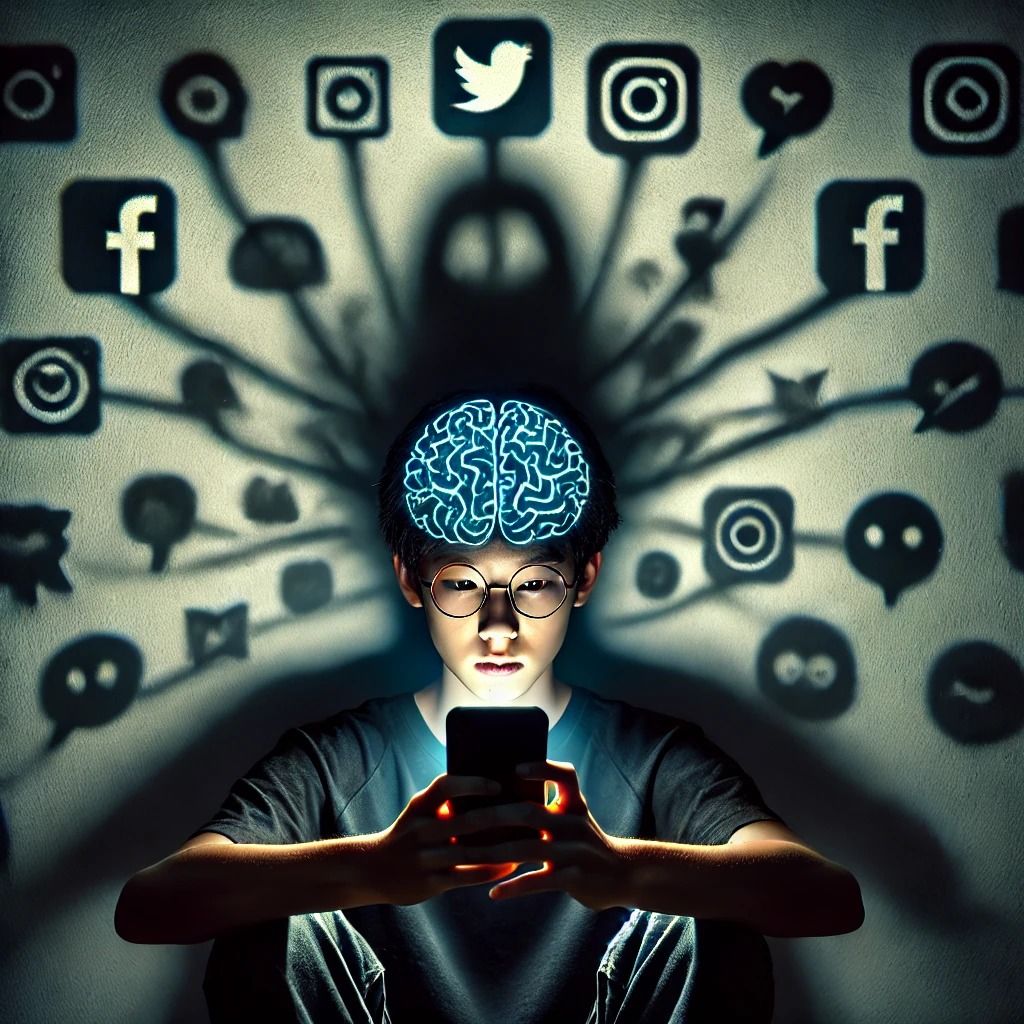
Social: In 2017, Sean Parker - the founding president of Facebook - gave an interview that was unusually candid for a Silicon Valley insider.
"The thought process that went into building these applications," he said, "was all about: How do we consume as much of your time and conscious attention as possible?" He described the engineering logic: "We need to give you a little dopamine hit every once in a while, because someone liked or commented on a photo or a post or whatever.
And that's going to get you to contribute more content, and that's going to get you more likes and comments."
Parker was not speaking as a critic. He was explaining, without apparent remorse, the intentional design philosophy of the world's most-used social platform.
This transparency was unusual. But the mechanism Parker described - exploiting the dopamine system through variable, unpredictable rewards - was the same principle being deployed across every major social platform simultaneously.
Instagram, Twitter, TikTok, YouTube, Reddit: each designed, with varying degrees of explicit intention, to maximize time-on-platform through the same neurological levers that casinos discovered a century ago.
Understanding how these systems work - what they are doing in the brain, what the research shows about the consequences, and what can be done about it - requires looking at both what neuroscience knows and what it honestly does not know.
"All of us are jacked into this system. All of our minds can be hijacked. Our choices are not as free as we think they are." - Tristan Harris, former Google design ethicist
Key Definitions
Variable ratio reinforcement schedule - A reinforcement pattern (from B.F. Skinner's operant conditioning) in which rewards occur after an unpredictable number of behaviors. Produces the most robust, persistent, and extinction-resistant behavioral responding of any reinforcement schedule.
The principle underlying both slot machines and social media feeds.
Dopamine prediction error - The neural signal generated by dopamine neurons when an outcome is better than expected (positive prediction error, generating reward learning) or worse than expected (negative prediction error, generating aversion learning).
Strongest when uncertainty is high. The basis for the reward-learning mechanism exploited by variable social media rewards.
Social comparison - Leon Festinger's concept (1954) that humans evaluate their opinions, abilities, and circumstances partly by comparing themselves to others, particularly upward comparison (to those doing better) and downward comparison (to those doing worse). Social media creates systematically distorted comparison environments.
FOMO (Fear of Missing Out) - Apprehension about missing rewarding social experiences or social information, driving compulsive checking behavior. Exploited by social media design through social activity notifications, stories, live events, and ephemeral content that disappears.
Default mode network (DMN) - The brain network active during rest, mind-wandering, and self-referential thought. Social media use competes with and potentially suppresses the DMN states that facilitate creativity, reflection, and integrative thought.
Passive social media use - Scrolling, browsing, reading others' content without active engagement. Associated with worse mental health outcomes than active use (direct communication, content creation). The dominant mode of social media consumption.
Attentional blink - A brief window (~500ms) after processing one stimulus during which a second stimulus in rapid sequence is often missed. Heavy digital media use may alter attentional dynamics in ways that affect task performance.
Upward social comparison - Comparison of oneself to others who are perceived as better in some relevant domain. Social media produces constant upward comparison against curated, artificially elevated presentations of others' lives.
Research Summary: Social Media Effects on Mental Health and Cognition
| Effect | Evidence Quality | Key Findings | At-Risk Population |
|---|---|---|---|
| Teen anxiety and depression | Moderate-strong (correlational + experimental) | 2x depression rates in heavy users; Instagram's own research showed 32% of teen girls body image worsened | Girls ages 11-16; heaviest users |
| Sleep disruption | Strong | Blue light + engagement before sleep delays sleep onset by 30-90 min; reduces slow-wave sleep quality | Adolescents; people with evening use habits |
| Attention fragmentation | Moderate | Heavy multitaskers worse at filtering irrelevant info (Nass, Stanford); average attention span on single task declining | Heavy multitaskers; teen boys gaming + social media |
| Upward social comparison | Strong | Curated highlight-reel content reliably produces worse mood and self-esteem in passive users | Passive consumers vs. active posters |
| Political polarization | Contested | Some experimental evidence of algorithm-driven radicalization; Facebook's own data showed reducing algorithmic recommendations barely changed polarization | Heavy Facebook users; partisan content consumers |
| Dopamine desensitization | Preliminary | Reward circuitry changes in heavy users paralleling substance use disorder patterns | Heavy users; adolescents with developing reward systems |
The Dopamine Architecture: How Platforms Are Engineered
The dopamine system is not, as popular science sometimes implies, a simple pleasure system. It is a prediction and learning system - generating signals not primarily about pleasure but about whether outcomes were better or worse than predicted.
Wolfram Schultz's foundational research with monkeys in the 1990s demonstrated this precisely: dopamine neurons fire most strongly not when the reward arrives, but when an unexpected reward arrives, and most strongly of all when a reward might or might not arrive - when uncertainty about reward is highest.[1]
This is the neurological basis for the variable ratio reinforcement effect that Skinner documented behaviorally. Variable ratio schedules are not just more exciting than predictable reward schedules. They are architecturally matched to the brain's reward-learning machinery in a way that makes them maximally compelling.
The Social Media Feed as Slot Machine
B.J. Fogg, director of the Stanford Persuasive Technology Lab, developed a framework for designing habit-forming technology that influenced generations of app designers. His former student, Nir Eyal, published Hooked in 2014 - a design manual for building "habit-forming products" that was read widely in Silicon Valley.
The core mechanism of the "Hook" model:
- Trigger: External (notification, ping, pop-up) or internal (boredom, loneliness, anxiety) cue that prompts the behavior
- Action: The simplest possible behavior in anticipation of a reward (open the app, begin scrolling)
- Variable reward: Unpredictable mixture of rewarding content and social validation and neutral content - the slot machine schedule
- Investment: The user contributes something (content, data, connection) that loads the next trigger
Each iteration of the loop deepens the conditioned association between the trigger states (boredom, anxiety, social impulse) and the action (opening the app). After sufficient repetitions, the app opens automatically - the behavior has been made habitual, requiring minimal conscious deliberation.
The Notification System
Notifications are the external trigger layer. They are designed to interrupt whatever you are doing to redirect attention to the platform - and they have been found to be effective at this regardless of whether users actually check them.
Research by Kostadin Kushlev and Elizabeth Dunn found that simply having a phone present on a desk (face-down, silenced) reduced available cognitive capacity - presumably because the phone commanded background attentional resources even without visible notifications.
The notification itself delivers a small reward: someone did something in response to your content. The anticipation of notification - the checking behavior triggered by uncertainty about whether a notification might have appeared - is a powerful driver of compulsive phone checking.
What Neuroscience Shows About Heavy Social Media Use
Prefrontal Cortex Changes
Several neuroimaging studies have found structural and functional differences in heavy social media users compared to light users. Dar Meshi at Michigan State, and researchers including Christian Montag and Matthias Brand, have found that heavy social media users show:
- Reduced gray matter volume in the prefrontal cortex - associated with impulse control, long-term planning, and decision-making
- Altered connectivity between prefrontal cortex and striatum (reward system)
- Exaggerated amygdala responses to social media content
These patterns are similar to, though typically less severe than, patterns seen in gambling disorder and substance use disorders. The critical question - causation or selection - is not definitively resolved by cross-sectional studies.
Longitudinal research finding that social media use predicts subsequent changes in brain structure would be stronger evidence for causation; most available data is cross-sectional.
The Reward System and Social Validation
Dar Meshi's 2013 fMRI study directly measured the brain's response to social rewards delivered via social media-like feedback.[2] Participants received positive feedback about themselves (their name was rated highly by others) and positive feedback about a stranger.
The nucleus accumbens - the brain's primary reward hub - responded more strongly to positive feedback about the self.
More importantly: the individual variation in nucleus accumbens response to social feedback predicted subsequent social media use - participants with greater reward-circuit responses to social validation spent more time on social media. The reward system is explicitly involved in the reinforcement of social media use.
Attention Fragmentation
Gloria Mark's research at UC Irvine has tracked attention patterns in office workers for two decades.[9] Her longitudinal data suggests a dramatic decrease in sustained attention:
- In 2004: average attention on a single focus before switching was approximately 2.5 minutes
- By the mid-2010s: approximately 47 seconds
- Recovery time after an interruption: approximately 23 minutes to return to full engagement
The causal chain she proposes: the digital work environment has trained frequent task-switching through constant notifications, multi-tab browsing, and the pull of social media checking. This training generalizes: people habituated to frequent switching lose the capacity for sustained focus even when they want it.
Social Media and Mental Health: The Contested Evidence
The claim that social media causes mental health problems - especially in teenagers - is both the most discussed and most contested claim in this domain.
The Haidt-Twenge Case
Jonathan Haidt (NYU Stern) and Jean Twenge (San Diego State) have assembled the most comprehensive case for a causal relationship.[5] Their argument:
- Adolescent mental health - especially for girls - began deteriorating sharply around 2012-2014 in the US, UK, Canada, and Australia simultaneously
- Smartphone adoption and social media use reached mass penetration in the same period
- The timing is too precise and too global to be explained by other factors
- The effect is larger for girls, who use social media more and engage in social comparison more intensely
- Mechanistically, social media produces upward social comparison, FOMO, sleep disruption, and cyberbullying - all documented risk factors for depression and anxiety
Haidt's 2024 book The Anxious Generation synthesized this evidence and proposed concrete policy responses including age verification for social media platforms.[6]
The Skeptical Response
Amy Orben (Cambridge) and Andrew Przybylski (Oxford) conducted methodologically rigorous re-analyses of the same large datasets.[4] Their key findings:
- Effect sizes for social media use on wellbeing are small - comparable to effects of wearing glasses, eating potatoes, or sleeping in socks
- The correlational patterns are inconsistent: social media use sometimes correlates positively, sometimes negatively, sometimes not at all depending on how variables are measured
- Researcher degrees of freedom - the many analytical choices available in large dataset analysis - can produce widely varying results from the same data (this is the "specification curve" problem)
- Causality cannot be established from cross-sectional correlations
This position has been criticized for minimizing effects that are meaningful at population scale even if modest in individual effect sizes, and for missing important moderating effects (vulnerable subgroups, passive vs. active use).
What the Experimental Evidence Shows
Randomized controlled experiments - where social media access is assigned rather than self-selected - provide cleaner evidence.
- Hunt et al. (2018, University of Pennsylvania): Randomly assigned undergraduates to limit social media to 30 minutes/day for 3 weeks vs. continue usual use. The restricted group showed significant reductions in depression and loneliness compared to controls.[3]
- Tromholt (2016, The Happiness Research Institute): 1,095 Facebook users randomly assigned to Facebook abstinence for one week vs. continued use. Abstinence group showed higher life satisfaction and more positive affect.
- Shakya & Christakis (2017): Longitudinal study finding that Facebook use predicted decreased self-assessed mental health, life satisfaction, and physical health over time.
- Verduyn et al. (2015): Passive Facebook use - but not active use - predicted decreased affective wellbeing over time, mediated by social comparison.[8]
The experimental evidence leans toward social media use, particularly passive use, having real negative effects on wellbeing - especially in groups already vulnerable to social comparison.
The Social Comparison Machine
In any previous era of human history, social comparison was bounded by geography and community. You compared yourself to the people in your town, your school, your extended family.
Social media radically expanded the comparison pool - and distorted it.
The Highlight Reel Problem
Instagram, TikTok, and Facebook present curated, filtered, selectively positive presentations of others' lives. Nobody posts their mediocre Tuesday; everybody posts their vacation, their relationship milestone, their professional achievement, their most photogenic moment.
The result is systematic upward comparison against an artificially elevated baseline - a sample of others' lives that is not representative of their actual experience but represents their best moments, photographically enhanced and socially selected.
Adolescent girls are particularly affected, for several reasons: social comparison is more central to female social bonding and identity formation in adolescence; appearance comparison is specifically amplified by image-heavy platforms; and the combination of puberty-related body dissatisfaction with daily comparison against professionally edited images creates conditions for serious body image disruption.
The evidence on Instagram and body image is particularly clear: experimental studies where participants are shown idealized social media images consistently produce temporary body dissatisfaction, appearance anxiety, and negative affect.
Longitudinal studies find higher Instagram use predicts internalization of appearance ideals and eating disorder risk in adolescent girls.
Parasocial Comparison
A distinctive feature of social media is the rise of parasocial relationships - one-sided relationships with content creators, influencers, and celebrities with whom users feel familiarity and closeness despite no mutual relationship existing.
Parasocial relationships are not inherently harmful - they are a normal aspect of media engagement. But they become distorted when they become comparison targets.
When a user feels emotionally close to an influencer whose carefully managed appearance and lifestyle they compare themselves against daily, the comparison has the psychological weight of a peer comparison but the unreality of a media production.
The Teenage Brain: Why Adolescents Are Especially Vulnerable
Adolescent brain development makes teenagers specifically vulnerable to social media's dopamine and comparison mechanisms.
The adolescent brain undergoes a major reorganization in which the reward system (including the nucleus accumbens) becomes more reactive, while the prefrontal cortex - which would modulate impulsive reward-seeking - is not fully developed until approximately age 25.
This creates a developmental period in which social rewards (peer approval, social comparison, inclusion/exclusion) are neurobiologically amplified beyond adult sensitivity.
The adolescent brain treats social acceptance and rejection with an urgency closer to survival threat than does the adult brain. Social pain and social validation produce stronger neurological responses.
Social media is, from a neurological perspective, a peer comparison and validation engine delivered to brains designed by evolution to be maximally sensitive to peer comparison and validation.
Sleep Disruption: The Underrated Pathway
One mechanism through which social media may impair mental health receives less attention than it deserves: sleep disruption.
The pathway:
- Evening phone use suppresses melatonin through blue light exposure (Chang et al., 2015: 1.5-hour delay in melatonin onset from e-reader use vs.[7] print)
- Engaging social media content creates cognitive and emotional arousal incompatible with sleep onset
- FOMO drives checking behavior during the night
- Cumulative sleep deprivation impairs prefrontal cortex function, specifically the regulatory capacity that would otherwise moderate compulsive phone use
Jean Twenge's analysis found that adolescent sleep duration declined approximately 16-20 minutes on average from 2012 to 2018 - a modest but consistently measured decline coinciding with smartphone adoption. Experimental studies of phone removal from bedrooms produce sleep improvements.
Sleep deprivation is independently associated with depression, anxiety, and impaired emotional regulation - providing a plausible pathway from social media use to mental health outcomes independent of social comparison mechanisms.
What the Evidence Supports Doing
The research landscape supports several conclusions about effective responses.
What Works
Usage restriction: The 30-minute/day social media limit used in experimental studies is not arbitrary - it appears to be a threshold below which many negative effects diminish significantly. Time-limit tools on iOS and Android can support this, though their effectiveness is limited by user ability to override them.
Phone-free bedrooms: Removing phones from bedrooms before sleep consistently improves sleep quality in experimental studies. The low-stimulation alternative (print reading, journaling) provides the transition to lower arousal that facilitates sleep.
Active over passive use: Passive scrolling (consuming others' content) is consistently associated with worse outcomes than active use (direct messaging, content creation, meaningful exchange). Intentionally shifting toward active use and away from passive scrolling appears beneficial.
Digital-free periods: "Dopamine fasting" - extended periods without high-stimulation digital input - appears to restore sensitivity to lower-stimulation rewards and reduce compulsive checking, consistent with evidence of receptor upregulation following reduced stimulation.
What Doesn't Work
Simply knowing about social media's psychological mechanisms does not automatically change behavior - this is the classic knowledge-intention-behavior gap. Awareness without structural change (app deletion, device placement, environment design) produces limited results.
Telling teenagers to "just use it less" without providing alternative social infrastructure is similarly ineffective - for many adolescents, social media is not optional but the primary medium through which peer relationships are maintained.
For related articles, see how habits form and change, why we get bored, how social media algorithms work, and why we procrastinate.
Sources & Further Reading
- Schultz, W. (2016). Dopamine Reward Prediction Error Coding. Dialogues in Clinical Neuroscience, 18(1), 23-32.
- Meshi, D., Tamir, D. I., & Heekeren, H. R. (2015). The Emerging Neuroscience of Social Media. Trends in Cognitive Sciences, 19(12), 771-782. DOI: 10.1016/j.tics.2015.09.004
- Hunt, M. G., et al. (2018). No More FOMO: Limiting Social Media Decreases Loneliness and Depression. Journal of Social and Clinical Psychology, 37(10), 751-768. DOI: 10.1521/jscp.2018.37.10.751
- Orben, A., & Przybylski, A. K. (2019). The Association Between Adolescent Well-Being and Digital Technology Use. Nature Human Behaviour, 3(2), 173-182. DOI: 10.1038/s41562-018-0506-1
- Twenge, J. M. (2017). iGen: Why Today's Super-Connected Kids Are Growing Up Less Rebellious, More Tolerant, Less Happy - and Completely Unprepared for Adulthood. Atria Books.
- Haidt, J. (2024). The Anxious Generation: How the Great Rewiring of Childhood Is Causing an Epidemic of Mental Illness. Penguin Press.
- Chang, A.-M., et al. (2015). Evening Use of Light-Emitting eReaders Negatively Affects Sleep, Circadian Timing, and Next-Morning Alertness. PNAS, 112(4), 1232-1237. DOI: 10.1073/pnas.1418490112
- Verduyn, P., et al. (2015). Passive Facebook Usage Undermines Affective Well-Being. Journal of Experimental Psychology: General, 144(2), 480-488. DOI: 10.1037/xge0000057
- Mark, G. (2023). Attention Span: A Groundbreaking Way to Restore Balance, Happiness and Productivity. Hanover Square Press.