
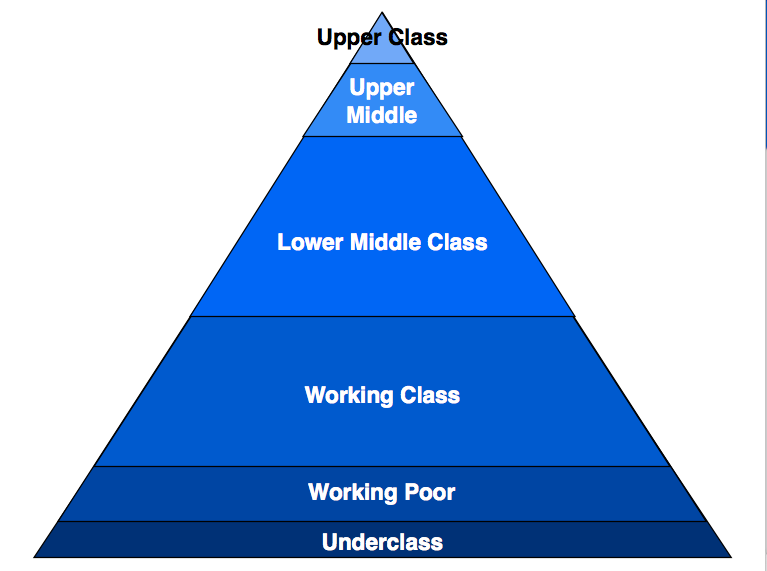
Income alone cannot capture the way class shapes opportunity, belonging, confidence, networks, and expectations across a lifetime. The answer to what is social class includes economic position, cultural knowledge, social connections, and the internalized sense of where one belongs. Marx emphasized ownership and exploitation, while Bourdieu's account adds forms of capital and habitus that reproduce advantage beyond wages or formal credentials.
At some point in their first year at university, many students who grew up in working-class households make a discovery that no one warned them about. It is not that the coursework is too hard - they were told that might happen, and they prepared for it.
The discovery is subtler: that the way they talk, the things they find funny, the references they make in conversation, the way they sit in a professor's office or address a formal email, the restaurants they feel comfortable in, the ease or discomfort they carry in their bodies in unfamiliar social spaces - all of this marks them.
Not as unintelligent, but as different. As not-quite-fitting into a social world that seems to have been designed for someone else.
What they are encountering is social class. Not income - they may have a scholarship that covers their fees as well as any of their classmates. Not race or gender, though those intersect with class in complex ways.
What they are encountering is the lived embodied reality of class difference: the difference between a life where professional norms, middle-class conversational conventions, and the unwritten rules of educated institutions were absorbed from childhood, and a life where they were not.
Social class is one of the most fundamental structures of human societies. It shapes who lives and who dies earlier, who goes to university and what happens to them there, who gets hired and who gets promoted, who owns property and who rents, who feels at ease in the world and who carries a constant low-level alertness to the danger of being exposed as someone who does not quite belong.
Yet it is also one of the least discussed aspects of social life in contemporary culture.
In societies that like to think of themselves as meritocracies, class is the embarrassing structural fact that the meritocracy story requires us not to look at too directly.
This article examines what social class is, how major theorists have conceptualized it, what research reveals about its psychological and material effects, and why the stubborn persistence of class inequality in societies that officially believe in equal opportunity demands more sustained attention than it typically receives.
"The most intolerable pain is produced by prolonging the present moment and breaking the routine of our daily lives." --- Pierre Bourdieu, The Weight of the World
Key Definitions
Social class: A hierarchical grouping of individuals who share similar economic positions, social statuses, and life chances, shaped by their access to material resources, cultural knowledge, and social networks.
Bourgeoisie: In Marxist analysis, the class that owns the means of production - factories, land, capital - and lives by appropriating the surplus value produced by workers.
| Social Class Dimension | Objective Measure | Subjective Measure |
|---|---|---|
| Economic | Income, wealth, employment status | Felt financial security and adequacy |
| Cultural | Education, cultural capital, taste | Sense of belonging in educated or elite contexts |
| Social | Social networks, connections, who you know | Feeling of being respected and included |
| Psychological | Internalized sense of place and worth | Class identity, impostor feelings, entitlement |
Proletariat: In Marxist analysis, the working class, who own only their labor power, which they must sell to the bourgeoisie to survive.
Class consciousness: Awareness by members of a class of their shared interests and their antagonistic relationship to other classes.
Habitus: Bourdieu's term for the durable, transposable set of dispositions - ways of perceiving, evaluating, and acting - that individuals acquire through their position in the social structure.
Capital (in Bourdieu's sense): Resources that confer power and advantage. Bourdieu identified economic capital (financial resources), cultural capital (knowledge, credentials, and dispositions), and social capital (networks and relationships).
Intergenerational mobility: The degree to which children's economic outcomes differ from their parents', either upward (improving economic position) or downward (declining economic position).
Life chances: A term from Max Weber referring to the typical opportunities for economic survival and advancement that individuals in a given social position are likely to encounter.
Marx: Class, Exploitation, and Consciousness
Karl Marx developed the most influential structural account of social class in intellectual history.[1]
His framework was not primarily sociological description but political economy: an attempt to understand how capitalism worked as a system, who benefited from it, and why the people who did not benefit nonetheless accepted and often defended it.
The Material Foundation of Class
For Marx, class is defined by position in the relations of production - specifically, by one's relationship to the ownership of the means of production.
Under capitalism, this creates two fundamental classes in necessary antagonism: the bourgeoisie, who own the factories, machinery, land, and capital that make production possible, and the proletariat, who own nothing of productive value except their capacity to work.
This relationship is not merely one of inequality in income or wealth. It is, in Marx's analysis, inherently exploitative. Value is produced by labor.
But workers do not receive the full value of what they produce - they receive wages sufficient to reproduce their capacity to work, while the difference (surplus value) is appropriated by the capitalist as profit.
The wage relationship is not a fair exchange between equals but a structural extraction that occurs whether or not individual capitalists are personally decent or cruel.
Marx recognized that capitalism created a complex division of labor that included groups - managers, professionals, shopkeepers, independent artisans - who did not fit neatly into the bourgeois-proletarian binary.
He addressed these in his later writings as 'intermediate strata' or the 'petty bourgeoisie,' but the two-class schema remained his primary analytical framework.
This simplification has been both the framework's strength (its clarity) and its weakness (its inability to capture the full complexity of modern stratification).
The Problem of Class Consciousness
Perhaps Marx's most politically important distinction was between a class 'in itself' - a group of people who share the same objective economic position - and a class 'for itself' - a class that has developed consciousness of its shared interests and is organized to pursue them.
The working class exists as an objective structural category whether or not individual workers recognize their common interests. But political transformation requires that workers develop class consciousness: an understanding of their position, their collective interests, and the systemic nature of the exploitation they experience.
The obstacle to class consciousness is ideology - the set of ideas, values, and representations that the ruling class propagates to secure the consent of the ruled.
When workers attribute poverty to personal failure rather than structural position, when they experience competition with other workers as more real than solidarity against the owning class, when they adopt aspirations shaped by ruling-class culture rather than their own collective interests, Marx argued they were exhibiting false consciousness: a distorted understanding of their own situation.
This analysis has been enormously productive for subsequent social science, even for scholars who reject Marx's political conclusions.
It directs attention to the ways in which dominant ideologies work to make inequality seem natural, inevitable, and just, and to the conditions under which that ideological work fails - when people see through the naturalization of inequality and begin to act collectively.
Weber: Class, Status, and Party
Max Weber's account of stratification, developed in essays and lectures in the first decades of the 20th century, was partly a dialogue with and critique of Marx's framework.
Weber accepted that economic class was a fundamental source of social inequality but argued that Marx's reduction of all social hierarchy to class was an oversimplification that obscured important dimensions of real social life.
Three Dimensions of Stratification
Weber distinguished three analytically separate and partially independent dimensions of social inequality:[2]
Class in Weber's sense refers to groups of people who share the same 'life chances' in the market: the same typical probabilities for acquiring goods, finding a social position, and achieving inner satisfaction, as determined by their economic power.
Weber distinguished between propertied classes (defined by ownership of productive assets) and acquisition classes (defined by marketable skills).
A highly skilled software engineer or a physician with no capital assets but high market value occupies a very different class position from an unskilled laborer, even if neither owns means of production.
This complicates the Marxist binary and has proven more accurate to the experience of advanced capitalist societies, where professional and managerial workers constitute a large and influential stratum.
Status (Stande) refers to the social honor or prestige attached to a group, maintained through distinctive lifestyles, consumption patterns, and social conventions. Status can align with class - wealthy people typically have high status - but the two can diverge.
The 'genteel poor' of 19th-century England had high social status and limited income. Some wealthy industrialists were regarded with condescension by aristocratic families with less money but more established status.
Status is maintained through social exclusion: controlling whom you marry, associate with, and admit to your social circle.
Party refers to any organized group oriented toward the purposive acquisition of social power - influence over the decisions and direction of the state or other significant institutions.
Parties in this broad sense may recruit across class and status lines, as when nationalist movements draw support from different economic strata, or labor movements organize across skill levels.
Weber's multi-dimensional approach has been foundational for subsequent stratification research because it acknowledges that people's social positions are complex and cannot be read off from a single variable.
Bourdieu: Habitus, Capital, and the Reproduction of Class
Pierre Bourdieu's sociology of class, developed across several decades of empirical research on French society and consolidated in his 1979 masterwork 'Distinction: A Social Critique of the Judgement of Taste,' is the most sophisticated and influential account of class in contemporary sociology.[3]
Bourdieu's central achievement was to explain how class inequalities reproduce themselves across generations without requiring explicit coercion or even conscious awareness on the part of the people involved.
Multiple Forms of Capital
Bourdieu retained Marx's insight that unequal distribution of resources is the foundation of class inequality, but he radically broadened the concept of relevant resources. Where Marx focused on economic capital, Bourdieu identified three forms of capital whose total volume and composition determine social position.
Economic capital is financial resources: income and wealth, including property, investments, and inherited assets.
Cultural capital takes three forms. Institutionalized cultural capital consists of educational credentials - degrees and qualifications that certify competence and confer access to occupational positions.
Objectified cultural capital consists of cultural goods: books, art, musical instruments, and other items that embody and transmit cultural value.
Embodied cultural capital is the most important form: the internalized dispositions, competencies, and sensibilities that individuals acquire through their upbringing and that are felt as 'natural' personal qualities rather than as social acquisitions.
Social capital consists of networks of relationships and connections that can be mobilized to access information, resources, and opportunities. Who you know, and whether those people are in a position to help you, is a significant determinant of life outcomes independent of individual ability.
Habitus: Class Lived from the Inside
Habitus is Bourdieu's most original contribution. It refers to the deeply internalized, durable, and generative system of dispositions that individuals develop through their experience of living in particular social conditions.
The habitus is not a set of rules or norms that people consciously follow; it is a second nature, a feel for the game, a practical sense of what is possible, appropriate, desirable, and worth doing.
The habitus is acquired through exposure to a particular social environment over many years, and it shapes perception and practice in ways that tend to reproduce the conditions of its own production.
A child who grows up in a professional household absorbs, through thousands of daily interactions, a set of dispositions - ways of speaking authoritatively, navigating institutions confidently, deferring strategically while maintaining self-assurance - that will serve them well in professional environments they will later encounter.[10]
This acquisition is not teaching in any formal sense; it is the unreflective absorption of a cultural environment.
For working-class children, the habitus acquired through their own upbringing may be well-suited to the environments they grow up in but ill-suited to the educational and professional environments they encounter if they move into higher education or professional work.
The mismatch is experienced as discomfort, self-consciousness, and the sense of not quite belonging - not because these individuals are less capable, but because the tacit knowledge and behavioral dispositions required are not ones they have had occasion to develop.
Distinction and the Politics of Taste
'Distinction' demonstrated empirically that taste - in music, food, sport, home decoration, art, clothing, books, and leisure activities - was systematically organized along class lines in French society.
Working-class people tended to prefer music, food, and entertainment that emphasized immediate sensory pleasure and practical value; the professional middle class tended to prefer more formal, distanced, or aesthetically 'elaborated' pleasures.
These preferences were not random or merely personal; they reflected the social conditions in which they had been formed and the habitus those conditions produced.
Bourdieu's crucial argument was that these taste distinctions were not merely differences but hierarchies - and that the hierarchies of taste mirrored and reinforced class hierarchies. When educational institutions treat middle-class cultural knowledge as the norm, children who arrive with that knowledge are advantaged.
When employers regard middle-class manners and communication styles as markers of competence, they disadvantage working-class candidates with equivalent skills.
The cultural preferences of the dominant class are presented as universally valid aesthetic standards, making class reproduction appear to be the natural selection of the competent and the tasteful.
The Great British Class Survey: Seven Classes in Contemporary Britain
The Great British Class Survey (GBCS), published in 2013 by Mike Savage and colleagues based on a BBC-administered survey with over 160,000 respondents, was the most ambitious empirical study of class in Britain in decades.[4]
Using Bourdieu's multi-dimensional framework, the researchers identified seven distinct class positions rather than the traditional three.
At the top, the Elite - approximately 6 percent of the population - combines very high economic capital with high cultural and social capital.
This group is distinguished not just by wealth but by social networks that span business, politics, and culture, and by cultural capital expressed in exclusive educational histories (predominantly elite boarding schools and Oxbridge), tastes, and social connections.
The Established Middle Class is the largest group, combining comfortable incomes, professional occupations, strong cultural capital (university education, wide cultural interests), and extensive social networks.
The Technical Middle Class is a smaller, distinctive grouping characterized by high income and economic security but relatively narrow social and cultural engagement - people in technical or specialist roles whose economic position is secure but whose social world is less cosmopolitan.
New Affluent Workers are younger people in service sector and creative jobs with middling economic capital but socially and culturally engaged lifestyles.
The Traditional Working Class has low capital across all dimensions but some social stability - typically older, in traditional working-class occupations or retired, with established community ties.
Emergent Service Workers are young, urban service workers with low economic capital but high social and cultural engagement.
At the bottom, the Precariat - approximately 15 percent of the population - has very low capital across all dimensions: low income, limited savings, narrow social networks, and limited cultural engagement.
The term, borrowed from sociologist Guy Standing, combines 'precarious' and 'proletariat' to capture the combination of economic insecurity and social isolation that defines this group's position.[11]
Social Mobility: The Evidence Against Meritocracy
The most important empirical question about social class is also the most politically consequential: to what degree do societies allow people to move between class positions across generations?
The answer, in wealthy societies including the United States and Britain, is that mobility is lower than the dominant ideology of meritocracy implies.
Raj Chetty and the Geography of Opportunity
Economist Raj Chetty's research at Opportunity Insights has produced the most detailed and influential body of evidence on intergenerational mobility in the United States.
Using administrative tax data linking parents and children across generations, Chetty and colleagues have documented that absolute mobility - the probability that children will earn more than their parents - has fallen dramatically.[5]
Among Americans born in 1940, roughly 90 percent earned more than their parents at age 30.
Among those born in 1980, only about 50 percent did. This is not primarily because economic growth has slowed but because inequality has increased: a rising tide still lifts many boats, but the additional boats being lifted are increasingly concentrated at the top.
Chetty's research has also revealed extreme geographic variation. Some American counties - particularly in the Mountain West and parts of the Midwest - have mobility rates comparable to Denmark. Others, particularly in the Southeast and parts of the Rust Belt, have mobility rates closer to Brazil.
The factors associated with high-mobility areas include lower residential segregation, lower income inequality, better primary schools, stronger social capital (community organizations, civic engagement), and greater stability in family structure.
Michael Sandel and the Tyranny of Merit
Philosopher Michael Sandel's 2020 book 'The Tyranny of Merit' provides a complementary critique of meritocracy as an ideology rather than simply as an empirical claim.[6]
Sandel argues that even if meritocracy worked perfectly - if talent and effort actually determined outcomes - it would have corrosive effects on democratic culture.
When the successful believe their success reflects their own merit, they tend to lose solidarity with those who have less, and to look down on failure as personal inadequacy.
When the unsuccessful are told their position reflects their own limitations, they are deprived of the dignity that comes from acknowledging that outcomes partly reflect circumstances beyond individual control.
The meritocratic ethic, Sandel argues, has become an instrument of humiliation: it makes inequality not just inevitable but deserved, and it closes off the moral space for the kind of solidarity and mutual obligation that democratic societies require.
The Psychology of Class
Research in social psychology has produced accumulating evidence that class position shapes cognition, behavior, and wellbeing in ways that go beyond the material effects of income.
Class and Social Cognition
Michael Kraus and colleagues have conducted extensive research on how class affects social perception.[7] One consistent finding is that people from lower-class backgrounds are more accurate in reading others' emotions and more attentive to social context than their upper-class counterparts.
The proposed explanation is environmental: people with fewer resources live in more constrained and unpredictable environments where sensitivity to others - knowing how the boss is feeling, reading the social dynamics in a room accurately - is a more valuable and frequently practiced skill.
Upper-class individuals, who have more resources to insulate themselves from adversity and more ability to exit unfavorable situations, develop different adaptive strategies, including a more individualistic, context-independent orientation.
This finding challenges the widespread cultural assumption that being middle or upper class is simply 'better' in every dimension. People from working-class backgrounds develop real competencies - above all, interpersonal attunement - that are valuable in many contexts and that more privileged people often lack.
Class, Health, and the Status Syndrome
Epidemiologist Michael Marmot's Whitehall Studies of British civil servants produced one of the most important findings in social medicine: a social gradient in health that ran through the entire civil service hierarchy.[8]
Even among employed professionals with adequate income and access to the National Health Service, those at higher levels of the organizational hierarchy were healthier than those below them, across a wide range of conditions from cardiovascular disease to mental health.
Marmot called this the 'status syndrome': the relationship between social status and health outcomes that exists independently of absolute income or material deprivation. The mechanism appears to involve chronic stress, autonomy, and sense of control over one's life.
Lower-status positions are associated with less control over work pace and conditions, greater uncertainty, and higher levels of chronic physiological stress responses that, accumulated over a lifetime, damage cardiovascular and immune function.
Class and Race: An Ongoing Debate
The relationship between class and race is one of the most contested questions in contemporary social science.
Both class and race independently predict life outcomes in stratified societies; both intersect in complex ways; and there are genuine intellectual and political disagreements about which framework is more fundamental and which policy approaches are most effective.
The empirical evidence consistently shows that class and race are not reducible to each other.
Black Americans with college degrees have significantly lower median wealth than white Americans with college degrees, controlling for income, largely because of accumulated historical disadvantages in homeownership, discriminatory lending practices, and inherited wealth.
These racial disparities persist after controlling for class, suggesting race operates as an independent source of disadvantage. Conversely, within racial groups, class differences in outcomes remain large.
The political debate about class versus race as organizing frameworks involves genuine disagreements about both analysis and strategy.
Those who argue for centering class politics contend that universal class-based policies (healthcare, housing, labor rights) can benefit all working-class people across racial lines, build broad coalitions, and address the material conditions that racial inequality disproportionately produces.
Critics respond that this approach systematically underweights the specifically racial dimensions of inequality, and that class solidarity across racial lines has historically been fragile, often undermined by deliberate strategies to divide working-class people along racial lines.
Intersectional approaches, associated with the legal scholar Kimberle Crenshaw and developed extensively in feminist sociology, argue that class, race, gender, and other dimensions of inequality cannot be understood in isolation because they shape each other.[9]
The experience of being Black and poor is not simply the sum of the disadvantages of Blackness and poverty separately; it involves specific forms of cumulative stigma and disadvantage that require analytical frameworks capable of holding multiple dimensions simultaneously.
Further Reading and Cross-References
For related topics that deepen understanding of social class and its context, see:
- What Is Sociology?
- What Is Inequality?
- What Is Power?
- What Is Meritocracy?
- What Is Intersectionality?
Sources & Further Reading
- Marx, K., & Engels, F. (1848). The Communist Manifesto. Workers' Educational Association.
- Weber, M. (1978). Economy and Society. University of California Press. (Original work composed 1921)
- Bourdieu, P. (1984). Distinction: A Social Critique of the Judgement of Taste. Harvard University Press. (Original work published 1979)
- Savage, M., Devine, F., Cunningham, N., Taylor, M., Li, Y., Hjellbrekke, J., et al. (2013). A new model of social class? Findings from the BBC Great British Class Survey experiment. Sociology, 47(2), 219-250.
- Chetty, R., Grusky, D., Hell, M., Hendren, N., Manduca, R., & Narang, J. (2017). The fading American dream: Trends in absolute income mobility since 1940. Science, 356(6336), 398-406.
- Sandel, M.J. (2020). The Tyranny of Merit: What's Become of the Common Good? Farrar, Straus and Giroux.
- Kraus, M.W., Piff, P.K., Mendoza-Denton, R., Rheinschmidt, M.L., & Keltner, D. (2012). Social class, solipsism, and contextualism: How the rich are different from the poor. Psychological Review, 119(3), 546-572.
- Marmot, M. (2004). The Status Syndrome: How Social Standing Affects Our Health and Longevity. Times Books.
- Crenshaw, K. (1989). Demarginalizing the intersection of race and sex. University of Chicago Legal Forum, 1989(1), 139-167.
- Lareau, A. (2003). Unequal Childhoods: Class, Race, and Family Life. University of California Press.
- Standing, G. (2011). The Precariat: The New Dangerous Class. Bloomsbury Academic.