
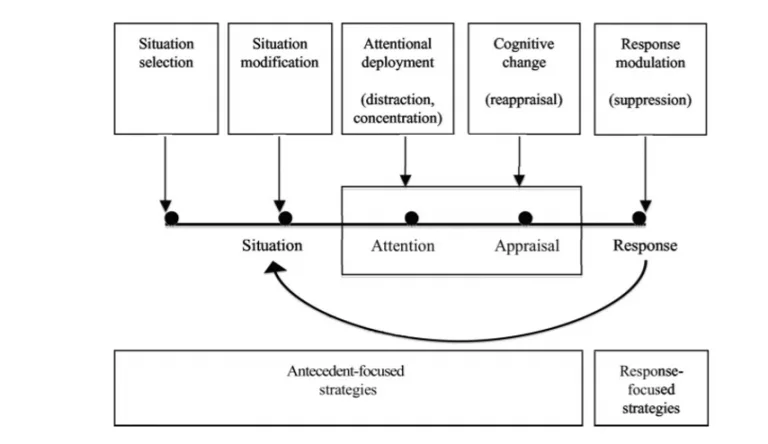
Managing feelings involves more than suppressing an outward reaction: people can influence emotions at different points in the process. Emotion regulation provides a framework for those strategies, bringing order to a field that had previously been studied as a fragmented set of practices.
In the spring of 1998, James Gross published a paper in Review of General Psychology that changed how researchers thought about one of the oldest questions in psychology. What do people actually do when they manage their feelings?
The paper, "The Emerging Field of Emotion Regulation: An Integrative Review," wasn't the first to look at emotional control. It was the first to bring real order to a fragmented literature, by pinpointing exactly where in the emotional process a given regulatory strategy steps in.
The insight was deceptively simple. Some strategies work before an emotion has fully formed. They alter the situation, redirect attention, reconstrue meaning, before the emotional response ever gathers momentum. Others work afterward, suppressing or reshaping a response that's already underway.
Gross called these antecedent-focused and response-focused regulation. That distinction, he'd go on to show, has real consequences for well-being, social functioning, mental health.
Here's the demonstration that made it stick. Gross (1998) had participants watch a film of a surgical procedure, graphic enough to generate genuine distress, under one of two conditions.[2]
Some got told to reappraise the footage cognitively. Picture yourself as a medical professional for whom this procedure is routine. Focus on the patient's recovery. Not the immediate trauma on screen.
Others got told to suppress their emotional expressions instead. Watch the film. Don't let anything show on your face.
Both strategies worked, on the surface. Reappraisers looked calm. Suppressors looked calm too. But their internal physiological profiles told a completely different story. Suppressors showed elevated cardiovascular activation the whole way through. Their bodies were working overtime to hold something in.
Reappraisers showed none of that cost. They'd changed what the film meant to them, and in doing that, they'd changed what it actually did to them. This single experiment became the bedrock the modern field of emotion regulation got built on.
What made Gross's framework influential wasn't just the antecedent-response split. It was the more detailed process model he worked out in later papers, a taxonomy of five families of strategies, organized by exactly where they enter the emotion-generative sequence.[1]
Emotions, in this account, run through something like a pipeline. A situation gets attended to. It gets appraised for personal significance. Then it generates coordinated experiential, behavioral, and physiological responses.
Regulatory strategies can step in at any link in that chain. Step in early, and the intervention shapes the final emotional output efficiently. Step in late, and the work gets effortful, metabolically costly. Not because late strategies are poorly designed. It's that the emotional response has already mobilized resources, and now those resources have to be fought back against.
"The ability to manage one's emotional responses is central to psychological health, adaptive functioning, and interpersonal effectiveness." - James Gross, 1998
The Five Strategies: A Process Model Comparison
| Strategy | Stage | Mechanism | Effectiveness | Cognitive Cost | Downstream Effects |
|---|---|---|---|---|---|
| Situation Selection | Pre-emotion; before exposure | Approaching or avoiding situations based on anticipated emotional impact | High for preventing unwanted emotions; can be adaptive or avoidant | Low in the moment; planning costs occur earlier | Adaptive when selective; maladaptive when it produces behavioral restriction or avoidance of growth opportunities |
| Situation Modification | Pre-emotion; during situation | Actively altering the environment or social context to change its emotional impact | Moderate to high; directly changes the stimulus | Low to moderate | Strengthens agency and problem-solving; can be manipulative or socially costly |
| Attentional Deployment | Pre-emotion; within situation | Redirecting attention toward or away from emotionally salient aspects (distraction, concentration, rumination) | Variable; distraction effective for acute pain and negative affect; rumination highly maladaptive | Low (distraction) to high (rumination, absorption) | Distraction buffers short-term distress; rumination amplifies and sustains negative affect; does not change underlying appraisal |
| Cognitive Change / Reappraisal | Pre-emotion; appraisal | Changing how a situation is construed - its meaning, personal relevance, or imagined consequences | High; reduces negative affect, preserves or enhances positive affect, reduces physiological stress response | Moderate; requires accessing and modifying representations | Greater well-being, authentic emotional expression, better social outcomes, less depression and anxiety |
| Response Modulation / Suppression | Post-emotion; response | Inhibiting behavioral or physiological aspects of an emotion after it has been generated | Partial; reduces visible expression but not subjective experience or physiology | High; sustained inhibitory effort | Worse social outcomes, memory impairment for social information, increased physiological burden, associated with depression and anxiety |
The Cognitive Science of Regulation
The process model gave researchers an organizing framework. Figuring out how these strategies actually work at the neural and cognitive level took separate research programs entirely.
Ochsner, Gross, and the Neuroscience of Reappraisal
Kevin Ochsner and James Gross led the most direct investigation into reappraisal's neural underpinnings.[4]
Their 2005 paper in Trends in Cognitive Sciences, "The Cognitive Control of Emotion," pulled together converging neuroimaging evidence. Cognitive reappraisal, it turned out, recruits a distributed prefrontal-parietal network, the lateral and medial prefrontal cortex and anterior cingulate cortex especially, to modulate activity in the amygdala and other subcortical structures that generate emotional responses.
Picture a top-down control architecture. Cortical regions handling abstract representation and executive function send regulatory signals downward into the emotional core.
An earlier fMRI study by Ochsner, Bunge, Gross, and Gabrieli (2002), published in the Journal of Cognitive Neuroscience, backed this up directly.
Participants who reappraised negative images to feel less negative showed increased activity in left lateral prefrontal and anterior cingulate cortex, and decreased activity in the amygdala and medial orbitofrontal cortex.
Here's the key relationship: the strength of prefrontal activation predicted how much the amygdala got suppressed, and that predicted how much the emotion actually dropped.
Reappraisal, in this account, is executive control pointed at emotional content. The same cognitive machinery that plans, reasons, and inhibits an impulsive response gets directed at the ongoing stream of emotional experience to reshape it from the inside.
This carries a real implication for individual differences in regulation. If reappraisal runs on prefrontal resources, then anything draining those resources, cognitive load, stress, fatigue, alcohol, a still-developing brain, should hurt reappraisal capacity.
Research backs this up. Under high cognitive load, reappraisal instructions lose a lot of their effectiveness. Children and adolescents, whose prefrontal cortex is still maturing, reappraise less efficiently than adults do. Patients with conditions involving prefrontal dysfunction, major depression, borderline personality disorder, show real deficits here too.
Lieberman and Affect Labeling
A parallel research program, led by Matthew Lieberman at UCLA, looked at something subtler: the simple act of putting a feeling into words.
His 2007 paper in Psychological Science, "Putting Feelings Into Words: Affect Labeling Disrupts Amygdala Activity in Response to Affective Stimuli," used fMRI to compare what happened when participants labeled emotional faces versus just matched them.[5]
Labeling an expression, attaching a verbal tag like "fear" or "anger," reduced amygdala response and increased activation in the right inferior prefrontal cortex, compared to simply matching faces.
Naming an emotion out loud seemed to engage the same inhibitory prefrontal circuits as deliberate reappraisal. Even though affect labeling takes far less cognitive effort and runs almost automatically for anyone with a decent emotional vocabulary.
Lieberman and colleagues argued something bigger: language itself might function as a regulatory tool at a basic processing level. Not just when you deliberately use it as a strategy, but any time emotional experience gets translated into symbolic form.
That has real implications for psychotherapy. Talking about feelings isn't just cathartic in some vague emotional-discharge sense. It might exert genuine downward pressure on subcortical emotional circuits.
The finding lines up with older clinical intuitions about emotional literacy, and with mentalization in attachment theory, the capacity to represent mental states explicitly, in symbolic form.
Nolen-Hoeksema and Rumination
If reappraisal is attentional deployment at its most effortful and constructive, rumination is its mirror image. The destructive version.
Susan Nolen-Hoeksema, across a research program running from the late 1980s through the 2000s, defined rumination as a repetitive, passive focus on distress and its causes and consequences. No problem-solving. No action.
Her response styles theory, laid out in a 1991 paper in the Journal of Abnormal Psychology and sharpened in later work, held that people respond to depressed mood in characteristically different ways. Some distract themselves. Some take action. Some ruminate.
Rumination, she found, didn't resolve depressive episodes. It prolonged them and made them worse.[7] It tracked with greater depression severity, longer episodes, weaker problem-solving, poorer relationships.
Here's the critical point for emotion regulation theory: rumination isn't an absence of regulation. It's a form of regulation, a strategy of attentional deployment, just a maladaptive one. People who ruminate aren't failing to manage their emotions. They're managing them in a way that backfires badly.
They engage with their own distress intensely, but without the cognitive restructuring that would actually change its meaning. Attention gets turned inward and held there, while the appraisal underneath stays untouched, or gets amplified instead of revised.
Rumination and reappraisal end up making for an illuminating contrast. Both engage deeply with emotional experience. Only one of them actually changes the evaluative construal generating the response in the first place.
Four Case Studies
Case Study 1: Gross and John (2003) - Individual Differences in Regulation
James Gross and Oliver John's 2003 paper in the Journal of Personality and Social Psychology, "Individual Differences in Two Emotion Regulation Processes: Implications for Affect, Relationships, and Well-Being," is the single most cited study in the whole emotion regulation literature. It established, empirically, that the well-being consequences of reappraisal versus suppression hold up as individual differences, not just as laboratory manipulations.
They used the Emotion Regulation Questionnaire, or ERQ, which Gross and John built specifically to measure how habitually someone uses reappraisal and suppression across everyday situations. Over 1,000 participants, across multiple studies. The results held up consistently.
Reappraisal use tracked with greater positive affect, greater life satisfaction, closer and more satisfying relationships, less depression.[3] Suppression tracked with less positive affect, but not less negative affect. Suppressors were still feeling the emotions underneath. They just weren't showing them.
Suppressors also fared worse socially. They shared less of themselves in relationships. People liked them less. They had less social support to lean on. The reason isn't mysterious, really: suppression creates a gap between inner experience and outward expression, and other people can feel that gap, even without naming it. It reads as distancing.
When someone is suppressing, part of them is simply absent from the interaction. They're managing an internal control problem instead of actually engaging with you.
This study shifted the field by showing that regulation strategies don't just matter in the moment. Their effects accumulate across time and across relationships. Habitual suppression isn't just inefficient on a given afternoon. It slowly wears down the social connections that buffer you against life stress.
Case Study 2: Aldao, Nolen-Hoeksema, and Schweizer (2010) - The Meta-Analytic Picture
Amelia Aldao, Susan Nolen-Hoeksema, and Susanne Schweizer published a meta-analysis in Clinical Psychology Review in 2010, "Emotion-Regulation Strategies Across Psychopathology: A Meta-Analytic Review." It pulled together 114 studies examining how emotion regulation strategies relate to symptoms of depression, anxiety, eating disorders, substance use disorders.[6]
The results confirmed, and quantified, the clinical weight of the process model's predictions. Rumination showed the strongest link to psychopathology, a mean effect size of d = 0.79. Suppression followed, at d = 0.34.
Reappraisal showed modest negative associations, meaning less psychopathology. Problem-solving showed strong negative associations too.
Here's the interesting asymmetry the study found: maladaptive strategies showed stronger effect sizes than adaptive ones did. Maladaptive regulation may actually drive disorder more actively than adaptive regulation drives health.
The authors flagged a gap too. Most studies measured suppression and rumination as stable traits, rather than asking when and how context shifts their effects.
This meta-analysis gave the field its evidence base for treating emotion regulation deficits as transdiagnostic, relevant across disorders rather than tied to just one condition. It directly backs clinical approaches that target regulation skills specifically, including Dialectical Behavior Therapy for borderline personality disorder and the Unified Protocol approach to emotional disorders generally.
Case Study 3: Troy, Shallcross, and Mauss (2013) - Context-Sensitivity and Reappraisal
Not everyone agreed reappraisal is simply the best strategy, full stop. Allison Troy, Amanda Shallcross, and Iris Mauss pushed back in a 2013 paper in Psychological Science, "A Person-by-Situation Approach to Emotion Regulation: Cognitive Reappraisal Can Either Help or Hurt, Depending on the Context."
Building on earlier work by Troy and colleagues (2010), which had linked reappraisal ability to stress buffering in daily life, the 2013 study asked a sharper question: does reappraisal's benefit depend on whether you can actually control the stressor? Participants reported on recent stressful life events that varied in exactly that, how much control they had over the outcome.
The key finding was an interaction. Reappraisal helped, tracking with lower depression, when stressors were uncontrollable. But for controllable stressors, it gave no advantage at all, and in some cases tracked with worse outcomes.[8]
Here's why that makes sense: for a controllable stressor, actually doing something about it beats mentally reconstruing what you could just change instead. Reappraising a solvable problem can backfire by dulling the emotional urgency that would otherwise push you to act.
This added a real nuance to the model. The process model never claimed reappraisal wins every time. It specifies that earlier-stage strategies tend to be more efficient when they're well-matched to the situation. That's the actual claim.
Troy and colleagues made the matching condition explicit: reappraisal fits best when the emotional response can't usefully motivate further action. When it can, something else probably works better.
Case Study 4: Linehan and Regulation Deficits in Borderline Personality Disorder
Marsha Linehan developed her biosocial theory of borderline personality disorder, BPD, through the 1980s, laying it out fully in her 1993 book Cognitive-Behavioral Treatment of Borderline Personality Disorder and the empirical papers that followed. Her core claim: BPD is, at bottom, a disorder of emotion dysregulation.
In Linehan's account, people with BPD carry two things at once. A biological temperament with heightened emotional sensitivity, and a developmental history where their emotional experience got systematically invalidated. That combination leaves someone unable to tolerate, label, modulate, or trust their own emotional responses.
Later neuroimaging work backed this up. Silbersweig and colleagues (2007), in American Journal of Psychiatry, found patients with BPD showing exaggerated amygdala and limbic activity alongside reduced prefrontal regulatory engagement, in response to emotionally provocative stimuli. That's the exact opposite neural pattern you'd see during effective reappraisal in a healthy participant.
The prefrontal-amygdala circuit Ochsner and Gross had identified as reappraisal's substrate looked genuinely dysfunctional in BPD. Top-down control simply wasn't strong enough to modulate the bottom-up emotional response.
Linehan's Dialectical Behavior Therapy, DBT, targets this deficit directly through a skills training module built around four competency areas: mindfulness, distress tolerance, interpersonal effectiveness, and, most directly relevant here, emotion regulation.
The emotion regulation skills map almost one-to-one onto the process model. Attentional deployment shows up as mindfulness of current emotion. Cognitive change shows up as checking the facts and problem-solving. Response modulation shows up as opposite action and reducing vulnerability to emotion mind.
DBT ranks among the most empirically supported treatments for BPD, and its track record lines up well with what the process model says effective regulation actually requires.
Intellectual Lineage
Gross's process model didn't spring out of nowhere. Its intellectual architecture pulls from at least four earlier research traditions.
The most direct ancestor is the stress-and-coping literature, started by Richard Lazarus and Susan Folkman.
Lazarus built his cognitive-relational theory of emotion across his career, synthesizing it in Psychological Stress and the Coping Process (1966) and Stress, Appraisal, and Coping (1984, with Folkman). His core claim put appraisal at the center of emotional life: emotions aren't direct responses to events. They're responses to the personal significance we attach to events.
That made appraisal an obvious target for regulatory intervention. Gross's cognitive change, or reappraisal, strategy is essentially a direct operationalization of manipulating Lazarus's appraisal processes.
Lazarus described appraisal as something that just happens to people as they run into stressors. Gross asked a different question: what happens when people deliberately change their own appraisals, and what are the consequences of doing that?
A second lineage runs through the experimental emotion research tradition tied to Paul Ekman, whose work on universal facial expressions made the case that emotions are discrete, biologically based programs with characteristic behavioral outputs. Outputs that, in principle, could be modulated more or less effectively.
Ekman's deception research found something striking. People trying to suppress an emotional expression produced detectable "microexpressions," brief facial movements lasting a fraction of a second. This was one of the earliest empirical demonstrations that suppression is imperfect. And costly.
That leakage Ekman documented is exactly the social consequence Gross and John (2003) later found in habitual suppressors. The thread connects directly.
A third lineage runs through the affective neuroscience of Joseph LeDoux and Antonio Damasio, who mapped out the neural architecture emotion and regulation actually operate inside of.
LeDoux's work on the amygdala as a rapid threat-detection system, especially the "low road" pathway through the thalamus that bypasses cortical processing entirely, implied something important: emotional responses get generated before the cortex has even finished its analysis.
That sets up exactly the regulatory problem Gross's model addresses. Once the amygdala has fired and the emotional program is already running, changing the response takes active cortical intervention. Which is effortful, as the physiology of suppression makes clear.
A fourth lineage comes from Daniel Wegner's research on ironic processes of mental control.
Wegner's 1994 Psychological Review paper, "Ironic Processes of Mental Control," found something counterintuitive. Trying to suppress a thought paradoxically made it intrude more often, specifically under cognitive load. That's the famous "don't think of a white bear" phenomenon.
This ironic rebound effect is specific to thought suppression, not emotional suppression. But it opened up a theoretical possibility that mattered a lot: regulatory effort can systematically backfire, and that gives a framework for understanding why suppression-based strategies carry such problematic downstream consequences.
Wegner's work raised a broader caution too, about the limits of control-based approaches to unwanted mental content in general.
Empirical Research: What the Evidence Shows
Beyond the landmark studies covered above, a handful of other findings round out the current picture.
Gross (1998) used psychophysiological methods to establish something important: reappraisal and suppression carry different cost profiles. Both can reduce outward expressive behavior. Only suppression produced increased sympathetic nervous system activation.
That finding has held up under replication, with cardiovascular measures (Richards and Gross, 2000, in Journal of Personality and Social Psychology), cortisol measures, and skin conductance.
The cumulative physiological toll of habitual suppression lines up with evidence linking emotional suppression to immune dysregulation and worse health outcomes, reviewed by Pennebaker (1997) in Psychological Science.
Richards and Gross (2000) also found a memory impairment specific to suppression. Participants who suppressed during social interactions remembered less of what their conversation partner actually said, compared to reappraisers and controls.[10]
Here's why: the cognitive resources that ongoing suppression burns up are the same resources needed for encoding memories. That has real implications for clinical populations who suppress habitually. They may end up genuinely impaired at learning and processing social information.
Sheppes and colleagues ran a series of studies from 2011 to 2014 asking a different question entirely. Not which strategy works better, but when do people actually choose among the strategies available to them?
Published in Journal of Experimental Psychology: General and Emotion, their findings showed people prefer distraction for high-intensity emotional stimuli and reappraisal for low-to-moderate intensity stimuli.
That preference isn't irrational. Distraction genuinely reduces acute distress fast, and reappraisal really can be harder to pull off when arousal is running high.
But it creates a real problem. High-intensity situations are exactly where reappraisal would be most valuable, if someone could actually pull it off. Avoiding reappraisal at high intensity may explain part of why maladaptive patterns pile up in clinical populations over time.
Gross's extended process model, published in Psychological Inquiry in 2015, folded regulatory effort into a broader goal-based account.[9] In this updated framework, emotion regulation becomes one instance of a more general process: goal pursuit and self-regulation.
The 2015 model lays out three stages: an "identification" stage (deciding whether to regulate), a "selection" stage (choosing a strategy), and an "implementation" stage (executing it), all driven by valuation.
That extension pulled emotion regulation into contact with motivation science, self-control, depletion, goal conflict, and let the model finally account for things like regulatory motivation and the conditions under which people decide to regulate at all in the first place.
Limits, Critiques, and Nuances
The process model ranks among the most influential frameworks in contemporary psychology. It's also attracted real criticism, the kind that complicates its predictions and pushes on some of its foundational assumptions.
The suppression-is-bad consensus may be overstated. Evidence from Western samples consistently links habitual suppression to worse social and emotional outcomes. Cross-cultural research tells a more complicated story, though.
Matsumoto and colleagues documented that collectivist cultures with strong norms around emotional restraint, East Asian cultures especially, don't show the same social costs for suppression that individualistic Western contexts do.
Here's why that makes sense: where emotional restraint is normatively expected and genuinely shared, suppression doesn't create the social disconnection Gross and John documented. Nobody's reading unexpressive behavior as concealment, because it isn't concealment there.
Mauss and Butler (2010), in Biological Psychology, found that for participants under social threat, suppression tracked with less cardiovascular reactivity, the opposite of Gross's Western finding, specifically among people for whom restraint matched their cultural identity.[11]
The lesson isn't that suppression is sometimes good. It's that regulatory strategies carry context-dependent consequences, in ways laboratory findings from one cultural setting can easily miss.
The reappraisal-suppression dichotomy oversimplifies regulatory reality. In everyday life, people rarely run a single strategy in isolation. They mix and layer them. Select a situation partly to dodge an emotional encounter, deploy attention strategically once inside it, then reappraise whatever still turns out disturbing.
Aldao (2013) argued in Current Directions in Psychological Science that the field's habit of comparing strategies in isolation has produced an artificially clean picture, one that may not translate to naturalistic regulation, where strategies interact and their effects compound on each other.
Ecological momentary assessment studies, sampling regulation in daily life through experience-sampling methods, find reappraisal's benefits less consistent in real-world data than in the lab. The conditions under which reappraisal actually works may be narrower in practice than laboratory evidence suggests.
The regulation-dysregulation distinction may be continuous rather than categorical. A lot of clinical and research writing treats emotion dysregulation as a discrete condition, cleanly separable from normal regulation.
The evidence points somewhere else, toward a dimensional view. The same strategies, deployed in different doses, frequencies, contexts, can be adaptive or maladaptive depending on where you catch them.
Rumination isn't a simple pathological alternative to normal processing. It shades gradually from adaptive reflection and problem analysis into the maladaptive repetitive pattern Nolen-Hoeksema described. Suppression isn't uniformly harmful either. Momentary suppression is part of ordinary social competence in plenty of contexts.
That points clinical interventions in a specific direction: pay attention to the flexibility and context-sensitivity of regulatory behavior. Not just its content in isolation.
Aldao, Sheppes, and Gross (2015), in Cognitive Therapy and Research, built out the concept of "regulatory flexibility," the capacity to switch strategies as demands change, as a better predictor of psychological health than using or avoiding any single strategy on its own.[12]
Conceptual boundaries remain contested. Is emotion regulation distinct from coping? From self-regulation? From emotion generation itself? Nobody fully agrees.
Gross's process model situates emotion regulation inside a broader self-regulatory framework. But the lines between regulating emotions, regulating the behavior emotions motivate, and regulating the situations that generate emotions in the first place stay porous.
Some researchers, Koole (2009) among them in a major review in Cognition and Emotion, argue the field hasn't adequately separated two things: regulating the emotional response itself, the feeling, expression, physiology, versus regulating the emotional process, the appraisal and attention generating that response.
That distinction matters, because interventions aimed at the response after it's already generated may run on fundamentally different mechanisms, with different limits, than interventions aimed at the generative process. That's precisely the insight behind Gross's antecedent-response distinction. It gets complicated once people learn to recognize, and preemptively adjust, their own appraisal tendencies.
Sources & Further Reading
Gross, J. J. (1998). The emerging field of emotion regulation: An integrative review. Review of General Psychology, 2(3), 271-299.
Gross, J. J. (1998). Antecedent- and response-focused emotion regulation: Divergent consequences for experience, expression, and physiology. Journal of Personality and Social Psychology, 74(1), 224-237.
Gross, J. J., & John, O. P. (2003). Individual differences in two emotion regulation processes: Implications for affect, relationships, and well-being. Journal of Personality and Social Psychology, 85(2), 348-362.
Ochsner, K. N., & Gross, J. J. (2005). The cognitive control of emotion. Trends in Cognitive Sciences, 9(5), 242-249.
Lieberman, M. D., Eisenberger, N. I., Crockett, M. J., Tom, S. M., Pfeifer, J. H., & Way, B. M. (2007). Putting feelings into words: Affect labeling disrupts amygdala activity in response to affective stimuli. Psychological Science, 18(5), 421-428.
Aldao, A., Nolen-Hoeksema, S., & Schweizer, S. (2010). Emotion-regulation strategies across psychopathology: A meta-analytic review. Clinical Psychology Review, 30(2), 217-237.
Nolen-Hoeksema, S. (1991). Responses to depression and their effects on the duration of depressive episodes. Journal of Abnormal Psychology, 100(4), 569-582.
Troy, A. S., Shallcross, A. J., & Mauss, I. B. (2013). A person-by-situation approach to emotion regulation: Cognitive reappraisal can either help or hurt, depending on the context. Psychological Science, 24(12), 2505-2514.
Gross, J. J. (2015). Emotion regulation: Current status and future prospects. Psychological Inquiry, 26(1), 1-26.
Richards, J. M., & Gross, J. J. (2000). Emotion regulation and memory: The cognitive costs of keeping one's cool. Journal of Personality and Social Psychology, 79(3), 410-424.
Mauss, I. B., & Butler, E. A. (2010). Cultural context moderates the relationship between emotion control values and cardiovascular challenge versus threat responses. Biological Psychology, 84(3), 521-530.
Aldao, A., Sheppes, G., & Gross, J. J. (2015). Emotion regulation flexibility. Cognitive Therapy and Research, 39(3), 263-278.