
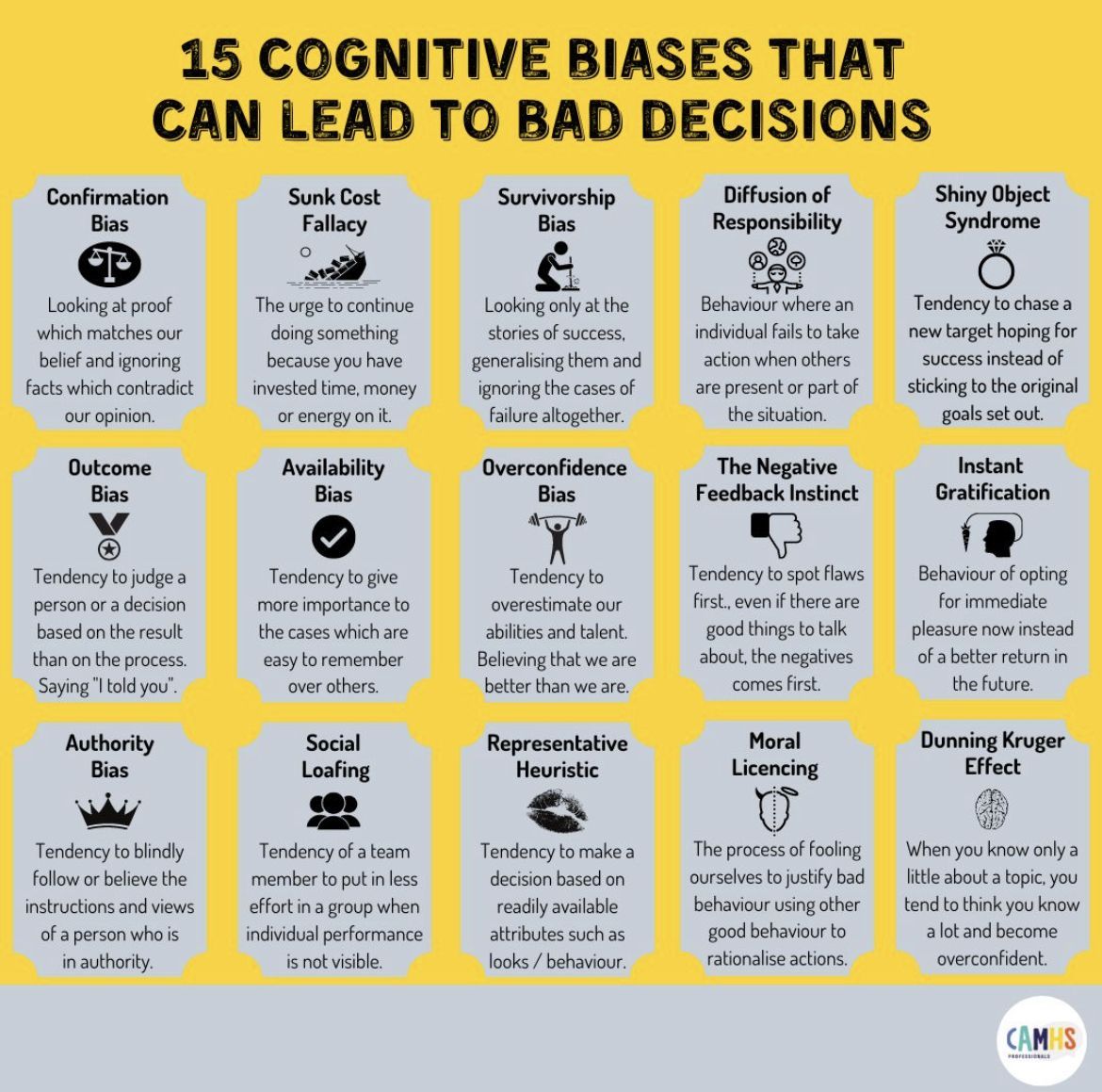
In 1974, Daniel Kahneman and Amos Tversky published a paper in Science titled "Judgment Under Uncertainty: Heuristics and Biases." It was eleven pages long and has since been cited over forty thousand times.[1]
The paper's central claim was modest in its framing but radical in its implications: people making probability judgments under uncertainty rely on a small number of mental shortcuts - heuristics - that are generally useful but that produce systematic, predictable errors under certain conditions.
These errors were not random noise. They were consistent across people, reproducible in the laboratory, and violated the axioms of rational choice theory in ways that could not be dismissed as aberrations.
Kahneman and Tversky were not the first to notice that human judgment departed from rational norms. But they were the first to build a systematic research program around characterizing those departures with the precision of experimental psychology.
What followed was fifty years of increasingly detailed documentation of the ways human reasoning diverges from idealized logic - research that influenced psychology, economics, law, medicine, public policy, and eventually, through popularizations like Kahneman's 2011 book Thinking, Fast and Slow, the wider culture.
The result has been both illuminating and somewhat inflated. The catalog of named cognitive biases has grown to over 180 entries in some taxonomies, a proliferation that partly reflects the creativity of researchers naming phenomena and partly reflects genuine discovery.
Sorting what matters most from what matters least, and what can be done about biases from what cannot, requires going back to the research rather than relying on the popular account.
"The confidence people have in their beliefs is not a measure of the quality of evidence but of the coherence of the story the mind has managed to construct." - Daniel Kahneman, Thinking, Fast and Slow, 2011[2]
Key Definitions
Cognitive bias: A systematic pattern of deviation from rational judgment in which inferences about other people and situations may be drawn in an illogical fashion.
Heuristic: A mental shortcut or rule of thumb that simplifies judgment and decision-making, reducing cognitive effort at the cost of occasional systematic error.
| Bias | Category | Core Mechanism | Classic Study |
|---|---|---|---|
| Anchoring | Judgment | First number encountered dominates estimates | Tversky & Kahneman, 1974 |
| Confirmation bias | Reasoning | Seeks evidence consistent with existing beliefs | Wason, 1960 |
| Availability heuristic | Probability | Ease of recall proxies for frequency | Tversky & Kahneman, 1973 |
| Dunning-Kruger effect | Metacognition | Incompetent performers lack awareness of incompetence | Dunning & Kruger, 1999 |
| Loss aversion | Decision-making | Losses feel ~2x as powerful as equivalent gains | Kahneman & Tversky, 1979 |
| Hindsight bias | Memory | Past events seem more predictable after the fact | Fischhoff, 1975 |
| Sunk cost fallacy | Decision-making | Past investment drives future choices irrationally | Arkes & Blumer, 1985 |
System 1 / System 2: Kahneman's terminology for the two modes of cognitive processing. System 1 is fast, automatic, and unconscious. System 2 is slow, deliberate, and effortful. Most cognitive biases arise from System 1 outputs that System 2 fails to check or correct. See the related article on how the mind actually works.
Debiasing: Interventions - educational, structural, procedural - aimed at reducing the frequency or magnitude of cognitive biases in judgment.
The Three Core Heuristics
Kahneman and Tversky's 1974 paper organized the bias research around three foundational heuristics that explain a large portion of the documented catalog.
The Availability Heuristic
The availability heuristic is the tendency to judge the probability of an event by how easily examples come to mind. If examples are easy to recall, the event seems frequent and likely. If examples are hard to recall, it seems rare and unlikely.
This works well when memory frequency actually correlates with real-world frequency - common events do tend to be more memorable than rare ones. It fails when memorability is determined by something other than frequency: vividness, emotional impact, recency, or media coverage.
The classic illustration is the plane crash vs. car crash comparison. Flying feels more dangerous than driving to most people, yet the statistics consistently show driving is far more dangerous per mile traveled.
Plane crashes are dramatic, memorable, and heavily covered when they occur; car accidents are routine, quickly forgotten, and individually unreported.
The availability heuristic leads people to overestimate the frequency of vivid, memorable causes of death (sharks, terrorists, plane crashes) and underestimate the frequency of mundane ones (heart disease, car accidents, falls at home).
Paul Slovic's research on risk perception, building on availability, documented how media coverage of risks creates systematic public misestimations of danger - misestimations that then drive policy in directions that do not match actual risk profiles.
Representativeness and the Base Rate Problem
The representativeness heuristic involves judging the probability that something belongs to a category by how closely it resembles the typical member of that category - rather than adjusting for the base rate frequency of the category.
Kahneman and Tversky demonstrated this with the Linda problem (1983): participants were told that Linda is 31, single, outspoken, and passionate about social justice.
When asked whether it was more probable that (a) Linda is a bank teller or (b) Linda is a bank teller who is active in the feminist movement, the majority chose (b) - the conjunction.
This is logically impossible: the probability of two events occurring together cannot exceed the probability of either alone. But Linda "looks like" a feminist bank teller, so the conjunction feels more probable.
The base rate problem is representativeness's most consequential manifestation.
Medical diagnosis routinely suffers from it: a physician who encounters a patient with symptoms matching a rare disease, and who mentally assigns a high probability to that disease based on symptom match, is ignoring the base rate - the prior probability of the disease in the population.
Bayes' theorem provides the correct procedure for integrating symptom evidence with base rates, but the representativeness heuristic short-circuits the integration.
Anchoring
Anchoring is the tendency for numerical estimates to be pulled toward an initially presented number (the anchor), even when that number is arbitrary or clearly irrelevant.
Tversky and Kahneman demonstrated this in 1974 by having participants spin a wheel of fortune (rigged to stop at either 10 or 65) and then estimate the percentage of African countries in the United Nations.
Estimates were significantly higher among participants who had seen 65 than among those who had seen 10. The anchor was obviously arbitrary - determined by a wheel spin - yet it systematically influenced estimates.
Anchoring effects are powerful across contexts: salary negotiations, legal damages, real estate prices, medical prognosis. The first number put on the table exerts disproportionate influence on where the negotiation ends. Sellers know this; buyers typically do not give it sufficient weight.
A 2006 study by Ariely, Loewenstein, and Prelec found that even having participants write down the last two digits of their Social Security number before bidding on auction items influenced bids: participants with higher digits bid substantially more for the same items.[12]
High-Impact Biases in Practice
Confirmation Bias
Confirmation bias is the tendency to search for, favor, and remember information that confirms existing beliefs while discounting information that challenges them. It is among the most thoroughly documented biases across domains and contexts.
Peter Wason's 1960 selection task demonstrated confirmation bias experimentally: given four cards (E, K, 4, 7) and told that each card has a number on one side and a letter on the other, participants were asked which cards to turn over to test the rule "if a card has a vowel on one side, it has an even number on the other." Most participants chose E and 4 - the cards that confirm the rule if positive - and failed to turn over 7, the card whose content could falsify it.[3]
The logical answer is E and 7: you need to check for violations, not confirmations.
The practical consequences of confirmation bias are most severe in high-stakes domains where disconfirming evidence is available but uncomfortable: medical diagnosis (anchoring on an initial hypothesis and seeking confirming tests), investment decisions (holding losing positions while seeking reasons to believe recovery is coming), organizational strategy (dismissing market signals that challenge the current plan).
The Sunk Cost Fallacy
The sunk cost fallacy involves continuing an investment - financial, emotional, temporal - because of prior investment rather than because of current expected value. The rational principle is clear: sunk costs are gone regardless of future action and should not influence forward-looking decisions.
The psychological reality is that they do influence decisions, consistently and substantially.
Research across domains - project continuation, relationship persistence, military strategy, product development - shows that decision-makers systematically continue failing courses of action longer when they have already invested more.
The mechanism is loss aversion: stopping a failing project means realizing a loss, while continuing it defers the realization even when continuation only increases the total loss.
See the dedicated article on the sunk cost fallacy for a full treatment.
Status Quo Bias
Samuelson and Zeckhauser (1988) documented status quo bias: the tendency to prefer the current state of affairs relative to alternatives, such that losses from leaving the status quo are weighted more heavily than equivalent gains.[5]
The paper showed this across hypothetical and real decision contexts, including actual investment choices and insurance selections.
Status quo bias is partly a manifestation of loss aversion: departing from the status quo involves accepting a certain loss (the current arrangement) in exchange for uncertain gain, which loss aversion makes systematically unattractive.
The policy applications have been extensively explored in choice architecture research.
The default option in any choice context attracts disproportionate selection: default organ donation enrollment increases donation rates substantially; default enrollment in 401(k) plans increases retirement saving; default green energy tariffs increase green energy adoption.
These are not trivial effects - the gap between opt-in and opt-out enrollment in retirement plans can be 30-40 percentage points.
In-Group Bias
Henri Tajfel's minimal group paradigm studies (1970s) demonstrated that in-group favoritism requires remarkably little: randomly assigning people to groups (ostensibly based on whether they preferred Klee or Kandinsky paintings, actually random) produced immediate favoritism toward in-group members in resource allocation tasks.[6]
Participants who had never met their supposed group members, knew the grouping was arbitrary, and would never encounter their group members again still allocated more resources to the in-group.
In-group bias produces consequences ranging from the mild (overrating in-group performance) to the severe (dehumanization of out-groups, discriminatory hiring, intergroup violence).
It interacts with availability bias and representativeness: in-group members' positive behaviors are attributed to character; out-group members' identical behaviors are attributed to situational factors or explained away.
See the dedicated article on in-group bias for a full treatment.
The Fundamental Attribution Error
Lee Ross coined the term "fundamental attribution error" in 1977 to describe the tendency to overattribute others' behavior to their dispositions (character, personality) rather than their situations, while applying more situational explanation to one's own behavior.[4]
Ross and colleagues demonstrated this in the "quiz show study": participants randomly assigned to be questioners generated difficult questions and posed them to contestants.
Observers watching this interaction rated the questioners as significantly more knowledgeable than the contestants - despite the fact that the questioner role obviously provided an unfair advantage.
The situational advantage was discounted; the questioner's apparent knowledge was attributed to a disposition.
The error is particularly consequential in performance management, criminal justice, and attribution of poverty and wealth. When managers attribute underperformance to attitude rather than examining systemic obstacles, they prescribe individual interventions for structural problems.
Optimism Bias
Tali Sharot's research, culminating in her 2011 book The Optimism Bias, found that approximately 80% of people show optimism bias: the belief that their future will be better than average and better than it statistically will be, on dimensions ranging from health to marriage duration to job prospects.[7]
Sharot and colleagues used neuroimaging to show that optimism bias has specific neural correlates: the brain updates beliefs more readily in response to positive information than negative information, producing systematic asymmetric learning that maintains positive illusions about the future.
Optimism bias is the engine behind the planning fallacy - the consistent underestimation of how long, how much, and how difficult any project will be.
Bent Flyvbjerg's analysis of major infrastructure projects found cost overruns averaging 28% for rail projects, 45% for tunnels and bridges, and 20% for roads - systematic patterns that persist across decades and cultures despite ample historical evidence of similar overruns.[11]
The Dunning-Kruger Effect
David Dunning and Justin Kruger's 1999 paper documented that incompetent performers in a domain systematically overestimate their own ability, while highly competent performers tend to slightly underestimate theirs.[8]
The explanation they offered was metacognitive: competence and the ability to recognize competence rely on the same underlying skills.
Those who lack a skill also lack the ability to recognize what good performance looks like, preventing accurate self-assessment.
The popular version of Dunning-Kruger - often depicted as a simple curve where the incompetent are most confident - is substantially an oversimplification. More careful analyses of the data show that the original effect was partly a statistical artifact (regression to the mean produces the pattern even with random data).
The underlying phenomenon - that people have imperfect metacognitive access to their own competence - is real and supported by multiple approaches, but the clean narrative of "the worst are always most confident" is too simple.
See the detailed treatment in Dunning-Kruger effect explained.
When Biases Are Useful: Gigerenzer's Fast-and-Frugal Heuristics
The dominant narrative in popular bias literature frames heuristics as errors - bugs in human cognition to be overcome. Gerd Gigerenzer at the Max Planck Institute for Human Development has spent decades challenging this framing.
Gigerenzer's research program - "fast-and-frugal heuristics" - demonstrates that simple rules often outperform complex optimization algorithms in uncertain, data-limited, real-world environments.[9]
His "Take the Best" heuristic (look up cues in order of their predictive validity; stop and decide at the first cue that discriminates) outperforms multiple regression in many prediction tasks, particularly in domains where data are limited or the structure of the environment is unknown.
Gigerenzer's argument is not that biases never produce errors but that the benchmark of ideal rationality is the wrong standard. The appropriate benchmark is ecological rationality: does this heuristic perform well in the environment in which it is actually used?
For many of the environments in which humans evolved, fast approximate reasoning outperformed slow exact reasoning, because the costs of slow reasoning (a delayed response to a predator) exceeded the costs of approximate reasoning (an occasional false alarm).
Many "biases" are heuristics misapplied to modern environments they were not designed for, not defects in an otherwise rational machine.
Debiasing: What Works
Larrick's 2004 review of debiasing research found that awareness of biases reduces some errors in some contexts but that effects are modest and often fail to generalize.[10] Teaching people about the availability heuristic does not reliably make them better at risk estimation in novel domains.
More effective interventions change processes rather than minds:
Structured pre-mortems (imagining that a decision has already failed and working backward to identify what went wrong) reduce overconfidence and optimism bias in project planning by about 30% in controlled studies.
Devil's advocacy and formally appointing a role for dissent reduces groupthink and confirmation bias in group decision contexts.
Reference class forecasting (Flyvbjerg's term for using base rates from similar past projects rather than inside-view estimates) dramatically improves accuracy in project planning.
Checklists reduce errors in high-stakes procedural contexts (surgery, aviation, medication administration) not by eliminating cognitive bias but by reducing the working memory demands that allow biases to operate unchecked.
The meta-lesson from debiasing research is consistent with the structure of the problem: biases are largely automatic System 1 outputs. Trying to correct them through System 2 vigilance is expensive, imperfect, and does not scale.
Designing environments, processes, and decision structures that produce good outcomes without relying on continuous individual vigilance is more robust.
Practical Takeaways
Knowing about cognitive biases is more useful for recognizing them in specific high-stakes decisions than for general vigilance. The practical application is situational: before a major financial decision, explicitly seek disconfirming evidence.
Before a project plan, apply reference class forecasting. Before a personnel decision, check whether you have more information about in-group than out-group candidates. Before accepting a first offer in a negotiation, note the anchor effect and consciously adjust farther than feels comfortable.
Biases are not personality flaws - they are systematic features of universal cognitive architecture operating in conditions they were not optimized for. The appropriate response is neither shame nor complacency but structural redesign of the decision environments that matter most.
For a deeper treatment of how these biases connect to decision-making under uncertainty, see decision-making under uncertainty and why smart people make bad decisions.
Sources & Further Reading
- Kahneman, D. & Tversky, A. "Judgment Under Uncertainty: Heuristics and Biases." Science, 185(4157), 1124-1131, 1974. DOI: 10.1126/science.185.4157.1124
- Kahneman, D. Thinking, Fast and Slow. Farrar, Straus and Giroux, 2011. View source
- Wason, P.C. "On the Failure to Eliminate Hypotheses in a Conceptual Task." Quarterly Journal of Experimental Psychology, 12(3), 129-140, 1960. DOI: 10.1080/17470216008416717
- Ross, L. "The Intuitive Psychologist and His Shortcomings." Advances in Experimental Social Psychology, 10, 173-220, 1977. DOI: 10.1016/S0065-2601(08)60357-3
- Samuelson, W. & Zeckhauser, R. "Status Quo Bias in Decision Making." Journal of Risk and Uncertainty, 1(1), 7-59, 1988. DOI: 10.1007/BF00055564
- Tajfel, H., Billig, M., Bundy, R., & Flament, C. "Social Categorization and Intergroup Behaviour." European Journal of Social Psychology, 1(2), 149-178, 1971. DOI: 10.1002/ejsp.2420010202
- Sharot, T. The Optimism Bias: A Tour of the Irrationally Positive Brain. Pantheon, 2011. View source
- Dunning, D. & Kruger, J. "Unskilled and Unaware of It." Journal of Personality and Social Psychology, 77(6), 1121-1134, 1999. DOI: 10.1037/0022-3514.77.6.1121
- Gigerenzer, G. & Gaissmaier, W. "Heuristic Decision Making." Annual Review of Psychology, 62, 451-482, 2011. DOI: 10.1146/annurev-psych-120709-145346
- Larrick, R.P. "Debiasing." In Koehler & Harvey (Eds.), Blackwell Handbook of Judgment and Decision Making. Blackwell, 2004.
- Flyvbjerg, B., Holm, M., & Buhl, S. "Underestimating Costs in Public Works Projects." Journal of the American Planning Association, 68(3), 279-295, 2002. DOI: 10.1080/01944360208976273
- Ariely, D., Loewenstein, G., & Prelec, D. "Tom Sawyer and the Construction of Value." Journal of Economic Behavior and Organization, 60(1), 1-10, 2006. DOI: 10.1016/j.jebo.2004.10.003