
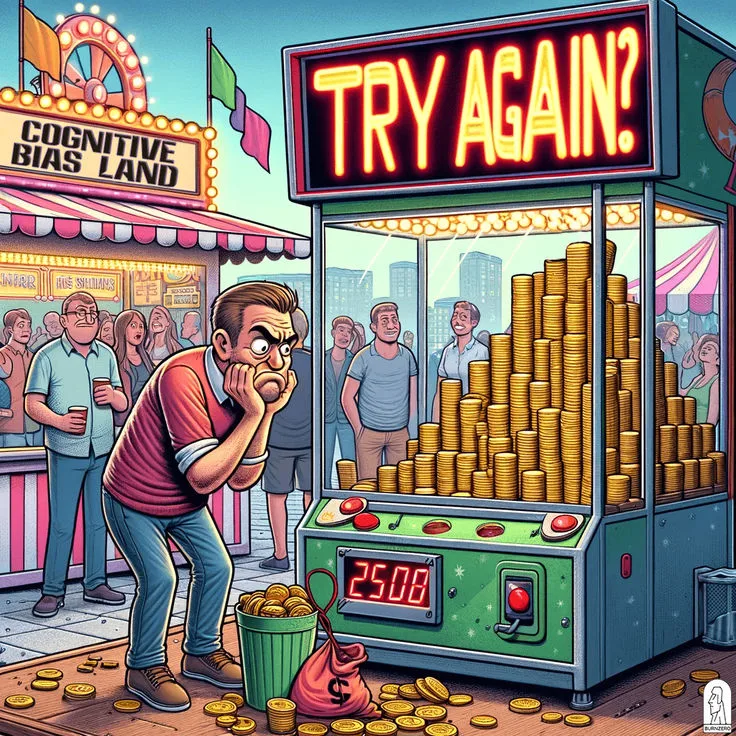
Understanding the sunk cost fallacy starts with a single, costly insight: why we keep pouring money, time, and effort into things we should walk away from. This guide explains how the trap works, where it shows up in real life, and how to spot it before it costs you.
The sunk cost fallacy is the tendency to continue an endeavor once an investment in money, effort, or time has been made - even when continuing is irrational.
The Day Britain and France Could Not Stop
On November 29, 1962, the governments of the United Kingdom and France signed one of the most consequential industrial agreements of the postwar era.
A supersonic passenger aircraft would be built jointly - a machine that would cross the Atlantic in three and a half hours, transforming civil aviation forever. The project was called Concorde.
Within three years, the economics had curdled. By 1965, internal Treasury assessments in Britain were circulating quietly through Whitehall corridors, carrying projections that the aircraft would never recoup its development costs.
The numbers were unambiguous: development was running massively over budget, the projected market of 400 aircraft had been revised downward, and most airlines - when pressed - were not interested in buying a plane that burned more fuel per seat mile than any existing jet.
The British government commissioned a study. The study confirmed what the Treasury suspected.
And yet the project continued.
The reason was stated plainly by a minister during a 1968 parliamentary debate. Withdrawing, he argued, would mean writing off everything already spent. "We cannot simply walk away," he told the House.
"The investment already made demands that we see this through." That phrase - the investment already made - carried all the weight of the decision.
It was not a strategic argument. It was not a forward-looking calculation about returns and risks. It was a backward-looking appeal to money that was already gone.
By the time Concorde entered commercial service in January 1976, development costs had reached approximately 1.3 billion, shared between the two governments.[12] Twenty Concordes were built in all (including 6 prototype, pre-production, and test airframes); only 14 production aircraft entered commercial service, split between British Airways and Air France at heavily subsidized prices.
The aircraft never turned a commercial profit on its manufacturing. The British and French governments had spent more than a decade pouring resources into a project whose economics they privately doubted, in part because stopping felt like admitting that everything already spent had been wasted.
What happened in Whitehall and Paris in those years was not unusual. It was a precise, government-scale demonstration of one of the most robustly documented errors in human decision-making: the sunk cost fallacy.
What the Sunk Cost Fallacy Actually Is
The sunk cost fallacy is the tendency to continue an endeavor because of previously invested resources - money, time, effort, or emotional capital - rather than on the basis of expected future outcomes.
A sunk cost is any cost that has already been incurred and cannot be recovered regardless of future decisions. Rational decision theory holds that such costs should be irrelevant to forward-looking choices: only future costs and future benefits should bear on whether to continue or quit.
The fallacy occurs when sunk costs influence decisions they should not.
Sunk Cost Fallacy vs. Rational Decision-Making
| Dimension | Sunk Cost Fallacy | Rational Decision-Making |
|---|---|---|
| What drives the decision | Past investment already spent | Expected future costs and future benefits only |
| Framing of prior losses | Losses feel like they must be "recovered" before quitting | Prior losses are recognized as irreversible and excluded from the calculus |
| Emotional driver | Pain of realizing a loss; waste aversion; need for self-justification | Indifference to prior spending; focus on marginal returns from this point forward |
| Response to negative feedback | Increases commitment ("we've come too far to stop now") | Reassesses and adjusts; exits if the forward case no longer holds |
| Accountability concern | Stopping feels like publicly admitting prior judgment was wrong | Stopping is evaluated independently of who made the original decision |
| Typical outcome | Continued investment in failing projects; delayed exit from losing positions | Earlier disengagement from failing endeavors; capital redeployed to higher-return alternatives |
| Example formulation | "We've already spent $5 billion - we can't walk away now" | "The $5 billion is gone regardless. Does the next dollar spent have a positive expected return?" |
The Cognitive Science of Why This Happens
Prospect Theory and Loss Aversion
The deepest psychological explanation for sunk cost effects comes from Daniel Kahneman and Amos Tversky's landmark 1979 paper "Prospect Theory: An Analysis of Decision Under Risk," published in Econometrica.
Kahneman and Tversky demonstrated through a systematic series of experiments that people evaluate outcomes not in terms of absolute levels of wealth or utility but in terms of gains and losses relative to a reference point.[2]
The value function has two critical properties: it is concave in the domain of gains (diminishing marginal satisfaction) and convex in the domain of losses (diminishing marginal pain), and - crucially - it is asymmetric, with the loss limb approximately twice as steep as the gain limb.
This asymmetry is loss aversion, and it generates a direct psychological driver for sunk cost effects. If you have spent $5,000 on a failing project, stopping means psychologically realizing a loss of $5,000.
Continuing keeps that loss in a kind of suspended, unrealized state - the project has not formally failed yet, the money has not yet been acknowledged as wasted.
So continuing is not just about future hope; it is also about deferring the present pain of mentally closing the books on a loss.
In the framework of Kahneman and Tversky's value function, the subjective pain of the certain loss associated with stopping exceeds the expected value of the uncertain outcomes associated with continuing, even when the objective expected value calculation runs in the opposite direction.
Kahneman and Tversky extended and refined this analysis in their 1991 paper "Loss Aversion in Riskless Choice: A Reference-Dependent Model," published in the Quarterly Journal of Economics, demonstrating that loss aversion shapes preference reversals across domains far beyond financial gambles.[10]
Mental Accounting
Richard Thaler's 1980 paper "Toward a Positive Theory of Consumer Choice," published in the Journal of Economic Behavior and Organization, introduced the concept of mental accounting - the way people categorize and track financial outcomes in psychologically distinct mental accounts rather than treating money as fully fungible.[3]
Thaler showed that people open mental accounts when they make purchases, and they feel an urge to close those accounts in a positive state.
Sunk cost effects are, in Thaler's framework, a consequence of the felt need to close a losing mental account with a positive outcome: if you have spent $500 on a ski trip you no longer want to take, attending anyway represents an attempt to close the account satisfactorily rather than accepting it as a loss.
The money is gone either way.
Thaler's later development of mental accounting in the context of prospect theory provided a formal mechanism linking Kahneman and Tversky's value function to everyday decision-making errors.
He extended this analysis in his 1985 paper "Mental Accounting and Consumer Choice," published in Marketing Science, demonstrating that the framing of prior expenditures as "costs" to be justified rather than as irretrievable history was a predictable feature of ordinary cognition.
Arkes and Blumer: The Foundational Experiment
The cleanest controlled demonstration of the sunk cost effect was published by Hal Arkes and Catherine Blumer in 1985, in a paper titled "The Psychology of Sunk Cost," in Organizational Behavior and Human Decision Processes. Their design was elegant.
Students at Ohio University who had purchased season tickets to the university theater were tracked through the season. Some had paid full price; others had been randomly offered a discount. The students who paid full price attended significantly more performances - including performances during bad weather and on inconvenient evenings.
This is striking because it should not matter. Once you have paid for the ticket, the money is gone whether you go or not. The rational calculus for any given evening should be identical regardless of what you paid: would you rather attend this specific performance, or do something else with the evening?
But the students who paid more felt a stronger pull toward attendance. The sunk cost was shaping behavior that the sunk cost could not logically justify.
Arkes and Blumer documented the same effect across a series of experiments involving hypothetical investments in research and development projects, ski trips, and business decisions.
Subjects given information about prior investment consistently increased their willingness to continue failing projects relative to subjects given the same forward-looking information without the investment history.
The effect was robust across different framings, different domains, and different magnitudes of investment.
Waste Aversion, Self-Justification, and Consistency Bias
Loss aversion alone does not fully explain the tenacity of sunk cost effects. Three additional psychological mechanisms typically operate in parallel.
Waste aversion is a near-universal moral intuition that waste is wrong - a sensible heuristic in most resource-scarcity contexts, but one that misfires when applied backward in time. Stopping a failing project does not waste the money already spent; that money is gone regardless.
The psychological grammar of "waste," however, constructs stopping as the wasteful act: if you quit, you are "wasting" what came before. This is an error of temporal attribution, but it is a powerful one.
Self-justification operates through the need to maintain a consistent, positively-valued self-image. If you were the person who decided to launch the project, stopping is not just an economic act but a biographical one - it requires revising the story you tell about your own judgment and competence.
Research on cognitive dissonance, beginning with Leon Festinger's foundational 1957 work, established that people will engage in considerable mental effort to avoid acknowledging that they were wrong. Continuing a failing project allows the self-concept of a competent decision-maker to remain intact a while longer.
Consistency bias - the tendency to behave in ways consistent with past behavior and past publicly stated positions - compounds self-justification. Reversing a major decision requires publicly acknowledging that the reasoning offered to justify it was flawed.
This cost falls especially hard on people who were not merely privately wrong but publicly committed.
Neurological Correlates
At the neurological level, research using functional magnetic resonance imaging has identified the anterior insula as a region particularly involved in the experience of loss and regret anticipation.
When subjects anticipate closing out a losing position, the anterior insula shows heightened activation - an aversive signal that produces a pull toward avoidance of the loss-closing act.
Imaging studies of financial decision-making have consistently shown that the subjective pain of realized loss involves the same cortical architecture as physical pain, which helps explain why "cutting your losses" is rarely the emotionally neutral calculation that rational choice theory implies.
Four Case Studies in the Same Error
Case Study 1: Concorde, 1962-2003
The Anglo-French Concorde program illustrates sunk cost logic operating at the scale of nation-states. As detailed in the opening of this article, the project continued through at least a decade of unfavorable economic projections.
By the early 1970s, when oil prices quadrupled following the OPEC embargo and the economics of fuel-hungry supersonic flight worsened further, internal analyses in both governments confirmed what outside observers were already saying openly.
The rational course at several points between 1965 and 1973 would have been program termination.
What kept Concorde alive was partly a bilateral treaty that contained no unilateral withdrawal clause - a structural mechanism that converted sunk cost logic into a legal obligation. The two governments had embedded their irrationality in the contractual architecture.
The phrase "the Concorde fallacy" entered academic literature as a standard synonym for sunk cost fallacy, and the program became the defining real-world illustration of the phenomenon at national scale.
Commercial service ended in 2003, not through any rational economic exit decision but because of the Air France crash in July 2000 and the post-September 11 collapse in premium transatlantic travel demand.
The airplane flew its last passenger service on November 26, 2003 - forty-one years after the treaty that committed two governments to build it.
Case Study 2: Vietnam War Escalation, 1965-1973
By late 1967, United States Secretary of Defense Robert McNamara had concluded privately that the United States was not winning in Vietnam and could not win on its current trajectory. His classified memorandum to President Lyndon B.
Johnson in May 1967 stated directly that continued escalation would not produce military victory and recommended a negotiated settlement. McNamara's analysis was suppressed. He was gone from the Defense Department by February 1968.
What followed was not disengagement but further escalation under both the Johnson and Nixon administrations. The logic expressed in internal administration discussions and in public statements repeatedly invoked what had already been sacrificed: the lives, the resources, the political capital, the national credibility.
To withdraw, as President Nixon framed it in his November 1969 "Silent Majority" address, would be to betray those who had already given everything.
"We cannot dishonor their sacrifice" is sunk cost reasoning applied to human life - the most emotionally overwhelming version of the fallacy, because the prior investment being cited is irreplaceable and the people who made it cannot be consulted about whether their sacrifice should be used to justify further fighting.
The war continued for six years after McNamara's resignation. The additional American deaths in that period numbered approximately 36,000.
Case Study 3: Motorola Iridium, 1987-1999
In 1987, Motorola engineers conceived a satellite telephone network that would provide global mobile coverage regardless of terrestrial infrastructure. The design called for 66 low-earth-orbit satellites.
By the mid-1990s, as the project consumed billions of dollars, the economic environment it had been designed to serve was transforming rapidly: terrestrial cellular networks were expanding across urban and suburban regions, coverage gaps were closing faster than Iridium's business plan assumed, and the per-device cost of Iridium handsets was projected at approximately $3,000 with per-minute charges of $3 to $8.
When Iridium LLC launched commercial service in November 1998, the market for $3,000 satellite phones with $3-per-minute charges in a world of expanding cellular coverage was far smaller than the business plan required. The company had spent approximately $5 billion developing and launching its constellation.
Iridium LLC filed for Chapter 11 bankruptcy in August 1999, nine months after launch - one of the fastest major bankruptcies in American corporate history.
A consortium of investors later acquired the entire operational satellite constellation for $25 million. The gap between $5 billion spent and $25 million recovered is a measure of how far the original decision-making had diverged from rational forward-looking valuation.
The investors who continued funding construction through 1996, 1997, and 1998 as the competitive landscape changed were exhibiting sunk cost-driven continuation: the $2 billion, then $3 billion, then $4 billion already deployed made stopping feel prohibitively expensive even as the forward case deteriorated.
Case Study 4: Robert Falcon Scott's Antarctic Expedition, 1911-1912
Scott's Terra Nova Expedition illustrates sunk cost effects at the most personal and irreversible scale. When Scott's five-man polar party reached the South Pole on January 17, 1912, they found Roald Amundsen's Norwegian flag already planted thirty-four days earlier.
The primary objective of the expedition had been preempted. The 800-mile return march began in deteriorating conditions - temperatures below -40 degrees Celsius, failing food depots, and men already weakened by the outward journey.
The expedition's entire structure - its emotional, logistical, and psychological architecture - had been built around reaching the pole first.
The two years of preparation, the departure from family and career, the deaths already sustained, the daily suffering of the march: all of this constituted a sunk cost of extraordinary psychological weight.
When the goal was found already achieved by others, the party pressed on in the manner the original plan required, in service of a mission that had already, in the relevant sense, failed.
There was no evident reassessment of what the return journey should look like given that the original objective was gone.
The choice of return route, the pace of travel, the decisions about when to make camp and when to push on - these proceeded in the grooves laid down by the original plan rather than by fresh calculation of what survival in altered circumstances required.
All five men died on the return journey between late February and late March 1912. The sunk cost here was not primarily financial but temporal and existential - and it was no less binding for that.
The Intellectual Lineage
The formal study of sunk costs as a cognitive and behavioral phenomenon has a well-defined intellectual lineage running from economic theory through social psychology and into organizational behavior.
The classical economic treatment begins with the observation that sunk costs are simply irrelevant to rational decision-making - a point clear in neoclassical economics but insufficiently integrated into models of actual human behavior.
It was the behavioral revolution of the 1970s and 1980s that brought the question from normative prescription to empirical investigation.
Barry Staw's foundational contribution came in 1976 with "Knee-Deep in the Big Muddy: A Study of Escalating Commitment to a Chosen Course of Action," published in Organizational Behavior and Human Performance.
Staw conducted an experimental study in which business school students were asked to allocate research and development funds to one of two operating divisions of a hypothetical company.[4]
When given negative feedback about their initial allocation and then asked to allocate additional funds, students who had made the original decision increased their investment in the failing division significantly more than students who were told they were evaluating someone else's prior decision.
The title's reference to the old antiwar metaphor - "waist deep in the big muddy, and the big fool says to push on" - named the dynamic: organizations push forward specifically because of what has already been committed.
Staw extended this analysis in "The Escalation of Commitment to a Course of Action," published in the Academy of Management Review in 1981, and in the co-authored 1987 paper "Knowing When to Pull the Plug" with Jeri Ross, published in the Harvard Business Review.[6]
The 1987 paper is particularly significant because it moved from documenting the phenomenon to prescribing organizational remedies: structures that separate the decision to continue from the identity of the person responsible for the original commitment.
Joel Brockner's 1992 paper "The Escalation of Commitment to a Failing Course of Action: Toward Theoretical Progress," published in the Academy of Management Review, provided an integrative theoretical framework that distinguished sunk cost effects proper from the broader category of escalation of commitment.
Brockner argued that escalation is driven by a combination of project completion norms (the felt obligation to finish what was started), self-justification processes, and social influence - and that these mechanisms interact multiplicatively rather than additively.
Brockner's synthesis identified conditions under which escalation is most extreme: when the decision-maker is personally responsible for the initial commitment, when the failure has been publicly visible, and when the decision-maker has high self-esteem (because the threat to self-concept is therefore greatest).
Arkes and Blumer's 1985 paper completed the foundational empirical picture by isolating the sunk cost effect in controlled experimental conditions and demonstrating that it operates through waste aversion rather than through any rational inference about future outcomes.
Their experimental designs were carefully constructed to rule out interpretations of continuation as rational: in the theater ticket studies, for instance, the discount was random rather than reflecting any quality difference, so there was no informational basis for inferring that full-price tickets represented more enjoyable performances.
Empirical Research: Methodology and Findings
Arkes and Blumer 1985: The Theater Ticket Studies
Arkes and Blumer's core experimental design assigned theater season ticket purchasers at Ohio University to full-price or discounted conditions at random.[1] Purchasers who paid full price attended approximately 25 percent more performances than discounted purchasers across the season.
Crucially, attendance differences were most pronounced early in the season and attenuated over time, suggesting that the psychological salience of the sunk cost diminishes as the original payment becomes temporally distant and as the total "use" obtained from the purchase increases.
Their hypothetical scenario studies used pairs of subjects given identical forward-looking descriptions of failing projects but different prior investment histories. Subjects given larger prior investment histories consistently allocated more additional resources to the failing project.
In one widely cited scenario, subjects told a company had invested $10 million in a project allocated significantly more in additional funding than subjects told the company had invested $1 million, even though the forward-looking description of the project's prospects was identical.
Staw 1976: Escalation and Personal Responsibility
Staw's 1976 study established the critical role of personal responsibility in amplifying sunk cost effects. Students who had made the initial investment decision themselves escalated 63 percent more than students who were evaluating a decision made by someone else.
This finding has been replicated across multiple domains and has significant organizational implications: it suggests that escalation is partly driven by self-justification rather than pure loss aversion, and that organizations can reduce escalation by separating continuation decisions from the people who made original commitments.
Brockner 1992: Integrative Analysis
Brockner's 1992 review synthesized evidence from more than forty empirical studies to identify the moderating variables that determine escalation magnitude.[7]
His analysis found that personal responsibility for the initial decision was the most consistently powerful moderator, followed by the degree of public visibility of the failure, and then by individual self-esteem (high self-esteem individuals escalated more, because the self-concept threat was greater).
Brockner also identified organizational-level variables: escalation was higher in organizations with strong project completion norms and lower in organizations with formal stage-gate processes that required periodic re-evaluation of continuation decisions against prospective criteria.
Heath 1995: The Role of Budget Consumption
Chip Heath's 1995 study in Organizational Behavior and Human Decision Processes, "Escalation and De-escalation of Commitment in Response to Sunk Costs: The Role of Budgeting in Mental Accounting," added important nuance to the Arkes-Blumer findings.
Heath found that sunk cost effects are moderated by whether the individual believes they have received "their money's worth" from the prior investment.[9]
Subjects who had obtained substantial value from earlier stages of a project showed reduced sunk cost pull relative to subjects who felt the prior investment had produced little return.
This finding is consistent with Thaler's mental accounting framework: the sunk cost creates a felt obligation to achieve a minimum threshold of return to close the mental account satisfactorily, and once that threshold is perceived as met, the obligation diminishes.
Heath's results also suggested that strict budgeting norms - in which spending more than the allocated budget is psychologically costly regardless of forward expected value - could paradoxically reduce escalation by creating a competing norm against continuation.
Garland 1990: Project Management Context
H. Garland's 1990 study "Throwing Good Money After Bad," published in the Journal of Applied Psychology, examined sunk cost effects specifically in project management decisions. Subjects were presented with failing projects at various stages of budget consumption and asked to make continuation or termination decisions.
Subjects told that a larger percentage of the total project budget had already been spent recommended continuation at significantly higher rates, even when the prospective return on additional investment was explicitly negative.
Garland's analysis showed that the sunk cost effect in project management was not explained by subjects' beliefs that the early investment signaled project quality - subjects who were told explicitly that quality was unrelated to budget spent still showed the effect.[8]
The effect was driven by the felt obligation not to "waste" the already-committed funds.
Limits and Nuances
The existence of the sunk cost fallacy does not mean that continuing projects in the face of adversity is always irrational, or that quitting early is always the rational choice. Several genuine arguments for continuation exist and deserve careful treatment.
Switching costs are real. Abandoning a partially completed system often requires writing off investment in learning, infrastructure, and relationships, while a replacement would incur those same costs fresh.
If the switching cost exceeds the expected loss from continuation, continuation is rational - even if it also happens to be consistent with sunk cost reasoning. The analytical task is to compute the switching cost correctly rather than using it as a cover for sunk cost thinking.
Commitment value is real in strategic contexts. In competitive environments, the credible demonstration of willingness to continue regardless of short-term costs can itself constitute a strategic asset, as Thomas Schelling's work on commitment and bargaining - developed in The Strategy of Conflict (1960) - established.
A reputation for following through on commitments has option value in future interactions. This is a legitimate forward-looking argument for continuation, but it is importantly different from sunk cost reasoning: it is a claim about the expected future value of a reputation, not a claim that past spending demands future spending.
Informational value from prior investment. Sometimes a large prior investment is a legitimate signal of project quality or of the decision-maker's superior information. In such cases, observing a large prior investment may rationally shift the forward probability distribution of success.
This is the most common rational reconstruction of apparent sunk cost reasoning, and it deserves scrutiny in each case: is the prior investment genuinely informative about future prospects, or is this an ex-post rationalization of what is actually sunk cost logic?
Organizational commitment norms. Barry Staw and Ha Hoang's 1995 study "Sunk Costs in the NBA," published in Administrative Science Quarterly, examined whether teams continued to play high-salary players more minutes regardless of performance - and found that they did, even controlling for objective performance measures.[11]
This represents a clean organizational sunk cost effect: salary already committed driving playing-time decisions that should be made on current performance.
But the study also illustrates the limit: in some organizational contexts, visible commitment to prior decisions serves internal political and motivational functions that have genuine value, even if they distort the specific decision in question.
The distinction that matters. The sunk cost fallacy names an error of reasoning; it does not prohibit continuation. It prohibits continuation for the wrong reasons. What the Concorde program needed, and never got, was a decision-maker willing to say clearly: the money already spent is gone.
From this point forward, does additional spending in this program produce positive expected returns? The answer in 1965, in 1968, and in 1971 was almost certainly no. The answer might in principle have been yes under different cost and demand conditions. The relevant question is always the prospective one.
The practical difficulty is that the two arguments - "we should continue because the forward case is sound" and "we should continue because we've already come too far to stop" - produce identical behavioral outputs (continuation) while being radically different in their reasoning quality.
Distinguishing between them requires institutional structures that separate the continuation decision from the prior commitment: independent review committees, mandatory stage-gate evaluations against pre-specified prospective criteria, and decision-makers who were not responsible for the original commitment and therefore have no self-justification interest in continuation.
Joel Brockner and Barry Staw's prescription in "Knowing When to Pull the Plug" (1987) remains the most actionable summary of the organizational remedy: create formal processes that require decision-makers to evaluate continuation against forward-looking criteria only, explicitly excluding sunk investment from the decision frame, and ensure that the people responsible for continuation decisions are institutionally separated from the people responsible for original commitments.[5]
Sources & Further Reading
Arkes, H. R., & Blumer, C. (1985). The psychology of sunk cost. Organizational Behavior and Human Decision Processes, 35(1), 124-140.
Kahneman, D., & Tversky, A. (1979). Prospect theory: An analysis of decision under risk. Econometrica, 47(2), 263-291.
Thaler, R. H. (1980). Toward a positive theory of consumer choice. Journal of Economic Behavior and Organization, 1(1), 39-60.
Staw, B. M. (1976). Knee-deep in the Big Muddy: A study of escalating commitment to a chosen course of action. Organizational Behavior and Human Performance, 16(1), 27-44.
Staw, B. M. (1981). The escalation of commitment to a course of action. Academy of Management Review, 6(4), 577-587.
Staw, B. M., & Ross, J. (1987). Knowing when to pull the plug. Harvard Business Review, 65(2), 68-74.
Brockner, J. (1992). The escalation of commitment to a failing course of action: Toward theoretical progress. Academy of Management Review, 17(1), 39-61.
Garland, H. (1990). Throwing good money after bad: The effect of sunk costs on the decision to escalate commitment to an ongoing project. Journal of Applied Psychology, 75(6), 728-731.
Heath, C. (1995). Escalation and de-escalation of commitment in response to sunk costs: The role of budgeting in mental accounting. Organizational Behavior and Human Decision Processes, 62(1), 38-54.
Tversky, A., & Kahneman, D. (1991). Loss aversion in riskless choice: A reference-dependent model. Quarterly Journal of Economics, 106(4), 1039-1061.
Staw, B. M., & Hoang, H. (1995). Sunk costs in the NBA: Why draft order affects playing time and survival in professional basketball. Administrative Science Quarterly, 40(3), 474-494.
Henderson, P. D. (1977). Two British errors: Their probable size and some possible lessons. Oxford Economic Papers, 29(2), 159-205.