
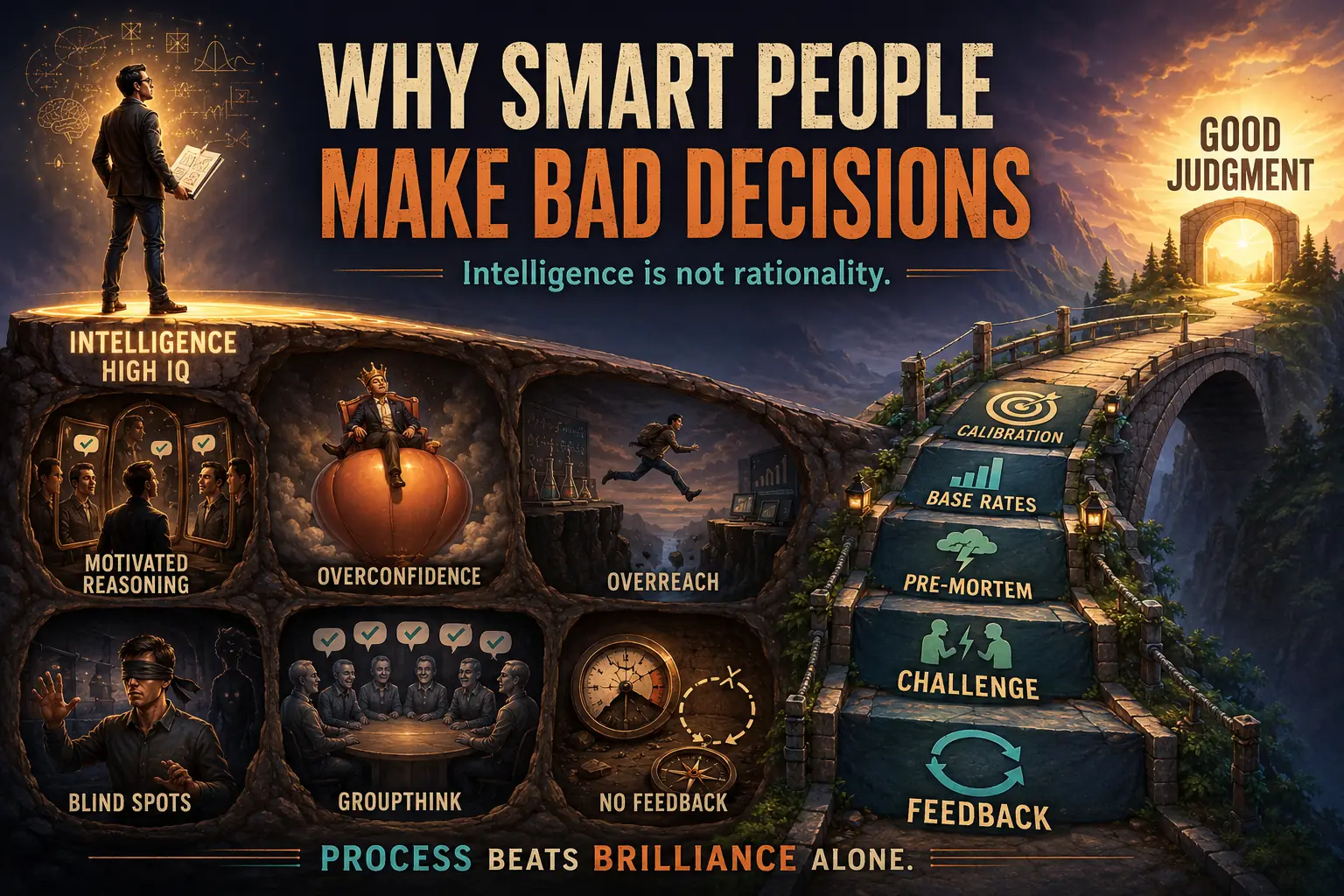
Why Smart People Make Bad Decisions
Intelligence - the capacity to process complex information, identify patterns, and learn quickly - is distinct from rationality, which is the disposition to calibrate beliefs to evidence and make decisions that genuinely serve one's goals.
Research by cognitive psychologist Keith Stanovich demonstrates that IQ explains only 20-30 percent of variance in rational thinking tasks; the remainder is accounted for by thinking dispositions, metacognitive habits, and susceptibility to systematic cognitive biases.
High intelligence can actually amplify certain errors - motivated reasoning, overconfidence, and sophisticated rationalization - because greater verbal ability enables smarter people to construct more compelling justifications for conclusions they reached on non-rational grounds.
In 1998, Long-Term Capital Management - a hedge fund staffed by two Nobel Prize winners in Economics, a former vice chairman of the Federal Reserve, and some of the most sophisticated mathematicians in finance - lost $4.6 billion in less than four months and required a $3.6 billion bailout organized by the Federal Reserve Bank of New York to prevent a broader financial crisis.
The firm's models were state-of-the-art. Its principals had spent careers in the most intellectually demanding corners of finance. By any reasonable measure, they were among the smartest people working in their field.
The failure was not a failure of intelligence. It was a failure of the specific mechanisms through which intelligent people systematically produce wrong answers: overconfidence about their models' assumptions, motivated reasoning about positions they had established, groupthink within a high-status cohort, and disciplinary overreach (applying financial theory to conditions where its assumptions broke down).
These are not random errors. They are predictable products of how intelligence interacts with cognitive architecture in ways that can amplify rather than reduce error.
"Intelligence is no protection against irrationality. Smart people are often better at rationalizing beliefs they arrived at for non-rational reasons." - Jonathan Haidt, 2012
Intelligence and Rationality Are Not the Same Thing
The most important distinction in understanding why smart people make bad decisions is the difference between intelligence and rationality. These are related but distinct capacities that do not reliably covary.
Intelligence (as typically measured) is the capacity to process complex information, identify patterns, learn quickly, and perform well on problems where the relevant information is provided and the task is well-defined. IQ tests, SAT scores, and academic performance primarily measure this capacity.
| Bias Type | Why Smart People Are Vulnerable | Example |
|---|---|---|
| Motivated reasoning | Greater verbal ability means better post-hoc rationalization | Expert economists defending ideologically convenient conclusions |
| Overconfidence | High general ability creates false confidence in unfamiliar domains | Physicists opining confidently on economics or medicine |
| Sophisticated narrative construction | Intelligence enables elaborate self-justifying stories | Smart people finding reasons why their intuitions are correct |
| Galaxy-brained thinking | Complex logical chains lead to conclusions ordinary judgment would reject | Policy analysts reasoning to extreme positions step-by-step |
| Blind spots around expertise | Experts in one domain underestimate the learning needed in another | Medical experts making investment decisions like novices |
Rationality is the disposition and ability to calibrate beliefs to evidence, form preferences consistent with one's values, and make decisions that serve one's goals.
It requires metacognitive awareness (knowing what you know and do not know), epistemic humility (appropriate uncertainty about one's beliefs), and the ability to identify and correct systematic biases in one's reasoning.
Keith Stanovich, a cognitive psychologist at the University of Toronto who has spent his career studying this distinction, calls the gap between intelligence and rationality dysrationalia: the systematic tendency to think irrationally despite adequate intelligence.[1]
In his research, intelligence measures (IQ, standardized test scores) explain roughly 20-30% of variance in rational thinking tasks. The remaining 70-80% is explained by thinking dispositions, cognitive styles, and the willingness and ability to engage in careful System 2 analysis rather than relying on intuitive System 1 responses.
The practical implication: a high IQ does not prevent systematic reasoning errors. It may even amplify some of them.
Motivated Reasoning: Intelligence in Service of Desired Conclusions
Motivated reasoning is the use of cognitive capacity to reach predetermined conclusions rather than to evaluate evidence objectively. It is the mechanism by which smart people become better at being wrong: more intelligence means more ability to construct elaborate justifications for positions held for non-rational reasons.
The psychological reality of motivated reasoning is robust and well-documented. Jonathan Haidt's "social intuitionist" model of moral reasoning proposes that moral judgments are typically made intuitively (by System 1), with reasoning used post-hoc to justify the intuitive conclusion.[9]
Deliberate reasoning is often not truth-seeking - it is conclusion-defense.
Ziva Kunda's research in the 1990s documented this in non-moral domains: subjects who received information suggesting that coffee consumption was a health risk showed greater skepticism about the methodology and validity of that research than subjects who received equivalent information suggesting coffee was safe - if the subjects were coffee drinkers.[6]
The reasoning capacity was real; it was deployed in service of protecting a desired conclusion.
More intelligent people are, in some studies, better at motivated reasoning: they have more cognitive resources for constructing counterarguments, more confidence in their analytical ability, and more social capital invested in their stated positions.
Dan Kahan's research on "identity-protective cognition" showed that on politically charged empirical questions (climate science, gun control effectiveness), higher numeracy and scientific literacy were associated with stronger motivated reasoning, not weaker.[3]
Smarter people were better at selectively interpreting data to confirm their prior positions.
*Example*: Richard Feynman, widely considered one of the greatest physicists of the twentieth century, famously described himself as deliberately cultivating distrust of his own reasoning.
He wrote extensively about how skilled his brain was at constructing plausible-seeming justifications for wrong positions, and about the specific disciplines (experimental testing, peer review, adversarial collaboration) that were necessary precisely because intelligence was insufficient to prevent motivated error.
Overconfidence: The Intelligence Amplifier
Overconfidence - the tendency to overestimate the accuracy of one's beliefs and the reliability of one's judgments - is one of the most consistent and consequential findings in decision research.
It is particularly consequential for highly intelligent people because intelligence provides genuine grounds for confidence (smart people are often right, and appropriately know it) that can generalize into overconfidence in domains where it is not warranted.
Three forms of overconfidence are relevant:
Calibration overconfidence: Overestimating the accuracy of one's judgments. When asked to give 90% confidence intervals around estimates, people typically include the true value 50-70% of the time rather than the stated 90% - their actual error rates exceed what their confidence implies.
Experts in medicine, law, engineering, and finance show similar calibration overconfidence, sometimes exceeding non-experts on specific tasks.
Better-than-average effect: The vast majority of people rate themselves above average on desirable characteristics (driving ability, intelligence, ethics). Most doctors in a survey rated themselves above average at avoiding patient care errors.
Most CEOs believe their company's next product will outperform competitors'. The statistical impossibility of all these beliefs being simultaneously true indicates systematic self-serving overassessment.
Illusion of explanatory depth: The sense that you understand complex systems more deeply than you actually do.
Sloman and Fernbach's research on the "knowledge illusion" found that people who felt confident about how everyday mechanisms worked (toilets, zippers, helicopters) proved unable to explain them at even a basic level when asked to articulate the explanation.[8]
Smart people may be more susceptible to this because they are better at constructing the partial explanations that feel like full understanding.
Dunning-Kruger and Its Misunderstanding
David Dunning and Justin Kruger's 1999 study is among the most cited in psychology - and among the most misunderstood.[4] The popular version is that incompetent people overestimate their ability. This is accurate but incomplete. The full finding has two parts:
- Incompetent performers overestimate their performance because they lack the metacognitive skill to recognize their incompetence.
- Highly competent performers underestimate their relative performance - they assume others can do what they can do.
The second finding is as important as the first for understanding why smart people make bad decisions.
Expert underestimation of others' difficulty can lead to poor teaching (failing to explain things clearly because the difficulty seems obvious from inside the expertise), poor delegation (not providing adequate support because the task seems simple), and poor risk assessment (underestimating how hard a task will be for the organization because it seems easy to the expert).
The inverse also matters: competent people who underestimate their own relative abilities may fail to assert their judgment in situations where their analysis is genuinely superior to the group's.
Disciplinary Overreach: Expertise Applied Beyond Its Domain
Expertise is domain-specific. Expert mental representations encode knowledge specific to the patterns, relationships, and concepts of a particular domain.
When an expert moves outside their domain, they carry their intelligence but not their domain expertise - and their intelligence, combined with the confidence earned in their home domain, can produce confident wrong answers.
Philip Tetlock's twenty-year study of expert political judgment, published in 2005, documented this at scale.[2] Experts asked to predict political, economic, and geopolitical outcomes performed barely better than chance and worse than simple statistical models.
More remarkably, experts with higher public profiles - invited to speak on television precisely because of their confident, decisive opinions - performed worse than lower-profile experts. Confidence and articulateness are rewarded by media attention; they are not indicators of predictive accuracy.
Tetlock's distinction between "hedgehogs" (thinkers who know one big thing and explain everything through it) and "foxes" (thinkers who know many things and integrate multiple perspectives) predicted forecasting accuracy.
Foxes outperformed hedgehogs substantially, partly because they were less likely to apply a single framework past its domain of validity.
*Example*: Watson and Crick's discovery of the double helix in 1953 was partly enabled by Francis Crick's willingness to work across disciplinary boundaries - bringing physics intuitions to biology. But this same cross-disciplinary confidence in experts can also produce confident errors.
Linus Pauling, a two-time Nobel laureate (Chemistry, 1954, and Peace, 1962), spent the later decades of his career advocating for high-dose vitamin C as a cure for cancer and other diseases, despite evidence that did not support this conclusion.
His genuine expertise in chemistry created authority that extended past his actual knowledge of biochemistry and clinical medicine.
Blind Spots and the Limits of Introspection
A fundamental constraint on smart people's ability to recognize their own errors is that systematic cognitive biases are not visible through introspection. The same cognitive processes that generate biased judgments generate the self-assessments that should detect those biases. You cannot use a biased ruler to measure its own bias.
Daniel Kahneman, who spent his career studying cognitive biases, wrote in Thinking, Fast and Slow (2011) that his intuitive thinking remained just as prone to overconfidence and other biases as before he studied them.[5] He could see biases in others' reasoning; he could not reliably detect his own in the moment of making a judgment.
The recognition of bias requires an external perspective - data, feedback, peer review, structured process - that introspection cannot provide.
This is why the most reliable defenses against smart-people bad-decisions are structural, not dispositional. A smart person who is more humble is somewhat less susceptible to some biases.
A smart person embedded in a process with adversarial challenge, pre-mortem analysis, base-rate anchoring, and external validation of judgments is substantially protected from a broader range of errors - regardless of their level of humility.
What Actually Improves Judgment
The question "how do smart people avoid bad decisions?" has a counterintuitive answer: not by trying harder to think well, but by using processes that compensate for the specific failure modes of intelligent reasoning:
Calibration practice: Deliberately practicing probability estimation with feedback - making predictions and tracking their accuracy - builds calibrated confidence over time.
Philip Tetlock's superforecasters, the best-performing predictors in his Good Judgment Project, shared a trait of aggressive calibration: they tracked their accuracy rates, decomposed forecasting errors, and updated their confidence appropriately based on track record.
Base rate anchoring: Before generating an explanation for why this specific case will turn out a particular way, ask how cases of this type usually turn out. The base rate provides an anchor that counteracts the tendency to over-weight specific narrative explanations relative to statistical regularities.
Pre-mortem analysis: Before a decision is finalized, ask "Imagine it is one year from now and this decision has failed.
What went wrong?" The pre-mortem is more effective than forward-looking analysis because it activates different mental associations and removes the motivated reasoning pressure to justify a decision not yet made.
Adversarial collaboration: Deliberately seeking out the best arguments against your position, or hiring people who will make those arguments, provides the external challenge that motivated reasoning prevents from arising internally.
Jeff Bezos's practice of having Amazon leadership write six-page memos before meetings rather than presenting slides is partly a mechanism to force rigorous pre-articulation of reasoning that adversarial colleagues can then challenge.
Slowing down: Many intelligent people's worst decisions are made quickly, under the confidence that their intelligence makes slow deliberation unnecessary. Speed compounds motivated reasoning and reduces the likelihood of System 2 engaging to check System 1's rapid conclusions.
The common thread: compensating for the failure modes of intelligent reasoning requires systematic process, not just more of the same intelligence that generated the error.
Smart people who make reliably good decisions are not smarter than smart people who make bad ones; they have built habits, environments, and processes that correct for the specific ways intelligence can lead astray.
Groupthink Among High-Intelligence Cohorts
One of the most consistent findings in the study of collective decision-making failures is that groups composed of highly intelligent, similarly trained individuals are particularly susceptible to a specific failure mode: not the well-documented groupthink of social conformity pressure, but what Irving Janis originally identified as a more subtle mechanism - the shared assumption that a group of smart, analytically rigorous people will collectively catch errors that any individual member might miss.
This assumption is not irrational; it reflects how peer review and adversarial collaboration are supposed to work. But it depends critically on whether group members have genuinely different perspectives and information sets, rather than high ability applied to the same information from within the same framework.
The Bay of Pigs fiasco, Janis's original case study in Groupthink (1982), involved some of the most intellectually formidable people in the Kennedy administration: Robert McNamara (former president of Ford Motor Company), McGeorge Bundy (former Harvard dean), Dean Rusk (Rhodes scholar).
The decision to proceed with the invasion reflected not stupidity but the failure of a high-status, high-ability cohort to seriously entertain dissenting information.
CIA analysts who had doubts were not invited to key meetings. Arthur Schlesinger, who had reservations, later wrote that he felt the social dynamics of the group - the sense that raising objections would seem naive or obstructionist among such capable colleagues - actively suppressed critical evaluation.
High-intelligence groups are specifically vulnerable to this dynamic because the social pressure toward conformity is amplified by the cost of appearing intellectually unsophisticated before capable peers.
The solution that has the most empirical support is structural rather than dispositional: assigning someone the formal role of skeptic (devil's advocate) before discussion begins removes the social stigma from raising objections, because the objections are perceived as role behavior rather than genuine disagreement.
Research by Charlan Nemeth at UC Berkeley found that even minority dissent that was ultimately incorrect improved group decision quality, because it forced the majority to articulate and examine reasoning they had assumed was self-evident.
The Role of Feedback Absence in Perpetuating Smart-People Errors
A structural reason why intelligent people's reasoning errors persist, rather than being corrected by experience, is that most professional environments provide limited high-quality feedback on the accuracy of judgments over time. A decision is made.
Consequences unfold weeks, months, or years later. Multiple intervening causes affect the outcome. The counterfactual - what would have happened under a different decision - is never observed. Under these conditions, learning from experience is not just difficult; it is systematically misleading.
Psychologist Robin Hogarth distinguishes between "kind" and "wicked" learning environments. In a kind learning environment (chess, certain medical diagnostics, some sports), feedback is rapid, accurate, and clearly attributable to specific decisions.
Expertise develops reliably in kind environments because the feedback loop calibrates judgment. In a wicked learning environment (strategic business decisions, macroeconomic forecasting, many medical treatments, personnel judgments), feedback is delayed, noisy, incomplete, and difficult to attribute causally to specific decisions.
In wicked environments, experience does not reliably produce expertise - it produces confidence without calibration, because the practitioner accumulates a subjective sense of having navigated similar situations without receiving accurate information about whether their judgment contributed to outcomes.
Superforecasters in Philip Tetlock's Good Judgment Project represent an empirically verified exception to this pattern. The common distinguishing practice among the top 2% of forecasters was not their domain knowledge or analytical method but their systematic tracking of their own prediction accuracy.
They recorded specific, falsifiable predictions with explicit probability estimates and then compared outcomes to estimates, tracking calibration scores over time.
This practice creates an artificial kind-learning environment: it generates the rapid, accurate, attributable feedback that professional experience normally fails to provide.
Tetlock's 2015 book Superforecasting documents that this practice - rather than any substantive forecasting method - was the most reliable predictor of improvement over time.
The implication for individuals and organizations seeking to reduce smart-people decision errors is that the first requirement is designing feedback mechanisms that make the quality of reasoning visible over time.
Documented Failures: Case Studies in High-Intelligence Decision Errors
The pattern of intelligent people making systematically predictable errors appears consistently across domains where intellectual credentials are highest and the consequences of error are largest.
NASA's Challenger disaster (1986) was analyzed by sociologist Diane Vaughan at Columbia University in her 1996 book The Challenger Launch Decision, which drew on thousands of internal NASA documents and interviews.
Vaughan found that the decision to launch despite engineers' warnings about O-ring failure in cold temperatures was not the result of stupidity or corruption.
It was the product of a highly educated, technically sophisticated organization that had developed what she called "the normalization of deviance" - a gradual process by which repeated small anomalies (O-ring erosion in previous launches) became accepted as within normal operating parameters.
Engineers at Morton Thiokol who opposed the launch were overruled partly because management framed the question as "prove it's unsafe to launch" rather than "prove it's safe to launch" - a motivated inversion of the burden of proof that protected the preferred conclusion.
The seven crew members who died had the protection of some of the most technically capable minds in the American government; those minds failed to prevent their deaths through processes that behavioral research now understands as well-documented cognitive patterns.
Long-Term Capital Management's 1998 collapse involved partners who included Robert Merton and Myron Scholes (1997 Nobel laureates in Economics), David Mullins (former vice chairman of the Federal Reserve), and dozens of PhDs from MIT, Harvard, and Stanford.
Roger Lowenstein's authoritative account in When Genius Failed (2000) documented that the firm's failure resulted from four identifiable cognitive failure modes: overconfidence in mathematical models trained on historical data that excluded tail-risk scenarios; motivated reasoning that interpreted the firm's own risk assessments as indicating their positions were sound when external analysts saw differently; disciplinary overreach (applying finance theory to market conditions where its assumptions - liquid markets, uncorrelated risks - broke down simultaneously); and groupthink within a homogeneous high-intelligence cohort that dismissed external skepticism as reflecting insufficient sophistication.
The Federal Reserve organized a $3.6 billion private sector bailout to prevent contagion; the models' errors had been invisible to the people best positioned to evaluate them.
The Knight Capital Group trading failure of August 2012 destroyed a 17-year-old firm in 45 minutes through a failure traceable to overconfidence in a complex system. Knight's engineers deployed new trading software without fully testing its interaction with legacy code.
When the system went live, it began executing erroneous orders at high frequency. The firm's executives - experienced technologists - initially assumed the problem was minor and recoverable based on incomplete information.
By the time they understood the scale of the failure, Knight had accumulated $440 million in losses and the firm was destroyed. A subsequent analysis by R.
Dennis at the SEC (2012) found that Knight's review processes had not included adversarial testing of edge-case interactions, a gap attributable in part to overconfidence that the engineers understood the system's behavior well enough to skip comprehensive failure-mode analysis.
The Reinhart-Rogoff error (2013) illustrates how motivated reasoning can persist even in academic economics at the highest level.
Carmen Reinhart (Harvard) and Kenneth Rogoff (former IMF chief economist, Harvard) published a 2010 paper claiming that countries with debt-to-GDP ratios above 90% experienced significantly lower economic growth.
The finding was cited extensively in policy discussions to support austerity programs in Europe. A 2013 replication attempt by graduate student Thomas Herndon at the University of Massachusetts Amherst found a spreadsheet coding error in Reinhart and Rogoff's analysis that, when corrected, substantially reduced the claimed effect.
The original paper's influence had survived three years of scrutiny by the field's most sophisticated economists partly because the conclusion aligned with prevailing policy preferences, illustrating how even high-intelligence professional communities can fail to critically examine findings that confirm their preferred positions.
Building Better Judgment: Institutional and Personal Approaches
Research on the conditions under which smart people make better decisions has produced practical guidance that goes beyond individual cognitive discipline.
Philip Tetlock and Barbara Mellers at the University of Pennsylvania have identified the practices that distinguish the most accurate forecasters - "superforecasters" - from intelligent but less accurate ones.[7]
Their Good Judgment Project (2011-2015), involving 20,000 participants making 500,000 predictions, found that the top 2% of forecasters shared practices that could be explicitly taught.
They decomposed complex questions into simpler estimable sub-questions (fermi decomposition), consulted base rate distributions before generating case-specific narratives, expressed beliefs in precise numerical probabilities rather than verbal qualifiers, and actively sought disconfirming evidence by asking "what would I believe if I had the opposite prior?" Most importantly, they maintained systematic records of their predictions and outcomes, reviewing calibration regularly.
Tetlock's training program, which teaches these practices without conveying any domain-specific knowledge, improved forecasting accuracy (Brier scores) by roughly 10% in randomized controlled testing - demonstrating that judgment quality is trainable through process, not only through intelligence.
The US Intelligence Community's structured analytic techniques, developed by Richards Heuer at the CIA and documented in his 1999 monograph Psychology of Intelligence Analysis, represent an institutional response to the recognition that experienced, highly educated analysts are susceptible to the same cognitive failure modes as everyone else.
Heuer's Analysis of Competing Hypotheses (ACH) method requires analysts to: list all plausible hypotheses, identify all available evidence bearing on each hypothesis, assess the diagnosticity of each evidence item for each hypothesis, calculate which hypothesis the evidence least contradicts (rather than most confirms), and explicitly identify assumptions that would have to be wrong for that hypothesis to be incorrect.
A 2011 evaluation by Marrin and Clemente at the National Intelligence University found that structured analytic techniques improved analysts' self-reported confidence calibration and reduced post-hoc rationalization of initial judgments, though rigorous outcome testing against ground truth remains difficult given the classified nature of intelligence products.
Amazon's "working backwards" and single-threaded leadership model represents a corporate architecture explicitly designed to counteract the groupthink that affects high-intelligence leadership teams.
Jeff Bezos identified in 2004 that PowerPoint presentations in executive meetings enabled smart leaders to paper over analytical weaknesses with confident delivery - a manifestation of halo effect and presentation skill substituting for analytical rigor.
The replacement requirement - six-page narrative memos read in silence at the meeting's start - forces pre-articulation of reasoning in a format that the room reviews simultaneously and critically.
Bezos's shareholder letters and subsequent accounts by executives including Colin Bryar and Bill Carr in Working Backwards (2021) document that the process was explicitly designed around the insight that smart people's real-time verbal reasoning is less reliable than their written reasoning, which can be reviewed, challenged, and tested for logical consistency before a decision is made.
Sources & Further Reading
- Stanovich, K. What Intelligence Tests Miss: The Psychology of Rational Thought. Yale University Press, 2009. View source
- Tetlock, P. Expert Political Judgment: How Good Is It? How Can We Know? Princeton University Press, 2005. View source
- Kahan, D., Peters, E., Wittlin, M. et al. "The Polarizing Impact of Science Literacy and Numeracy on Perceived Climate Change Risks." Nature Climate Change, 2(10), 732-735, 2012. DOI: 10.1038/nclimate1547
- Dunning, D. & Kruger, J. "Unskilled and Unaware of It." Journal of Personality and Social Psychology, 77(6), 1121-1134, 1999. DOI: 10.1037/0022-3514.77.6.1121
- Kahneman, D. Thinking, Fast and Slow. Farrar, Straus and Giroux, 2011. View source
- Kunda, Z. "The Case for Motivated Reasoning." Psychological Bulletin, 108(3), 480-498, 1990. DOI: 10.1037/0033-2909.108.3.480
- Tetlock, P. & Gardner, D. Superforecasting: The Art and Science of Prediction. Crown Publishers, 2015. View source
- Sloman, S. & Fernbach, P. The Knowledge Illusion. Riverhead Books, 2017.
- Haidt, J. "The Emotional Dog and Its Rational Tail." Psychological Review, 108(4), 814-834, 2001. DOI: 10.1037/0033-295X.108.4.814
Further Reading
- Ariely, D. Predictably Irrational: The Hidden Forces That Shape Our Decisions. Harper Collins, 2008.