
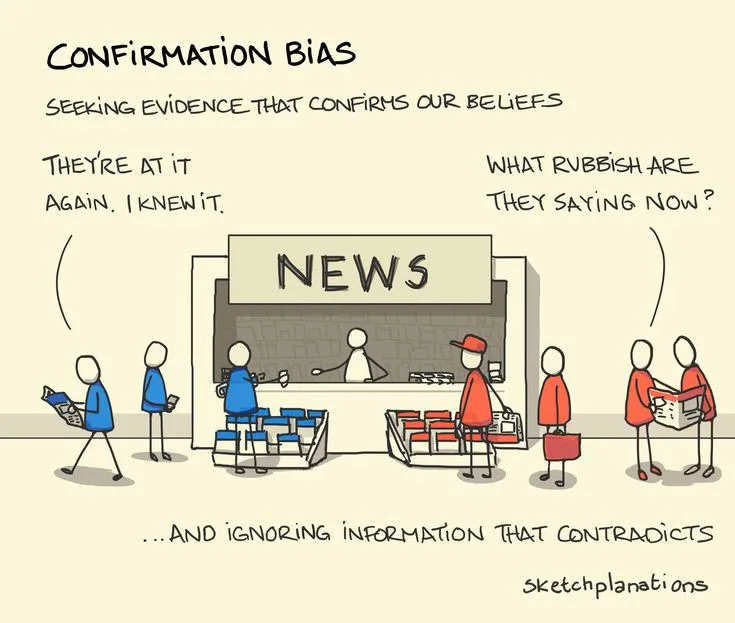
People often test ideas by looking for confirming examples instead of trying to disprove them. Confirmation bias makes an initial hypothesis feel stronger as supporting evidence accumulates, even when the search itself has ignored the information most capable of showing the belief is wrong.
The 2-4-6 Problem
In 1960, British psychologist Peter Wason gave participants in his laboratory a deceptively simple task.[2] They were shown a sequence of three numbers - 2, 4, 6 - and told that the sequence conformed to a rule. Their job was to discover the rule by proposing other sequences of three numbers.
After each proposed triple, the experimenter would say whether it followed the rule or not. When participants felt confident they had found the rule, they were to state it.
Almost all participants immediately formed a hypothesis. The sequence 2, 4, 6 looks like even numbers. Or ascending even numbers. Or numbers that increase by two each step. Armed with that hypothesis, they began testing it - by proposing triples that fit their hypothesis: 8, 10, 12.
Yes, that follows the rule. 14, 16, 18. Yes. 20, 22, 24. Yes. After three or four confirmations, most participants stated their rule with confidence: "Numbers increasing by two" or "even numbers in ascending order."
The rule was: any three numbers in ascending order.
Any three ascending numbers - 1, 2, 3; 5, 17, 412; 3, 3.5, 1000 - would have confirmed the actual rule. But participants almost never proposed triples that could have disconfirmed their hypothesis. They did not try 1, 2, 3 (which would have been confirmed and immediately indicated the rule was not about even numbers).
They did not try 3, 2, 1 (which would have been disconfirmed, and which would have told them the rule involved ascending order). They tested what they believed, found it confirmed, and concluded they were right.
Wason published this finding in "On the Failure to Eliminate Hypotheses in a Conceptual Task" in the Quarterly Journal of Experimental Psychology (1960, Vol. 12, No. 3, pp. 129-140).
The paper gave experimental form to a pattern of reasoning that would turn out to be one of the most pervasive and consequential in all of cognitive psychology. The name for the tendency it exposed: confirmation bias.
What Confirmation Bias Is
Confirmation bias is the tendency to search for, interpret, favor, and recall information in a way that confirms or supports one's prior beliefs, hypotheses, or values, while giving disproportionately less attention and weight to information that could contradict them.
Confirmation Bias vs. Disconfirmation Strategy
The following table contrasts the natural confirmatory mode with the deliberate disconfirmatory approach that scientific reasoning and good epistemics require:
| Dimension | Confirmation Bias | Disconfirmation Strategy |
|---|---|---|
| Evidence search | Seek out information expected to be consistent with the current hypothesis | Deliberately seek information that could falsify the hypothesis |
| Evaluation standard | Apply more scrutiny to disconfirming evidence than to confirming evidence | Apply the same methodological standard to all evidence regardless of whether it supports or challenges the hypothesis |
| Hypothesis testing | Propose tests likely to produce confirming outcomes (as Wason's participants did with 8-10-12) | Propose tests that would produce disconfirming outcomes if the hypothesis is wrong (as Wason's participants rarely did with 1-2-3) |
| Attitude toward anomalies | Explain away, discount, or ignore data that does not fit the current model | Treat anomalies as informative signals; pursue them as potential falsifications |
| Updating behavior | Update beliefs weakly or not at all when encountering contradictory evidence; update strongly on confirmatory evidence | Update beliefs proportionally to evidence strength, treating both confirming and disconfirming evidence as symmetrically informative |
| Intellectual posture | Defend the current belief against incoming information | Hold the current belief provisionally; remain genuinely open to revising or abandoning it |
| Risk direction | Risk of entrenchment: holding a false belief longer than warranted | Risk of instability: revising correct beliefs too readily (though this risk is far less common in practice) |
The disconfirmation strategy is not a natural default. It requires deliberate effort, institutional structure, or explicit instruction. Left to their own devices, human reasoners operate primarily in the confirmatory mode - a fact with significant implications for individuals, organizations, and democratic societies.
The Cognitive Science of Confirmation Bias
Wason and the Experimental Tradition
Peter Wason's 1960 2-4-6 study was followed by a second landmark experiment in 1966: the Wason Selection Task.[3] Participants were shown four cards - E, K, 4, 7 - and told that each card had a letter on one side and a number on the other.
The rule was: if a card has a vowel on one side, it has an even number on the other. Which cards must you turn over to determine whether the rule is true or false?
The logically correct answer is E and 7. You must check whether E has an even number on its back, and you must check whether 7 has a vowel on its back (which would falsify the rule). The card showing 4 is irrelevant: whatever is on its back cannot falsify the rule.
Only about 10 percent of participants chose E and 7. The vast majority chose E and 4 - the cards that could only confirm the rule, never disprove it. Almost no participant spontaneously selected the 7, the card with the most diagnostic value.
Wason described participants as conducting "verification experiments" when they should be conducting "falsification experiments." The paper, "Reasoning about a Rule," appeared in the Quarterly Journal of Experimental Psychology in 1968 (Vol. 20, No. 3, pp. 273-281).
The selection task has since been administered to tens of thousands of participants across cultures, education levels, and countries.
The result is one of the most robustly replicated findings in cognitive psychology: on the abstract logical version of the task, correct performance hovers near 10 percent regardless of participant background.
Logicians, statisticians, and trained scientists perform only marginally better.
When the task is embedded in a social-cheating context - checking whether bar patrons are old enough to drink - performance improves dramatically, suggesting that humans have specialized cognitive circuitry for detecting social violations.
The abstract logical version is what exposes the default: test by confirming, not by falsifying.
Lord, Ross, and Lepper: Biased Assimilation
In 1979, Charles Lord, Lee Ross, and Mark Lepper published a study that remains the most influential demonstration of confirmation bias in real-world belief domains.[5]
They recruited participants who either strongly supported or strongly opposed capital punishment, confirmed their attitudes with a pre-test questionnaire, and then showed all participants the same portfolio of two research studies about whether the death penalty deters crime.
One study appeared to support deterrence; the other appeared to undercut it. Both were described with identical levels of methodological detail. Participants on both sides rated the study supporting their prior view as significantly more methodologically rigorous, more convincing, and more relevant to the policy question.
The study contradicting their prior view was rated as flawed, poorly designed, or inapplicable. The dependent variable that produced the most striking result was attitude change: after reading exactly the same mixed evidence, participants on both sides became more extreme in their original positions.
The pro-capital punishment group became more strongly pro-capital punishment; the anti-capital punishment group became more strongly anti-capital punishment.
Lord, Ross, and Lepper called this biased assimilation - the tendency to accept evidence consistent with prior beliefs at face value while subjecting inconsistent evidence to critical scrutiny.
The outcome - attitude polarization from balanced evidence exposure - directly overturns the intuitive assumption that presenting "both sides" of a contested issue will move people toward the center.
When confirmation bias is operating, exposure to balanced evidence can deepen disagreement.
The paper, "Biased Assimilation and Attitude Polarization: The Effects of Prior Theories on Subsequently Considered Evidence," appeared in the Journal of Personality and Social Psychology (1979, Vol. 37, No. 11, pp. 2098-2109).
Mynatt, Doherty, and Tweney: Scientific Reasoning
Research psychologists Clifford Mynatt, Michael Doherty, and Ryan Tweney (1977) investigated whether confirmation bias persisted when people were explicitly engaged in scientific-style hypothesis testing.[4]
They constructed a computer-based simulated research environment in which participants could fire particles at objects and observe whether the particles were deflected. The task was to discover the rule governing deflection.
Even with explicit instructions to test hypotheses systematically, participants overwhelmingly generated confirming rather than disconfirming tests.
When they formed a hypothesis - say, that round objects caused deflection - they sent particles toward round objects to verify, rather than toward non-round objects to check whether deflection required roundness at all.
The study, "Confirmation Bias in a Simulated Research Environment: An Experimental Study of Scientific Inference," appeared in the Quarterly Journal of Experimental Psychology (1977, Vol.
29, No. 1, pp. 85-95), and was among the first to demonstrate that the bias persists in explicit hypothesis-testing contexts, not just in everyday reasoning.
Motivated Reasoning: Ditto and Lopez
Peter Ditto and David Lopez (1992) demonstrated that the asymmetry in evidence evaluation is intensified when the conclusion has personal stakes. In their experiments, participants received either positive or negative results from a fictitious medical test for a pancreatic enzyme deficiency.
Participants who received unfavorable results requested more repeated tests, spent more time scrutinizing the test procedure, and were more likely to conclude the test was unreliable - compared with participants who received favorable results.
The authors termed this motivated skepticism: the tendency to apply more rigorous evidential standards when a conclusion is unwelcome, and more lax standards when it is desired.
The paper, "Motivated Skepticism: Use of Differential Decision Criteria for Preferred and Nonpreferred Conclusions," was published in the Journal of Personality and Social Psychology (1992, Vol. 63, No. 4, pp. 568-584).
Ditto and Lopez's work integrated confirmation bias with the broader framework of motivated cognition: the phenomenon is not merely a cold reasoning heuristic but is actively amplified by emotional investment in particular outcomes.
Neural Correlates: Westen and the Brain Basis of Political Reasoning
In 2006, Drew Westen and colleagues at Emory University used functional neuroimaging to study what happens in the brain when partisan reasoners encounter politically threatening information.[11] Participants who were strong supporters of either George W.
Bush or John Kerry were shown statements in which their preferred candidate appeared to contradict himself. The task was to reason about whether the contradiction was genuine.
When participants encountered contradictions from their own candidate, the brain areas associated with conflict and negative emotion activated.
But the reasoning-associated areas of the prefrontal cortex did not show sustained activation - instead, participants generated rationalizations, and once a rationalization was found, the threat circuits deactivated and the brain's reward circuits showed increased activity.
Partisan reasoners effectively experienced a small dopamine-like reward each time they successfully explained away a threat to their preferred candidate.
The paper, "Neural Bases of Motivated Reasoning: An fMRI Study of Emotional Constraints on Partisan Political Judgment," appeared in the Journal of Cognitive Neuroscience (2006, Vol. 18, No. 11, pp. 1947-1958).
The neuroimaging finding has a significant implication: confirmation bias does not feel like bias. It feels like rigorous reasoning. The heightened scrutiny applied to unwelcome evidence feels like intellectual care. The smooth acceptance of confirming evidence feels like sound judgment.
There is no phenomenological signal to alert the reasoner that an asymmetry is occurring.
Media Selection: Knobloch-Westerwick and Meng
Silvia Knobloch-Westerwick and Jingbo Meng (2009) examined confirmation bias in the context of news consumption.[12] In a controlled study, participants with established political attitudes were given free access to an online news portal and were able to browse political articles at will.
Their browsing behavior was tracked precisely. Participants spent significantly more time on articles that aligned with their existing political views than on articles that challenged them, and were more likely to select such articles from menus.
The study, "Looking the Other Way: Selective Exposure to Attitude-Consistent and Counterattitudinal Political Information," was published in Communication Research (2009, Vol. 36, No. 3, pp. 426-448).
The Knobloch-Westerwick and Meng findings extended the experimental evidence for confirmation bias into naturalistic information-seeking behavior: when given free choice, people select confirming information not only by evaluating it more favorably but by actively choosing to encounter it in the first place.
Four Named Case Studies
Case Study 1: Wason's Laboratory - The Structure of the Bias at Its Purest
The cleanest demonstration of confirmation bias remains Wason's own 2-4-6 experiment because it strips away the complicating factors of identity, motivation, and stakes. The participants had no personal reason to believe the rule was "ascending even numbers." They had no ideology to protect.
No career investment. No emotional attachment. They simply formed a plausible hypothesis from three data points and then tested it exclusively by looking for confirming instances.
Of the participants who stated an incorrect rule, the great majority had never generated a single disconfirming triple during their testing phase. Their sequences - 4, 6, 8; 10, 12, 14; 100, 102, 104 - were all redundantly confirming.
They had discovered that their hypothesis was consistent with the data without ever testing whether the data was consistent with any other hypothesis.
Wason described this as "a failure to eliminate hypotheses in a conceptual task" - not a failure of intelligence or motivation, but a structural failure in the logic of inquiry. The failure is to confuse evidence-for with evidence-against-alternatives.
This is the irreducible core of confirmation bias: the tendency to test hypotheses by looking for evidence that they are true, rather than by looking for evidence that they are false. It operates even in the absence of any stake in the outcome.
Case Study 2: The Iraq WMD Intelligence Failure (2002-2003)
By late 2001, senior officials in the United States government held a strong prior belief that Iraq possessed active weapons of mass destruction programs. When the intelligence community was tasked with assessing this belief, the institutional architecture amplified confirmation bias at every tier.
Analysts who produced assessments consistent with the senior leadership's prior belief were rewarded with access, resources, and policy relevance.
The Curveball source - an Iraqi defector claiming knowledge of mobile biological weapons laboratories - was assessed positively despite explicit written warnings from German intelligence that he was unreliable and his claims unverified.
A Defense Intelligence Agency report from February 2002 quietly noted that "there is no reliable information on whether Iraq is producing and stockpiling chemical weapons" - a direct disconfirmation of the central hypothesis - but this sentence did not feature in presentations to senior officials.
The Department of Energy's own weapons experts, who assessed that the aluminum tubes cited as evidence of centrifuge construction were more likely intended for conventional rocket artillery, were overridden by the CIA interpretation that supported the weapons hypothesis.
The disconfirming evidence was available at every stage. UN inspectors on the ground found nothing. The DIA dissent was documented. The DOE technical assessment existed in writing.
Each piece of disconfirming evidence was individually explained away - through challenges to the source's access, the inspector's competence, or the DOE's expertise in the particular case - while confirming evidence passed through without equivalent scrutiny.
This is the precise signature of biased assimilation as Lord, Ross, and Lepper described it: identical evidentiary standards are not applied across the board. On February 5, 2003, Colin Powell told the UN Security Council: "These are not assertions.
What we're giving you are facts and conclusions based on solid intelligence." He later called the presentation "a blot" on his record.
The post-invasion Iraq Survey Group found no active WMD programs. The Senate Select Committee on Intelligence's 2004 report identified "the tendency of analysts to believe that they understood Saddam's intentions" - a textbook description of a prior hypothesis shaping evidence interpretation.
Case Study 3: N-Rays and the Self-Confirming Scientific Community (1903-1904)
In 1903, Rene Blondlot, a respected French physicist at the University of Nancy, announced the discovery of a new form of radiation. He called them N-rays (after Nancy).
Over the following year and a half, more than 120 French scientists published papers in the Comptes Rendus de l'Academie des Sciences confirming the detection of N-rays and elaborating their properties: their refraction indices, their interactions with various materials, their curious behavior when combined with anesthetized subjects.
N-rays did not exist. Detection was performed through the subjective assessment of slight changes in the brightness of a phosphorescent thread or screen. The observations were generated by expectation.
Robert Wood, an American physicist from Johns Hopkins University, visited Blondlot's laboratory in 1904 and, during a critical demonstration in a darkened room, surreptitiously removed the aluminum prism that was supposedly separating N-rays from the incident radiation.[15]
Blondlot and his assistant continued to report normal, expected observations. Wood replaced the prism; they continued reporting normally. He published a short, devastating account in Nature (1904, Vol. 70, pp. 530-531). The N-ray literature collapsed within a year.
No fraud was involved. Blondlot was not a charlatan; he was a genuinely accomplished physicist who had made real prior contributions to electromagnetism.
The approximately 120 confirmatory publications were each produced by researchers who expected to find what they found, and who interpreted ambiguous subjective signals through the lens of that expectation.
Disconfirming observations - failed replications, anomalous readings, inability to detect N-rays under controlled conditions - were attributed to improper experimental technique, unsuitable detector sensitivity, or poor-quality N-ray sources.
The community collectively confirmed a phenomenon that did not exist because no robust mechanism for generating disconfirming tests was in place.
The N-ray episode is the most instructive scientific case study in confirmation bias because it demonstrates that the bias is not corrected by intelligence, professional training, or peer review when those systems are themselves organized around confirmatory expectations.
Case Study 4: The Theranos Investor Failure (2013-2018)
Elizabeth Holmes founded Theranos in 2003 on the claim that a single drop of blood drawn from a fingertip could accurately run hundreds of diagnostic tests. By 2013, Theranos had been valued at approximately nine billion dollars. Board members included George Shultz, Henry Kissinger, James Mattis, and other high-prestige figures.
The company's narrative - a young, visionary founder revolutionizing healthcare - was compelling, and investors and board members were not seeking to falsify it.
The disconfirming evidence was embedded in the technology itself. Theranos's proprietary Edison machines were performing only a small fraction of advertised tests, with most being run on commercially available Siemens analyzers, and results from both were systematically outside acceptable accuracy ranges for clinical diagnostics.
Multiple laboratory scientists raised concerns; several resigned. Whistleblower Tyler Shultz - grandson of board member George Shultz - raised concerns internally and was met with legal threats. None of this information penetrated the board's decision-making or investor due diligence in any meaningful way.
When Wall Street Journal reporter John Carreyrou began investigating in 2015, sources described a company culture in which questioning the technology was categorized as disloyalty and suppressed.
The investor community had formed a hypothesis - that Theranos's technology was transformative - and processed subsequent information entirely through that lens.
Confirming signals (high-profile partnerships, favorable press coverage, the founder's charismatic certainty) were weighted heavily.
Disconfirming signals (technical objections, whistleblowers, failed accuracy studies) were discounted. Holmes was convicted of fraud in 2022.
The nine-billion-dollar valuation had been built, in substantial part, on a confirmation-biased epistemic environment in which no one with power had asked: what would convince us this technology does not work?
Intellectual Lineage
The phenomenon now called confirmation bias was described philosophically centuries before it was studied empirically. In 1620, Francis Bacon wrote in Novum Organum:
"The human understanding when it has once adopted an opinion draws all things else to support and agree with it.
And though there be a greater number and weight of instances to be found on the other side, yet these it either neglects and despises, or else by some distinction sets aside and rejects; in order that by this great and pernicious predetermination the authority of its former conclusions may remain inviolate."
Bacon's diagnosis was precise: the mind does not merely weight confirming evidence more heavily; it actively works to neutralize disconfirmation through "distinction" and rejection.[1]
He identified this tendency as the central obstacle to empirical inquiry, and his proposed remedy was systematic: the natural philosopher must force equal attention on negative instances. The Novum Organum was, in essence, a debiasing manual for the scientific mind.
The concept migrated through philosophy of science without acquiring a common name. John Stuart Mill's methods of induction (1843) implicitly required attention to negative cases. Claude Bernard's Introduction to the Study of Experimental Medicine (1865) stressed the importance of designing experiments to challenge hypotheses.
Karl Popper's theory of falsificationism (1934, published in English as The Logic of Scientific Discovery, 1959) elevated the disconfirmation imperative into a demarcation criterion: a theory that cannot in principle be falsified is not scientific.
Popper's falsificationism is the philosophical inverse of confirmation bias - it places falsification at the center of epistemic practice precisely because verification can never establish a universal claim.
The psychological literature was slow to catch up. Wason's 1960 and 1966 papers gave confirmation bias its first rigorous experimental operationalization and coined the term as used today.
His choice of the term "confirmation" was deliberate and descriptive: the behavior he observed was not motivated by identity or emotion, but was a structural feature of the hypothesis-testing process itself.
In 1979, Lord, Ross, and Lepper moved the study of confirmation bias from abstract logical tasks into the domain of real-world belief, showing that the bias operated powerfully on socially and politically loaded topics and produced attitude polarization as its signature outcome.
Ross and Lepper were central figures in the broader Stanford social cognition tradition that examined belief perseverance, lay theories, and the psychology of social inference.
Raymond Nickerson's 1998 review in the Review of General Psychology - "Confirmation Bias: A Ubiquitous Phenomenon in Many Guises" (Vol. 2, No. 2, pp.
175-220) - synthesized over three decades of findings across virtually every domain of psychology in which the phenomenon had been studied: legal reasoning, clinical diagnosis, personnel selection, scientific hypothesis testing, eyewitness testimony, and interpersonal inference.
Nickerson concluded that confirmation bias was among the most pervasive and consequential biases documented in the psychological literature and that it operated through multiple distinct mechanisms at different stages of information processing - search, interpretation, encoding, and retrieval - all of which tended in the same direction.[9]
Daniel Kahneman's Thinking, Fast and Slow (2011) integrated confirmation bias into his System 1 / System 2 architecture.[14] System 1 - the fast, associative, intuitive processing mode - generates hypotheses rapidly from pattern recognition.
System 2 - the slower, deliberative, effortful mode - is capable in principle of generating disconfirming tests. But in practice, Kahneman argued, System 2 is frequently deployed not to challenge but to rationalize: it is enlisted after System 1 has already reached a conclusion, to provide reasons for what has already been decided.
In this framing, sophisticated reasoning ability does not eliminate confirmation bias; it may simply make a person better at constructing convincing justifications for their preexisting conclusions.
Empirical Research
The empirical record for confirmation bias is among the richest in cognitive psychology, spanning six decades, dozens of paradigms, and tens of thousands of participants.
The Wason 2-4-6 task has been administered in numerous variations. Tweney and colleagues (1980) showed that relabeling the experimenter's feedback - using "DAX" and "MED" instead of "right" and "wrong" - affected the rate of disconfirmatory testing, suggesting that the framing of hypothesis testing has procedural effects on confirmatory behavior.
Klayman and Ha (1987), in an influential theoretical paper in Psychological Review (Vol.[8]
94, No. 2, pp. 211-228), reanalyzed the Wason selection task and argued that what appears as a confirmation bias is often a "positive test strategy" - testing by asking "does this case have the property I am predicting?" - which produces confirmatory behavior as a byproduct rather than as a motivated goal.
The distinction is theoretically significant but practically modest: both accounts predict that most hypothesis tests will be confirmatory in structure.
The Lord, Ross, and Lepper (1979) biased assimilation finding has been replicated and extended across many domains. Ditto and Lopez (1992) extended it to medical self-diagnosis contexts and introduced the motivated skepticism framework.[10]
MacCoun (1998) reviewed evidence from legal contexts, finding that mock jurors evaluated forensic evidence differently depending on whether it supported the prosecution or defense, and that these evaluations tracked prior sympathies rather than objective quality assessments.
The Darley and Gross (1983) study - "A Hypothesis-Confirming Bias in Labeling Effects," Journal of Personality and Social Psychology (Vol.[6] 44, No. 1, pp.
20-33) - demonstrated that prior expectations about a child's social class led participants to interpret the same ambiguous academic performance as above average (when the child was identified as upper-class) or below average (when identified as lower-class).
The same test answers, the same behavioral footage - interpreted through different prior hypotheses, perceived as evidence for different conclusions.
Nickerson's 1998 review covered more than 2,000 studies and concluded that confirmation bias appeared with remarkable consistency across legal reasoning, medical diagnosis, scientific hypothesis testing, personnel selection, eyewitness testimony, social impression formation, and political judgment.
Knobloch-Westerwick and Meng (2009) added the dimension of selective exposure: confirmation bias is not only a matter of evaluating encountered information differently, but of actively selecting the information one encounters.
In a free-browsing environment with a realistic news interface, participants with established political attitudes spent substantially more time on attitude-consistent articles and were significantly more likely to select them from headlines alone.
This finding has been replicated and extended in the context of social media algorithm research.
The literature on filter bubbles - most influentially described by Eli Pariser in The Filter Bubble: What the Internet Is Hiding from You (2011) - argues that algorithmic recommendation systems on social media platforms structurally implement selective exposure at scale.
Algorithms trained to optimize for engagement preferentially serve content that confirms users' existing views, because such content produces more clicks, shares, and extended dwell time.
The mechanism is not purely psychological; it is built into the architecture of the information infrastructure.
Whether this structural amplification of confirmation bias is a primary driver of political polarization remains contested in the empirical literature, with some researchers (Bail et al., 2018) finding that exposure to opposing-view content on Twitter can actually increase rather than decrease polarization - an echo of the Lord, Ross, and Lepper attitude-polarization finding in a social media context.
Limits and Nuances
Bayesian Reasoning Is Not Biased Reasoning
Any theory of confirmation bias must reckon with Bayesian inference, which requires using prior probabilities. When a doctor interprets a positive test for a rare disease, they are right to remain skeptical even in the face of a positive result, because the prior probability of the disease is low.
This is not confirmation bias; it is correct Bayesian updating. The problem is not that humans use priors - they must - but that they apply them asymmetrically: weighting confirming evidence more heavily than its actual diagnostic value, and discounting disconfirming evidence below its actual diagnostic value.
Klayman and Ha (1987) argued that the positive test strategy is not inherently biased in all environments. When the hypothesis predicts a common feature and the target class is small, the positive test strategy will efficiently identify true hypotheses.
The strategy becomes biased when applied asymmetrically, when the prior is overstated, or when the evidence environment is one in which most confirming instances are compatible with multiple competing hypotheses.
Intelligence and Expertise Do Not Eliminate the Bias
A well-replicated and uncomfortable finding is that intelligence and expertise provide limited protection against confirmation bias, and in some cases may exacerbate it.
Stanovich, West, and Toplak (2013) found that cognitive ability and performance on reflective thinking tests predicted willingness to engage in System 2 reasoning but did not consistently predict rational belief updating.
More cognitively sophisticated participants were sometimes better at rationalizing their existing beliefs, not at revising them.
The N-ray case illustrates this in historical context: Blondlot was a credentialed physicist with genuine prior contributions to science. The 120 confirmatory publications were produced by trained researchers.
Their expertise equipped them to perform complex experiments; it did not protect them from interpreting ambiguous data through the lens of prior expectation.
Confirmation Bias May Have Adaptive Origins
Jonathan Haidt's social intuitionist model (2001) and the related argumentative theory of reasoning proposed by Mercier and Sperber (2011) suggest that confirmatory reasoning may have been adaptive in ancestral environments.[13] Mercier and Sperber argued in Behavioral and Brain Sciences (Vol.
34, No. 2) that human reasoning evolved primarily for social argumentation - producing and evaluating reasons in a group context - rather than for individual truth-seeking.
In an adversarial group context, each person's one-sided advocacy for their position, combined with skeptical evaluation of others' arguments, may produce collectively better reasoning than any individual attempting to be internally balanced.
The adaptive function of confirmation bias may be social even if its epistemic consequences are negative for the individual.
Debiasing: What Works and What Does Not
The most consistently effective single debiasing intervention identified in the controlled literature is the "consider the opposite" strategy: explicitly instructing participants to generate specific reasons why their current hypothesis or judgment might be wrong.
Lord, Lepper, and Preston (1984) showed in a follow-up to the 1979 capital punishment study that this instruction significantly reduced attitude polarization even for motivated reasoners.[7] The effect was genuine but modest, and it required explicit external instruction - it did not arise spontaneously.
Structural interventions show more promise than individual cognitive instructions. Red teams - groups formally tasked with attacking a plan or hypothesis - represent an institutionalization of the consider-the-opposite strategy.
Pre-mortems, in which decision-makers are asked to assume a project has failed and to explain why, use a similar mechanism.
Blind review processes in scientific publishing reduce the influence of the researcher's identity and reputation on evidence evaluation.
Pre-specified stopping rules and outcome metrics in clinical research reduce the ability to selectively interpret results after the fact.
The deepest problem with debiasing remains the phenomenological one that Westen's neuroimaging research illustrated: confirmation bias does not announce itself. It feels like rigorous reasoning. The heightened scrutiny applied to disconfirming evidence feels like intellectual care and rigor.
Overcoming confirmation bias requires not only knowing it exists but building environments in which the asymmetry is externally visible and carries costs - environments in which someone else can look at your evidence-evaluation process and point out that you are applying a double standard.
Good intentions, high intelligence, and professional training are insufficient in the absence of those structural conditions.
Sources & Further Reading
Bacon, F. (1620). Novum Organum. London: John Bill.
Wason, P. C. (1960). On the failure to eliminate hypotheses in a conceptual task. Quarterly Journal of Experimental Psychology, 12(3), 129-140.
Wason, P. C. (1968). Reasoning about a rule. Quarterly Journal of Experimental Psychology, 20(3), 273-281.
Mynatt, C. R., Doherty, M. E., & Tweney, R. D. (1977). Confirmation bias in a simulated research environment: An experimental study of scientific inference. Quarterly Journal of Experimental Psychology, 29(1), 85-95.
Lord, C. G., Ross, L., & Lepper, M. R. (1979). Biased assimilation and attitude polarization: The effects of prior theories on subsequently considered evidence. Journal of Personality and Social Psychology, 37(11), 2098-2109.
Darley, J. M., & Gross, P. H. (1983). A hypothesis-confirming bias in labeling effects. Journal of Personality and Social Psychology, 44(1), 20-33.
Lord, C. G., Lepper, M. R., & Preston, E. (1984). Considering the opposite: A corrective strategy for social judgment. Journal of Personality and Social Psychology, 47(6), 1231-1243.
Klayman, J., & Ha, Y. W. (1987). Confirmation, disconfirmation, and information in hypothesis testing. Psychological Review, 94(2), 211-228.
Nickerson, R. S. (1998). Confirmation bias: A ubiquitous phenomenon in many guises. Review of General Psychology, 2(2), 175-220.
Ditto, P. H., & Lopez, D. F. (1992). Motivated skepticism: Use of differential decision criteria for preferred and nonpreferred conclusions. Journal of Personality and Social Psychology, 63(4), 568-584.
Westen, D., Blagov, P. S., Harenski, K., Kilts, C., & Hamann, S. (2006). Neural bases of motivated reasoning: An fMRI study of emotional constraints on partisan political judgment. Journal of Cognitive Neuroscience, 18(11), 1947-1958.
Knobloch-Westerwick, S., & Meng, J. (2009). Looking the other way: Selective exposure to attitude-consistent and counterattitudinal political information. Communication Research, 36(3), 426-448.
Mercier, H., & Sperber, D. (2011). Why do humans reason? Arguments for an argumentative theory. Behavioral and Brain Sciences, 34(2), 57-74.
Kahneman, D. (2011). Thinking, Fast and Slow. New York: Farrar, Straus and Giroux.
Wood, R. W. (1904). The n-rays. Nature, 70(1822), 530-531.