
Psychology: In the summer of 2017, Melissa Hunt, a psychologist at the University of Pennsylvania, ran an experiment she expected to produce modest results.
She randomly assigned undergraduate students to limit their use of Facebook, Instagram, and Snapchat to ten minutes per platform per day - a total of thirty minutes of social media daily - for three weeks, while a control group continued their normal social media use.
When Hunt and colleagues measured outcomes at the end of three weeks, the experimental group showed significant reductions in loneliness and depression relative to the control group.[2]
The effects were largest for students who had entered the study with elevated depressive symptoms.
Reducing social media use to thirty minutes per day had a measurable, meaningful impact on mental health - not because social media use is uniformly harmful, but because the specific mechanism of passive social comparison that characterizes scrolling through curated highlights of other people's lives was, for many participants, making them measurably worse.
Thorstein Veblen had identified the mechanism more than a century earlier, without the benefit of Instagram. In "The Theory of the Leisure Class" (1899), Veblen described how modern consumption is organized not around satisfying needs but around signaling status relative to peers and competitors.
Wealthy classes distinguish themselves through "conspicuous consumption" - visibly wasteful expenditure that demonstrates the capacity to waste - and this standard then cascades downward as each class emulates the one above it.
Veblen's analysis was sociological and economic, but its psychological core is exactly what Festinger would formalize half a century later: humans evaluate their standing by reference to others, and the evaluation is never purely about absolute conditions but always relative position.
Someone living in genuine material comfort can feel poor if surrounded by people with dramatically more.
What has changed in the century between Veblen and Instagram is not human psychology but the comparison environment. Festinger's original social comparison theory predicted that we compare to similar others - peers, neighbors, people near us in relevant social dimensions.
This constraint on the comparison pool limited the scale of the problem. A farmer in Iowa in 1950 compared herself to other farmers in her county.
A person scrolling Instagram in 2024 compares herself to professional athletes, celebrities, influencers who have built entire careers around presenting idealized versions of their lives, and hundreds of acquaintances who post only their best moments.
The comparison pool has exploded in size, and its composition has been selected for the most envy-inducing content the algorithm can identify.
"Social comparison is one of the most natural human tendencies. We need to know how we're doing, and other people are how we find out.
The problem is not the comparison instinct but the comparison environment we have built for ourselves, which presents us with a systematically misleading picture of how other people actually live." - Leon Festinger's social comparison theory (1954), as extended by contemporary researchers
Key Definitions
Social comparison theory: Leon Festinger's 1954 theory proposing that humans have a drive to evaluate their opinions and abilities by comparing them to others.[1] The theory predicts comparison to similar others (the similarity hypothesis) and bidirectional comparison (both upward and downward).
Upward social comparison: Comparing oneself to people who appear to be doing better in a relevant dimension. Can be inspiring (when the gap seems bridgeable and attributable to effort) or deflating (when the gap seems fixed or the comparison standard is unrealistic).
| Comparison Type | Direction | Typical Effect | Exception |
|---|---|---|---|
| Upward social comparison | Comparing to someone better off | Increases motivation OR decreases wellbeing | Motivating when gap feels closeable |
| Downward social comparison | Comparing to someone worse off | Temporary self-esteem boost | Can backfire; creates guilt or fear of falling |
| Lateral comparison | Comparing to perceived equals | Calibration; can increase or decrease satisfaction | Depends on context and outcome |
| Social media comparison | Upward, curated highlight reels | Consistently linked to decreased satisfaction | Passive consumption most harmful |
Downward social comparison: Comparing oneself to people who appear to be doing worse. Provides short-term self-esteem boost but is a fragile strategy dependent on identifying a continuous supply of worse-off others.
Positional goods: Robert Frank's term for goods whose value derives primarily from their relative position - having more than others - rather than their absolute characteristics. Status goods, prestigious addresses, and elite education function as positional goods.
The Easterlin Paradox: Economist Richard Easterlin's finding (1974) that within a given society, richer people report higher happiness, but rising national income over time does not produce rising average happiness.[4] The interpretation is that happiness depends on relative income rather than absolute income.
Self-compassion: Kristin Neff's construct combining self-kindness (treating oneself as one would treat a friend), common humanity (recognizing that suffering and imperfection are shared human experiences), and mindfulness (balanced awareness of negative thoughts and feelings without over-identification).
Festinger's Theory and Its Legacy
Leon Festinger published "A Theory of Social Comparison Processes" in Human Relations in 1954, at a time when the dominant psychological theories of motivation focused on biological drives and reinforcement.
His insight was simpler and more universal: people need to know how they are doing, and in the absence of objective measurement standards, other people are the standard.
Festinger proposed several specific predictions. The similarity hypothesis: we compare to others who are similar to us in relevant characteristics, not to those who are very different. A beginning runner compares finishing times to other beginners, not to Olympic athletes.
A junior employee compares salary to peers, not to the CEO. The prediction was that large differences in comparison target reduce the comparison's informational value and therefore its motivational impact.
The unidirectional drive upward: given a choice of comparison targets, people tend to compare to those slightly above them in the relevant dimension rather than those below, creating a consistent upward pressure on performance standards.
These predictions have been extensively tested and generally supported, with important qualifications.
The similarity hypothesis holds, but people also make comparison choices strategically - selecting upward comparisons when they want motivation, downward comparisons when they want reassurance, and lateral comparisons when they want accurate self-assessment.
The problem is that social media short-circuits this strategic selection: the algorithm selects comparison content for engagement (which tends to mean aspirational and impressive content), not for the user's psychological needs.
Subsequent researchers expanded Festinger's framework. Wheeler and Miyake (1992) documented that social comparison is often automatic and difficult to suppress even when people prefer not to compare.
Buunk and Gibbons identified individual differences in social comparison orientation - the habitual tendency to engage in comparison - and found that higher orientation is associated with worse psychological outcomes, suggesting that the comparison tendency, while universal, varies in intensity and that the more compulsively one compares, the more one suffers.[12]
Veblen, Frank, and Positional Consumption
Thorstein Veblen's analysis of conspicuous consumption anticipated modern behavioral economics by half a century. Veblen observed that in societies that have solved the basic problem of subsistence, much consumption is not about utility in any conventional sense but about status demonstration.[5]
Consuming visibly wasteful things - expensive wine, large houses, luxury vacations - signals that one has more than enough, which in a competitive status hierarchy signals power and desirability.
This logic drives consumption choices up the income distribution as each tier tries to emulate the appearance of the tier above.
Robert Frank at Cornell developed Veblen's insight into a formal economic framework in "Luxury Fever" (1999) and earlier work. Frank's key concept is the "positional good" - a good whose value is primarily relational rather than absolute.[3]
A house is a positional good in expensive cities: what matters for social purposes is not the absolute quality of the shelter but its relative size and location compared to peers'.
A private school education is positional: its value comes partly from the relative advantage it provides over less exclusive schooling.
Frank documented the "expenditure cascades" that result from positional competition: when the rich get richer and spend more conspicuously on positional goods, this shifts the reference point for middle-class consumption, which in turn shifts the reference point for working-class consumption, ratcheting up spending across the income distribution on goods that improve relative position but produce no net gain in wellbeing for anyone.
The empirical support for this mechanism is substantial. Erzo Luttmer at Dartmouth published research (2005) finding that controlling for individual income, people who live in higher-income neighborhoods report lower life satisfaction - consistent with the reference income theory that wellbeing depends on relative position.[8]
Andrew Oswald at the University of Warwick has found similar results across different data sources and methodological approaches.
The Easterlin Paradox and Relative Income
Richard Easterlin, an economist at the University of Southern California, published a finding in 1974 that proved surprisingly resilient to subsequent challenges: within a given country, richer people are happier than poorer people, but rising average national income over time is not associated with rising average happiness.
The US became dramatically wealthier between 1946 and 1970; average self-reported life satisfaction did not increase. If income reliably produced happiness, both patterns should show the same correlation.
Easterlin's explanation was the treadmill of relative income: happiness within a society depends primarily on relative income rather than absolute income. When a society becomes richer, the gains are broadly distributed, and relative positions are approximately maintained.
The person who was at the median in 1970 is still at the median in 2000, even if their absolute income has doubled, because everyone else's income has also roughly doubled. Their hedonic position - defined by reference to their social surroundings - is unchanged.
This interpretation has been debated vigorously. Angus Deaton and Daniel Kahneman published research in 2010 finding that higher income does continue to produce higher wellbeing at the level of global cross-country comparison (richer countries are happier than poorer countries), but the relationship flattens or saturates at higher income levels.
More recently, Matthew Killingsworth at the University of Pennsylvania used experience sampling methodology and found continued positive associations between income and moment-to-moment wellbeing up to very high income levels, challenging the saturation hypothesis. The debate is ongoing.
What is not seriously disputed is that relative income - how you are doing compared to people around you - matters substantially for self-reported wellbeing.
The policy implication is uncomfortable: if wellbeing depends on relative position, economic growth does not straightforwardly translate into wellbeing growth for everyone. A rising tide lifts all boats, but if everyone's boat rises equally, no one's relative position changes.
Social Media and Amplified Comparison
The psychological literature on social media and comparison has grown rapidly since the emergence of Facebook (2004), Instagram (2010), and TikTok (2016). The findings are fairly consistent in direction, though the magnitude of effects varies considerably across studies and populations.
Cross-sectional studies find that heavier social media use, particularly passive consumption (scrolling without posting or interacting), is associated with higher rates of depressive symptoms, anxiety, and lower self-esteem.
These associations are stronger for women than men, stronger for adolescents than adults, and stronger for platforms with high visual social comparison content (Instagram, TikTok) than for more conversational platforms.
Melissa Hunt's randomized trial provides some of the strongest causal evidence. Her 2018 study, "No More FOMO: Limiting Social Media Decreases Loneliness and Depression," found that the thirty-minute-daily cap produced effects that were statistically significant after just three weeks.
The mechanisms she identified included reduced social comparison, reduced FOMO (fear of missing out - the anxiety that others are having more rewarding experiences), and reduced passive consumption time.
The Facebook company's own internal research, revealed through the Facebook Papers in 2021, included findings that Instagram worsened body image and was associated with increased suicidal ideation in a minority of teenage girl users.
The internal presentation quoted one internal researcher: "We make body image issues worse for one in three teen girls." Facebook's response - that these findings were mischaracterized and that the overall research showed mixed effects - is technically defensible but was widely perceived as minimizing a pattern its own researchers had documented.
Amy Orben and Andrew Przybylski at the University of Oxford conducted large-scale analyses of British and American survey data (2019) and concluded that the effects of technology use on adolescent wellbeing were statistically significant but small - comparable in magnitude to the negative effects of wearing glasses or eating potatoes, in their deliberately provocative framing.[7]
This analysis became influential in pushing back against the most alarming characterizations.
Jean Twenge, whose "iGen" (2017) had documented large increases in adolescent depression and anxiety tracking smartphone adoption, pushed back on the Orben/Przybylski analysis, arguing that aggregating all technology uses obscures the specific effects of social media use.[11] This debate continues in peer-reviewed journals.
The Envy Mechanism
Envy - the aversive emotion produced by comparing unfavorably to others in a domain we care about - is the psychological mechanism at the heart of social comparison's costs.
Unlike jealousy (wanting to protect what one has) or admiration (responding positively to another's qualities), envy specifically involves wanting what someone else has and resenting them for having it.
Helmut Schoeck's sociological study "Envy: A Theory of Social Behavior" (1966) argued that envy is a universal human emotion and a fundamental driver of social organization.
The cultural management of envy - through norms against conspicuous display, through redistributive institutions, through religious prohibitions - was, in Schoeck's view, central to the possibility of social cooperation.
Societies that cannot manage envy experience destructive competition, sabotage, and social fragmentation.
Contemporary psychology research finds that envy has two variants with different behavioral consequences.[10] Benign envy produces motivation to achieve what the envied person has. Malicious envy produces motivation to undermine or deprive the envied person.
Research by Niels van de Ven and colleagues found that which type of envy is triggered depends partly on whether the envied person's advantage is perceived as deserved (more likely to trigger benign envy) or undeserved (more likely to trigger malicious envy).
On social media, where others' apparent success is visible but its basis largely obscure, the attribution of desert is difficult, creating conditions for both variants.
Counterfactual Thinking and Near-Miss Anguish
Daniel Kahneman and Amos Tversky's work on counterfactual thinking illuminates one specific mechanism by which comparison produces misery: the near-miss.[9] Their research found that people are more distressed by outcomes that were almost different than by outcomes that were further from an alternative.
A silver medalist, research by Medvec, Madey, and Gilovich (1995) found, is on average less happy than a bronze medalist: the silver medalist's natural comparison is the gold medal she almost won; the bronze medalist's natural comparison is fourth place, and she is glad to have medaled at all.
This mechanism operates in social comparison when the comparison person is close to us: the colleague who got the promotion we were also considered for, the friend who bought the house we also looked at.
The psychological pain of these near-comparisons is disproportionate to the actual difference in outcomes, because the counterfactual (I almost had that) is vivid and easily constructed.
Distance from the comparison person reduces this anguish: it is easier to accept that a celebrity has a much larger house than that a peer does, because the celebrity's advantage is not one that could plausibly have gone differently.
Stoic and Buddhist Perspectives
Philosophical traditions that predate empirical psychology by millennia identified the comparison trap and proposed responses. The Stoics - Epictetus, Marcus Aurelius, Seneca - developed practices directly aimed at reducing suffering from relative position.
The "view from above" (a contemplative exercise in which one imagines one's circumstances from a cosmic perspective that renders social rankings insignificant) and the practice of negative visualization (imagining the loss of what one currently has, to cultivate gratitude for it rather than longing for more) are both consistent with contemporary cognitive psychology research on attentional reorientation and hedonic adaptation.
Buddhist psychology's concept of "comparing mind" - the tendency to evaluate oneself against others as a source of suffering - and its proposed antidote of present-moment awareness have found increasing empirical support.
Mindfulness-based interventions, which train the capacity to observe mental states without over-identification, have shown effects on reducing social comparison rumination in randomized trials, though effect sizes are typically modest.
Self-Compassion as Antidote
Kristin Neff at the University of Texas at Austin has developed the most empirically grounded alternative to comparative self-evaluation: self-compassion.[6]
Neff's construct has three components: self-kindness (responding to one's own suffering and failures with warmth rather than harsh self-criticism), common humanity (recognizing that imperfection and failure are shared human experiences rather than individual inadequacies), and mindfulness (holding difficult thoughts and feelings in balanced awareness without suppression or over-identification).
Neff's research program has produced a self-compassion scale, training programs (including the Mindful Self-Compassion program co-developed with Christopher Germer), and numerous studies finding that higher self-compassion is associated with lower depression, anxiety, and rumination, and that self-compassion can be cultivated through practice.
Importantly, Neff has found that self-compassion does not reduce motivation or accountability - a common concern that treating oneself kindly after failure will reduce the motivation to improve.
Research consistently finds that self-compassion maintains or improves motivation while reducing the paralysis and avoidance that self-criticism produces.
The relevance to social comparison is direct: self-compassion provides an evaluative framework that does not depend on relative standing.
One can acknowledge that someone else is doing better (common humanity: of course, there is always someone doing better), respond to one's own feelings of inadequacy with kindness rather than criticism (self-kindness), and maintain awareness of the feeling without being swept away by it (mindfulness).
This is not the denial of comparison but a different relationship to its results.
Temporal Comparison as Healthier Alternative
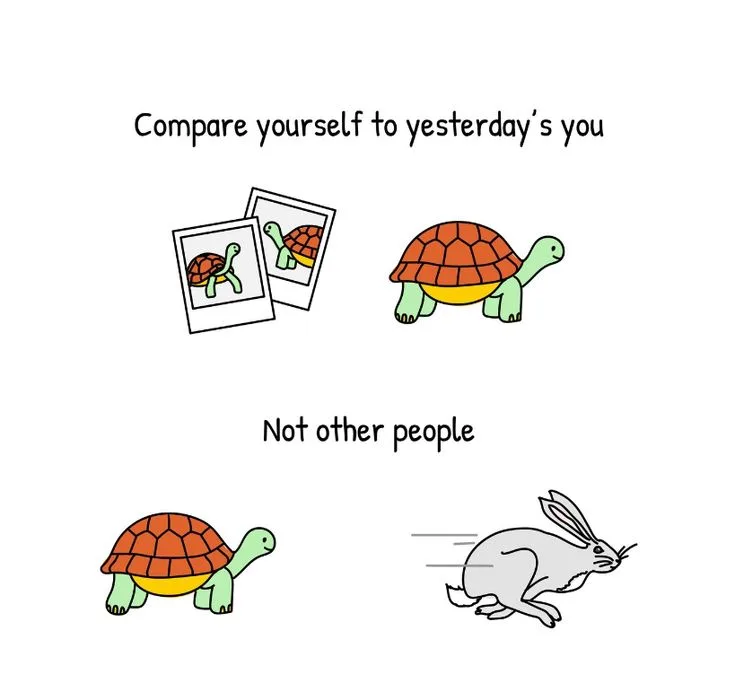
Research consistently finds that temporal self-comparison - comparing one's current self to one's past self - is more conducive to wellbeing than social comparison.
This is partly because temporal comparison frames progress as an internal process rather than a competitive ranking, making improvement the relevant standard rather than superiority.
It is also because temporal comparison is more likely to reveal genuine progress (most people improve at things they practice) and less likely to present unrealistic standards (one's past self is a realistic baseline by definition).
The practical implication is to deliberately reorient self-evaluation toward personal progress rather than social ranking. Journaling, goal-tracking, and periodic reflection on change over time provide the informational substrate for temporal comparison.
This is not a counsel of isolation from social information but a deliberate reweighting of which comparisons matter.
Practical Implications
For individuals: Audit your comparison environment. Identify which social media patterns generate the most unfavorable comparisons and reduce or restructure them. Practise noticing when comparison is occurring and what it is triggering. Cultivate self-compassion practices.
Reorient toward temporal self-comparison. Invest in close relationships, which provide belonging without the competitive anxiety of social comparison.
For parents: Model the temporal comparison orientation rather than rank-based evaluation. Be alert to the specific comparison dynamics of image-based social media for adolescents. Consider the Hunt et al. finding: structured limits on social media use have documented effects on wellbeing.
For organizations: Performance management systems that rank employees against each other (forced distribution curves, stack ranking) explicitly institutionalize social comparison and research on their effects finds increased competition, reduced collaboration, and - in some studies - reduced overall performance.
Evaluation against individual goals and development baselines avoids some of these costs.
See also: Are Attention Spans Really Shrinking | What Explains the Gender Pay Gap | Why Is Housing So Expensive
Sources & Further Reading
- Festinger, L. (1954). "A Theory of Social Comparison Processes." Human Relations, 7(2), 117-140.
- Hunt, M., Marx, R., Lipson, C., & Young, J. (2018). "No More FOMO: Limiting Social Media Decreases Loneliness and Depression." Journal of Social and Clinical Psychology, 37(10), 751-768.
- Frank, R. (1999). Luxury Fever: Why Money Fails to Satisfy in an Era of Excess. Free Press.
- Easterlin, R. (1974). "Does Economic Growth Improve the Human Lot?" In Nations and Households in Economic Growth: Essays in Honor of Moses Abramowitz. Academic Press.
- Veblen, T. (1899). The Theory of the Leisure Class. Macmillan.
- Neff, K. (2003). "Self-Compassion: An Alternative Conceptualization of a Healthy Attitude Toward Oneself." Self and Identity, 2(2), 85-101.
- Orben, A., & Przybylski, A. (2019). "The Association Between Adolescent Well-Being and Digital Technology Use." Nature Human Behaviour, 3(2), 173-182.
- Luttmer, E. (2005). "Neighbors as Negatives: Relative Earnings and Well-Being." Quarterly Journal of Economics, 120(3), 963-1002.
- Kahneman, D., & Tversky, A. (1982). "The Simulation Heuristic." In Judgment Under Uncertainty: Heuristics and Biases. Cambridge University Press.
- van de Ven, N., Zeelenberg, M., & Pieters, R. (2011). "The Envy Premium in Product Evaluation." Journal of Consumer Research, 37(6), 984-998.
- Twenge, J. (2017). iGen: Why Today's Super-Connected Kids Are Growing Up Less Rebellious, More Tolerant, Less Happy. Atria Books.
- Buunk, B., & Gibbons, F. (2007). "Social Comparison: The End of a Theory and the Emergence of a Field." Organizational Behavior and Human Decision Processes, 102(1), 3-21.