
Dunning: In 1995, a man named McArthur Wheeler robbed two Pittsburgh banks in broad daylight. He wore no mask or disguise. When police later showed him the surveillance footage, Wheeler was reportedly baffled. He had rubbed lemon juice on his face before the robbery, believing it would render him invisible to cameras.
Lemon juice is used as invisible ink; Wheeler had apparently concluded that what made it invisible on paper would make his face invisible on film.
Wheeler's case caught the attention of David Dunning, a psychology professor at Cornell University. How, Dunning wondered, could someone be so incompetent and simultaneously so confident in their incompetence?
Working with his graduate student Justin Kruger, he designed a series of experiments to test a specific hypothesis: that people who lack the skills to perform well at a task also lack the skills to recognize that they perform poorly.
The result was a 1999 paper that became one of the most cited and most misunderstood findings in all of psychology.
The Original Research
Dunning and Kruger's 1999 paper, "Unskilled and Unaware of It: How Difficulties in Recognizing One's Own Incompetence Lead to Inflated Self-Assessments," ran four studies examining performance and self-assessment across three domains: logical reasoning, grammar, and humor.
What They Did
In each study, participants completed tests measuring their actual performance and were then asked to estimate:
- Their overall score on the test
- How their score ranked relative to other participants
The central finding: participants in the bottom quartile of actual performance dramatically overestimated both their raw scores and their percentile rank. In one study, people who scored in the 12th percentile on logical reasoning estimated they had scored in the 62nd percentile.
Dunning and Kruger also found a second, less-discussed result: people who scored in the top quartile slightly underestimated their relative performance.
The researchers interpreted this as a separate phenomenon: high performers assumed others found the tasks as easy as they did, leading to modest underestimation of how well they stood out.
The Core Mechanism
The theoretical explanation Dunning and Kruger proposed drew on an insight from philosopher Bertrand Russell and psychologist Robert Sternberg: the very skills needed to recognize poor performance are the same skills needed to perform well.
"The skills needed to produce correct responses are virtually the same skills needed to evaluate the accuracy of one's responses." - David Dunning and Justin Kruger, 1999
Consider logical reasoning. If you lack training in logic, you will make logical errors. But recognizing logical errors also requires training in logic. A person without that training cannot evaluate their own performance because they lack the evaluative framework.
They are not merely ignorant of the answer; they are ignorant of how to know whether their answer is correct.
The researchers likened it to being unable to tell a joke and also being unable to tell whether a joke is funny. The same comedic sensibility does both jobs, and if you lack it, you lack both.
Comparing Themselves to Others
A particularly telling component of the original experiments involved what happened when low-performing participants were trained. Dunning and Kruger gave some bottom-quartile participants brief instruction in logical reasoning before asking them to re-evaluate their test performance.
After training, these participants not only improved on the test itself but also became substantially better at estimating how they had originally performed: they downgraded their initial self-assessments closer to reality.
This finding was important because it confirmed the metacognitive explanation: the training gave participants the tools to see their original errors, which they had previously lacked. The same skill that improved performance also improved self-assessment accuracy, in exactly the way the theory predicted.
The sample was relatively small (undergraduate students at Cornell), but this specific element of the design helped distinguish the metacognitive hypothesis from simpler alternatives.
What the Popular Version Gets Wrong
The Dunning-Kruger effect has become a cultural meme, and the meme version differs significantly from the actual research.
The "Mount Stupid" Misrepresentation
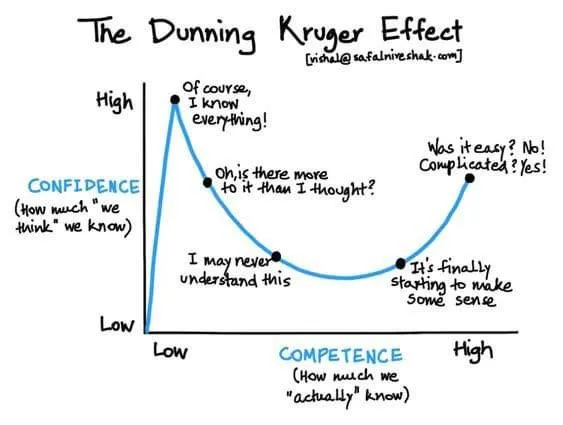
The most common popular depiction shows a curve with a "peak of Mount Stupid" at low knowledge, a "valley of despair" as knowledge increases, and a gradual ascent to "enlightened competence." This chart is not in Dunning and Kruger's paper.
It does not represent their findings. The original paper measured overconfidence at low performance levels; it did not plot a complete trajectory from novice to expert.
The real finding was more specific: low performers overestimate their relative percentile rank on specific tasks. This is not the same as claiming that beginners are always supremely confident or that gaining a little knowledge makes people maximally overconfident.
"Everyone Else Is Dunning-Kruger Except Me"
The effect has become weaponized in online arguments as a way of dismissing people whose opinions you disagree with: "You're exhibiting Dunning-Kruger." This usage is almost always incorrect. The effect describes specific overconfidence in specific skills, measured against actual performance data.
Invoking it as a rhetorical dismissal is itself a form of overconfident misapplication - arguably fitting the pattern it claims to diagnose.
It Is Not About Intelligence
The Dunning-Kruger effect is domain-specific. Someone can be highly skilled and well-calibrated in their professional domain while being a low-skilled, overconfident novice in an unrelated area. A brilliant surgeon may be wildly overconfident about monetary policy.
An expert economist may be confidently wrong about vaccine mechanisms. The effect says nothing about intelligence in general; it describes the relationship between skill and self-assessment within specific domains.
The Effect Does Not Mean Beginners Are Useless
A subtler misreading of the research is the idea that novice contributions should always be discounted because novices cannot recognize their incompetence. This is not what the research supports.
Novice enthusiasm, including overconfident novice enthusiasm, has been the engine behind many genuine innovations, particularly when domain experts have calcified around existing approaches.
The Dunning-Kruger effect describes a calibration error, not a reliability floor. Novices can be right about things; they are simply overconfident about how often they are right.
The Replication Debate
Like many findings from social psychology, the Dunning-Kruger effect has faced scrutiny in the era of the replication crisis. The debate is nuanced.
The Statistical Critique
Several researchers have argued that part of the Dunning-Kruger pattern can be explained by statistical artifacts rather than genuine psychological mechanisms.
The most technically sophisticated challenge came from Gilles Gignac and Marcin Zajenkowski in a 2020 paper, and separately from work by Nuhfer, Cogan, and colleagues.
The central argument: when you ask people to estimate their percentile rank on a test, the observed pattern - low scorers overestimating, high scorers underestimating - can emerge purely from the mathematical structure of the data, even without any underlying psychological mechanism.
This is related to a phenomenon called regression to the mean: extreme low scores have more room to be overestimated, and extreme high scores have more room to be underestimated, simply because both ends of the scale are bounded.
If performance and self-assessment are imperfectly correlated (as they always are), the observed Dunning-Kruger pattern can appear as a mathematical artifact.
Nuhfer et al. (2016) published a particularly pointed version of this critique in the journal Numeracy, using a large dataset of 1,154 students across multiple universities.
When they analyzed their data using methods that did not confound the measurement of performance with the measurement of self-assessment (by using absolute rather than relative self-estimates), the dramatic overconfidence at the low end largely disappeared.
Their paper argued that the original Dunning-Kruger effect, as typically depicted, is substantially a product of how the data are analyzed rather than a robust psychological phenomenon.
The Defense
Dunning has responded to these critiques by arguing that the statistical artifact explanation is not sufficient to explain the full magnitude of the overestimation observed in the original studies and subsequent replications.
The sheer degree of mismatch - bottom-quartile performers believing they are above average - cannot be fully explained by regression to the mean alone.
Dunning also points to converging evidence from different methodologies. Studies using different self-assessment formats, different domains, and different populations have produced broadly consistent findings.
Research on overconfidence among beginners has found that low performers consistently showed less accurate self-assessments than high performers, even when alternative statistical explanations were controlled for.
The effect size was smaller than the original paper suggested, but it was still present.
What the Current Evidence Actually Supports
The honest assessment, as of the mid-2020s:
| Claim | Evidence Status |
|---|---|
| Low performers overestimate their relative rank | Robustly replicated |
| The mechanism is metacognitive deficit (can't evaluate what you can't do) | Plausible but not definitively proven |
| The "Mount Stupid" curve with peak at slight competence | Not supported by original research |
| The pattern is entirely explained by statistical artifacts | Contested; probably partially true |
| High performers underestimate their relative standing | Replicated, though smaller effect |
| Training in a domain improves self-assessment accuracy | Supported by multiple studies |
The conservative conclusion: there is a real tendency for lower-performing people to be less accurate (not necessarily more confident) in their self-assessments, and this is partially explained by the mechanism Dunning and Kruger proposed and partially by statistical properties of self-assessment data.
The dramatic, cartoon version of the effect is an oversimplification.
Why We Misremember Our Own Incompetence
One of the most interesting aspects of the effect is what happens as people gain competence: they often become better at remembering how confused they were as beginners. But in the moment of incompetence, that perspective is unavailable.
This is sometimes called the curse of knowledge in reverse: experts cannot easily remember what it felt like not to know what they now know. But beginners are living that state and cannot see it. They have no reference point for what competence in this domain feels like.
Research on learning and expertise suggests that one of the most important transitions in skill development is the shift from unconscious incompetence (you don't know what you don't know) to conscious incompetence (you know what you don't know). That transition requires encountering someone or something that reveals the gap.
The Four Stages of Competence
The four-stage competence model, attributed to psychologist Abraham Maslow and later Gordon Training International (though its precise origin is debated), maps neatly onto the Dunning-Kruger research:
- Unconscious incompetence: You don't know what you don't know. Performance is poor and self-assessment is uncalibrated. This is the Dunning-Kruger zone.
- Conscious incompetence: You've encountered enough of the domain to know what you're missing. Confidence dips, sometimes sharply, as the gap between your skill and the required standard becomes visible.
- Conscious competence: You can perform well, but it requires deliberate effort. You know enough to evaluate your own performance reasonably accurately.
- Unconscious competence: Skilled performance becomes automatic. Paradoxically, at this stage articulating what you know becomes difficult again: the expert blind spot can re-emerge.
The Dunning-Kruger effect is a Stage 1 phenomenon. Crucially, the movement from Stage 1 to Stage 2 often feels like getting worse, because conscious awareness of deficiencies replaces comfortable obliviousness.
This is why the experience of learning a complex skill often involves a morale dip at intermediate stages: the moment you are good enough to see how much you are still missing.
Real-World Examples
Medical Self-Diagnosis
Studies on medical self-assessment consistently find that laypeople with limited medical knowledge are more confident in their self-diagnoses than medically trained people evaluating the same cases.
A 2013 study in Medical Education found that first-year medical students, despite knowing far less than senior clinicians, expressed higher confidence in their diagnostic conclusions. More education reliably produced more calibrated uncertainty.
A related phenomenon has been documented in patient self-assessment of medication adherence. Patients in studies by DiMatteo et al. (2002) consistently overestimated their own compliance with prescribed medication regimens when compared to pharmacy refill records.
The overestimation was largest among patients with the lowest actual adherence - consistent with the metacognitive failure mechanism, where those least engaged with their health management also had the least accurate models of their own behavior.
Stock Market Investors
Behavioral finance research has documented significant overconfidence among amateur investors. A landmark study by Barber and Odean (2000) found that the most actively trading individual investors - who presumably felt most confident in their stock-picking ability - earned significantly lower returns than passive investors.
Men traded 45% more than women and earned returns 1.4 percentage points lower per year, a difference the researchers attributed to overconfidence.
The effect persists even when controlling for wealth and experience. Grinblatt and Keloharju (2009), in a study of Finnish investors using comprehensive registry data covering 158,044 individuals, found that overconfident investors - identified by high trading frequency and a history of taking on more risk - underperformed their more cautious counterparts by statistically significant margins over multi-year periods.
The Dunning-Kruger interpretation here is sobering: the investors most actively managing their portfolios, and presumably most confident in their analytical skill, had the most inflated sense of their comparative advantage - and paid for it in returns.
Political Knowledge
A 2014 study of public knowledge about US interventions in Ukraine found that the less informed respondents were (measured by ability to locate Ukraine on a map), the more confident and extreme their policy preferences were.
Most respondents could not locate Ukraine on a map, yet the farther they placed it from its actual location, the more they tended to favor US military intervention.
A broader pattern was documented by Fernbach, Rogers, Fox, and Sloman (2013) in Psychological Science, examining what they called the illusion of explanatory depth in political beliefs.
Participants who held strong opinions about complex policies - the Affordable Care Act, a cap-and-trade emissions system, a flat tax - were asked to explain, in mechanistic detail, how those policies actually worked.
Most could not. When forced to confront their failure to explain, their confidence in their opinions dropped substantially.
The findings pointed to a specific form of the Dunning-Kruger dynamic: political overconfidence driven by an inability to distinguish having an opinion from understanding the underlying system.
Performance Reviews in Organizations
A meta-analysis by Harris and Schaubroeck (1988), examining 3,186 pairs of self-ratings and supervisor ratings across 55 studies, found that self-ratings of job performance consistently exceeded supervisor ratings. The gap was larger in domains where performance was harder to objectively measure, and larger for lower-performing employees.
More recent work by Zenger and Folkman (2022), drawing on 360-degree feedback data from over 69,000 managers, found that the bottom quartile of performers rated themselves in the 55th percentile on average - nearly identical to the inflation ratios observed in the original Dunning-Kruger laboratory studies.
Cross-Cultural Evidence
One important question about the Dunning-Kruger effect is whether it is universal or culturally specific. Much of the foundational research used Western, educated, individualistic samples.
Ehrlinger and colleagues extended the research across cultural contexts in 2008, comparing American and Japanese samples on multiple self-assessment tasks. They found the classic pattern in American samples but a more attenuated version in Japanese participants.
This is consistent with the broader literature showing that East Asian cultural norms place more emphasis on self-improvement and modesty, which tends to produce underconfidence in self-assessments relative to actual performance rather than overconfidence.
The Dunning-Kruger effect may therefore be stronger in individualistic, self-promotion-oriented cultures where confident self-presentation is socially rewarded.
This does not eliminate the phenomenon but it does suggest that cultural context modulates its magnitude - and that the effect cannot be treated as a fixed feature of human cognition independent of social environment.
Practical Implications
Understanding the Dunning-Kruger effect has concrete applications, even after accounting for the statistical critiques.
For Individuals
The most reliable counter to overconfidence in any domain is calibration: actively seeking feedback on your performance relative to others and comparing your predictions to outcomes. People who keep track of their predictions and review their accuracy over time become significantly better calibrated than those who do not.
Superforecasters - the highly accurate political and economic forecasters studied by Philip Tetlock in his Superforecasting research - are distinguished not by exceptional intelligence or access to information but by their disciplined practice of tracking their predictions, scoring their accuracy, and actively updating their models when wrong.
Tetlock's research involving 20,000 forecasters over multiple years found that the most accurate forecasters updated their beliefs roughly twice as often as average forecasters in response to new information, and were substantially better at identifying the domains where they had genuine edge versus domains where they were guessing.
A second approach is actively seeking out experts in the domain and paying attention to what they find difficult or uncertain. If experts acknowledge significant uncertainty about something you find obvious, that is a strong signal that you are missing complexity.
Finally, look for the moment when a domain stops feeling simple. Genuine beginners often find a new field exciting and manageable. As expertise develops, the field starts to look more complicated, not less. That increasing sense of complexity is often a sign that you are moving in the right direction.
For Organizations
Organizations can reduce the damage from overconfident low performers through structural mechanisms rather than attempting to change individual psychology.
Pre-mortems require teams to assume a project has failed and to generate reasons why before it begins. This surfaces the low-confidence signals that overconfident participants might otherwise suppress.
Gary Klein, who pioneered the pre-mortem technique, found that it increased the identification of potential problems by approximately 30% compared to standard planning processes.
Anonymous input mechanisms remove the social incentive to perform confidence. When contributions are anonymous, there is less pressure to sound certain and less social risk in expressing doubt.
Structured decision processes that require explicit evidence and reasoning make the quality of thinking visible, reducing the degree to which confident delivery can substitute for accurate analysis.
Separating idea generation from evaluation - having different people propose and assess - reduces the risk that the person most confident in their idea controls its evaluation.
Calibration training - explicitly teaching people to match their confidence levels to their accuracy rates, using scored prediction exercises - has been shown to improve decision quality in military, intelligence, and medical contexts.
Studies of calibration training with physicians (Poses et al., 1990) found improvements in both diagnostic accuracy and confidence calibration that persisted at six-month follow-up.
The Role of Feedback Quality
A frequently overlooked aspect of the Dunning-Kruger effect is that it is most severe in environments with poor feedback loops. When performance is rarely measured, when feedback is delayed, vague, or absent, and when there are social penalties for delivering accurate criticism, the conditions for sustained overconfidence are maximized.
Dunning has argued in later work that feedback quality is as important as raw cognitive ability in producing calibrated self-assessment.
Professions with immediate, objective, and repeated feedback - surgeons who see patient outcomes, salespeople whose numbers are tracked daily, chess players whose ratings update after every game - tend to produce better-calibrated practitioners over time than professions where performance feedback is rare, subjective, and socially filtered.
This has implications for how organizations design performance management: not as an annual review ritual but as a system of frequent, objective, and actionable feedback that creates the conditions for genuine calibration to occur.
The Meta-Point: Who Gets to Apply This Concept?
One final, uncomfortable observation: the Dunning-Kruger effect is most frequently invoked by people who are confident they are not subject to it. The irony is built in. Someone who does not understand the research cites it to dismiss others, which fits the pattern they are claiming to diagnose.
The useful version of the Dunning-Kruger insight is not a hammer to hit others with. It is a prompt for self-examination: In which domains am I most confident? In those same domains, how much feedback have I actually gotten on my performance? How does my confidence compare to my measurable track record?
The answer, for most people in most areas, is humbling. Which may be the most practical takeaway from a body of research that, even with its methodological debates, points consistently at the same fundamental truth: knowing what you do not know is hard, and the less you know, the harder it is.
The deepest version of the Dunning-Kruger insight is not about incompetent people overestimating themselves.
It is about the near-universal structure of human self-knowledge: we evaluate ourselves using the same cognitive tools we use to perform, and when those tools are underdeveloped, both performance and self-evaluation are compromised simultaneously.
This means the question is not whether you are subject to the effect - you almost certainly are in some domain - but which domains those are, and how to build the feedback structures that make calibration possible.