
"The evidence is clear: external control of human behavior is at best a short-term solution and often undermines the very motivation it is designed to produce." - Edward Deci and Richard Ryan, 1985
In the winter of 1969, Edward Deci, then a doctoral student at Carnegie Mellon University, set up an experiment that looked almost trivially simple.
He brought undergraduate students into a laboratory one at a time and had them work on Soma puzzles - intricate, three-dimensional plastic blocks that can be assembled into hundreds of different shapes.
Most people find these puzzles genuinely absorbing. In the first session, all participants worked on them without any external inducement.
In the second session, one group received a dollar per solved puzzle while the other continued without payment. In the third session, payment stopped for everyone.
Crucially, during each session there was a midpoint "break" in which the experimenter left the room on a pretext, leaving the participant alone with the puzzles and some magazines.
The real dependent variable was what the participants chose to do during those unobserved free-choice intervals.
The results, published in the Journal of Personality and Social Psychology in 1971, were arresting.[1] Students who had never been paid continued to engage with the puzzles during free time at roughly the same rate across all three sessions.
Students who had been paid in session two and then unpaid in session three showed a marked drop - they spent less free time with the puzzles in session three than they had in session one, before payment had ever been introduced.
The reward had not added to their motivation; it had partially displaced and then eroded it.
Deci called this the "undermining effect" of external rewards on intrinsic motivation, though it would later become widely known as the overjustification effect: a surplus of external justification for an activity paradoxically weakens the internal justification a person had been relying on all along.
This single finding, modest as it seemed in 1971, cracked open one of the most productive research programs in twentieth-century psychology.
Over the next three decades, Deci - joined by his University of Rochester colleague Richard Ryan - built a comprehensive macro-theory of human motivation, personality, and well-being: Self-Determination Theory (SDT).
Its central claim is deceptively straightforward. People are not passive systems waiting to be activated by incentives.
They are active, growth-oriented organisms with three fundamental psychological needs, and the degree to which their social environments support versus thwart those needs predicts, with remarkable consistency, the quality of their motivation, the depth of their engagement, and the sustainability of their well-being.
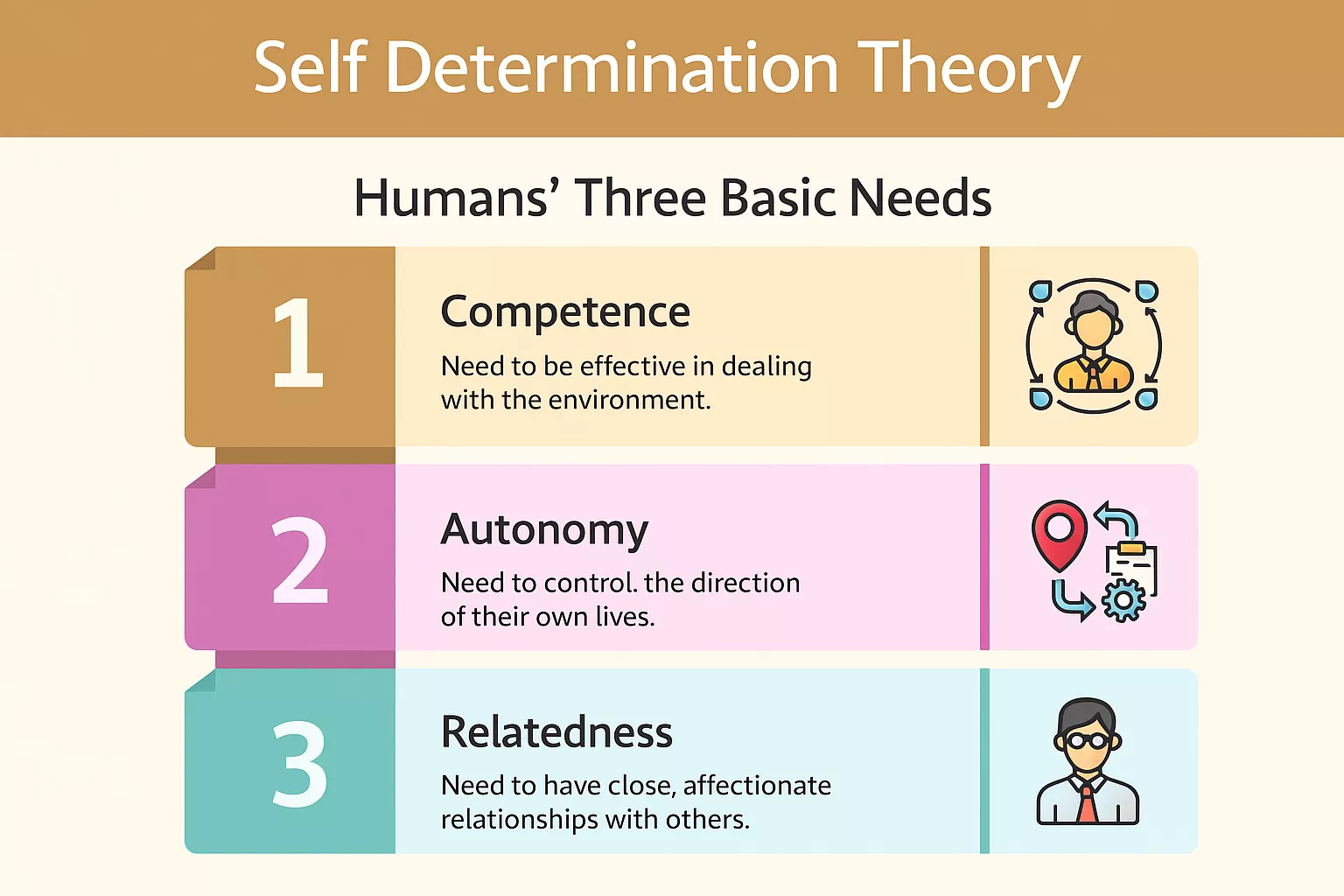
The Three Basic Psychological Needs
SDT is built on the proposition that human beings have three innate and universal psychological needs. Unlike preferences, which vary by culture and biography, these needs are argued to be organismic requirements - their satisfaction produces growth and vitality, their frustration produces ill-being.
The theory makes sharp predictions about contexts: environments that support all three needs will consistently produce better motivational outcomes than environments that undermine them, regardless of domain.
| Need | Definition | Satisfied When | Thwarted When |
|---|---|---|---|
| Autonomy | The sense that one's actions are self-initiated and volitionally endorsed - that one is the author of one's own behavior | Given choices, rationale for rules, minimal pressure; internal locus of causality | Controlled through surveillance, contingent rewards, threats, demands without rationale |
| Competence | The sense that one can produce desired outcomes and avoid undesired ones - mastery and effectance | Given optimal challenges, constructive feedback, opportunities for skill growth | Exposed to tasks too hard or too easy; given negative evaluative feedback without support |
| Relatedness | The sense of being meaningfully connected to others - caring and being cared for | Embedded in warm, genuine relationships; felt understanding and belonging | Isolated, rejected, treated instrumentally, or relating only in competitive contexts |
Cognitive Evaluation Theory: The Mechanism Behind Undermining
Deci's 1971 finding raised an immediate question: what is the psychological mechanism by which rewards damage intrinsic motivation?
This question motivated the first of SDT's several sub-theories - Cognitive Evaluation Theory (CET), developed through the 1970s and formally articulated in Deci and Ryan's landmark 1985 book, Intrinsic Motivation and Self-Determination in Human Behavior, published by Plenum Press.[2]
CET proposes that the effects of any external event on intrinsic motivation depend on how that event affects a person's perceived locus of causality and perceived competence.
When a reward is experienced as controlling - as a mechanism that shifts the perceived cause of behavior from the self to the environment - it moves the perceived locus of causality from internal to external, and intrinsic motivation falls.
When an event is experienced as informational - as feedback that confirms competence without implying external control - it supports the sense of competence and may actually enhance intrinsic motivation.
This functional distinction between the controlling and informational aspects of external events explains a range of otherwise puzzling findings.
Verbal praise, for instance, is a form of external reward, yet meta-analyses show that it does not undermine intrinsic motivation in the way that contingent monetary payments do - because verbal praise, when genuine, tends to be processed as informational rather than controlling.
Conversely, surveillance and imposed deadlines, even without any material reward, reduce intrinsic motivation because they shift the perceived locus of causality toward external pressure. The architecture of the social environment, not just its rewards, shapes motivation.
CET was extensively tested through the 1970s and 1980s in laboratories across multiple countries.
In one influential line of work, Ryan (1982) demonstrated that competence-affirming feedback enhanced intrinsic motivation even when delivered by an experimenter, while feedback framed in evaluative and controlling language undermined it - establishing that the same informational content can have opposite motivational effects depending on the interpersonal tone in which it is delivered.[3]
This "interpersonal context" finding proved especially consequential for applications in education and management.
Organismic Integration Theory: The Internalization Continuum
For most of its early history, SDT research focused on the contrast between intrinsic motivation and the absence of it. But the theory's most practically important contribution may be its account of what lies between those poles. Not all externally initiated behavior is equally alienated from the self.
People can be induced to perform a behavior for external reasons and yet, over time, come to endorse and genuinely value it. SDT calls this process internalization, and it is the subject of the second major sub-theory: Organismic Integration Theory (OIT).
OIT posits that externally regulated behavior exists on a continuum of relative autonomy, and that movement along this continuum represents genuine psychological transformation, not merely a change in verbal report.
The internalization continuum, as formally presented by Ryan and Deci (2000) in their overview article in Psychological Inquiry, comprises:[5]
External regulation - behavior performed solely to obtain a reward or avoid a punishment. The regulation is entirely outside the self; remove the contingency and the behavior stops.
Introjected regulation - behavior performed because the person has partially taken in the regulation but has not fully accepted it as their own. The person acts to avoid guilt or shame, or to maintain ego-esteem.
The pressure is now internal, but it still feels like pressure; the person acts to appease an internal critic rather than to express a genuine value.
Identified regulation - behavior performed because the person consciously values the goal or outcome, even if the activity itself is not inherently enjoyable. A student who does not love statistics but genuinely cares about becoming a researcher will study statistics with identified regulation.
The behavior is experienced as personally important.
Integrated regulation - the most autonomous form of extrinsic motivation, reached when an identified regulation has been assimilated with the person's other values and sense of self.
Integrated motivation resembles intrinsic motivation in its quality but differs in that the behavior is still instrumental - performed for its valued outcomes - rather than inherently satisfying.
A physician who stays late to review a difficult case not because they enjoy paperwork but because caring for patients is central to their identity is operating from integrated regulation.
The empirical signature of higher internalization - identified and integrated regulation as opposed to external and introjected - is a cluster of outcomes that includes greater persistence, more flexible and creative engagement, better subjective well-being, and reduced burnout.
The boundary between extrinsic motivation types, in other words, is not merely conceptual: it is measurably consequential.
Cognitive Science: Researchers, Findings, and the Empirical Record
Gagné and Deci: SDT in the Workplace
The most comprehensive application of SDT to organizational behavior came in Marylène Gagné and Edward Deci's 2005 synthesis in the Journal of Organizational Behavior.[6]
Reviewing experimental and field research across multiple industries, Gagné and Deci demonstrated that managerial styles supporting employee autonomy - providing rationale for tasks, acknowledging employee perspectives, minimizing pressure and control - consistently produced higher levels of internalized motivation, greater job satisfaction, and better performance on complex work.
Critically, the effect of autonomy-supportive management on performance was mediated by workers' satisfaction of all three basic needs: managers who supported autonomy also tended to provide structures that supported competence and relationships that supported relatedness.
The practical implication ran counter to the dominant managerial assumption that control produces output: the evidence consistently showed that control produced compliance but undermined the autonomous motivation that drives discretionary effort and innovation.
Vansteenkiste and SDT in Education
Maarten Vansteenkiste and colleagues conducted extensive research on SDT's predictions in educational settings, much of it published in the Journal of Educational Psychology through the 2000s and 2010s.
In a representative 2004 study with Belgian high school students, Vansteenkiste, Simons, Lens, Sheldon, and Deci experimentally varied the framing of a learning activity - presenting the same content either in terms of its intrinsic value (deepening understanding, connecting to genuine curiosity) or its extrinsic value (outperforming peers, avoiding failure).[12]
Students in the intrinsic-framing condition showed deeper processing, better retention, greater persistence, and higher performance on subsequent assessments.
The findings replicated across cultures and age groups, and they pointed specifically to the role of the teacher's communication style as a variable that could be modified without changing the curriculum.
Vansteenkiste's subsequent work on autonomy-supportive teaching - a style that involves taking the student's perspective, providing choice where possible, offering explanatory rationale for required tasks, and avoiding pressure and control - established this as a teachable intervention.
Teachers trained in autonomy-supportive techniques produced measurable improvements in student engagement and learning outcomes compared to teachers trained in more directive, controlling styles.
Sheldon and Kasser: Goal Pursuit and Well-Being
Kennon Sheldon and Tim Kasser published a series of studies through the late 1990s and 2000s examining the relationship between goal content and structure and psychological well-being.[7]
In their 1995 paper in the Journal of Personality and Social Psychology, they demonstrated that people who organized their personal goals around intrinsic aspirations - growth, relationships, community contribution - reported greater well-being than people who organized their goals around extrinsic aspirations - wealth, fame, image.
Crucially, the critical variable was not how much of the aspiration was achieved but rather the content of what was being pursued.
In a 1998 paper, Sheldon and Kasser extended this to the autonomy of goal pursuit: even when goals were extrinsic in content, people who pursued them with higher degrees of autonomous motivation (identified and integrated regulation) showed better well-being outcomes than those who pursued them with controlled motivation.[8]
Goal content and motivational quality, in other words, are partially independent predictors of well-being, each contributing unique variance. This distinction between what you pursue and why you pursue it has become one of SDT's most practically useful insights.
Cross-Cultural Evidence: Chirkov et al. 2003
A persistent critique of autonomy as a basic need was that it reflected a culturally specific, Western, individualist value - that people in collectivist cultures might genuinely function better under higher external control.
Valery Chirkov, Richard Ryan, Youngmee Kim, and Ulas Kaplan addressed this directly in a 2003 study published in the Journal of Personality and Social Psychology.[9]
Sampling participants from South Korea, Russia, Turkey, and the United States, they examined the relationship between autonomy in cultural practices and well-being within each cultural context.
The finding was consistent across all four cultures: regardless of whether individuals endorsed individualist or collectivist values, the degree to which they experienced their conformity to cultural practices as autonomously chosen versus externally imposed predicted their psychological well-being.
People in collectivist cultures who genuinely endorsed and internalized their cultural roles were psychologically better off than those who conformed from external pressure or introjection - even when the behavior being performed was identical.
This distinction between what culture one inhabits and how one inhabits it has become the standard SDT response to the cultural universality challenge.
Intellectual Lineage
SDT did not emerge from a vacuum. Its intellectual genealogy runs through several traditions that Deci and Ryan explicitly engaged with and synthesized.
The most proximate influence was the humanistic psychology of Abraham Maslow and Carl Rogers.
Maslow's needs hierarchy (1943) established the conceptual template of innate psychological needs whose satisfaction is necessary for growth, and Rogers' (1963) concept of organismic valuing - the idea that organisms have an inherent tendency to move toward conditions of growth - provided the biological grounding for treating autonomy, competence, and relatedness as requirements rather than preferences.
SDT is, in part, humanistic psychology subjected to the discipline of experimental method.
From the cognitive tradition, Deci drew on Fritz Heider's (1958) work on perceived locus of causality in attribution theory and on de Charms' (1968) concept of personal causation - the distinction between being a pawn moved by external forces and an origin initiating action from within.
The shift from behaviorist terminology (reinforcement schedules, contingencies) to cognitive terminology (perceived control, internal causation) was not just semantic: it changed what variables researchers measured and what interventions they designed.
From developmental psychology, SDT inherited and formalized the concept of internalization from psychoanalytic tradition, but stripped it of its conflict-based framing.
Where Freud saw internalization as the defensive incorporation of external demands, SDT conceptualizes it as an active organismic process of integration - moving regulations from external to internal not through defense but through the satisfaction of relatedness and competence needs within supportive social contexts.
The work of Richard deCharms on intrinsic versus extrinsic orientation in classrooms (1976) provided a precursor to the educational applications developed by Vansteenkiste and colleagues.
Limits, Critiques, and Nuances
The Eisenberger and Cameron Challenge
The most technically serious challenge to CET's core claim came in a 1996 meta-analysis by Robert Eisenberger and Judy Cameron in American Psychologist.[10]
Analyzing 96 studies, they reported that the undermining effect of rewards on intrinsic motivation was limited to specific conditions: tangible, expected, and non-contingent rewards did undermine motivation, but performance-contingent rewards - rewards delivered specifically for attaining a high standard - did not reliably show the effect and in some conditions appeared to enhance it.
Eisenberger and Cameron argued that the undermining effect had been overgeneralized and that the evidence for it was weaker and more conditional than SDT's advocates maintained.
Deci, Koestner, and Ryan responded in 1999 with their own meta-analysis, also published in Psychological Bulletin, covering 128 studies.[11]
This analysis largely confirmed that the undermining effect is real and robust for tangible, expected, and task-contingent rewards - the kind most commonly deployed in organizational and educational incentive systems - while acknowledging that verbal rewards (praise) and performance-contingent rewards show more complex and sometimes neutral or positive effects.
The debate clarified the boundary conditions of CET without dismantling its core claims, and it established that the practical import of the undermining effect depends heavily on the specific design of the incentive system in question.
Conceptual and Measurement Challenges
A second line of critique concerns the operationalization of autonomy as a need versus autonomy as a value. The Chirkov et al.
cross-cultural evidence argued for universality, but critics such as Hagger and Chatzisarantis noted that the measures of need satisfaction frequently used in SDT research - the Basic Psychological Needs Scale and its variants - were developed largely with Western samples and may not translate cleanly across cultural and linguistic contexts without modification.
The distinction between identified and integrated regulation has also attracted scrutiny.
In practice, self-report measures show these two regulatory styles to be highly correlated, raising questions about whether they represent psychologically distinct states or points on a continuous dimension that is difficult to differentiate in survey data.
Ryan and Deci have maintained that the distinction is theoretically important and can be operationalized in longitudinal research and experimental contexts even when cross-sectional survey items fail to separate them cleanly.
Autonomy Support vs. Structure
A more nuanced complication concerns the relationship between autonomy support and the provision of structure.
Early presentations of SDT were sometimes read as implying that less structure, fewer rules, and more choice always produce better outcomes - a reading that produced predictable criticisms from educators and managers who found that complete permissiveness produced disorientation rather than engagement.
SDT's formal position is that autonomy support and structure are orthogonal dimensions: optimal environments provide both a clear structure and the autonomy to navigate within it.
The empirical evidence supports this distinction. Teachers who provide both structure and autonomy support outperform those who provide either alone. This nuance has been incorporated into SDT's basic psychological needs theory but has not always been clearly communicated in popular treatments of the research.
Empirical Research: The Durability of the Core Claims
The empirical base supporting SDT has grown substantially since Deci's 1971 experiment, spanning domains from physical health behavior to sport, romantic relationships, and prosocial conduct.
In clinical research, Geoffrey Williams and colleagues demonstrated through randomized controlled trials that autonomy-supportive clinical interactions - in which healthcare providers acknowledge patient perspectives and provide rationale rather than issuing directives - produced better adherence to diabetes and cardiovascular disease management protocols.
The effect was mediated by patients' autonomous motivation for health behavior, confirming the basic SDT model of how autonomy support translates into well-being outcomes.
Ryan and Deci's (2000) review article in American Psychologist, which synthesized two decades of SDT research across domains, has become one of the most cited papers in psychological science.[4]
It established SDT not as a laboratory curiosity but as a framework with generative applications wherever human motivation matters - which is to say, nearly everywhere.
The framework's unusual combination of breadth and specificity - it makes clear, falsifiable predictions about the conditions under which motivation will flourish or wither - has made it more durable than more general accounts of motivation that are difficult to test directly.
The theory is not complete. Its account of how organisms integrate conflicting values, how relatedness needs interact with the drive for autonomy in intimate relationships, and how need satisfaction in one domain spills over into others remains an active research frontier.
But as a framework for understanding why some forms of motivation reliably sustain human growth and why others reliably corrode it, Self-Determination Theory has earned its central place in the science of mind and behavior.
Sources & Further Reading
Deci, E. L. (1971). Effects of externally mediated rewards on intrinsic motivation. Journal of Personality and Social Psychology, 18(1), 105-115.
Deci, E. L., & Ryan, R. M. (1985). Intrinsic motivation and self-determination in human behavior. Plenum Press.
Ryan, R. M. (1982). Control and information in the intrapersonal sphere: An extension of cognitive evaluation theory. Journal of Personality and Social Psychology, 43(3), 450-461.
Ryan, R. M., & Deci, E. L. (2000). Self-determination theory and the facilitation of intrinsic motivation, social development, and well-being. American Psychologist, 55(1), 68-78.
Ryan, R. M., & Deci, E. L. (2000). The darker and brighter sides of human existence: Basic psychological needs as a unifying concept. Psychological Inquiry, 11(4), 319-338.
Gagné, M., & Deci, E. L. (2005). Self-determination theory and work motivation. Journal of Organizational Behavior, 26(4), 331-362.
Sheldon, K. M., & Kasser, T. (1995). Coherence and congruence: Two aspects of personality integration. Journal of Personality and Social Psychology, 68(3), 531-543.
Sheldon, K. M., & Kasser, T. (1998). Pursuing personal goals: Skills enable progress, but not all progress is beneficial. Personality and Social Psychology Bulletin, 24(12), 1319-1331.
Chirkov, V., Ryan, R. M., Kim, Y., & Kaplan, U. (2003). Differentiating autonomy from individualism and independence: A self-determination theory perspective on internalization of cultural orientations and well-being. Journal of Personality and Social Psychology, 84(1), 97-110.
Eisenberger, R., & Cameron, J. (1996). Detrimental effects of reward: Reality or myth? American Psychologist, 51(11), 1153-1166.
Deci, E. L., Koestner, R., & Ryan, R. M. (1999). A meta-analytic review of experiments examining the effects of extrinsic rewards on intrinsic motivation. Psychological Bulletin, 125(6), 627-668.
Vansteenkiste, M., Simons, J., Lens, W., Sheldon, K. M., & Deci, E. L. (2004). Motivating learning, performance, and persistence: The synergistic effects of intrinsic goal content and autonomy-supportive context. Journal of Personality and Social Psychology, 87(2), 246-260.