
Efficacy: In the spring of 1977, Albert Bandura published a paper in Psychological Review that would reshape the way psychologists understood human motivation, therapeutic change, and behavioral persistence.
The paper was titled "Self-Efficacy: Toward a Unifying Theory of Behavioral Change," and its central claim was at once simple and radical: the most important factor determining whether people initiate action, how hard they try, and how long they persist in the face of difficulty is not their actual ability, not the objective difficulty of the task, and not the concrete consequences that await them.
It is their belief that they are capable of executing the behavior required to produce the outcome they want.
Bandura arrived at this claim through a research program on snake phobias that had begun years earlier.
In a series of controlled studies, he and his colleagues treated people with severe ophidiophobia - debilitating fear of snakes that prevented them from walking through parks, doing yard work, or living normal lives - using different therapeutic approaches.
The centerpiece of these studies was participant modeling, in which a therapist demonstrated handling a snake, then guided the patient through progressively closer contact, building up to direct handling.
What Bandura observed, and what the data consistently confirmed, was that different therapeutic approaches did not differ primarily in how much they reduced fear. They differed in how much they altered patients' beliefs about their own capability to cope.
Patients who emerged from treatment believing they could handle snakes - and by extension, believing they could manage their own anxiety responses - showed not merely reduced avoidance of snakes but improved functioning across unrelated threat domains.
The mechanism, Bandura argued, was not the extinction of fear but the construction of a new self-referent belief: the conviction that one possesses the capability to execute the coping behaviors the situation demands.[1] He called this conviction self-efficacy.
What made the 1977 paper a landmark was not just its empirical base but its theoretical ambition.
Bandura proposed self-efficacy as a unifying mechanism - a common pathway through which different therapeutic techniques, different environmental experiences, and different sources of psychological information all produced their behavioral effects.
Whether a person improved through direct experience, through watching others succeed, through verbal encouragement from a credible authority, or through altered awareness of their own physiological responses, the behavioral change ultimately passed through the same cognitive bottleneck: a revised belief about personal capability.
This was an explanatory framework with reach far beyond snake phobia, and the subsequent decades proved it.
"People's beliefs about their capabilities to produce designated levels of performance have a profound effect on the outcomes they achieve." - Albert Bandura, 1997[3]
The Four Sources of Self-Efficacy Information
Bandura identified four distinct sources through which self-efficacy beliefs are developed and modified. They differ substantially in mechanism, psychological strength, durability, and how they translate into practical applications.
| Source | Mechanism | Strength | Durability | Practical Applications |
|---|---|---|---|---|
| Mastery Experiences | Direct performance accomplishment; the person completes the relevant behavior and observes their own success | Strongest of the four sources; success provides direct, unambiguous evidence of capability | Most durable, particularly when success is achieved through genuine effort against real challenge rather than trivially easy tasks | Graduated task design, scaffolded skill-building, progressive challenge in training and therapy; ensuring early wins on genuinely challenging material |
| Vicarious Modeling | Observing a similar other succeed at the task; social comparison provides inferential evidence ("if they can do it, I probably can too") | Moderate strength, highly dependent on perceived similarity to the model; fades if the observer concludes the model is fundamentally more capable | Moderately durable, more vulnerable to disconfirmation than mastery experiences; a single personal failure can undercut vicariously-derived efficacy | Mentorship programs, peer modeling, peer tutoring; selecting models who are similar in relevant characteristics to the observer |
| Social Persuasion | Credible others verbally communicate confidence in the person's capability | Moderate but fragile; easier to undermine than to build; a single credible negative evaluation can erase the effects of multiple positive ones | Low durability in isolation; persuasion-derived efficacy tends to deteriorate quickly if not supported by subsequent performance success | Coaching, feedback design, mentorship; must be paired with performance opportunities to have lasting effect |
| Physiological and Affective States | Interpretation of bodily arousal (heart rate, muscle tension, fatigue, anxiety symptoms) as signals of capability or incapacity | Weak in isolation but can be amplified or attenuated by attribution and context; the same physiological state can raise or lower efficacy depending on interpretation | Variable; depends on whether the person has developed stable interpretive frameworks for their arousal; biofeedback training can make this source more reliable | Arousal reappraisal training, biofeedback, anxiety management that reframes somatic symptoms as energy rather than threat; reducing aversive emotional states through relaxation training |
The hierarchy matters. Mastery experiences are not merely the strongest source but categorically different in kind from the others. Watching someone else succeed tells you something about what a person like you might be able to do. Being told you can do something tells you something about how a credible other assesses your capability.
Noticing that your heart is pounding tells you something about your physiological state. But actually doing the thing - actually completing the behavior under genuine challenge and emerging successful - tells you something about yourself, specifically and directly.
Bandura was consistent on this point across his 1977 paper, his 1986 book Social Foundations of Thought and Action, and his comprehensive 1997 monograph Self-Efficacy: The Exercise of Control: no other source of efficacy information is as powerful, as stable, or as resistant to disconfirmation as the direct experience of successful performance.
The Cognitive Science of Self-Efficacy
Bandura's Foundational Architecture
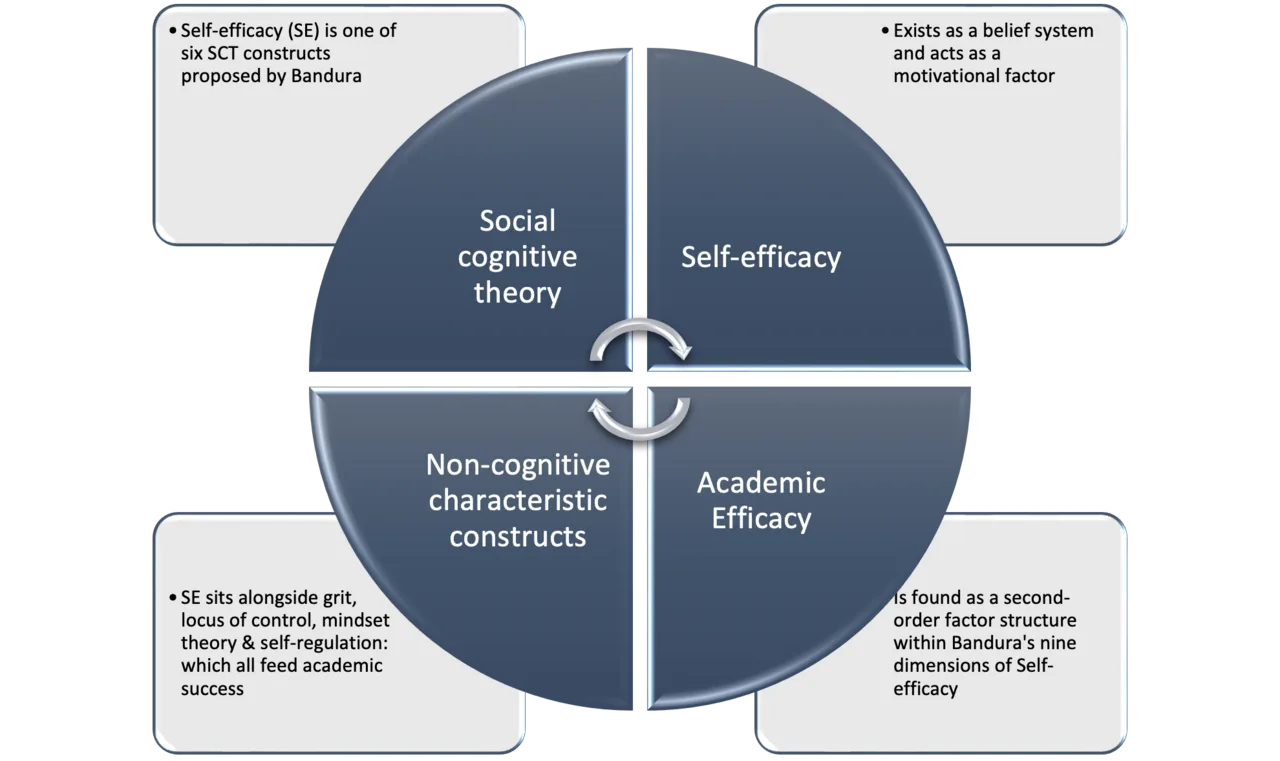
Bandura developed self-efficacy theory within the broader framework he called social cognitive theory, presented systematically in his 1986 book and elaborated in subsequent work.[2]
Social cognitive theory's core architectural concept is reciprocal determinism: the proposition that behavior, person variables (including cognition, affect, and biological characteristics), and environmental factors all mutually influence one another rather than any single factor determining the others.
Self-efficacy is the pivotal person variable in this triadic system. It shapes which environments a person enters, what behaviors they attempt, how much effort they invest, and how they respond to failure - and each of these behavioral consequences then generates new environmental feedback and new information that either confirms or revises the efficacy belief itself.
This reciprocal architecture has a critical implication: self-efficacy does not merely predict performance, it causally participates in producing it.
A person with high self-efficacy for mathematics will take on more difficult math problems, persist longer when they encounter difficulty, interpret errors as problems to be solved rather than evidence of incapacity, and therefore accumulate more mathematical mastery over time - which then further reinforces the efficacy belief.
A person with low mathematics self-efficacy will avoid difficult problems, withdraw earlier when they encounter difficulty, interpret errors as confirming evidence of incapacity, and therefore accumulate less mastery.
Two people with identical initial mathematical ability can diverge substantially over time because their self-efficacy beliefs created different patterns of engagement with mathematical experience.
Efficacy does not replace ability, but it dramatically amplifies or attenuates the translation of ability into performance.
Domain-Specificity: The Task-Specific Versus Generalized Distinction
One of the most theoretically important features of self-efficacy, emphasized throughout Bandura's work but sometimes lost in popular treatments, is its domain-specificity.
Self-efficacy is not a global trait - a general sense that one can handle whatever life throws - but a set of context-specific beliefs about capability for particular tasks in particular situations.
A person may have high self-efficacy for public speaking and low self-efficacy for interpersonal conflict resolution; high self-efficacy for long-distance running and low self-efficacy for strength training; high self-efficacy for quantitative analysis and low self-efficacy for expository writing.
This domain-specificity is what gives self-efficacy theory much of its predictive power, because it allows fine-grained prediction about behavior in specific domains rather than global predictions that wash out in aggregate measures.
Pajares and Miller, writing in the Journal of Educational Psychology in 1994, demonstrated that mathematics self-efficacy predicted mathematics performance more strongly than did mathematics self-concept or general academic self-efficacy, precisely because the specificity of the efficacy measure matched the specificity of the performance measure.
Researchers have also studied generalized self-efficacy - a broader belief in one's capacity to handle novel situations effectively - as a personality construct. Schwarzer and Jerusalem developed the General Self-Efficacy Scale, which has been validated across numerous languages and cultures.
But generalized self-efficacy functions differently from task-specific self-efficacy: it predicts behavior in novel, undefined situations where task-specific beliefs have not yet been formed, while task-specific efficacy is the stronger predictor when the task is familiar and well-defined.
Bouffard-Bouchard and Cognitive Performance
A particularly instructive study in the cognitive science of self-efficacy was conducted by Therese Bouffard-Bouchard in 1990, published in the Journal of Social Psychology.[7]
Bouffard-Bouchard manipulated students' self-efficacy beliefs experimentally by giving them false feedback about their performance on an initial task before assessing their actual cognitive performance on a subsequent problem-solving task.
Students told they had performed well - inducing higher self-efficacy - showed better monitoring of their own understanding, more effective use of cognitive strategies, greater persistence in the face of difficult problems, and ultimately higher performance than students told they had performed poorly, despite equivalent actual ability as measured by prior testing.
The study is significant because it provides experimental rather than merely correlational evidence that self-efficacy causally influences cognitive performance through identifiable mechanisms: altered strategy use, improved self-monitoring, and increased persistence.
It is not simply that high-efficacy people are better at the task; they approach the task differently in ways that make better performance more likely.
Stajkovic and Luthans: The Workplace Meta-Analysis
The most methodologically comprehensive examination of self-efficacy's predictive validity in applied settings came from Alexander Stajkovic and Fred Luthans in 1998, published in Psychological Bulletin.[5]
Their meta-analysis synthesized 114 studies examining the relationship between self-efficacy and work-related performance, covering diverse occupational domains from sales to managerial decision-making to technical task performance.
Stajkovic and Luthans found a mean weighted correlation of .38 between self-efficacy and work performance - a relationship stronger than that of any other motivational variable included for comparison, including goal difficulty, goal specificity, and outcome expectancies.
When they examined moderators, they found that the self-efficacy-performance relationship was stronger for tasks that were more complex and less routine - exactly what social cognitive theory predicts, because complex tasks involve greater choice about strategy, effort allocation, and persistence, all of which self-efficacy directly influences.
The Stajkovic and Luthans meta-analysis also highlighted an important qualification: self-efficacy's predictive power is moderated by actual ability. The relationship between efficacy and performance is strongest when ability is held relatively constant.
Heggestad and Kanfer, in a 2005 study published in the Journal of Applied Psychology, demonstrated that when ability varies substantially within a sample, it accounts for much of the variance in performance that self-efficacy would otherwise explain, and that in some high-ability samples, high self-efficacy without the corresponding ability can actually produce inferior performance relative to more calibrated self-assessment.[11]
This interaction between self-efficacy and ability is theoretically important and empirically non-trivial.
Four Named Case Studies
Case Study 1: Pajares and Academic Achievement
Frank Pajares built the most systematic program of research examining self-efficacy in academic settings, and his 1996 review in the Review of Educational Research - titled "Self-Efficacy Beliefs in Academic Settings" - remains the definitive synthesis of this literature.[6]
Pajares examined evidence across mathematics, writing, science, and general academic performance domains, and drew two conclusions with particular force.
First, self-efficacy is consistently among the strongest predictors of academic achievement, outperforming prior achievement, ability measures, and attitudinal variables in regression analyses when measures are calibrated at the appropriate level of specificity.
A student's belief in their capability to solve a specific type of equation predicts their performance on those equations more strongly than their general academic self-confidence or their liking for mathematics.
Second, and more subtly, self-efficacy beliefs in academic settings are frequently miscalibrated, and the direction of miscalibration matters.
Students who overestimate their competence slightly - who are mildly overconfident - tend to show better academic resilience than students who are well-calibrated, because mild overconfidence sustains effort through early difficulty while accurate awareness of genuine deficiency might rationally reduce effort investment.
But substantial overconfidence is harmful: students who dramatically overestimate their competence fail to engage in corrective effort and are blindsided by failure.
Pajares's review called attention to the optimal zone of efficacy calibration as an underexplored research question, one that subsequent researchers including Sanna and Pusecker (1994) would examine with mixed findings.
Case Study 2: Bandura and Locke on Self-Efficacy and Goals
Edwin Locke's goal-setting theory and Bandura's self-efficacy theory represent the two most empirically supported motivational theories in organizational and educational psychology, and their relationship is not competitive but complementary.
In a 2003 paper in the Journal of Applied Psychology, Bandura and Locke examined the joint and interactive effects of self-efficacy and goals on performance.[4]
Their synthesis established that self-efficacy and goals function as a mutually reinforcing system. High self-efficacy leads people to set more challenging goals, because they believe they are capable of attaining them.
Challenging goals, in turn, direct attention and sustain effort in ways that make successful performance more likely - which then generates the mastery experiences that further strengthen self-efficacy.
The cycle is self-amplifying in both directions: the high-efficacy, high-goal person accumulates evidence that confirms and extends their efficacy, while the low-efficacy, low-goal person remains in an environment that generates no disconfirming information.
Bandura and Locke also established that self-efficacy influences not just whether goals are set but how goals are used. High-efficacy individuals respond to failure against a challenging goal by revising their strategy while maintaining the goal; low-efficacy individuals respond by lowering the goal.
This asymmetry compounds over time: the same initial goal produces different long-term trajectories because efficacy mediates the response to inevitable failures along the way.
Case Study 3: Health Behavior and Self-Efficacy - The Cardiac Rehabilitation Research
Among the most clinically consequential applications of self-efficacy theory is the literature on health behavior change, particularly in cardiac rehabilitation.
Bandura's early work on snake phobia had already established that self-efficacy predicted avoidance behavior; subsequent researchers extended this to health contexts where the behavioral question is not avoidance of a stimulus but adoption and maintenance of effortful health behaviors.
Ewart, Taylor, Reese, and DeBusk (1983), publishing in the American Journal of Cardiology, studied patients recovering from myocardial infarction and found that self-efficacy for physical exertion - patients' beliefs about how much physical stress their heart could sustain - was the strongest predictor of return to physical activity, sexual activity, and vocational functioning, significantly outpacing the predictions of medical assessments of actual cardiac function.
Patients whose physicians communicated more conservatively about their physical limitations showed reduced self-efficacy even when their cardiac function warranted greater activity, and this reduced efficacy directly predicted reduced activity.
The Ewart et al. findings established that in health contexts, self-efficacy is not merely an epiphenomenon of physical capability - it is an independent causal variable that determines whether physical capability gets translated into actual behavior.
A person who believes they cannot safely exercise will not exercise, regardless of what their cardiologist's tests show, and the resulting deconditioning then creates a real functional decline that retrospectively seems to justify the initial low-efficacy belief.
This is the reciprocal determinism that Bandura's theoretical framework predicted: the erroneous belief becomes causally self-confirming through its effects on behavior.
Case Study 4: Schunk's Self-Efficacy and Children's Learning
Dale Schunk's research in the 1980s and 1990s examined self-efficacy in the context of children's skill acquisition, with particular attention to how instructional practices shape the development of efficacy beliefs alongside competence.
In a series of studies conducted with elementary school children on mathematical skills, Schunk and his colleagues (Schunk & Hanson, 1985, Journal of Educational Psychology; Schunk, 1989, Journal of Educational Psychology) compared the effects of different types of feedback and modeling on both actual mathematical performance and self-efficacy.
Schunk found that process feedback - feedback that attributed progress to effort and strategy - produced greater self-efficacy development than outcome feedback alone, even when the performance outcomes being reported were identical.
Children told "you've been working hard and using good strategies" developed higher efficacy beliefs than children told "you got 80% correct," even though both groups had produced the same performance.
The explanation is that process feedback points toward controllable, repeatable factors - effort and strategy - while outcome feedback is ambiguous about whether the outcome reflects capability or circumstance.
Process feedback gives children a more informative story about why they succeeded, a story in which the relevant variables are under their control.
Schunk's peer modeling studies extended this finding to the vicarious source of efficacy information.[8]
Children who observed a similar peer master a skill showed greater self-efficacy than children who observed an adult expert demonstrate the same skill, consistent with Bandura's prediction that vicarious modeling is most effective when the model is perceived as similar to the observer.
The peer's success communicated something the adult expert's success did not: that the performance level required was within the reach of someone like them.
Intellectual Lineage
Self-efficacy theory did not emerge from a vacuum. Its intellectual genealogy runs through several distinct traditions, each of which contributed indispensable elements.
Julian Rotter's social learning theory, particularly his 1954 book Social Learning and Clinical Psychology and his 1966 formalization of the locus of control construct, established the conceptual territory that self-efficacy theory would refine.
Rotter argued that behavior in a situation depends on expectancy (the person's belief that a particular behavior will lead to a particular outcome) and reinforcement value (how much the person wants that outcome).
Self-efficacy theory refined this framework by distinguishing between two types of expectancy that Rotter's theory collapsed: outcome expectancies (the belief that a behavior will produce an outcome) and efficacy expectancies (the belief that one can actually execute the behavior).
Bandura argued, and empirically demonstrated, that efficacy expectancies are frequently the limiting factor - people fail to act not because they doubt that the action would work but because they doubt they can perform the action at all.
Edward Tolman's cognitive theory of learning, developed against behaviorism in the 1930s and 1940s, established that organisms form cognitive maps and expectancies about the environment rather than simply conditioning stimulus-response chains.
Tolman's framework made conceptual space for the idea that beliefs about the relationship between behavior and outcome - not just the history of reinforcement - shape behavior. This cognitive turn was the intellectual prerequisite for a theory like self-efficacy that makes belief the pivotal variable.
Martin Seligman and Steven Maier's learned helplessness theory, developed contemporaneously with self-efficacy theory in the late 1960s and 1970s, provided the complement that clarified self-efficacy's scope.
Where learned helplessness concerns the belief that outcomes are independent of behavior - outcome expectancies that have been extinguished - self-efficacy concerns the belief that one can execute the behavior required to produce desired outcomes.
The two frameworks illuminate different failure modes of motivated behavior: learned helplessness is the failure of outcome expectancy ("nothing I do will work"), while low self-efficacy is the failure of efficacy expectancy ("I cannot do what would be required to make it work").
Real clinical cases frequently involve both, and the Abramson, Seligman, and Teasdale 1978 attribution reformulation can be read as a framework that makes both types of expectancy explicit.
Richard deCharms and the concept of personal causation, and subsequently Edward Deci and Richard Ryan's self-determination theory, developed the related claim that humans have a basic psychological need for autonomy - for experiencing themselves as the locus of causation of their own behavior.
Self-determination theory and self-efficacy theory share the premise that perceived capability and agency are fundamental to motivated behavior, and they have been integrated in research on intrinsic motivation, where high self-efficacy in a domain tends to co-occur with and reinforce intrinsic motivation for activities in that domain.
Empirical Research: What the Studies Establish
The Magnitude of the Effect
The empirical literature on self-efficacy is unusually consistent for a psychological construct. Across educational, clinical, organizational, and health domains, the self-efficacy-behavior relationship is reliably positive and typically large by conventional standards.
Multon, Brown, and Lent's 1991 meta-analysis in the Journal of Counseling Psychology synthesized 39 studies examining self-efficacy and academic performance or persistence, finding mean effect sizes of .38 for the relationship with performance and .34 for the relationship with persistence - correlations strong enough to be practically meaningful and consistent enough to hold across diverse samples and measurement approaches.[10]
Distinguishing Self-Efficacy from Adjacent Constructs
A persistent challenge in the self-efficacy literature is discriminant validity - establishing that self-efficacy measures are capturing something distinct from self-esteem, optimism, neuroticism, or generalized positive affect.
Bandura was emphatic on this point: self-efficacy is not a measure of how good one feels about oneself (self-esteem), not a dispositional tendency to expect good outcomes (optimism), and not a cognitive style of positive thinking.
It is specifically a belief about capability for particular behaviors in particular domains.
Empirical work has supported these distinctions. Judge, Erez, Bono, and Thoresen (2002), in a large-scale investigation published in the Journal of Applied Psychology, examined the structure of what they called "core self-evaluations" - a higher-order factor encompassing self-efficacy, self-esteem, locus of control, and emotional stability (low neuroticism).
While these constructs share variance, factor analytic work consistently shows that self-efficacy as measured by domain-specific scales retains independent predictive validity for domain-specific performance after removing the shared variance. The discriminant validity is real, if imperfect.
Calibration and Its Limits: Overcalibration and Undercalibration
The question of optimal calibration - how closely self-efficacy beliefs should match actual capability - is theoretically and practically important.
Bandura's 1986 and 1997 work argued for the adaptive value of mildly optimistic self-efficacy - beliefs slightly inflated above actual capability - because such inflation sustains effort through the early stages of learning when performance is necessarily below asymptote.
Sanna and Pusecker (1994), writing in Personality and Social Psychology Bulletin, complicated this picture by demonstrating that the relationship between self-efficacy and performance is not monotonic.[9]
In their studies of cognitive tasks, individuals with substantially overinflated self-efficacy - who vastly overestimated their capability - showed worse performance than those with moderately inflated or even well-calibrated efficacy beliefs, apparently because extreme overconfidence reduced the effortful engagement that the task actually required.
The high-efficacy individuals felt the task did not demand their full attention or effort, and their performance suffered as a result.
This finding, along with related work by Heggestad and Kanfer on ability-efficacy interactions, establishes that the self-efficacy-performance relationship is not simply "higher is better."
It is better characterized as: appropriately challenging but achievable - self-efficacy beliefs high enough to sustain effort and approach rather than avoidance, but calibrated closely enough to actual capability that the person's effortful engagement remains proportionate to what the task actually requires.
Malleability and Intervention
Perhaps the most practically consequential finding in the self-efficacy literature is that efficacy beliefs are malleable rather than fixed, and that targeted interventions can shift them with meaningful consequences for behavior.
Schunk's educational research, Ewart's cardiac rehabilitation work, and Bandura's own clinical research all demonstrated that brief, targeted interventions designed to provide mastery experiences, model success, and reframe physiological arousal produce measurable shifts in self-efficacy that translate into measurable shifts in behavior.
A 2004 meta-analysis by Hutchinson and Betz examined self-efficacy interventions across vocational and career counseling contexts and found a mean effect size of .46 for the effects of efficacy-targeted interventions on career-related self-efficacy beliefs, with downstream effects on career exploration and decision-making behavior.
The malleability of self-efficacy beliefs is not unlimited - deeply entrenched low self-efficacy built over years of failure and negative feedback is not quickly reversed - but the evidence consistently shows it is substantial and can be strategically amplified through deliberate design of performance experiences.
Limits, Critiques, and Nuances
The Problem with "High Self-Efficacy Is Always Better"
Popular treatments of self-efficacy theory frequently reduce it to a motivational maxim: believe in yourself more. The empirical literature does not support this reduction.
The Sanna and Pusecker (1994) findings on overcalibration, the Heggestad and Kanfer (2005) findings on ability-efficacy interactions, and theoretical critiques from the decision-making literature all point toward the same conclusion: there is an optimal zone of self-efficacy calibration, and exceeding it is genuinely costly.
The costs of extreme overconfidence go beyond reduced effort. A person who is highly confident they can complete a task in two hours and commits accordingly - scheduling other obligations, declining help, refusing to prepare contingency plans - may be worse off when the task takes five hours than a person who estimated the task would take four hours and planned accordingly.
Overconfident self-efficacy produces planning failures, inadequate preparation, insufficient help-seeking, and poor response to unexpected difficulty.
Cultural Differences in Optimal Calibration
Cross-cultural research has found substantial variation in both average self-efficacy levels and in the relationship between self-efficacy and performance across cultures.
East Asian populations in particular tend to show lower self-reported self-efficacy than North American populations even when controlling for objective performance differences, and - critically - this lower self-efficacy is not associated with correspondingly worse performance in many domains.
Work by Heine, Lehman, Markus, and Kitayama (1999), synthesizing cross-cultural self-concept research in Psychological Review, argued that the self-enhancing bias that produces mildly inflated self-efficacy in North American samples is itself a cultural product rather than a universal feature of human motivation.[12]
This cultural variation has theoretical implications for self-efficacy theory. If the performance advantages of mildly inflated self-efficacy are substantial and universal, populations with lower average self-efficacy should show correspondingly worse performance - and this is not consistently observed.
The alternative interpretation is that the relationship between self-efficacy calibration and performance is itself culturally moderated, and that in cultural contexts where collective efficacy, social obligation, and external performance standards rather than personal confidence are the primary motivational structures, individual self-efficacy may play a less central role than Bandura's North American research program suggested.
Distinguishing Self-Efficacy from Self-Esteem
Despite Bandura's repeated and emphatic insistence on the distinction, conflation of self-efficacy with self-esteem remains widespread in both popular and applied treatments of the theory. The distinction is not merely semantic.
Self-esteem is a global evaluation of one's worth as a person, carrying affective valence and social belonging implications.
Self-efficacy is a domain-specific assessment of capability for particular behaviors. These constructs have different antecedents, different consequences, and different intervention points.
The conflation is harmful because it has led practitioners to design self-esteem-building interventions - providing unconditional positive regard, protecting people from failure, communicating that they are valued regardless of performance - and expect the resulting psychological changes to produce the behavioral effects that self-efficacy theory predicts.
They typically do not. Self-esteem interventions that do not produce actual mastery experiences, credible vicarious modeling, or genuine physiological habituation do not reliably increase domain-specific self-efficacy, and they do not reliably produce the performance improvements that efficacy-targeted interventions achieve.
The Measurement Problem
Self-efficacy is properly measured with task-specific scales asking about confidence in performing specific behaviors at specific difficulty levels, not with general measures of positive self-evaluation. The operationalization matters substantially.
Studies using general self-efficacy measures find weaker and less consistent predictive relationships with specific behaviors than studies using properly domain-matched efficacy scales.
This measurement heterogeneity makes meta-analytic synthesis difficult, as different studies are effectively measuring different constructs under the same theoretical label.
Pajares and Miller's 1994 study of mathematics self-efficacy illustrated this problem sharply: when they compared the predictive validity of mathematics-specific self-efficacy, general academic self-efficacy, and math self-concept for mathematics performance, the domain-matched measure substantially outperformed the more general measures.
The implication for practice is direct: assessing and targeting self-efficacy requires the same specificity as the behavior one aims to predict or change.
Sources & Further Reading
Bandura, A. (1977). Self-efficacy: Toward a unifying theory of behavioral change. Psychological Review, 84(2), 191-215. DOI: 10.1037/0033-295X.84.2.191
Bandura, A. (1986). Social foundations of thought and action: A social cognitive theory. Prentice-Hall.
Bandura, A. (1997). Self-efficacy: The exercise of control. W. H. Freeman.
Bandura, A., & Locke, E. A. (2003). Negative self-efficacy and goal effects revisited. Journal of Applied Psychology, 88(1), 87-99. DOI: 10.1037/0021-9010.88.1.87
Stajkovic, A. D., & Luthans, F. (1998). Self-efficacy and work-related performance: A meta-analysis. Psychological Bulletin, 124(2), 240-261. DOI: 10.1037/0033-2909.124.2.240
Pajares, F. (1996). Self-efficacy beliefs in academic settings. Review of Educational Research, 66(4), 543-578. DOI: 10.3102/00346543066004543
Bouffard-Bouchard, T. (1990). Influence of self-efficacy on performance in a cognitive task. Journal of Social Psychology, 130(3), 353-363. DOI: 10.1080/00224545.1990.9924591
Schunk, D. H., & Hanson, A. R. (1985). Peer models: Influence on children's self-efficacy and achievement. Journal of Educational Psychology, 77(3), 313-322. DOI: 10.1037/0022-0663.77.3.313
Sanna, L. J., & Pusecker, P. A. (1994). Self-efficacy, valence of self-evaluation, and performance. Personality and Social Psychology Bulletin, 20(1), 82-92. DOI: 10.1177/0146167294201008
Multon, K. D., Brown, S. D., & Lent, R. W. (1991). Relation of self-efficacy beliefs to academic outcomes: A meta-analytic investigation. Journal of Counseling Psychology, 38(1), 30-38. DOI: 10.1037/0022-0167.38.1.30
Heggestad, E. D., & Kanfer, R. (2005). The predictive validity of self-efficacy in training performance: Little more than past performance. Journal of Experimental Psychology: Applied, 11(2), 84-97. DOI: 10.1037/1076-898X.11.2.84
Heine, S. J., Lehman, D. R., Markus, H. R., & Kitayama, S. (1999). Is there a universal need for positive self-regard? Psychological Review, 106(4), 766-794. DOI: 10.1037/0033-295X.106.4.766