
Habits: In 1953, a 27-year-old man underwent surgery to cure severe epilepsy. Surgeons removed his hippocampus - a seahorse-shaped structure deep in each temporal lobe - along with surrounding tissue. The surgery worked. His seizures stopped. But something else happened: the man, known for decades in the scientific literature as H.M.
(later identified as Henry Molaison), could no longer form new memories. Each conversation reset when the person left the room. Each time he met a nurse, it was the first time. He could not remember what he had eaten for lunch ten minutes after the meal.
And yet, when researchers taught H.M. to trace a star using a mirror - a difficult motor skill requiring you to reverse the visual feedback from your movements - he improved with practice session after practice session. When brought back to the task, he had no memory of having done it before.
But his hands had learned. His motor cortex and basal ganglia had retained what his hippocampus could not.
H.M.'s case revealed something fundamental about habit: it is stored in a different part of the brain than explicit memory. Habits are not memories in the ordinary sense. They are compiled programs - neural sequences so thoroughly rehearsed that they run automatically, below conscious awareness, consuming minimal cognitive resources.
Understanding how they form, why they persist, and what it actually takes to change them is one of the most practically valuable things neuroscience has produced.
"We are what we repeatedly do. Excellence, then, is not an act, but a habit." - Attributed to Aristotle (paraphrase of Nicomachean Ethics)
Key Definitions
Habit - A learned behavior sequence that is triggered automatically by contextual cues, executed with minimal conscious deliberation, and reinforced by past rewards. Habits differ from goal-directed actions in their automaticity: goals require deliberate intention; habits are triggered by context.[7]
Automaticity - The characteristic of a behavior that it occurs without conscious awareness, intention, or effortful cognitive control. Automaticity develops through extensive repetition in consistent contexts.[9]
Driving a familiar route, touch-typing, and tying shoelaces are highly automatic; learning a new language or solving a novel math problem are not.
| Phase | Timeline | What Happens | Key Factor |
|---|---|---|---|
| Initiation | Days 1-7 | Deliberate, effortful repetition required | Motivation and intention |
| Learning | Weeks 2-6 | Cue-behavior link strengthens; less conscious effort | Consistency of context |
| Stabilization | Weeks 6-12+ | Behavior becomes automatic in familiar cues | Repetition density |
| Habit | Months+ | Automatic execution; difficult to suppress | Context and cue salience |
Basal ganglia - A group of subcortical brain structures (including the striatum, globus pallidus, subthalamic nucleus, and substantia nigra) strongly implicated in habit learning, procedural memory, and routine behavior.
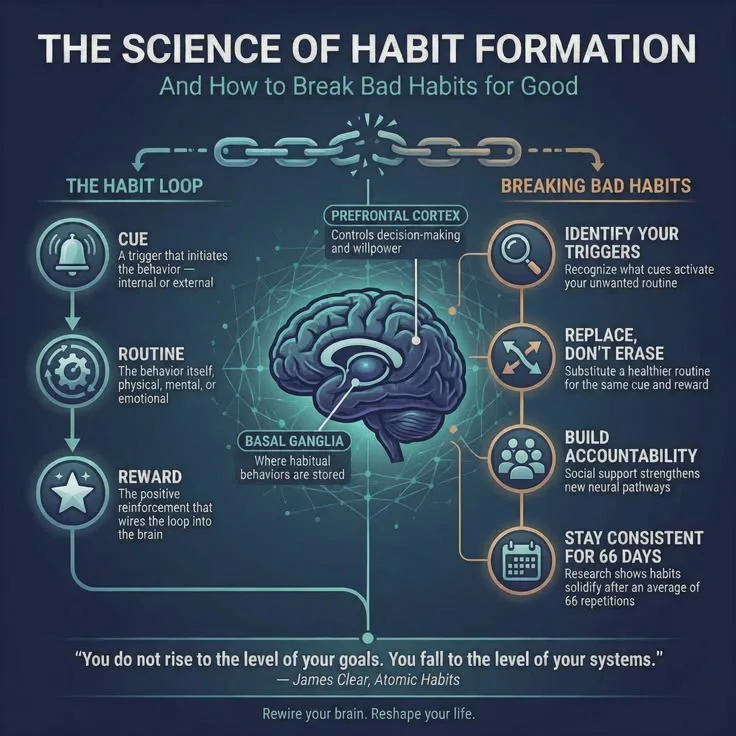
When habits are acquired, control shifts from the prefrontal cortex to the basal ganglia - reducing cognitive load. Parkinson's disease, which involves degeneration of basal ganglia circuits, severely disrupts habitual actions.
Chunking - The process by which the basal ganglia packages a sequence of individual actions into a single "chunk" that can be executed as a unit. When you first learn to drive, each action (check mirror, apply foot to pedal, turn steering wheel) requires conscious attention.
After extensive practice, the entire sequence of actions to navigate a familiar route runs as a single chunk, allowing you to drive while thinking about something else entirely.
Habit loop - The three-part structure of habitual behavior: cue (the contextual trigger), routine (the behavior itself), and reward (the outcome that reinforces the pattern). First clearly articulated by MIT's Ann Graybiel and popularized by Charles Duhigg in The Power of Habit (2012).
Dopamine - A neurotransmitter central to the brain's reward and motivation systems. Dopamine neurons initially fire in response to unexpected rewards (the reward prediction error signal). As a habit forms, the dopamine signal shifts: it fires at the cue, not the reward - you experience anticipatory craving.
If the expected reward doesn't arrive, dopamine firing drops below baseline, creating a negative signal. This temporal shift is the neurological signature of habit formation.
Reward prediction error - The difference between the reward you expected and the reward you received. Positive prediction error (better than expected): dopamine spike, behavior reinforced. Negative prediction error (worse than expected): dopamine dip, behavior weakened.
Zero prediction error (exactly as expected): no learning signal. The dopamine system is a continuous learning algorithm, always updating predictions.
Implementation intention - A planning strategy formulated as "When situation X arises, I will perform behavior Y." Research by Peter Gollwitzer and colleagues demonstrates that implementation intentions substantially increase follow-through on intended behaviors by linking the behavior to specific situational cues in advance.
Habit stacking - A behavioral strategy (popularized by James Clear in Atomic Habits, 2018) of attaching a new habit to an established one: "After [current habit], I will [new habit]." This exploits the existing habit's cue structure to trigger the new behavior.
Keystone habit - A habit whose adoption triggers positive change in other areas of life - a cascade effect. Charles Duhigg observed that exercise is often a keystone habit: people who start regular exercise tend to improve diet, sleep, and productivity without directly targeting those areas.
The mechanism is partly through increased self-efficacy (if I can do this, I can do other things) and partly through cognitive resources.
Ego depletion - The hypothesis (Roy Baumeister, 1998) that willpower draws from a limited cognitive resource that becomes depleted with use.
The theory is contested - replication failures have been significant - but some evidence supports the practical implication: effortful self-control is more difficult when cognitively depleted (tired, hungry, stressed).
The Neuroscience of Habit Formation
Ann Graybiel's Lab Rat Experiments
The canonical experiments on habit formation were conducted by MIT neuroscientist Ann Graybiel using rats learning to navigate a T-maze.[1] Researchers implanted electrodes recording individual neuron firing in the basal ganglia (specifically the striatum) as rats learned to run to the chocolate reward at the maze's end.
At the start of training, striatal neurons fired throughout the maze run - the brain was actively processing every moment of the experience. As training progressed, something remarkable happened: the firing pattern changed.
Neurons became selectively active at the beginning and end of the maze run - when the "chunk" started and when it completed - but quiet in the middle. The basal ganglia had packaged the entire maze-running sequence into a single behavioral unit.
Critically, this chunked representation was retained long after the rat stopped receiving the maze training - even after weeks of rest, the pattern re-emerged immediately on re-exposure to the maze. Old habits truly don't die; they go dormant.
Habit Formation in Humans
Human neuroimaging studies confirm the animal findings. Early in skill learning, the prefrontal cortex (associated with working memory, attention, and deliberate control) is highly active. As behavior becomes habitual, prefrontal activity decreases and basal ganglia activity increases.
This shift represents efficiency: a behavior that once required cognitive effort now runs automatically.
Phillippa Lally and colleagues at University College London conducted the most rigorous study of habit acquisition timelines in humans (2010).[2]
They recruited 96 participants and asked them to adopt a simple daily habit (eating fruit with lunch, drinking water before breakfast, going for a run before dinner) and track automaticity over 12 weeks.
The time to reach automaticity varied from 18 to 254 days, averaging 66 days. The shape of the automaticity curve was asymptotic - gains were fastest early in practice and slowed as the habit approached maximum automaticity.
Missing a single day had little effect on the ultimate acquisition trajectory; perfect consistency was not necessary, but overall frequency was.
The Dopamine Signal's Migration
Wolfram Schultz's research on dopamine neurons demonstrated the reward prediction error mechanism.[3] Initially, dopamine neurons respond to unexpected rewards (the chocolate at the maze end).
As learning progresses, the dopamine response shifts: it fires at the cue that predicts the reward (the click of the maze gate opening) rather than the reward itself. The cue becomes the trigger for craving.
This temporal shift explains the difficulty of breaking habits. When you encounter a cue (the smell of coffee, the route past the donut shop, the phone notification sound), your dopamine system generates a craving before conscious thought intervenes.
The routine that follows the craving has been run hundreds or thousands of times; the neural pathway is deeply worn.
The Habit Loop in Practice
Cues: What Triggers Behavior
Habits can be triggered by any consistent contextual feature:
Location: Offices, gyms, and kitchens trigger the behaviors typically performed there. The same person who snacks compulsively while watching television in the living room may not snack at all while working at a library.
Time: Morning routines, afternoon energy crashes, and evening rituals are time-triggered habits.
Emotional state: Stress, boredom, loneliness, and anxiety are common cues for eating, drinking, social media scrolling, and smoking.
Other people: Behaviors often trigger when specific people are present - you smoke when you're with smokers; you exercise when your running partner shows up.
Immediately preceding actions: The behavior that precedes a habit in a fixed sequence serves as its cue. Morning coffee and checking email often become inseparable because each has triggered the other hundreds of times.
Routines: The Behavioral Pattern
The routine is the behavior itself. Routines vary in complexity from simple reflexes (cracking knuckles when anxious) to elaborate behavioral sequences (a runner's warmup ritual) to complex cognitive processes (checking social media as a procrastination response to difficult work).
Rewards: What Reinforces the Loop
Rewards need not be tangible. The brain's reward system responds to:
- Sensory pleasures: Food, drink, physical touch, visual stimulation
- Novelty and information: The anticipation of new information activates dopamine - which is why notifications are designed to be irresistible
- Social approval: Positive social response (likes, comments, recognition) strongly activates reward circuits
- Stress reduction: Behaviors that reduce anxiety are powerfully reinforcing, even if the overall effect is harmful (smoking is less enjoyable than non-smokers imagine; smokers smoke partly to relieve the nicotine withdrawal that would not exist without the habit)
- Identity consistency: Acting in line with your self-concept is intrinsically rewarding
Why Habits Are Hard to Break
The popular conception of breaking a habit - identifying it, deciding to stop, and stopping - fails because it ignores the neuroscience. Habits are not deliberate choices that can be revoked by counter-decisions. They are compiled programs that run below conscious awareness when their cues appear.
Extinction vs. Inhibition
When you "quit" a habit, the learned association between cue and routine is not erased. It is suppressed - inhibited by competing learning. The prefrontal cortex learns to inhibit the habitual response when it appears. But:
Inhibitory control is resource-depleting: When tired, stressed, hungry, or cognitively overloaded, the prefrontal cortex's ability to inhibit habit responses weakens. The habit resurfaces not because you "lack willpower" but because the inhibitory mechanism is temporarily impaired.
Context reinstatement: Encountering the original habit's cue - especially in its original context - can trigger the old response powerfully even after extended abstinence.
Returning to a familiar bar (for a recovering alcoholic), the country (for an ex-smoker who "only smoked abroad"), or the situation (for a compulsive checker seeing an inbox notification) reactivates the original association.[10]
Spontaneous recovery: In conditioning research, extinguished responses spontaneously reappear after a rest period. The basal ganglia's representation of the old habit persists; extinction suppresses but does not delete it.
This is why relapse rates are high for addictions even after long abstinence, and why old behavioral patterns re-emerge under stress even after apparent change.
The Golden Rule of Habit Change
The neurological implication: instead of eliminating a habit loop, substitute the routine while preserving the cue and reward structure.
If you crave the stress relief of a cigarette, find a different routine that delivers stress relief - a brief walk, a few minutes of breathing exercises - in response to the same stress cue.
If you habitually snack out of boredom, identify when the boredom cue occurs and prepare a competing routine.
This "habit substitution" framework is the mechanism behind many effective behavior change programs, including Alcoholics Anonymous (replacing drinking with meeting attendance and community, which address the social reward structure of drinking) and cognitive-behavioral therapy for OCD (response prevention paired with competing behaviors).
What Actually Works: Evidence-Based Strategies
Implementation Intentions
Peter Gollwitzer's research demonstrates that forming an implementation intention ("When I leave work on Tuesday and Thursday, I will go directly to the gym") dramatically increases the probability of following through on an intended behavior compared to a mere goal ("I intend to exercise more").[6]
The mechanism: implementation intentions pre-link the situational cue (leaving work) to the behavior, so when the cue occurs, the intended behavior is automatically activated - functioning like a planned habit.
Meta-analyses confirm that implementation intentions increase goal attainment across diverse domains: exercise, diet, medication adherence, academic performance. Effect sizes are moderate but consistent.
Environment Design
The physical and social environment is a powerful shaper of behavior. Removing cues for unwanted habits and engineering cues for desired ones is often more effective than relying on in-the-moment willpower.
People who keep fruit on the counter eat more fruit. People who leave their gym bag by the door exercise more. People who set up automatic savings transfers save more. These environmental interventions work without requiring repeated conscious decisions - they restructure the cue landscape.
Stanford's BJ Fogg, in Tiny Habits (2019), argues for reducing friction for desired behaviors to the point where they are almost effortless to start.[8] A habit whose routine begins with flossing one tooth, or doing one push-up, is easier to anchor than one that requires changing clothes and driving to the gym.
Identity-Based Approaches
James Clear in Atomic Habits (2018) argues that the most durable habit changes operate at the level of identity rather than outcomes: instead of "I want to run a 5K," adopting "I am a runner." Behavior-identity alignment is self-reinforcing: acting like a runner makes you feel more like a runner, which makes running more automatic.[5]
This is consistent with research on self-perception: people infer their own traits from their behaviors (Bem's self-perception theory, 1967). Repeated small behaviors in a domain gradually shift self-concept, which then sustains further behavior.
Self-Monitoring
The simple act of tracking behavior increases its frequency when the tracked behavior is desired (and decreases it when it is undesired - the "observer effect"). Food diaries, exercise logs, and habit trackers all leverage this effect.
The mechanism involves increased self-awareness, reduced automaticity (you notice what you're doing), and commitment consistency (you don't want to break a streak).
Habits at Scale: Organizations and Culture
Habits operate not just in individual brains but in organizational routines and cultural patterns.
Charles Duhigg's account of Alcoa's turnaround under CEO Paul O'Neill - who focused obsessively on a single keystone metric, workplace safety - illustrates how changing one organizational routine can cascade into broader transformation.[4]
Institutional habits ("the way we do things here") are maintained by social cues and rewards - approval from colleagues, avoidance of disapproval, identity consistency - using the same mechanisms as individual habits.
Changing organizational culture requires changing the cue-routine-reward structures at a systemic level, not merely issuing new directives.
For related concepts, see how behavioral economics works, why intentions don't predict actions, and self-determination theory explained.
Sources & Further Reading
- Graybiel, A. M. (2008). Habits, Rituals, and the Evaluative Brain. Annual Review of Neuroscience, 31, 359-387. DOI: 10.1146/annurev.neuro.29.051605.112851
- Lally, P., van Jaarsveld, C. H. M., Potts, H. W. W., & Wardle, J. (2010). How Are Habits Formed: Modelling Habit Formation in the Real World. European Journal of Social Psychology, 40(6), 998-1009. DOI: 10.1002/ejsp.674
- Schultz, W., Dayan, P., & Montague, P. R. (1997). A Neural Substrate of Prediction and Reward. Science, 275(5306), 1593-1599. DOI: 10.1126/science.275.5306.1593
- Duhigg, C. (2012). The Power of Habit: Why We Do What We Do in Life and Business. Random House.
- Clear, J. (2018). Atomic Habits: An Easy and Proven Way to Build Good Habits and Break Bad Ones. Avery.
- Gollwitzer, P. M. (1999). Implementation Intentions: Strong Effects of Simple Plans. American Psychologist, 54(7), 493-503. DOI: 10.1037/0003-066X.54.7.493
- Wood, W., & Neal, D. T. (2007). A New Look at Habits and the Habit-Goal Interface. Psychological Review, 114(4), 843-863. DOI: 10.1037/0037.114.4.843
- Fogg, B. J. (2019). Tiny Habits: The Small Changes That Change Everything. Houghton Mifflin Harcourt.
- Verplanken, B., & Orbell, S. (2003). Reflections on Past Behavior: A Self-Report Index of Habit Strength. Journal of Applied Social Psychology, 33(6), 1313-1330. DOI: 10.1111/j.1559-1816.2003.tb01951.x
- Corbit, L. H., & Balleine, B. W. (2011). The General and Outcome-Specific Forms of Pavlovian-Instrumental Transfer Are Differentially Mediated by the Nucleus Accumbens Core and Shell. Journal of Neuroscience, 31(33), 11786-11794. DOI: 10.1523/JNEUROSCI.2711-11.2011