
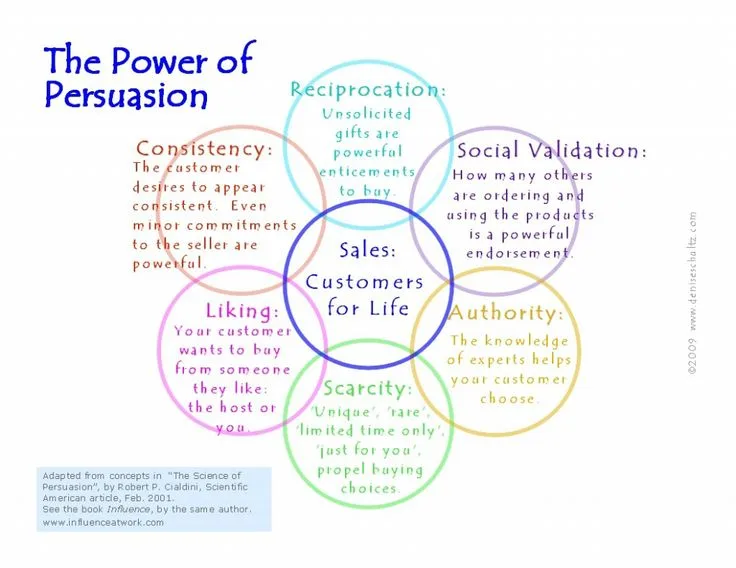
Persuasion is the process of changing someone's attitudes, beliefs, or behaviors through communication, and it is one of the most extensively studied phenomena in social psychology.
The modern science of persuasion rests on three pillars: Robert Cialdini's six principles of influence, first published in Influence: The Psychology of Persuasion (1984); Richard Petty and John Cacioppo's Elaboration Likelihood Model (1986), which explains when and why different persuasion strategies work; and William McGuire's inoculation theory (1961), which shows how resistance to persuasion can be systematically built.
Together, these frameworks provide both a toolkit for ethical influence and a diagnostic system for recognizing when persuasion techniques are being used against your interests - a form of literacy that has become essential in an era of algorithmic content curation, targeted advertising, and designed digital environments.
In the late 1970s, Cialdini decided that the academic study of attitude change had a blind spot.
Laboratory experiments on persuasion were producing rigorous findings in controlled settings, but the people who actually persuaded others for a living - salespeople, fundraisers, recruiters, advertisers - had developed an entirely different knowledge base through trial, error, and the immediate feedback of real transactions.
Cialdini wanted to find out what they knew.
He spent three years in undercover fieldwork, taking jobs in sales, advertising, and fundraising organizations, observing the practitioners of professional persuasion in their natural habitat.
What he found became one of the most influential texts in applied psychology, read by everyone from marketing executives to hostage negotiators to politicians to people who simply wanted to understand why they kept agreeing to things they had not intended to agree to.
The book has sold over five million copies worldwide and has been translated into more than 30 languages.
"Influence is not manipulation. Manipulation is attempting to move someone to a conclusion through illegitimate means. Influence works through legitimate appeal to reason, evidence, and genuine shared interest." - Robert Cialdini, Influence (1984)
Cialdini's Six Principles: Evidence and Mechanisms
Each of Cialdini's six principles is grounded in a substantial research literature spanning decades. Understanding the psychological mechanism behind each one provides both practical guidance for legitimate influence and a diagnostic tool for recognizing when the principle is being exploited.
| Principle | Psychological Mechanism | Legitimate Use | Manipulative Use |
|---|---|---|---|
| Reciprocity | Obligation from gifts/favors | Genuine helpfulness before asking | Unsolicited gifts to manufacture obligation |
| Commitment/Consistency | Cognitive dissonance reduction | Getting small genuine commitments first | Foot-in-door for escalating requests |
| Social proof | Informational conformity | Authentic reviews and testimonials | Fake reviews, manufactured consensus |
| Authority | Deference to expertise | Real credentials when relevant | Misleading titles and fake credentials |
| Liking | Relationship-based compliance | Genuine rapport and similarity | Fake friendship tactics |
| Scarcity | Loss aversion activation | Real limited availability | Fake countdown timers, false "last item" |
Reciprocity: The Oldest Social Contract
Reciprocity is among the most deeply rooted social norms across human cultures. Anthropologist Marcel Mauss documented the universality of gift exchange and the obligations it creates in his 1925 work The Gift, studying societies from the Pacific Northwest to Polynesia.
He found that gift-giving was never truly free - it created a social bond and an obligation to reciprocate that was as binding as any formal contract. Cialdini's contribution was to show how this ancient norm is deliberately activated in commercial persuasion contexts.
Research by Dennis Regan (1971) at Cornell University demonstrated the power quantitatively. Participants who received an unsolicited Coca-Cola from a confederate (a researcher posing as a fellow participant) subsequently purchased significantly more raffle tickets from that person - on average, twice as many.
Crucially, the felt obligation activated by the gift was independent of whether participants liked the confederate. Even participants who rated the confederate as unlikeable bought more tickets after receiving the drink.
This finding was important because it showed that reciprocity operates as an automatic norm, not a conscious calculation of social exchange.
The most effective reciprocity triggers share three characteristics identified in subsequent research: they are personalized (tailored to the recipient rather than generic), unexpected (not part of an established transaction or routine), and significant (meaningful enough to register as a genuine favor).
A 2002 study by David Strohmetz and colleagues at Monmouth University found that restaurant servers who left a personalized candy with the check - especially if they initially left, then returned to leave a second candy while mentioning it was specifically for the customer - saw tips increase by up to 23%.
The personalization and apparent spontaneity activated reciprocity more powerfully than a routine gesture.
Reciprocity that is transparently instrumental - "I am giving you this so that you will feel obligated to do X" - activates psychological reactance rather than compliance. People resist feeling manipulated. The norm works precisely because it operates below conscious calculation in most interactions.
Commitment and Consistency: The Self-Image Trap
Commitment and consistency reflects research by Leon Festinger on cognitive dissonance (1957) and subsequent work on self-perception theory by Daryl Bem (1972).
Once people have publicly committed to a position or completed an action, they experience psychological pressure to remain consistent with it - updating their beliefs and subsequent behavior to align with what they have already said or done.
The mechanism is rooted in the deep human need for internal coherence: inconsistency between our actions and our self-concept produces genuine psychological discomfort.
The foot-in-the-door technique, studied in a landmark experiment by Jonathan Freedman and Scott Fraser (1966) at Stanford University, exploits this principle. In their study, researchers went door-to-door asking homeowners to display a small, unobtrusive "Drive Carefully" window sign.
Most agreed - a trivial request. Two weeks later, a different researcher visited the same homes and asked homeowners to allow a large, poorly lettered "DRIVE CAREFULLY" billboard to be installed on their front lawn.
Of those who had agreed to the small sign, 76% agreed to the billboard. Among a control group that had not been asked about the small sign, only 17% agreed.
The escalation mechanism: people rationalize each small commitment by constructing a self-image consistent with it ("I am someone who cares about road safety"), and each larger request is then tested against that self-image rather than evaluated independently on its merits.
This is why charitable organizations often begin with a small request - signing a petition, sharing a social media post - before making the financial ask. Each small action shifts the donor's self-concept incrementally.
A related technique is the low-ball, studied by Robert Cialdini and colleagues (1978). A salesperson secures agreement to a deal, then changes the terms (the price increases, a feature is removed). Having already committed to the purchase mentally, the buyer frequently agrees to the worse terms rather than reversing their commitment.
Auto dealerships have historically used this technique extensively - securing agreement on a price, then discovering that the manager "cannot approve" that price and offering a higher one.
Social Proof: Following the Crowd
Social proof is the mechanism by which uncertainty resolves toward consensus behavior. When we do not know what to do, we look at what others are doing and follow suit.
The principle operates most powerfully in conditions of ambiguity - when the correct course of action is genuinely unclear - and similarity - when the people we observe are similar to ourselves.
Muzafer Sherif's autokinetic effect experiments (1935) demonstrated this in a laboratory setting.
Participants watching a stationary point of light in a dark room (which appears to move due to a perceptual illusion) converged on a shared estimate of its movement when placed in groups, even though the "correct" answer did not exist.
More strikingly, Solomon Asch's conformity experiments (1951-1956) showed that social pressure produces conformity even when the correct answer is completely unambiguous - approximately 75% of participants conformed to an obviously wrong group judgment at least once across multiple trials.
In commercial persuasion, social proof appears as testimonials, star ratings, "bestseller" labels, and the deliberate display of adoption numbers ("Join 2 million satisfied customers").
A 2008 study published in the Journal of Consumer Research by Noah Goldstein, Robert Cialdini, and Vladas Griskevicius found that hotel guests were 26% more likely to reuse their towels when told that the majority of previous guests in their specific room had done so, compared to a generic environmental appeal.
The specificity of the social proof - "people like you, in this exact situation" - dramatically increased its power.
The dark side of social proof is manufactured consensus. A 2020 investigation by the UK Competition and Markets Authority estimated that approximately 4% of all online reviews on major platforms are fake, representing a multi-billion-dollar industry of fabricated social proof.
Research by Dina Mayzlin and colleagues at Yale School of Management (2014) found that hotels with weaker reputations were more likely to purchase fake positive reviews and post fake negative reviews about competitors - a strategic deployment of artificial social proof.
Authority: Trust and Its Exploitation
Authority draws on the extensive research literature on deference to legitimate expertise.
Stanley Milgram's obedience experiments at Yale University (1961-1963) demonstrated the power of perceived authority to produce compliance with requests that participants would otherwise refuse - in his most famous condition, 65% of participants administered what they believed were dangerous electric shocks to another person when instructed by a researcher in a lab coat.
While the ethical implications of Milgram's methods have been extensively debated, the finding itself has been replicated in multiple countries and contexts.
In professional persuasion contexts, authority cues include credentials, titles, uniforms, and endorsements by recognized experts.
A 1996 study by Brad Bushman found that a woman asking pedestrians for change to feed a parking meter received significantly more compliance when wearing a uniform (either police or firefighter) than when wearing casual clothes - even though neither uniform conveyed any legitimate authority over parking meters.
The ethical use of authority involves deploying genuine credentials when they are relevant to the decision at hand.
The manipulative use involves implying expertise that is either absent or irrelevant - the "trusted voice" who is actually a paid spokesperson, the "doctor" who is a marketing character rather than a clinician, the "expert panel" that is an industry-funded advocacy group.
Liking and Scarcity: The Remaining Levers
Liking is perhaps the most intuitively familiar principle but no less powerful for that. We are significantly more likely to comply with requests from people we like - and research has identified the specific factors that drive liking in persuasion contexts.
Joe Girard, listed by the Guinness Book of World Records as the world's greatest car salesman (selling over 13,000 cars in his career), attributed his success primarily to making customers like him through genuine interest, follow-up, and personalized attention.
Research identifies five primary drivers of liking: physical attractiveness (a well-documented halo effect documented by Karen Dion, Ellen Berscheid, and Elaine Walster in 1972), similarity (we like people who are similar to us in background, values, and interests), compliments (even when we suspect they may be strategic), familiarity (repeated exposure increases liking, as established by Robert Zajonc's mere exposure effect research in 1968), and association (we like people associated with positive things and dislike those associated with negative ones).
Scarcity activates loss aversion - the well-documented finding from Daniel Kahneman and Amos Tversky's prospect theory (1979) that potential losses are weighted roughly twice as heavily as equivalent potential gains. When something becomes scarce or appears to be disappearing, its perceived value increases sharply.
A classic demonstration by Stephen Worchel and colleagues (1975) found that cookies from a jar containing only two cookies were rated as significantly more desirable than identical cookies from a jar containing ten - even though participants could see the cookies were identical.
Moreover, cookies that had become scarce (participants watched as cookies were removed from a full jar) were rated as even more desirable than cookies that had always been scarce.
In commercial persuasion, legitimate scarcity includes genuinely limited editions, time-limited offers with real deadlines, and naturally constrained supply.
Manipulated scarcity includes fake countdown timers that reset, "only 3 left in stock" warnings that never change, and "limited time" offers that run indefinitely.
A 2019 investigation by the Norwegian Consumer Council found that multiple major airlines displayed misleading scarcity messages - "only 2 seats left at this price" - that did not accurately reflect available inventory.
Dual-Process Theory: The Architecture of Influence
Richard Petty and John Cacioppo's Elaboration Likelihood Model (ELM), developed through a series of studies in the 1980s and published comprehensively in Communication and Persuasion (1986), provides the most influential theoretical framework for understanding when and how persuasion works.
The central insight is that attitude change can occur through qualitatively different cognitive processes depending on the motivation and ability of the message recipient to engage with argument content:
Central route processing occurs when both motivation and ability are high - when the message is personally relevant and the recipient has the knowledge, cognitive resources, and time to evaluate it carefully. Under central route processing, attitude change depends primarily on argument quality.
Strong, well-evidenced arguments produce durable attitude change; weak arguments are rejected. Attitudes formed through central route processing are more persistent over time, more resistant to counter-persuasion, and more predictive of actual behavior.
Peripheral route processing occurs when either motivation or ability is low - when the topic is not personally relevant, when the recipient is cognitively busy or distracted, when expertise is lacking.
Under peripheral route processing, attitude change depends primarily on heuristic cues: the attractiveness of the source, the apparent expertise of the speaker, the length of the message, the number of arguments presented (regardless of their quality), and emotional tone.
Attitudes formed through peripheral processing are faster to create but less durable, less resistant to counter-arguments, and less predictive of behavior.
A landmark study by Petty, Cacioppo, and Goldman (1981) demonstrated both routes simultaneously. College students heard an argument about a new comprehensive exam policy. When told the policy would affect their own university (high personal relevance, activating central processing), only strong arguments changed attitudes.
When told it would affect a distant university (low relevance, activating peripheral processing), the number of arguments mattered more than their quality - and the expertise of the source became a powerful persuasion factor regardless of argument strength.
The ELM and Dark Patterns
The ELM framework clarifies why dark patterns - a term coined by Harry Brignull in 2010 - are ethically problematic.
Dark patterns work by artificially suppressing the conditions for central route processing: creating time pressure that reduces motivation to deliberate ("This deal expires in 3:47!"), introducing complexity that reduces ability to process (burying the opt-out in a labyrinth of settings), or exploiting emotional triggers that hijack attentional resources ("You'll miss out forever!").
By deliberately preventing rational evaluation, dark patterns produce compliance that would not survive conscious deliberation.
A 2019 study by Arunesh Mathur and colleagues at Princeton University analyzed 11,000 shopping websites and found dark patterns on approximately 11% of them, with deceptive practices including hidden costs, forced continuity (making it easy to subscribe and difficult to cancel), and "confirmshaming" (using guilt-laden language on opt-out buttons, such as "No thanks, I don't want to save money").
Inoculation Theory: Building Resistance to Persuasion
William McGuire's inoculation theory, introduced in 1961 at Yale University, represents one of the most practically useful frameworks in persuasion research.
The analogy is biological: just as vaccination exposes the immune system to a weakened pathogen to build resistance to the real thing, psychological inoculation exposes people to weakened persuasive attacks to build cognitive resistance to full-strength persuasion.
The mechanism has two components. The threat component activates motivation to defend existing attitudes - the realization that one's beliefs are under attack triggers a defensive mindset.
The refutation component provides the cognitive content of the defense - the specific counterarguments and recognition skills needed to resist the attack.
Both components are necessary: threat without refutation produces anxiety but no resistance; refutation without threat produces knowledge but no motivation to deploy it.
Sander van der Linden at Cambridge University and colleagues have extended inoculation theory into large-scale applied work on combating misinformation.
Their "prebunking" approach, published in a series of studies beginning in 2017, identifies the persuasion techniques used in misinformation campaigns - emotional manipulation, false dichotomies, misleading statistics, appeals to fake authority, conspiratorial reasoning - and exposes audiences to these techniques in clearly labeled form, alongside explanation of why they are misleading.
This builds recognition and resistance to the techniques regardless of the specific topic to which they are subsequently applied.
A 2022 study by van der Linden, Jon Roozenbeek, and colleagues, published in Science Advances, tested prebunking videos on YouTube with over 5.4 million views across multiple countries.
They found that short (approximately 90-second) inoculation videos improved the ability to identify misinformation techniques by 5-10 percentage points - an effect that, while modest at the individual level, is significant when scaled across millions of viewers.
The World Health Organization and Google's Jigsaw project have both implemented prebunking approaches based on this research to combat health misinformation and online manipulation.
Pre-suasion: Setting the Stage
Cialdini's 2016 book Pre-Suasion introduced a concept that extends the persuasion framework in an important direction: the idea that what happens before a persuasive message is delivered can be as important as the message itself.
Pre-suasion is the practice of directing attention and shaping mental associations in ways that make the audience more receptive to a specific message before they ever encounter it.
The psychological basis is priming - the well-established finding that exposure to a stimulus influences responses to subsequent stimuli. Cialdini synthesized decades of priming research with his own studies to argue that skilled persuaders instinctively create mental contexts that favor their message.
A fundraiser who asks "Do you consider yourself a helpful person?" before making an ask activates a self-concept that makes agreement more likely.
A website that shows images of clouds and soft backgrounds before asking visitors to rate comfort features of a sofa receives higher comfort ratings than one showing images of coins (which primes price sensitivity).
Research by Naomi Mandel and Eric Johnson (2002), published in the Journal of Consumer Research, found that the background design of a website influenced product choices: a website with a green, money-themed background led visitors to prioritize price, while a comfort-themed background led them to prioritize comfort features - even though visitors were unaware of the influence and denied it when asked.
The Ethics of Persuasion
The line between legitimate influence and manipulation is one of the more philosophically contested questions in applied ethics, and the growth of behavioral science in commercial and political contexts has made it more pressing than ever.
Cialdini's own ethical position is that the six principles are ethically neutral tools that can be used in the service of genuine shared interests or exploited to manipulate against the target's interests.
The distinction he draws is between activating a principle when its conditions genuinely apply - genuine scarcity, genuine social proof, genuine authority - and manufacturing the appearance of conditions when they do not apply. The first is legitimate communication of relevant information.
The second is deception.
Richard Thaler and Cass Sunstein's nudge framework, developed in their 2008 book Nudge: Improving Decisions About Health, Wealth, and Happiness, adds a different ethical dimension. They argue that the design of choice architecture - the way choices are presented - always influences decisions, whether intentionally or not.
Organ donation rates, for example, are dramatically higher in countries with opt-out systems (where you are a donor unless you actively decline) than in opt-in countries - a difference driven entirely by the default setting rather than by differences in values.
Thaler and Sunstein argue that making choice architecture explicit and orienting it toward the decision-maker's wellbeing ("libertarian paternalism") is both ethically defensible and practically beneficial.
The nudge framework has generated substantial controversy, particularly around the question of who decides what constitutes the target's wellbeing and how consent to being nudged is obtained.
Cass Sunstein addressed many of these objections in The Ethics of Influence (2016), arguing that since some choice architecture is unavoidable, the relevant question is not whether to influence but how to do so transparently and in the interest of those being influenced.
The practical ethical test that emerges from the literature: does this influence attempt work by providing accurate information genuinely relevant to the decision, or does it work by circumventing deliberation to produce compliance that would not survive conscious evaluation? The former is legitimate; the latter is not.
For related perspectives on influence and communication, see framing effects in communication, narrative transportation and persuasion, ethical persuasion explained, common decision traps, and what is behavioral economics.
Sources & Further Reading
- Cialdini, R. B. (1984). Influence: The Psychology of Persuasion. HarperCollins.
- Petty, R. E., & Cacioppo, J. T. (1986). Communication and Persuasion: Central and Peripheral Routes to Attitude Change. Springer-Verlag.
- McGuire, W. J. (1961). The effectiveness of supportive and refutational defenses in immunizing and restoring beliefs against persuasion. Sociometry, 24(2), 184-197.
- Kahneman, D., & Tversky, A. (1979). "Prospect theory: An analysis of decision under risk". Econometrica, 47(2), 263-291.
- Regan, D. T. (1971). Effects of a favor and liking on compliance. Journal of Experimental Social Psychology, 7(6), 627-639.
- Freedman, J. L., & Fraser, S. C. (1966). Compliance without pressure: The foot-in-the-door technique. Journal of Personality and Social Psychology, 4(2), 195-202.
- Van der Linden, S., Roozenbeek, J., & Compton, J. (2020). Inoculating against fake news about COVID-19. Frontiers in Psychology, 11, 566790.
- Roozenbeek, J., van der Linden, S., et al. (2022). Psychological inoculation improves resilience against misinformation on social media. Science Advances, 8(34), eabo6254.
- Thaler, R. H., & Sunstein, C. R. (2008). Nudge: Improving Decisions About Health, Wealth, and Happiness. Yale University Press.
- Cialdini, R. B. (2016). Pre-Suasion: A Revolutionary Way to Influence and Persuade. Simon & Schuster.
- Asch, S. E. (1956). Studies of independence and conformity. Psychological Monographs, 70(9), 1-70.
- Brignull, H. (2010). Dark patterns: Deceptive UX design. deceptive.design.
- Mauss, M. (1925). The Gift: Forms and Functions of Exchange in Archaic Societies. Cohen & West.
- Mathur, A., et al. (2019). Dark patterns at scale: Findings from a crawl of 11K shopping websites. Proceedings of the ACM on Human-Computer Interaction, 3(CSCW), 1-32.
- Strohmetz, D. B., et al. (2002). Sweetening the till: The use of candy to increase restaurant tipping. Journal of Applied Social Psychology, 32(2), 300-309.
- Goldstein, N. J., Cialdini, R. B., & Griskevicius, V. (2008). A room with a viewpoint: Using social norms to motivate environmental conservation in hotels. Journal of Consumer Research, 35(3), 472-482.
- Mandel, N., & Johnson, E. J. (2002). When web pages influence choice: Effects of visual primes on experts and novices. Journal of Consumer Research, 29(2), 235-245.
- Milgram, S. (1963). "Behavioral study of obedience". Journal of Abnormal and Social Psychology, 67(4), 371-378.
- Sunstein, C. R. (2016). The Ethics of Influence: Government in the Age of Behavioral Science. Cambridge University Press.