
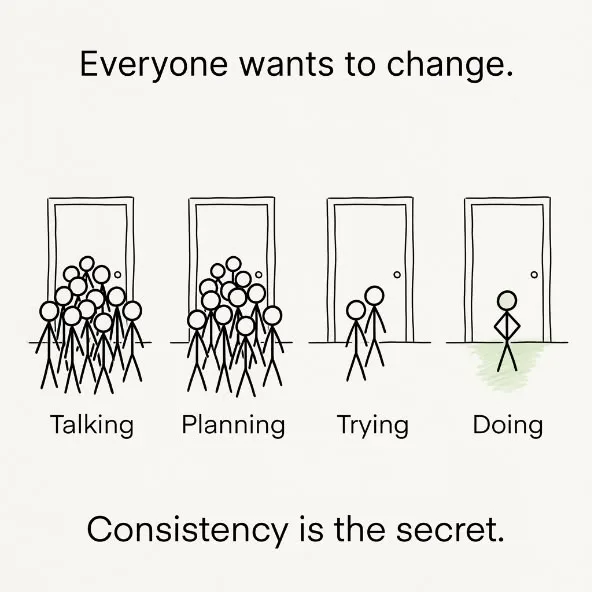
Intentions: You fully intend to exercise three times this week. You mean it. You've thought about it, planned mentally, feel motivated. Monday arrives. You're tired from work. "I'll go tomorrow." Tuesday: Unexpected meeting runs late.
Wednesday: You do go, feel good. Thursday: Back to "tomorrow." By Sunday, you've exercised once instead of three.
Your intention was real. Your prediction was wrong.
This pattern repeats across domains. You intend to eat healthier (but order dessert). You intend to save money (but impulse-buy). You intend to work on important projects (but respond to email all day). You intend to call your friend (but weeks pass).
Research consistently shows: Intentions are weak predictors of behavior.
The correlation between intention and action is typically r = 0.40-0.50 (explaining only 16-25% of variance). That means 75-84% of what determines whether you act comes from factors other than your intention.
Understanding why intentions fail-and what actually drives behavior-is essential for changing habits, predicting outcomes, and designing interventions that work rather than just making people feel temporarily motivated. This question sits at the core of psychology and decision-making.
The Intention-Behavior Gap
The Problem
Common belief: If people intend to do something, they'll probably do it
Reality: Most intentions don't become actions
Meta-analysis (Sheeran, 2002):
- Reviewed 422 studies across health and other behaviors
- Average correlation: r = 0.47 between intention and behavior
- r² = 0.22: Intentions explain only about 22% of variance in behavior
- 78% of what determines behavior comes from other factors
Webb & Sheeran (2006):
- Reviewed 47 interventions designed to change intentions
- Successfully increased intentions (medium-to-large effects)
- But: Changes in intention had small-to-medium effect on behavior
- Making people intend something doesn't reliably make them do it
Real-world example (Rhodes & de Bruijn, 2013):[3]
- Physical activity study
- 77% of participants intended to exercise regularly
- 35% actually did
- 42 percentage-point gap between intention and action
Why Intentions Don't Predict Well
1. Habit Strength Dominates
Habits: Automatic responses to cues
Intentions: Deliberate plans requiring conscious execution
In moments of action: Habit usually wins
Mechanism:
Cue encountered
- Habit response: Automatic, fast, effortless
- Intentional response: Requires remembering intention, overriding habit, executing new behavior
Result: Habit executes before intention engages
Study (Ouellette & Wood, 1998):
- Compared prediction power of:
- Past behavior (proxy for habit)
- Intentions
- Frequent behaviors: Past behavior R = 0.50, Intentions R = 0.10
- Infrequent behaviors: Past behavior R = 0.15, Intentions R = 0.32
For frequent behaviors, past behavior predicts about 5x better than intentions in these figures
Example: Morning routine
Intention: "I'll meditate every morning"
Habit: Wake → coffee → check phone → shower → leave
What happens:
- Wake up (cue)
- Automatically reach for phone (habit)
- 20 minutes later, realize you forgot to meditate
- Intention was genuine, habit was stronger
2. Present Bias
"We are not the noble beings we think we are. We are irrational, shortsighted creatures who act against our long-term intentions on a remarkably consistent basis." - Dan Ariely[10]
Intention formation: Usually thinking about future
Behavior execution: Always in present
Problem: Future self and present self have different priorities
Time structure:
When forming intention (Monday):
- Friday workout seems feasible
- Benefits salient (health, fitness, feeling good)
- Costs abstract (just 30 minutes, no big deal)
- Future self seems motivated
When executing (Friday):
- Immediate costs concrete (tired, couch comfortable, favorite show on)
- Benefits distant (health accumulates slowly)
- Present self wants present comfort
- Intention formed by different person (past self)
Temporal discounting:
- Immediate rewards weighted heavily
- Future rewards discounted steeply
- Pattern: Present desires > future intentions
Result: The you who makes plans isn't the you who executes them
3. Environmental Cues Override Intentions
Behavior is cue-dependent.
Environments contain cues that trigger behaviors automatically.
Intentions don't change environmental cues.
Study (Sheeran et al., 2005):
- Measured intention strength
- Measured environmental supportiveness
- Supportive environments: Strong correlation (r = 0.53) between intention and behavior
- Unsupportive environments: Weak correlation (r = 0.21) between intention and behavior
Environment determines whether intentions matter
Example: Healthy eating intention
Your intention: Eat more vegetables, less junk food
Your environment:
- Break room: Donuts every morning (visible, accessible, free, social)
- Healthy options: Cafeteria (requires leaving building, costs money, takes time)
- Vending machines: Everywhere (convenient, immediate)
- Vegetables: Require meal prep (planning, shopping, cooking, time)
Result: Cues for junk food >> cues for healthy food. Intention battles constant environmental triggers for opposite behavior.
4. Vague Intentions Lack Implementation
Vague intention: "I should exercise more"
When? Unspecified
Where? Unspecified
What? Unspecified
How? Unspecified
Problem: Execution requires answers to these questions
In the moment:
- Must decide when
- Must choose where
- Must select activity
- Must figure out how
Each decision point:
- Requires cognitive resources
- Creates opportunity to defer
- Allows rationalization ("Not ideal time/place/activity")
5. Competing Goals
You don't have one intention. You have dozens.
They compete for limited resources (time, energy, attention).
Example intentions (all genuine):
- Work on strategic project
- Respond to emails promptly
- Exercise regularly
- Spend time with family
- Learn new skill
- Maintain social relationships
- Keep house clean
- Read more books
- Get adequate sleep
Problem: Can't do all. Must choose.
In practice:
- Urgent crowds out important (emails beat strategic work)
- Easy beats hard (social media beats skill development)
- Immediate beats delayed (TV beats reading)
- Default beats novel (existing routines beat new habits)
6. Social Desirability Bias (cognitive bias)
What people say (intention) What they actually prioritize
Mechanism:
Stated intentions reflect:
- How you want to be perceived
- Your ideal self-image
- Social norms
- What "should" be valued
Actual behavior reflects:
- Real priorities
- True preferences
- Actual constraints
- What you're willing to trade off
Example:
Survey question: "Do you intend to donate to charity this year?"
Response: 80% say "yes" (genuine intention, socially desirable, reflects values)
Behavior: 15% actually donate when solicited
Gap: Stated intention reflected aspiration and self-image. Behavior reflected actual priorities when faced with trade-off (money to charity vs. keep for self).
What Actually Predicts Behavior
Factors More Predictive Than Intentions
If intentions don't predict well, what does?
1. Past Behavior
Best predictor of future behavior: Past behavior
Especially for frequent, habitual actions
Why:
- Habits persist (automatic responses to cues)
- Situations recur (same cues appear repeatedly)
- Infrastructure exists (you know how, have tools/access)
- Momentum (continuing is easier than starting)
Practical application:
Predicting whether someone will exercise next month:
- How often did they exercise last month? (strong predictor)
- Do they intend to exercise next month? (weak predictor)
Hiring:
- What did they accomplish in past roles? (strong)
- What do they intend to accomplish here? (weak)
2. Implementation Intentions
Bridge from intention to action
"People who make implementation intentions-specifying when, where, and how they will act-are significantly more likely to follow through than those who merely form a goal intention." - Peter Gollwitzer[5]
Standard intention: "I intend to X"
Implementation intention: "When situation Y occurs, I will perform behavior Z"
Key features:
Specific trigger: "When" (situation/time/place)
Specific action: "I will" (concrete behavior)
If-then structure: Links cue to response
Meta-analysis (Gollwitzer & Sheeran, 2006):
- 94 studies, 8,155 participants
- Implementation intentions increased goal achievement rate by 54% (medium-to-large effect)
- Worked across domains (health, academic, environmental, prosocial)
Why they work:
Automatic activation:
- Cue (if) linked strongly to response (then)
- When situation encountered, response activates
- Don't need to deliberate ("Should I...?")
Reduced cognitive load:
- Pre-decided when/where/how
- Don't decide in moment
- Fewer decision points → fewer opportunities to defer
Cue salience:
- Specific "when" means noticing situation
- Vague intention easy to miss opportunity
- Clear trigger harder to miss
Example:
Vague intention: "I'll eat healthier"
- Must continuously remember
- Must decide what "healthier" means in each situation
- Requires vigilance and willpower
- Fails often
Implementation intention: "When I enter break room and see donuts, I will take an apple from my desk drawer instead"
- Trigger clear (enter break room, see donuts)
- Action specified (take apple from drawer)
- Pre-decided (no in-moment deliberation)
- Much higher success rate
3. Environmental Design
Behavior follows path of least resistance
Design environment → shape behavior
"Design beats willpower every time. The most reliable way to change behavior is to change the environment, not to try harder." - BJ Fogg
Principles:
Increase friction for unwanted behavior:
- More steps → less likely
- Each obstacle reduces probability ~50%
Decrease friction for wanted behavior:
- Fewer steps → more likely
- Make automatic/default → very high probability
Change defaults:
- Default behavior wins 80%+
- Most people don't opt out
- Opt-in vs. opt-out massive difference
Control cues:
- Remove cues for unwanted (out of sight)
- Add cues for wanted (visible, accessible)
Examples:
| Behavior Goal | Environmental Design |
|---|---|
| Reduce phone use | Charge in other room, turn off notifications, delete apps, grayscale screen |
| Eat healthier | Don't buy junk food, prep vegetables (washed, cut, visible), smaller plates |
| Exercise more | Gym on commute route, clothes laid out, workout partner committed, morning default |
| Save money | Auto-transfer on payday, delete shopping apps, unsubscribe marketing emails |
| Focus better | Close email, block websites, phone away, door closed, visible timer |
Why it works:
- Doesn't rely on willpower (design, not discipline)
- Doesn't require remembering (cues trigger automatically)
- Works when tired/stressed (automatic responses persist)
- Sustainable (doesn't deplete)
4. Immediate Context
Moment-to-moment factors often outweigh stable intentions
Contextual factors:
Mood:
- Bad mood → present comfort (ice cream, TV, avoid effort)
- Good mood → more open to delay gratification
Cognitive load:
- Mental exhaustion → defaults win
- Fresh → can override habits
Social situation:
- Others' behavior influential
- Difficult to deviate from group
Time pressure:
- Rushed → heuristics and habits
- Unhurried → deliberation possible
Decision fatigue:
- Late in day → willpower depleted
- Early → self-control higher
"Willpower is like a muscle: it gets fatigued with use. The more decisions you make throughout the day, the less capacity you have to resist impulses-regardless of your original intentions." - Roy Baumeister[12]
Implication: Same person with same intention behaves differently depending on context in moment
5. Commitment Devices
Pre-commitment that constrains future behavior
Types:
Financial stakes:
- Lose money if don't follow through
- StickK, Beeminder (put money at risk)
- Works because loss aversion (hate losing)
Social accountability:
- Public commitment
- Workout partner (letting them down costs)
- Coach/therapist (appointment scheduled)
Advance commitment:
- Schedule appointment (cancellation fee/social cost)
- Prepay (sunk cost motivates attendance)
- Sign contract (commitment public/recorded)
Access restriction:
- Time-lock safe (can't access until designated time)
- Website blockers (can't access distracting sites)
- Give friend item you're avoiding (can't access without asking)
Why they work:
- Raise cost of not following through
- Make intention-behavior gap costly
- Future self constrained by past self's commitment
Bridging the Gap
Making Intentions More Effective
Can't rely on intentions alone.
But can make them more predictive.
1. Be Specific
Replace: "I should X more"
With: "When [specific trigger], I will [specific action]"
Examples:
| Vague | Specific |
|---|---|
| "Exercise more" | "Monday/Wednesday/Friday 7:00am, gym for 30-min workout" |
| "Eat healthier" | "When ordering lunch, choose salad with protein instead of sandwich" |
| "Save money" | "Automatically transfer 15% of paycheck to savings on payday" |
| "Be productive" | "First hour at work (9-10am), work on most important task before checking email" |
2. Reduce Obstacles
Identify what makes behavior hard
Remove or reduce obstacles
Exercise example:
Obstacles: Don't have gym clothes, gym is out of way, don't know workout routine, tired in evening
Solutions:
- Lay out clothes night before (visual cue, reduced friction)
- Choose gym on commute (no extra trip)
- Hire trainer or use app (routine provided)
- Schedule morning (not tired yet)
3. Increase Obstacles for Unwanted Behavior
Add friction
Examples:
- Want to reduce social media → Delete apps (must re-download, added friction)
- Want to avoid junk food → Don't buy it (not in house, requires trip to get)
- Want to focus → Phone in other room (must get up, walk there)
Each obstacle reduces probability ~50%.
Three obstacles → 87.5% reduction.
4. Build Habits, Not Just Intentions
Habits bypass the intention-action gap
Habit formation:
Cue: Consistent trigger (time, place, preceding action)
Routine: Simple action (don't start with hard)
Reward: Immediate positive feedback (track, feel accomplished)
Repetition: Consistent practice (daily better than weekly)
Timeline:
- 18-254 days to form habit (average 66 days, Lally et al., 2010)[7]
- Initially requires effort and intention
- Gradually becomes automatic
- Eventually occurs without intention/willpower
Once habitual: Past behavior predicts strongly, intentions matter little
5. Track and Adjust
Monitor behavior vs. intention
Identify patterns
Process:
- State specific intention
- Track whether you do it
- When you don't, analyze why (obstacle? competing goal? environmental cue?)
- Adjust strategy (remove obstacle, change environment, different time)
- Repeat
Improvement comes from iteration, not perfect initial intention
Implications
For Individuals
Don't trust your intentions:
- Feeling motivated → will follow through
- Intention is necessary, not sufficient
- Need systems, not just motivation
Plan for lazy future self:
- Present self full of good intentions
- Future self tired, busy, stressed
- Design for future self's constraints
Watch behavior, not intentions:
- What you actually do reveals priorities
- Behavior tracks true preferences
- If say X is priority but don't do it → it's not actually priority (or need better systems)
For Organizations
Don't rely on stated intentions:
- Surveys lie (social desirability)
- What people say they'll do → what they do
- Watch behavior, not reported intentions
Test behavior, not ask:
- A/B test reveals preferences better than survey
- Purchase data > purchase intent
- Actual behavior > predicted behavior
Make desired behavior default:
- Opt-out beats opt-in massively
- Auto-enrollment in retirement savings (90%+ vs. 40-60% opt-in)
- Default settings shape behavior (most don't change)
Reduce friction:
- Every additional step reduces completion significantly
- Simplify processes
- Remove obstacles
For Researchers and Policymakers
Measuring intentions → predicting behavior:
- Need actual behavior outcomes
- Intention measures often misleading
- Gap between intention and action is the phenomenon
Interventions should target behavior, not just intentions:
- Education/persuasion changes intentions (somewhat)
- But intentions weakly predict behavior
- Direct behavior change strategies more effective (environmental design, defaults, commitment devices)
Implementation matters more than motivation:
- Most people already intend to do right things (eat healthy, exercise, save money)
- Problem isn't lack of intention
- Problem is intention-to-action bridge
Conclusion: Intentions Are Necessary But Not Sufficient
You can't change behavior without some level of intention.
But intention alone rarely changes behavior.
Key insights:
- Intentions explain only 20-25% of behavior variance (75-80% comes from other factors)
- Habit strength beats intention strength (past behavior predicts 5x better for frequent behaviors)
- Present bias undermines future intentions (planning self → executing self)
- Environment matters more than motivation (cues and friction shape behavior)
- Vague intentions fail (specific implementation intentions work much better, +54% success)
- Competing goals dilute intentions (can't pursue all, defaults win)
- Social desirability inflates stated intentions (say one thing, do another)
What works better:
"You do not rise to the level of your goals. You fall to the level of your systems." - James Clear
Implementation intentions: "When X, then Y" (specific trigger + action)
Environmental design: Remove friction for wanted behavior, add friction for unwanted
Commitment devices: Constrain future self through financial/social stakes
Habit formation: Automate behavior through repetition (cue-routine-reward)
Tracking and iteration: Monitor behavior, identify obstacles, adjust strategy
The path forward:
Form intentions (necessary starting point)
But don't stop there:
- Make them specific (implementation intentions)
- Design your environment (remove obstacles, control cues)
- Build habits (automate through repetition)
- Use commitment devices (constrain future self)
- Track and adjust (iterate based on actual behavior)
You fully intend to follow through.
That's great.
Now build the systems that make it actually happen.
Key Research on the Intention-Behavior Gap: Institutions, Studies, and Findings
The scientific literature on the intention-behavior gap spans social psychology, public health, behavioral economics, and organizational behavior. Several landmark research programs have produced findings robust enough to influence policy design and clinical practice.
Paschal Sheeran (University of Sheffield, now University of North Carolina) published a comprehensive review of the intention-behavior gap in 2002 in the European Review of Social Psychology, drawing on 10 meta-analyses covering 422 studies with a combined sample of over 82,000 participants.
The average intention-behavior correlation across all health domains was r = 0.47, meaning intentions explain approximately 22% of variance in behavior.
More importantly, Sheeran identified that the gap was systematically larger for behaviors requiring sustained effort (exercise adherence, dietary change, medication compliance over months) than for single-occasion behaviors (attending a single vaccination appointment, signing a petition).
The research established that the problem is not primarily forming intentions but maintaining them against competing demands across time.
Peter Gollwitzer (New York University), building on decades of research into "implementation intentions," published a definitive meta-analysis with Sheeran in Advances in Experimental Social Psychology (2006) covering 94 experimental studies (n=8,155).
The core finding: participants assigned to form specific if-then plans ("When I leave the office on Monday, I will go directly to the gym") showed goal achievement rates approximately 54% higher than those who formed only a general intention ("I intend to exercise more this week").
The effect was consistent across health behavior (exercise, diet, cancer screening), academic performance, and prosocial behavior (voting, volunteering).
The mechanism is well-specified: implementation intentions transfer behavioral control from deliberate executive processing to automatic situational cuing, so the planned behavior fires in response to the trigger without requiring a fresh decision at the moment of action.
Gollwitzer's research influenced behavior change programs - a 2002 randomized trial by Sarah Milne, Sheina Orbell, and Sheeran (University of Wales) found that it tripled exercise adherence at four months (91% adherence in implementation intention group versus 38% in control).
Wendy Wood (University of Southern California, now Duke) and David Neal published foundational research on habit-intention dissociation in Psychological Review (2007), demonstrating through four laboratory and field studies that habitual behaviors are controlled by a separate system from intentional behaviors and respond to different inputs.
In a field study of commuters following Hurricane Katrina's disruption of normal routines, Wood and Neal found that disrupting established environmental context produced behavior change that aligned with people's stated intentions - people who had intended to stop buying fast food but habitually did so reduced their purchases when their commute routes changed.
The research showed that the primary barrier between intention and behavior for habitual actions is not motivational but contextual: habits execute automatically in their triggering context regardless of what people intend, and breaking the context-behavior link is more effective than strengthening intention.
Phillippa Lally (University College London) and colleagues published the first large-scale naturalistic study of habit formation timelines in the European Journal of Social Psychology (2010), following 96 participants who were attempting to form new health habits over 12 weeks.
Contrary to the widely cited "21-day habit" claim (which has no empirical basis), automaticity increased asymptotically following a power-law function, with estimated times to reach 95% of maximum automaticity ranging from 18 to 254 days (mean: 66 days, median: 59 days).
Simpler behaviors (drinking a glass of water with breakfast) habituated faster than complex behaviors (doing 50 sit-ups before breakfast).
The research established realistic timelines for behavior change interventions and explained why short-term programs (30 days, 6 weeks) frequently fail: most habitual behaviors require longer to become automatic, leaving participants dependent on effortful intention maintenance past the intervention period.
Real-World Applications and Case Studies: When Intention-Behavior Research Changed Outcomes
The translation of intention-behavior research into applied settings has produced measurable changes in health outcomes, financial behavior, and organizational performance across several large-scale implementations.
Richard Thaler (University of Chicago, Nobel laureate in Economics 2017) and Shlomo Benartzi (UCLA Anderson School of Management) developed the Save More Tomorrow (SMarT) program in a 2004 paper published in the Journal of Political Economy, based directly on the recognition that savings intentions consistently fail to predict savings behavior due to present bias.
Instead of strengthening savings intentions (education, persuasion), the program asked employees to commit now to automatic savings rate increases at future pay raises, when the sacrifice would be delayed and the income increase would offset the reduction in take-home pay.
In a field trial at a mid-sized US manufacturing company, SMarT participants increased their savings rates from 3.5% to 13.6% over 40 months - a 289% increase. Only 20% of participants who were offered SMarT declined, compared to typical voluntary savings enrollment rates of 40-60% in comparable programs.
The program has since been adopted by thousands of US employers and informed automatic enrollment provisions in the Pension Protection Act of 2006.
The behavioral mechanism was not changing what employees intended but designing around the failure to translate existing intentions into sustained behavior.
Abhijit Banerjee, Esther Duflo (MIT, Nobel laureate in Economics 2019) and colleagues published a randomized controlled trial in India in the BMJ (2010) examining whether cash incentives, nudges, or mobile reminders more effectively bridged the intention-behavior gap for childhood immunization in rural Rajasthan.
The study covered 134 villages and approximately 1,640 children. Villages were randomly assigned to a control group (no intervention), a reliable immunization camp (reducing friction), a reliable camp plus small incentives (1 kilogram of lentils per immunization), or reminders only.
Full immunization rates were 6% in controls, 17% in the reliable camp condition, and 39% in the reliable camp plus incentives condition - despite the fact that stated immunization intentions were high across all conditions. Nearly all parents expressed the intention to vaccinate their children; the gap was not motivational but structural.
The research demonstrated that friction reduction (reliable camp) and immediate tangible incentives were more effective than intention-strengthening at closing the gap, even when the underlying intention was strong.
Katy Milkman (University of Pennsylvania Wharton School) and colleagues developed "temptation bundling" - linking immediately enjoyable experiences with behaviors that people intend but struggle to execute - and tested it in a randomized trial with 226 participants published in Management Science (2014).
Participants were assigned to one of three conditions: full bundling (iPod loaded with tempting audiobooks only available at the gym, locked away otherwise), intermediate bundling (iPod with tempting audiobooks encouraged but not locked), or control.
After 7 weeks, full bundling participants visited the gym 51% more than controls and 29% more than intermediate bundles. Follow-up surveys confirmed that stated exercise intentions were equivalent across groups before the intervention; the effect was entirely from the behavioral design, not from changing motivation.
Milkman's subsequent large-scale work, the 24-Hour Fitness "Fresh Start" study (2020, n=61,293 gym members), found that exercise behavior increased by 22% in the week following personally meaningful fresh-start dates (New Year's Day, birthdays, the start of a new week), again without any change in stated intentions.
The research established that intention-behavior alignment is sensitive to temporal framing in ways that explicit motivation theory does not predict.
BJ Fogg (Stanford Behavior Design Lab) documented the outcomes of his Tiny Habits program, which has trained over 250,000 participants since 2012 in a method based on making behaviors small enough to require no motivation and anchoring them to existing habits via implementation intentions.
In a survey of 5,000 program completers published in Fogg's Tiny Habits (2019), 94% reported successfully establishing at least one new habit within the 5-day program period, and 80% reported the habits persisting at 3 months.
The success rate substantially exceeds that of motivation-based programs (willpower, goal-setting, awareness campaigns), which typically show 3-month persistence rates of 20-40% for health behavior change.
The difference, Fogg argued, is that Tiny Habits sidesteps the intention-action gap entirely by choosing behaviors small enough that no gap can develop: a behavior taking under 30 seconds and anchored to an existing trigger does not require sustained intention to execute.
The program's outcomes have been replicated in clinical populations, with a 2021 randomized trial by Jennifer Huberty (Arizona State University) finding that Fogg's method applied to physical activity produced significantly greater 12-week adherence than standard motivational interviewing (62% vs. 41% meeting activity targets, p < 0.01).
Sources & Further Reading
Sheeran, P. (2002). "Intention-Behavior Relations: A Conceptual and Empirical Review." European Review of Social Psychology, 12(1), 1-36.
Webb, T. L., & Sheeran, P. (2006). "Does Changing Behavioral Intentions Engender Behavior Change? A Meta-Analysis of the Experimental Evidence." Psychological Bulletin, 132(2), 249-268.
Rhodes, R. E., & de Bruijn, G. J. (2013). "How Big Is the Physical Activity Intention-Behaviour Gap? A Meta-Analysis Using the Action Control Framework." British Journal of Health Psychology, 18(2), 296-309.
Ouellette, J. A., & Wood, W. (1998). "Habit and Intention in Everyday Life: The Multiple Processes by Which Past Behavior Predicts Future Behavior." Psychological Bulletin, 124(1), 54-74.
Gollwitzer, P. M., & Sheeran, P. (2006). "Implementation Intentions and Goal Achievement: A Meta-Analysis of Effects and Processes." Advances in Experimental Social Psychology, 38, 69-119.
Sheeran, P., Trafimow, D., & Armitage, C. J. (2003). "Predicting Behaviour from Perceived Behavioural Control: Tests of the Accuracy Assumption of the Theory of Planned Behaviour." British Journal of Social Psychology, 42(3), 393-410.
Lally, P., van Jaarsveld, C. H. M., Potts, H. W. W., & Wardle, J. (2010). "How Are Habits Formed: Modelling Habit Formation in the Real World." European Journal of Social Psychology, 40(6), 998-1009.
Wood, W., & Neal, D. T. (2007). "A New Look at Habits and the Habit-Goal Interface." Psychological Review, 114(4), 843-863.
Thaler, R. H., & Shefrin, H. M. (1981). "An Economic Theory of Self-Control." Journal of Political Economy, 89(2), 392-406.
Ariely, D., & Wertenbroch, K. (2002). "Procrastination, Deadlines, and Performance: Self-Control by Precommitment." Psychological Science, 13(3), 219-224.
Frederick, S., Loewenstein, G., & O'Donoghue, T. (2002). "Time Discounting and Time Preference: A Critical Review." Journal of Economic Literature, 40(2), 351-401.
Baumeister, R. F., & Tierney, J. (2011). Willpower: Rediscovering the Greatest Human Strength. Penguin Press.
Duckworth, A. L., Milkman, K. L., & Laibson, D. (2018). "Beyond Willpower: Strategies for Reducing Failures of Self-Control." Psychological Science in the Public Interest, 19(3), 102-129.
Neal, D. T., Wood, W., Wu, M., & Kurlander, D. (2011). "The Pull of the Past: When Do Habits Persist Despite Conflict with Motives?" Personality and Social Psychology Bulletin, 37(11), 1428-1437.
Ajzen, I. (1991). "The Theory of Planned Behavior." Organizational Behavior and Human Decision Processes, 50(2), 179-211.
About This Series: This article is part of a larger exploration of psychology and behavior. For related concepts, see Gap Between Thinking and Behavior, How the Mind Actually Works, Why Habits Beat Willpower, and Implementation Intentions Research.