
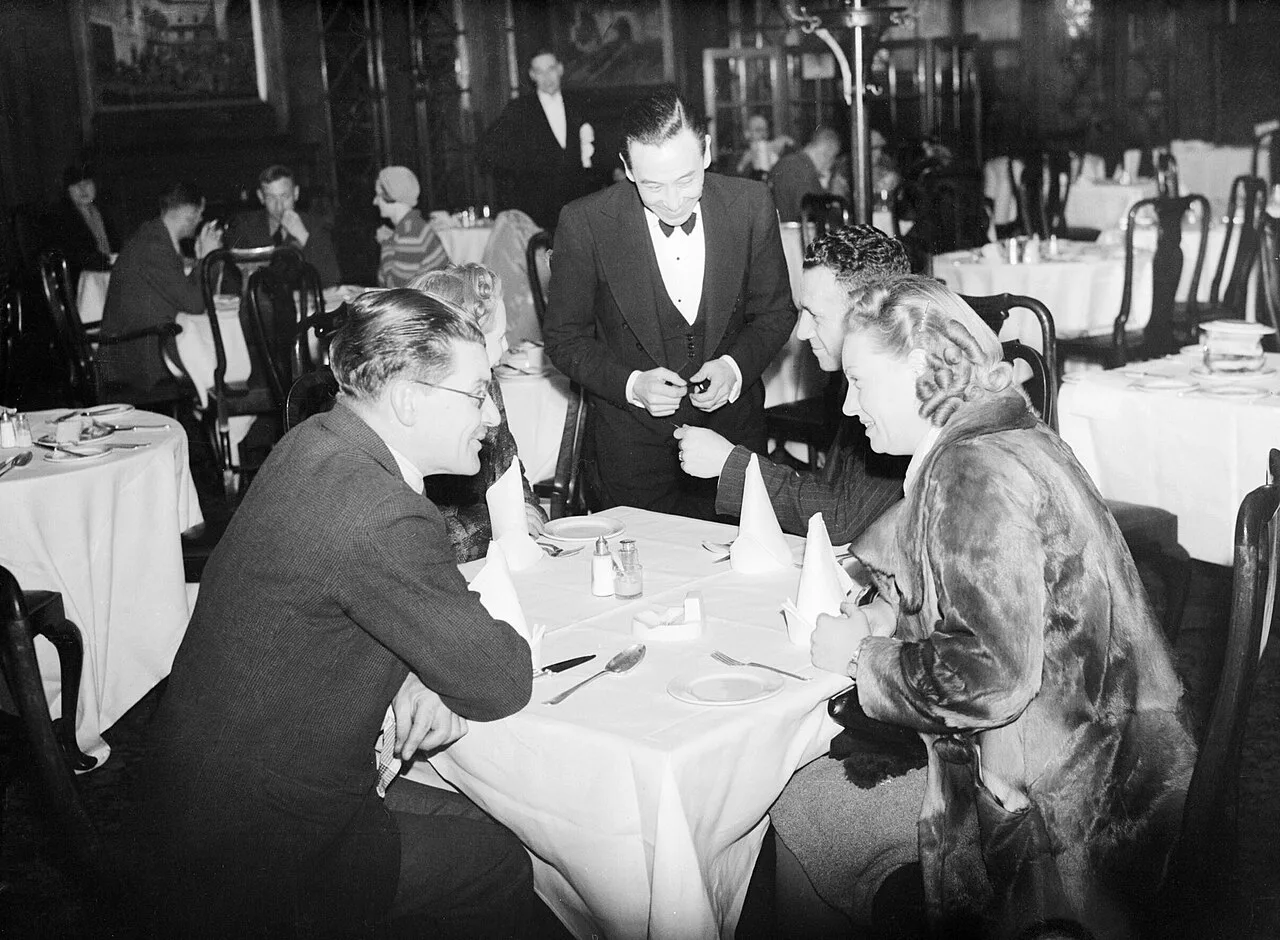
The Zeigarnik effect is the finding that interrupted or unfinished tasks are remembered more readily than completed ones. Open goals create psychological tension that keeps their representations active, whereas completion releases that tension and frees attention for new goals. This helps explain lingering awareness of unread messages or incomplete work, but chronic unfinished tasks can also contribute to preoccupation, rumination, and cognitive overload.
On a warm afternoon in Vienna sometime around 1927, a young Soviet psychology student named Bluma Zeigarnik sat in a busy Viennese cafe and watched a waiter navigate between tables without a notepad.
He took orders from six or seven customers at once, holding every item - a Wiener Schnitzel with roasted potatoes, two glasses of Riesling, a coffee with a particular type of sugar - in his head without error. The system worked flawlessly until the moment each bill was settled.
Once a customer paid, the waiter seemed to release the entire order from memory like a stone dropped into water. A few minutes after clearing the table, he could not recall what they had ordered. If a customer wanted to dispute a charge after paying, the waiter had nothing to offer. The information was simply gone.
This observation - made in the company of Zeigarnik's mentor, the German-American psychologist Kurt Lewin - struck Lewin as theoretically significant. Why would payment function as a cognitive eraser? Why could the waiter retain six open orders simultaneously but lose each one the moment it closed?
Lewin proposed an explanation rooted in his developing field theory: unpaid orders represented uncompleted tasks, and uncompleted tasks maintained a kind of psychological tension that kept them active in memory. Completed tasks, by contrast, released that tension, and with it, the mental representation of the goal.
Zeigarnik, then a doctoral student at the University of Berlin's Psychological Institute, took the observation into the laboratory. Working under Lewin's supervision, she designed a series of experiments that would become the foundation of one of the most durable findings in cognitive psychology.
She had participants perform between 18 and 22 small tasks - puzzles, arithmetic problems, clay modeling, cardboard construction - and interrupted roughly half of them before completion.
After all the tasks were finished or interrupted, she asked participants to recall what they had been working on. The results were stark: interrupted tasks were recalled approximately 90 percent more frequently than completed ones.
The finding was published in 1927 in the German journal Psychologische Forschung under the title "Uber das Behalten von erledigten und unerledigten Handlungen" - "On the Retention of Completed and Uncompleted Actions."
A phenomenon that had started with a waiter's peculiar memory in a Vienna cafe had become quantified, replicable, and theoretically grounded. It now bears the name of the researcher who brought it out of observation and into science.
"Uncompleted tasks are remembered better than completed ones because the tension of the unfinished goal keeps the memory active." - Bluma Zeigarnik, 1927
What the Zeigarnik Effect Is
The Zeigarnik Effect is the empirical finding that people retain interrupted or uncompleted tasks in memory with greater fidelity and persistence than tasks they have successfully completed.[1]
Zeigarnik Effect vs. Closure Effect
The Zeigarnik Effect does not operate in isolation. It exists in productive tension with a complementary phenomenon: the Closure Effect, which describes the cognitive and emotional relief that accompanies task completion. Understanding the difference between them clarifies how the mind manages open and closed goal-states.
| Dimension | Zeigarnik Effect | Closure Effect |
|---|---|---|
| Core finding | Interrupted tasks are recalled better than completed ones | Completed tasks release psychological tension and are more readily forgotten |
| Cognitive state | Active tension; ongoing mental rehearsal of unfinished goals | Tension discharge; goal representation deactivated after completion |
| Memory effect | Enhanced recall of uncompleted items | Diminished recall of completed items |
| Emotional tone | Often experienced as intrusive thoughts, low-level preoccupation, mild anxiety | Experienced as satisfaction, relief, or neutral calm |
| Adaptive function | Maintains goal pursuit by keeping active tasks salient | Frees cognitive resources for new goals once prior goals are achieved |
| Failure mode | Chronic preoccupation with incomplete goals; rumination; cognitive overload | Premature satisfaction; abandonment of goals after partial progress is framed as complete |
| Applied domain example | The unread email that persists in awareness; the half-written report that intrudes during leisure | The sense of relief after submitting a project; why completed to-do items are rarely revisited |
The two effects are not opposites in a simple sense. They are complements that together describe how goal-directed cognition allocates and withdraws attentional resources across a task lifecycle.
The Cognitive Science: Mechanisms and Underlying Theory
Lewin's Field Theory and the Concept of Quasi-Needs
The theoretical foundation for the Zeigarnik Effect was not Zeigarnik's own - it was Kurt Lewin's.
Before Zeigarnik conducted her experiments, Lewin had already developed a framework in which human behavior was understood as occurring within a dynamic psychological "field" shaped by forces, tensions, and goal-directed vectors.[3]
His 1926 paper "Vorsatz, Wille und Bedurfnis" ("Intention, Will, and Need"), published in Psychologische Forschung, introduced the concept of the "quasi-need" - a psychologically induced tension state created when a person sets an intention or accepts a task.
Lewin distinguished genuine biological needs (hunger, thirst) from quasi-needs: artificially created but functionally equivalent motivational states that arise whenever a goal is adopted.[2]
Crucially, Lewin proposed that quasi-needs generate a specific type of cognitive pressure: they keep the goal-object mentally active until the goal is either achieved or explicitly abandoned.
Achievement releases the tension. Interruption leaves it unresolved, meaning the quasi-need persists and continues to influence cognitive processing.
This is the theoretical engine behind the Zeigarnik Effect. The waiter's memory was not performing some special trick with incomplete orders. He was simply experiencing the predictable output of unresolved quasi-needs: tasks with no closure maintained their psychological presence; tasks with closure were released.
Lewin's field theory provided the architecture. Zeigarnik's 1927 experiments provided the first controlled empirical demonstration that the architecture worked as predicted.
Ovsiankina and the Resumption Tendency
The year after Zeigarnik's dissertation, another of Lewin's students, Maria Ovsiankina, published a closely related finding in Psychologische Forschung (1928).
Where Zeigarnik had measured memory, Ovsiankina measured behavior: specifically, whether participants would spontaneously resume interrupted tasks when given the opportunity to do so in a period of apparent free time. Her results confirmed the predictions of Lewin's field theory.
The vast majority of participants - more than 80 percent in her conditions - spontaneously returned to interrupted tasks without any instruction to do so, even when they believed the experiment was over. Completed tasks showed no such tendency; participants did not voluntarily redo finished work.
Ovsiankina's contribution was to demonstrate that the unresolved tension Lewin had theorized was not merely a memory phenomenon. It was a motivational one. The quasi-need did not just keep the task cognitively active; it generated actual behavioral pressure toward resumption.
Working Memory and the Open Loop
More recent cognitive science has reframed the Zeigarnik Effect in terms of working memory architecture. The prefrontal cortex maintains active representations of goal-states, and tasks that have been accepted but not completed occupy working memory resources in a way that completed tasks do not.
Research by Edward Smith and colleagues in the 1990s on the neural substrates of goal maintenance suggested that prefrontal working memory does not merely store information passively - it actively holds goal representations in a state of readiness for continued processing.
Roy Baumeister and colleagues at Florida State University extended this framework to understand intrusive thoughts.
In research published in the Journal of Personality and Social Psychology (Baumeister & Bushman, among others in this line of work), they demonstrated that uncompleted personal goals generate involuntary, intrusive cognitive intrusions - spontaneous thoughts about the unfinished task that arise without conscious intention.
These intrusions are the subjective experience of the Zeigarnik Effect operating below deliberate attention.
Baumeister's work also intersected with E.J. Masicampo's experimental research.
In a 2011 paper in the Journal of Experimental Social Psychology, Masicampo and Baumeister demonstrated that simply making a concrete plan to complete an unfinished task - without actually completing it - was sufficient to reduce intrusive thoughts about that task.[10]
This was a landmark finding because it suggested the brain's motivational system is not checking for completion per se.
It is checking for commitment to a resolution pathway. A credible plan satisfies the quasi-need enough to reduce its cognitive pressure, even though the actual work remains undone.
This finding has direct implications for productivity methodology, particularly David Allen's Getting Things Done system, which advocates capturing every open commitment into a trusted external system with a specific next action.
Allen's methodology, developed from practical observation rather than academic research, accidentally formalized the Masicampo-Baumeister insight: the mind relaxes its grip on an open loop not when the task is done, but when it trusts that the task will be done.
Four Case Studies Across Domains
Case Study 1: Television Narrative Structure and the Cliffhanger
The entertainment industry has operationalized the Zeigarnik Effect with precision, even without using the term.
The episodic cliffhanger - ending a narrative at a point of high tension and unresolved action - is a direct application of the principle: leave the viewer's quasi-need for narrative resolution unsatisfied, and they will maintain heightened interest in the next installment.
Soap operas pioneered systematic use of this technique in broadcast television in the 1950s and 1960s. The ABC network's internal audience research in the 1970s found that episodes ending on unresolved questions or threats generated significantly higher return viewership than episodes with self-contained plots.
In contemporary streaming, Netflix's autoplay feature and the design of multi-episode story arcs apply the same mechanism at scale.
The psychological researcher Tom Vanderbilt described in his 2009 book Traffic and related work how incomplete information states generate persistent attentional return - the same mechanism that makes people unable to stop watching a television series mid-season.
The cliffhanger works not through excitement alone but through the cognitive discomfort of unresolved narrative tension. The story is an open task. The mind wants to close it.
Case Study 2: Advertising and the Incomplete Message
Advertising researchers identified the Zeigarnik Effect's commercial applications in the 1970s and 1980s. A series of studies by Heimbach and Jacoby (1972), published in the proceedings of the Third Annual Conference of the Association for Consumer Research, tested recall of complete versus incomplete advertisements.[8]
Participants who saw truncated advertisements - commercials that were cut off before the product was named or before the concluding tagline - recalled the brand and message details at significantly higher rates than those who saw the complete advertisement.
The finding was uncomfortable for advertisers accustomed to thinking that complete information delivery was the goal. Intentional incompleteness, it turned out, could be more memorable than completeness.
The incomplete message created a small unresolved quasi-need - a mild cognitive itch to know what the ad was going to say - which kept the advertisement active in memory.
This principle later influenced the design of advertising copy that poses questions rather than answers them, teasers that withhold product identity, and "curiosity gap" content strategies that became central to digital media engagement tactics in the 2010s.
Case Study 3: Education and the Unfinished Lecture
In educational psychology, the Zeigarnik Effect has been studied in the context of learning and retention. A significant practical application involves the deliberate use of interruption in lecture design.
Studies conducted by cognitive psychologist Nate Kornell and colleagues on desirable difficulties in learning - including research published in Psychological Science (2009) - found that incomplete or interrupted information presentations, followed by retrieval attempts, produced stronger long-term retention than presentations that delivered complete information cleanly.
In a more targeted application, teachers and curriculum designers have experimented with ending lessons at points of unresolved intellectual tension: posing a problem without immediately providing the answer, or introducing a conceptual conflict that will be resolved in the following session.
Students taught this way show reliably higher engagement with inter-session review materials and stronger retention of the core concepts when tested one week later.
This application extends to textbook design. Chapters that end with unresolved problems or open questions generate more engagement with subsequent chapters than chapters with clean summary conclusions. The reader's quasi-need for resolution pulls them forward.
Case Study 4: Software Development and the Open Ticket
In software engineering culture, the Zeigarnik Effect operates through the ticketing and task-tracking systems that structure team workflows.
Developers who are interrupted mid-implementation - a common occurrence in team environments with meetings, code reviews, and shifting priorities - show measurable cognitive costs associated with task-switching, but also a documented tendency to maintain a persistent mental representation of the interrupted implementation problem.
Research on programmer cognitive load by Thomas D. LaToza and Brad A. Myers, published in the proceedings of the ACM International Conference on Software Engineering (2010), documented that interrupted programming tasks created "maintenance of task context" in working memory that was both a resource drain and a navigational aid.[11]
Developers could often resume interrupted implementations with remarkably precise recall of where they had left off, consistent with the Zeigarnik Effect.
However, when the interruption lasted longer than a working day, recall degraded significantly - suggesting a time limit on the quasi-need's active maintenance.
This finding has practical implications for agile sprint design. Teams that structure tasks to fit within a single uninterrupted work session, or that provide explicit "parking" mechanisms (written context notes at the point of interruption) that externalize the open loop, show lower re-entry costs when returning to interrupted work.
Intellectual Lineage: From Lewin's Field to Zeigarnik's Dissertation
The Zeigarnik Effect did not emerge from thin air. It is the product of a specific intellectual lineage rooted in the Gestalt psychology movement of early 20th century Germany and the particular theoretical innovations of Kurt Lewin.
Lewin arrived at the University of Berlin in the early 1920s with a background in philosophy and an interest in the psychology of action - specifically, in what caused people to initiate, maintain, and complete goal-directed behavior.
The dominant psychological framework of the era was behaviorism, which treated mental states as either inaccessible or irrelevant, and association theory, which explained memory through stimulus-response chains. Lewin found both frameworks inadequate for explaining motivated, purposeful behavior.
His field theory, developed through the 1920s and formalized in his 1935 book A Dynamic Theory of Personality, drew on physics - specifically on the concept of a field as a region of forces that interact dynamically - to model the psychological space in which behavior occurs.
In Lewin's framework, a person's "life space" contained vectors of attraction and repulsion, regions of psychological tension, and goal-objects that functioned as attractors.
Intentions generated quasi-needs that created tension systems within the life space. These tension systems persisted until resolved through goal achievement, substitution, or abandonment.
The implications for memory were not Lewin's primary concern - he was more interested in volition and action - but he recognized that quasi-needs should influence not just behavior but cognition.
He suggested to Zeigarnik that the cafe observation was worth testing: if unresolved quasi-needs maintained their cognitive pressure, they should make uncompleted tasks more cognitively salient, and salience should predict better recall.
Zeigarnik's 1927 dissertation at the University of Berlin, conducted in the Psychological Institute that Lewin ran with Wolfgang Kohler, tested this prediction with careful experimental control.
She developed a methodology that is recognizable today as standard cognitive psychology: participants performed a randomized set of tasks, the experimenter interrupted roughly half of them using a standardized procedure, and recall was measured after all tasks were presented.
The 90 percent recall advantage for interrupted tasks across her full sample was robust and consistent across task types.
What made Zeigarnik's contribution distinctive was not just the empirical finding but the experimental operationalization. She had converted a theoretical prediction from field theory into a falsifiable, measurable claim, and she had confirmed it.
The paper established a model for how Lewin's largely theoretical framework could be tested, and it opened a productive line of research that continued through the following four decades.
Zeigarnik herself went on to a distinguished career in Soviet psychology after returning to Moscow, where she became a professor at Moscow State University and made further contributions to the study of pathological thinking and clinical psychology.
Her 1927 paper, however, remained her most internationally cited work throughout the 20th century.
Empirical Research: Key Studies, Methodologies, and Findings
Zeigarnik (1927): The Original Study
Zeigarnik's methodology involved 164 participants (though some analyses focus on specific subsets), each given 18 to 22 tasks of varying types - manual tasks such as clay modeling and paper construction, and cognitive tasks such as arithmetic and puzzles.
Tasks lasted between 3 and 5 minutes when completed. Approximately half were interrupted at a point roughly midway through, determined by the experimenter using a randomized schedule. After all tasks were completed or interrupted, participants were asked to recall what they had done.
The recall advantage for interrupted tasks was 1.9 to 1 - approximately 90 percent better - in the primary analysis.
The critical methodological feature was the within-subjects design: each participant experienced both completed and interrupted tasks, controlling for individual differences in memory capacity.
Zeigarnik also conducted systematic variations, comparing the effect under different levels of participant ego-involvement and finding that higher ego-involvement (participants who cared more about performance) showed stronger Zeigarnik effects.
Ovsiankina (1928): Behavioral Resumption
Published one year after Zeigarnik's paper in the same journal, Psychologische Forschung, Ovsiankina's study measured not recall but spontaneous resumption of interrupted tasks.[4] Participants were given tasks and then interrupted by the experimenter, who introduced a new task or created a distraction.
During a free period, the experimenter observed whether participants returned to the interrupted tasks voluntarily. Over 80 percent of participants resumed interrupted tasks.
The resumption rate was near zero for completed tasks. Ovsiankina also found that task resumption was reduced when participants were explicitly told they would not need to complete the interrupted task - suggesting that the quasi-need could be partially discharged by explicit permission to abandon a goal.
Atkinson (1953): Achievement Motivation and Task Completion
John Atkinson's 1953 paper, published in the Journal of Experimental Psychology, investigated whether the Zeigarnik Effect interacted with individual differences in achievement motivation.
Using the Thematic Apperception Test to assess participants' baseline achievement motivation, Atkinson found that the effect was not uniform across individuals.[5]
Participants high in achievement motivation showed a strong Zeigarnik Effect under conditions that were framed as tests of ability.
Participants low in achievement motivation showed a weaker or reversed effect under the same conditions - in some cases recalling completed tasks better than interrupted ones. Atkinson's finding introduced the important qualification that ego-involvement and motivational orientation modulate the size and even direction of the effect.
Baddeley (1963): Replication and Boundary Conditions
Alan Baddeley, later to become one of the foremost researchers on working memory, conducted a replication study in 1963 published in the British Journal of Psychology.[6]
Baddeley was interested in the robustness of the Zeigarnik Effect under varying experimental conditions and found that the effect was sensitive to several factors: the type of task (the effect was stronger for tasks that had clear completion criteria), the delay between interruption and recall (the effect diminished over delays longer than 24 hours), and the participant's perception of whether they would have the opportunity to complete the interrupted task later.
Baddeley's work was among the first to treat the Zeigarnik Effect not as a fixed law but as a conditional phenomenon that depended on specific cognitive and motivational parameters.
Van Bergen (1968): Conditions For and Against
A. Van Bergen's 1968 monograph, Task Interruption, published by North-Holland Publishing Company, compiled and extended the experimental literature to map the boundary conditions of the effect systematically.[7]
Van Bergen identified conditions under which the Zeigarnik Effect was strong (high ego-involvement, clear task structure, short delay to recall, tasks perceived as personally relevant) and conditions under which it was weak or absent (low involvement, ambiguous task boundaries, fatigue, external pressure).
Van Bergen also identified conditions under which the effect actually reversed: participants who found the interrupted tasks aversive showed better recall of completed tasks, since completing the task brought relief rather than tension discharge, reframing the valence of closure.
Van Bergen's synthesis remains one of the most thorough accounts of the moderating variables, and it established that the Zeigarnik Effect is not a universal cognitive law but a context-sensitive phenomenon with well-defined conditions of application.
Masicampo and Baumeister (2011): Plans as Tension Relief
E.J. Masicampo and Roy Baumeister's 2011 paper in the Journal of Experimental Social Psychology, "Unfulfilled Goals Interfere With Tasks That Require Cognitive Capacity," demonstrated that unfinished goals consumed working memory resources and interfered with concurrent cognitive performance, even when participants were not consciously attending to the unfinished goal.[9]
Critically, participants who were prompted to make a specific plan for completing the unfinished goal showed no such interference.
The planning manipulation reduced intrusive cognition about the unfinished task to baseline levels without requiring actual task completion.
This was a significant extension of the Zeigarnik framework: it showed that the brain's goal-tracking system is appeased not by completion per se, but by the encoding of a credible completion plan. The quasi-need, in Lewin's terms, can be partially discharged by committing to a future tension-release pathway.
Limits and Nuances
The Effect Is Not Universal
The Zeigarnik Effect is not an iron law of human cognition. Dozens of replication attempts across the 20th century produced inconsistent results, with effect sizes ranging from strong confirmation to outright reversal.
Van Bergen's 1968 synthesis counted as many failures to replicate as successes in the existing literature, and later meta-analyses have confirmed that the effect is highly sensitive to moderating variables.
Researchers should not expect interrupted tasks to always be remembered better than completed ones.
Ego-Involvement Is a Critical Moderator
Atkinson's 1953 work established that the Zeigarnik Effect depends substantially on how much the participant cares about the task. Tasks that are genuinely meaningless to a participant - arbitrary puzzles performed for a researcher with no personal stakes attached - may produce weak or absent effects.
The effect is strongest when the task is connected to a goal that the person values: a work project, a creative endeavor, a relationship commitment. The quasi-need is only as strong as the genuine need it mimics.
Completion Can Strengthen Memory Under Some Conditions
Van Bergen's compilation and subsequent research have identified conditions under which completion enhances rather than reduces memory - the inverse of the standard Zeigarnik finding.
When tasks are highly meaningful and completion is experienced as a significant achievement, the positive emotional state associated with completion can itself enhance memory consolidation.
This is consistent with the broader finding in memory research that emotionally significant events are better encoded.
The Zeigarnik Effect applies most cleanly to tasks that are neutral in valence - where the cognitive significance comes from resolution status rather than emotional intensity.
The Effect Decays Over Time
Baddeley's 1963 work and subsequent research have consistently found that the Zeigarnik Effect is strongest immediately after interruption and decays over time.
This time-sensitivity reflects the nature of working memory: active goal representations are maintained through rehearsal and attentional resources, and without ongoing reinforcement, they decay.
For very long interrupted tasks - a multi-year project, a relationship that ended without resolution - the cognitive dynamics are more complex than the original laboratory paradigm captures.
Chronic rumination about long-term unresolved goals involves mechanisms beyond working memory, including episodic memory consolidation and schema-based reconstruction.
Planful Closure Can Substitute for Actual Closure
As Masicampo and Baumeister (2011) demonstrated, the mind does not require actual task completion to release attentional tension - it requires a credible commitment to a future completion pathway.
This finding has significant practical implications: productivity systems, journaling, and planning rituals may function in part by providing psychological closure substitutes that free working memory without requiring the completion of every pending task.
The implication is that the Zeigarnik Effect is not simply about finishing things - it is about the mind's need to trust that things will be finished.
The Effect May Be Stronger for Some Personality Types
Research on conscientiousness, need for cognitive closure (a personality variable measured by the Need for Cognitive Closure Scale developed by Arie Kruglanski in the 1990s), and perfectionism suggests that individuals high on these traits show stronger Zeigarnik-type effects.[12]
People with high need for closure may find incomplete tasks particularly intrusive, while those low on need for closure may be less affected. This individual-difference dimension has not been fully integrated into the experimental Zeigarnik literature but represents an important nuance for applied contexts.
Conclusion
Bluma Zeigarnik walked into a Vienna cafe as a doctoral student and walked out with what would become her defining scientific contribution. The waiter who forgot settled bills and remembered open ones was not displaying a personal quirk.
He was demonstrating something structural about how human cognition manages incomplete business: the mind treats unresolved goals as active files that cannot be closed, allocating persistent attentional resources to them until something provides a signal that they can be archived.
That signal, it turns out, does not have to be completion. It can be a credible plan. It can be explicit abandonment. It can be a clear acknowledgment that the goal has been transferred elsewhere. What it cannot be, without cognitive cost, is silence and forgetting.
Open loops stay open. The quasi-need persists. The waiter keeps carrying the order in his head until the bill is settled.
Nearly a century of research has refined Zeigarnik's original finding, introduced important boundary conditions, and extended the mechanism into working memory theory, achievement motivation, intrusive thought research, and productivity science.
The core finding has survived: incomplete tasks maintain cognitive presence in a way that completed tasks do not. The mechanism is robust enough to have been operationalized in television narrative structure, advertising strategy, educational design, and software development workflow.
What has changed since 1927 is the granularity of the explanation. We understand now that the effect is conditional on ego-involvement, that it decays over time, that plans can substitute for completions, and that individual differences in need for closure moderate its magnitude.
What has not changed is the underlying reality: the human mind is a goal-tracking system, and goal-tracking systems are not passive. They pursue. They persist. They do not let go until they have reason to.
Sources & Further Reading
Zeigarnik, B. (1927). Uber das Behalten von erledigten und unerledigten Handlungen [On the retention of completed and uncompleted actions]. Psychologische Forschung, 9, 1-85.
Lewin, K. (1926). Vorsatz, Wille und Bedurfnis [Intention, will, and need]. Psychologische Forschung, 7, 330-385.
Lewin, K. (1935). A Dynamic Theory of Personality. McGraw-Hill.
Ovsiankina, M. (1928). Die Wiederaufnahme unterbrochener Handlungen [The resumption of interrupted actions]. Psychologische Forschung, 11, 302-379.
Atkinson, J. W. (1953). The achievement motive and recall of interrupted and completed tasks. Journal of Experimental Psychology, 46(6), 381-390.
Baddeley, A. D. (1963). A Zeigarnik-like effect in the recall of anagram solutions. Quarterly Journal of Experimental Psychology, 15(1), 63-64.
Van Bergen, A. (1968). Task Interruption. North-Holland Publishing Company.
Heimbach, J. T., & Jacoby, J. (1972). The Zeigarnik effect in advertising. In M. Venkatesan (Ed.), Proceedings of the Third Annual Conference of the Association for Consumer Research (pp. 746-758). Association for Consumer Research.
Baumeister, R. F., & Masicampo, E. J. (2011). Unfulfilled goals interfere with tasks that require cognitive capacity. Journal of Experimental Social Psychology, 47(1), 300-304.
Masicampo, E. J., & Baumeister, R. F. (2011). Consider it done! Plan making can eliminate the cognitive effects of unfulfilled goals. Journal of Personality and Social Psychology, 101(4), 667-683.
LaToza, T. D., & Myers, B. A. (2010). Developers ask reachability questions. In Proceedings of the 32nd ACM/IEEE International Conference on Software Engineering (Vol. 1, pp. 185-194). ACM.
Kruglanski, A. W., & Webster, D. M. (1996). Motivated closing of the mind: "Seizing" and "freezing." Psychological Review, 103(2), 263-283.