
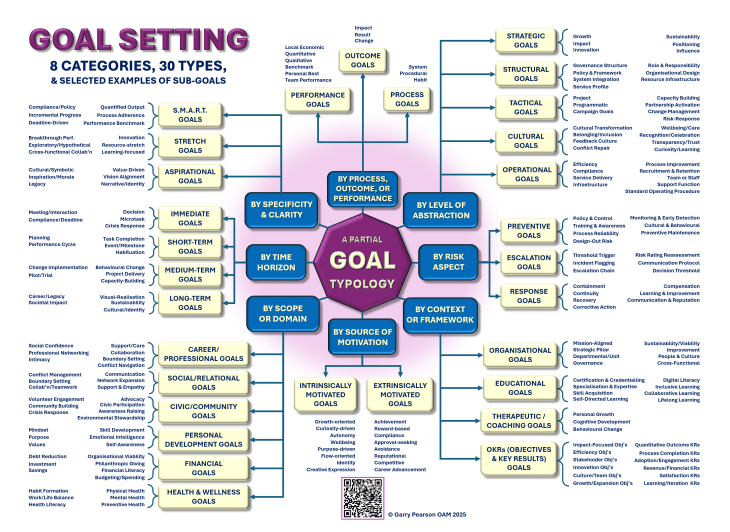
Goal setting is the process of identifying a desired outcome and creating a structured plan to achieve it, backed by decades of research in organizational psychology and behavioral science.
Effective goal setting is one of the most reliably proven methods for improving performance - but most popular advice about it either ignores the research entirely or oversimplifies it into frameworks that sound actionable but produce mediocre results.
Understanding what the science actually says about how to set goals, why certain approaches work, and when goals backfire is the difference between the kind of New Year's resolution that evaporates by February and the kind of structured intention that changes the trajectory of a career.
The Foundational Research: Locke and Latham
Thirty-Five Years and Four Hundred Studies
The most extensive empirical work on goal setting comes from Edwin Locke and Gary Latham, two organizational psychologists who spent over 35 years studying the relationship between goal characteristics and human performance.
Their Goal Setting Theory, synthesized across more than 400 laboratory and field studies and published in their definitive 1990 book A Theory of Goal Setting and Task Performance, identifies the specific conditions under which goals reliably improve outcomes.
Their core findings have been replicated across industries, cultures, and task types:
Specific goals outperform vague ones. Telling someone to "do their best" consistently produces worse performance than giving them a specific target.
In a 1968 study by Locke, loggers told to load a specific number of tons per trip loaded significantly more timber than loggers told to "do your best." The specificity provides a clear standard against which to measure current performance and direct effort.
This finding has been replicated in over 100 subsequent studies.
Difficult goals produce higher performance than easy ones. This finding directly contradicts the "achievable" component of the SMART framework. Within the range of goals people genuinely commit to, harder goals produce better outcomes.
The relationship is roughly linear until the goal becomes genuinely impossible, at which point commitment collapses. A 2002 meta-analysis by Locke and Latham covering studies from 1966 to 2002 confirmed a strong positive correlation (d = 0.82) between goal difficulty and performance.
Goal commitment is the essential moderator. Goals only work when the person genuinely commits to them. Assigned goals without explanation or participation produce lower commitment and lower performance than self-set or participatively set goals. Commitment is not the same as compliance - it requires genuine buy-in, not just acquiescence.
Feedback is non-negotiable. Goals without feedback about progress perform no better than no goals at all. The combination of specific, challenging goals plus regular feedback is what drives sustained improvement. Goals set the standard; feedback reveals the gap; effort closes it.
"Goals that are both specific and challenging lead to the highest levels of performance. This conclusion holds for all but the most complex of tasks." - Edwin Locke and Gary Latham, A Theory of Goal Setting and Task Performance (1990)
SMART Goals: What the Research Supports and What It Does Not
The Origin of SMART
The SMART framework - Specific, Measurable, Achievable, Relevant, Time-bound - is the most widely used goal-setting tool in organizations worldwide. It was popularized by George T. Doran in a 1981 paper titled "There's a S.M.A.R.T.
Way to Write Management's Goals and Objectives," published in Management Review. Doran was a consultant, not a researcher, and the paper did not include empirical evidence. The framework was practical and memorable, which explains its adoption. But its relationship to the actual research is mixed.
What SMART Gets Right
- Specific: Strongly supported. This is Locke and Latham's single most consistent finding across hundreds of studies. Specificity reduces ambiguity, directs attention, and provides a clear success criterion.
- Measurable: Well-supported as a practical mechanism for the feedback that Goal Setting Theory requires. If you cannot measure progress, you cannot provide the feedback loop that makes goals effective.
- Time-bound: Moderately supported. Deadlines help overcome procrastination and provide reference points for progress assessment. Research by Dan Ariely and Klaus Wertenbroch (2002) at MIT demonstrated that self-imposed deadlines improve task completion rates compared to no deadlines, though externally imposed deadlines are even more effective.
What SMART Gets Wrong
Achievable is directly contradicted by the research. Locke and Latham's most robust finding is that difficult goals outperform easy ones.
The "achievable" criterion, interpreted as most practitioners interpret it - set goals you are confident you can reach - produces precisely the kind of comfortable target that the research says leads to mediocre performance.
The qualifier probably exists because managers fear setting goals so ambitious that people give up, but the solution is building commitment and self-efficacy, not deliberately lowering the bar.
Relevant is true but trivially so. Of course goals should be relevant. This criterion adds no analytical value; it is the equivalent of advising someone to "eat food that is nutritious." Nobody sets deliberately irrelevant goals.
The Goal Displacement Problem
A deeper limitation of narrow measurable goals is goal displacement - the systematic tendency for people to optimize the measured metric at the expense of unmeasured but important dimensions. This is not a theoretical concern. It is one of the most well-documented failure modes in organizational management.
Orddonez, Schweitzer, Galinsky, and Bazerman addressed this directly in their influential 2009 paper "Goals Gone Wild: The Systematic Side Effects of Over-Prescribing Goal Setting," published in the Academy of Management Perspectives.
They documented cases where specific, measurable targets produced systematically harmful behavior:
- Ford Pinto (1970s): A specific weight and cost target drove engineers to omit safety improvements, contributing to fuel tank explosions that killed an estimated 27 people.
- Sears auto repair (1992): When sales targets were introduced for auto mechanics, employees generated fraudulent repair recommendations to hit their numbers.
- Wells Fargo (2016): Aggressive cross-selling targets incentivized employees to open over 3.5 million unauthorized accounts, resulting in $3 billion in fines and one of the largest banking scandals in American history.
- Enron: A culture built around aggressive financial targets contributed to the systematic accounting fraud that destroyed the company in 2001.
The mechanism is straightforward: when goals are narrow and measurable, rational actors optimize for the goal even when doing so degrades overall performance or ethics. The more precisely you specify what you want measured, the more you get exactly that - and nothing else.
OKRs: A More Sophisticated Framework
Origins and Structure
Objectives and Key Results (OKRs) were developed at Intel by Andy Grove in the 1970s and popularized globally by venture capitalist John Doerr, who introduced them to Google in 1999.
Doerr's 2018 book Measure What Matters brought OKRs mainstream, and they have since become the dominant goal framework in technology companies and an increasing number of organizations in other sectors.
An OKR has two components:
- Objective: A qualitative, inspiring description of what you want to achieve. Example: "Become the most trusted brand in our category."
- Key Results: Two to five specific, measurable indicators that would demonstrate achievement of the Objective. Example: "Net Promoter Score above 60," "Customer retention rate above 92%," "Unaided brand awareness increases from 18% to 35%."
The pairing addresses a fundamental weakness of purely measurable goals: the Objective provides qualitative intent and inspiration; the Key Results provide measurable evidence. If you hit all the Key Results but miss the spirit of the Objective, something went wrong in how you defined or pursued them.
How OKRs Differ from SMART Goals
| Dimension | SMART Goals | OKRs |
|---|---|---|
| Ambition level | Achievable (conservative) | Deliberately challenging (70% achievement = success) |
| Update cycle | Often annual | Typically quarterly |
| Transparency | Often private between employee and manager | Typically public within the organization |
| Structure | Single statement | Objective + multiple Key Results |
| Primary use | Individual performance management | Team and organizational alignment |
| Failure signal | Missed targets indicate underperformance | Consistent 100% achievement indicates targets too easy |
The most important structural difference: OKRs are calibrated so that 70% achievement indicates success. Google has historically said that consistently achieving 100% of an OKR means it was set too conservatively.
This directly implements the Locke-Latham finding that challenging goals outperform easy ones - and it structurally prevents the "achievable" trap that SMART goals create.
For organizations evaluating which framework to adopt, the comparison with KPIs and other measurement systems is also worth understanding, since OKRs and KPIs serve different but complementary functions.
Implementation Intentions: The Missing Link Between Goals and Action
The Intention-Action Gap
The most practically significant finding in goal research that most people have never encountered comes from Peter Gollwitzer, a psychologist at New York University, and his work on implementation intentions.
The insight addresses a fundamental problem: there is a substantial gap between intending to pursue a goal and actually taking action. Most goal-setting research measures what people intend to do - and finds that people with specific goals outperform those with vague ones.
But real-world goal achievement requires the translation of intention into behavior, and that translation is where most goals fail. You intend to start exercising. You intend to write that book. You intend to have that difficult conversation. And then Monday arrives, the alarm goes off at 6 AM, and the intention evaporates.
Implementation intentions are if-then plans that specify the when, where, and how of goal-directed action:
- "When I finish my morning coffee, I will write for 30 minutes before opening email."
- "When I feel the urge to check social media during work, I will take three deep breaths and return to the current task."
- "When I arrive at the office on Monday morning, I will spend the first 20 minutes on the highest-priority project before checking messages."
The format links a specific situational cue (the "if") to the goal-directed behavior (the "then"). The decision is made in advance, at a moment of calm deliberation, rather than in the moment when competing impulses, fatigue, and circumstances create friction.
The Evidence
A meta-analysis by Gollwitzer and Sheeran (2006), published in Advances in Experimental Social Psychology and covering 94 independent studies with over 8,000 participants, found that forming implementation intentions produced a medium-to-large effect (d = 0.65) on goal achievement compared to simply intending to pursue goals.
The average participant with implementation intentions was roughly twice as likely to achieve their goal.
The effect holds across domains: exercise initiation, medication adherence, voting behavior, healthy eating, academic performance, cancer screening attendance, and recycling behavior.
The mechanism appears to be automaticity - the if-then link creates a mental association between the situational cue and the behavior, pre-empting the deliberation that often derails action at the critical moment.
Practical application: After setting any goal, ask yourself: What specific situation will trigger the first action? What exactly will I do when that situation occurs? Write the answer in if-then form. This single step, taking less than two minutes, approximately doubles the probability of follow-through.
Approach vs. Avoidance Goals
Framing Effects on Motivation and Performance
A dimension of goal framing with consistently documented effects is the distinction between approach goals and avoidance goals:
- Approach goals direct behavior toward a desired positive outcome: "I will read for 30 minutes each evening."
- Avoidance goals direct behavior away from an undesired negative outcome: "I will stop watching TV after 10 PM."
Andrew Elliot at the University of Rochester has conducted extensive research on this distinction since the mid-1990s.
His meta-analyses find that approach goals reliably produce better outcomes than avoidance goals across academic performance, physical health behaviors, interpersonal relationships, and psychological well-being (Elliot & Church, 1997; Elliot & McGregor, 2001).
The mechanisms are well understood:
- Approach goals generate more positive affect and sustained motivation because pursuit feels like progress toward something good.
- Avoidance goals create vigilance and anxiety that can impair performance, because pursuit feels like fleeing from something bad.
- Approach goals provide a clearer behavioral direction - what to do rather than what not to do. The brain processes positive instructions more efficiently than negative ones.
This does not mean avoidance goals are never appropriate - sometimes the problem genuinely is a behavior to stop. But when possible, reframing avoidance goals as approach goals improves outcomes.
"I will exercise three mornings per week" typically produces better results than "I will stop being sedentary," even though both target the same underlying behavior change.
Mental Contrasting: Why Positive Visualization Alone Fails
The Surprising Problem with Optimistic Fantasy
Gabriele Oettingen, a psychologist at New York University and the University of Hamburg, has produced some of the most important and underappreciated findings in goal psychology through her research on mental contrasting.
Popular self-help advice frequently recommends vivid visualization of goal achievement: imagine yourself crossing the finish line, picture the promotion, feel the satisfaction of the completed project.
Oettingen's experiments, published across multiple studies from 1991 through the 2010s, found that this approach - which she calls positive fantasizing - actually reduces goal-directed effort compared to no visualization at all (Oettingen & Mayer, 2002).
The mechanism is both elegant and troubling: positive fantasy provides a cognitive preview of the desired future that produces the emotional satisfaction of achievement without the effort. The brain, having already experienced a simulation of success, reduces the motivational energy needed for actual pursuit.
Students who vividly imagined getting high grades studied less. Job seekers who fantasized about landing their dream job sent out fewer applications.
WOOP: The Evidence-Based Alternative
What works instead is a structured process Oettingen developed called WOOP (Wish, Outcome, Obstacle, Plan):
- Wish: Articulate what you want to achieve.
- Outcome: Vividly imagine the best outcome of achieving it - feel the emotions, picture the details.
- Obstacle: Identify the most critical internal obstacle - not external circumstances but your own psychological or behavioral patterns that have derailed similar efforts in the past.
- Plan: Form an implementation intention (if-then plan) for how you will respond when that obstacle arises.
WOOP has been tested in multiple randomized controlled trials. A 2015 study by Oettingen, Mayer, and Brinkmann found that WOOP improved physical activity levels, dietary habits, and academic performance compared to both positive visualization alone and no intervention.
The combination of positive visualization with obstacle anticipation - rather than positive visualization alone - produces the motivational energy needed for sustained effort.
The mechanism is energization through contrast: imagining the desired future creates desire; confronting the obstacle creates urgency; the implementation intention provides a plan. Together, these elements produce commitment that pure optimism cannot.
Goal Commitment: Why Some Goals Stick and Others Dissolve
The Moderating Role of Commitment
Locke and Latham identified goal commitment as the critical moderator in their theory - challenging goals only improve performance when the person is genuinely committed. Several factors determine commitment:
Participation in goal setting increases commitment compared to purely assigned goals. People commit more to goals they had a role in creating.
This does not require full autonomy - even partial participation ("here are three options, which resonates most?") improves commitment over pure assignment. A 1988 meta-analysis by Latham, Erez, and Locke confirmed this effect across organizational settings.
Self-efficacy moderates commitment to difficult goals. Albert Bandura, the Stanford psychologist whose research on self-efficacy theory is among the most cited in psychology, demonstrated that very difficult goals produce high performance when people believe they can achieve them with effort, and produce abandonment when people believe they are fundamentally incapable (Bandura, 1997).
Building evidence of competence through small wins, feedback on progress, and observation of similar others succeeding maintains commitment to challenging goals.
Public commitment increases follow-through, though the effect is more nuanced than popular wisdom suggests. A 2019 study by Klein, Molloy, and Brinsfield found that public commitment works primarily through accountability mechanisms - the social cost of visible failure motivates continued effort.
Writing goals down, sharing them with an accountability partner, or creating visible tracking systems all leverage this mechanism.
Values alignment is obvious but frequently overlooked: people commit to goals they actually care about. Many goal-setting failures are not failures of technique but failures of values clarification - people setting goals they think they should want rather than goals reflecting genuine preferences.
The discipline of asking "do I actually want this, or do I think I should want this?" before committing to a goal prevents a substantial proportion of abandonment.
When Goals Backfire: The Dark Side of Goal Setting
Intrinsic Motivation Erosion
Edward Deci and Richard Ryan's Self-Determination Theory (SDT), developed over four decades at the University of Rochester, documents how introducing external performance goals for activities people intrinsically enjoy can systematically undermine their motivation.
When people begin tracking metrics, competing for rewards, or pursuing external recognition for activities they previously did for pleasure, intrinsic motivation often declines - a phenomenon known as the overjustification effect.
This is particularly relevant in creative and learning contexts. Imposing performance goals on learning activities can shift people from learning goals (aimed at understanding and growth) to performance goals (aimed at demonstrating competence), which impairs performance on complex, novel tasks (Dweck, 1986).
The difference between genuine learning and performance theater has profound implications for how goals should be structured in educational and developmental contexts.
The Near-Miss Effect
Research by Amir and Ariely (2008) and by Schweitzer, Orddonez, and Douma (2004) shows that when people are close to but slightly below a goal threshold, they engage in escalating risk-taking and, in some cases, unethical behavior.
Bank loan officers approaching quarterly quotas, salespeople nearing end-of-month targets, and executives close to bonus thresholds all show this pattern. The goal creates a psychological bright line that overrides broader ethical and rational constraints.
The 2004 Schweitzer study, published in the Academy of Management Journal, found that participants who fell just short of a goal were significantly more likely to misrepresent their performance than those who fell far short or those who met the goal. The proximity to the target, not the absolute shortfall, drives the behavior.
Tunnel Vision and Missed Opportunities
Narrow goals focus attention - which is both their value and their danger. People with specific numerical goals pay less attention to information outside the goal domain. This is useful when the goal domain is the right domain.
It is harmful when circumstances change and the goal should be revised, but tunnel vision prevents recognition of the change.
In rapidly changing environments, rigid adherence to goals set under different conditions is not discipline - it is a form of the sunk cost fallacy. The discipline of reviewing and revising goals when material circumstances change is as important as the discipline of pursuing them.
Practical Integration: An Evidence-Based Goal-Setting Process
The research converges on an integrated approach that draws from multiple findings:
Set challenging, specific goals - not "do your best" and not trivially easy targets. The goal should require genuine effort and represent meaningful progress.
Separate the aspirational from the measurable - OKR-style. Articulate what you actually want in qualitative terms, then identify the measurable evidence that would demonstrate you achieved it.
Form implementation intentions - for every goal, specify the when, where, and how of the first action. Write it in if-then format.
Frame goals as approach, not avoidance - wherever possible, specify what you will do rather than what you will stop doing.
Use mental contrasting (WOOP) - imagine the outcome, then identify the most likely internal obstacle, then plan your response to it.
Build commitment deliberately - participate in setting the goal, connect it to values you genuinely hold, share it with someone who will hold you accountable.
Track leading indicators, not just outcomes - outcomes are often lagging and imprecise. Tracking process behaviors (writing sessions completed, calls made, workouts done) provides more frequent feedback and maintains motivation through visible progress.
Review and revise on a regular cadence - goals should be updated when circumstances change materially. Quarterly review is a useful default. Rigid adherence to goals that have become obsolete or harmful is not discipline; it is waste.
Conclusion
Goal setting is one of the most powerful tools in the psychology of motivation and performance - when done correctly. The research from Locke and Latham is clear: specific, challenging goals with feedback improve performance with an effect size that few interventions in organizational psychology can match.
Gollwitzer's implementation intentions research shows how to bridge the critical gap from intention to action. Oettingen's work on mental contrasting corrects the counterproductive popular advice about positive visualization.
The failure modes are equally well-documented: goals that displace unmeasured priorities, erode intrinsic motivation, or trigger near-miss unethical behavior all represent real risks of naive goal implementation. The framework matters less than the thinking behind it.
The synthesis is not complicated, but it requires ignoring some popular advice: set goals that are challenging rather than comfortably achievable, convert them into specific if-then action plans, use mental contrasting rather than fantasy, build commitment through participation and values alignment, and track behavior rather than just outcomes.
That combination, applied consistently, is what the evidence actually supports.
Sources & Further Reading
- Locke, Edwin A., and Gary P. Latham. A Theory of Goal Setting and Task Performance. Prentice Hall, 1990.
- Locke, Edwin A., and Gary P. Latham. "Building a Practically Useful Theory of Goal Setting and Task Motivation." American Psychologist 57, no. 9 (2002): 705-717.
- Doran, George T. "There's a S.M.A.R.T. Way to Write Management's Goals and Objectives." Management Review 70, no. 11 (1981): 35-36.
- Orddonez, Lisa D., Maurice E. Schweitzer, Adam D. Galinsky, and Max H. Bazerman. "Goals Gone Wild: The Systematic Side Effects of Over-Prescribing Goal Setting." Academy of Management Perspectives 23, no. 1 (2009): 6-16.
- Gollwitzer, Peter M., and Paschal Sheeran. "Implementation Intentions and Goal Achievement: A Meta-Analysis of Effects and Processes." Advances in Experimental Social Psychology 38 (2006): 69-119.
- Oettingen, Gabriele, and Doris Mayer. "The Motivating Function of Thinking About the Future: Expectations Versus Fantasies." Journal of Personality and Social Psychology 83, no. 5 (2002): 1198-1212.
- Oettingen, Gabriele. Rethinking Positive Thinking: Inside the New Science of Motivation. Current, 2014.
- Doerr, John. Measure What Matters: How Google, Bono, and the Gates Foundation Rock the World with OKRs. Portfolio/Penguin, 2018.
- Elliot, Andrew J., and Marcy A. Church. "A Hierarchical Model of Approach and Avoidance Achievement Motivation." Journal of Personality and Social Psychology 72, no. 1 (1997): 218-232.
- Bandura, Albert. Self-Efficacy: The Exercise of Control. W.H. Freeman, 1997.
- Schweitzer, Maurice E., Lisa Orddonez, and Bambi Douma. "Goal Setting as a Motivator of Unethical Behavior." Academy of Management Journal 47, no. 3 (2004): 422-432.
- Ariely, Dan, and Klaus Wertenbroch. "Procrastination, Deadlines, and Performance." Psychological Science 13, no. 3 (2002): 219-224.