
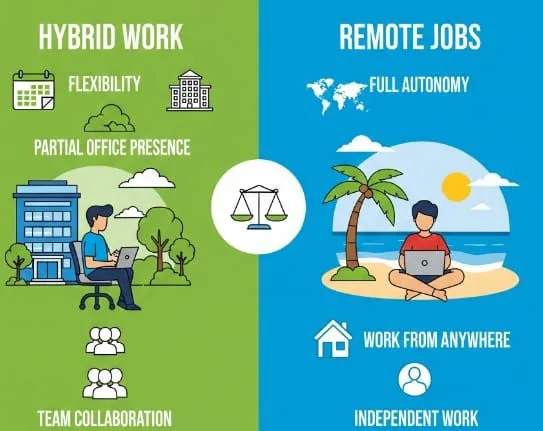
The remote work debate picked up unusual urgency after 2020 for one reason: it stopped being theoretical. For the first time, hundreds of millions of knowledge workers ran the same natural experiment all at once. Leave the office. Close the door. Work from home.
Some thrived. A software engineer who'd spent years getting interrupted every fifteen minutes in an open office suddenly had four quiet hours a day. Turned out vastly more productive once they had quiet and autonomy.
Others found themselves isolated. Struggling to separate work from home life. Missing the social scaffolding of a shared space. Falling behind peers who stayed more visible to their managers, the ones still walking past the boss's desk every day.
The experiment generated better data than this debate had ever had before. Economists, organizational psychologists, management researchers gathered real-world productivity measures, career outcome data, wellbeing surveys, at a scale nobody had seen.
The findings turned out more nuanced than either camp, "remote work is clearly better" or "everyone needs to be in the office," wants to admit.
Here's what the research actually shows: the optimal arrangement is highly task-dependent and career-stage-dependent, and hybrid arrangements capture most of the benefits of each while cutting most of the costs.
"The research question is not 'is remote work good or bad?' It is 'which tasks, roles, and career stages benefit from remote work, and by how much, and what are the costs in each case?' The honest answer requires nuance that neither side of the popular debate usually provides." - Nicholas Bloom, Professor of Economics, Stanford University
A few terms are worth pinning down before going further. Full remote work means the employee works entirely from home or other non-office locations, with no required in-office presence at all. It's common in fully distributed companies like GitLab, Automattic, and Basecamp.
Hybrid work mixes in-office and remote days, either flexibly or on a fixed structure. Most hybrid arrangements settle around 2-3 days in the office per week. Nicholas Bloom's 2024 Nature paper found hybrid work is the arrangement with the strongest current evidence behind it.[2]
Proximity bias is the documented tendency for managers and organizations to perceive and evaluate in-person employees more favorably than remote employees doing equivalent work, and to include them more readily in opportunities, decisions, informal career development.
Deep work is Cal Newport's term for cognitively demanding, focused, uninterrupted work, writing, coding, analysis, creative work, that requires sustained concentration. It's generally easier to achieve in environments with few interruptions.
And collaborative work covers tasks requiring real-time interaction, spontaneous communication, shared problem-solving, interpersonal relationship building. Research suggests this category is harder to fully replicate in digital formats.
Work Arrangement Comparison
| Factor | Full Remote | Hybrid (2-3 days office) | Full Office |
|---|---|---|---|
| Deep work quality | High (fewer interruptions) | High on remote days | Varies by office environment |
| Collaboration quality | Lower | High | Highest |
| Commute cost | Zero | 2-3x/week | 5x/week |
| Career visibility | Lower | Moderate-High | Highest |
| Early-career mentorship | Significant gap | Moderate gap | Best |
| Job satisfaction (research) | Variable | Consistently high | Moderate |
| Retention outcomes | Mixed | Significantly better | Baseline |
| Isolation risk | High | Low-moderate | Low |
Data sources: Bloom et al. (2024), Nature; Yang et al. (2022), Nature Human Behaviour; Gallup State of the Global Workplace 2023.
The Scale of the Shift
Before diving into the research, it's worth appreciating just how dramatically work arrangements have shifted. Barrero, Bloom, and Davis (2021) found remote work in the United States went from roughly 5% of working days before the pandemic to over 60% in May 2020.[7]
By late 2022, it had settled at around 30%. Still six times the pre-pandemic level.[15]
A 2023 survey by SHRM, the Society for Human Resource Management, found 58% of employers now offer hybrid arrangements, while 20% offer fully remote options.[18] Only 22% require full-time office attendance.
This is a structural shift. Not a temporary accommodation. Employers who tried mandating a full-time return to the office in 2022-2023 ran into real employee resistance, with several high-profile departures and real hiring difficulties at firms including Apple, Amazon, and several major banks.
Globally, the picture varies a lot by country. Japanese workers spend the most time in offices of any developed nation. Dutch and Scandinavian workers spend the least.
That variation reflects both cultural norms and housing conditions. Workers packed into dense cities with small apartments face a very different home-office reality than those in suburban homes with a spare room to spare.
What the Productivity Research Actually Shows
The Stanford Call Center Study
Nicholas Bloom's 2015 study of Ctrip, a Chinese travel agency, call center workers became the most-cited study in remote work research.[1] Workers randomly assigned to work from home showed a 13% productivity increase relative to office-based controls.
Where did the gains come from? Mostly fewer breaks and sick days, quieter work environments, reduced commute fatigue.
What makes this study matter so much is its randomized design, rare in social science research, which gives it unusually high internal validity. Workers got randomly assigned to home or office conditions, controlling for the self-selection effects that plague observational studies.
Home workers turned out more productive. Not less. That contradicted the prevailing managerial assumption at the time, and it drew real attention.
There's a real limitation here, one Bloom and others have acknowledged repeatedly: call center work is unusually measurable, and involves relatively low collaboration needs. Productivity could be tracked in real time, through calls handled and sales made.
Those productivity gains don't automatically transfer to knowledge work that requires real coordination, mentorship, or innovation.
Post-2020 Research on Knowledge Workers
Larger studies of knowledge worker productivity post-2020 show more mixed results. A 2023 study by Bloom and colleagues found that hybrid work (2 days per week remote) produced no measurable productivity difference compared to full office work on standard output metrics, while significantly improving job satisfaction and retention.
This is the most policy-relevant finding: hybrid work preserves productivity while substantially improving the factors that drive employee retention and wellbeing.
Gibbs, Mengel, and Siemroth (2023), analyzing data from over 10,000 workers at an Asian technology company before and after a work-from-home mandate, found that remote work was associated with a 18% reduction in productivity for software developers, with the losses driven primarily by reduced collaboration and knowledge spillovers.[9]
The finding stands in contrast to the Ctrip study and illustrates how much task type and company culture moderate the productivity effect.
Research on full-time remote work for knowledge workers is less favourable at the margins.
Microsoft's research on its own workforce found that organisational networks became more siloed and less cross-functional under full remote work - effects that are harder to quantify as productivity in the short run but may represent real costs in innovation and knowledge transfer.
Yang et al.'s (2022) Nature Human Behaviour study confirmed this: remote work caused information worker collaboration networks to become more static and insular, reducing the informal cross-team knowledge flows that research identifies as important sources of creative output.[3]
Task Type Matters More Than Arrangement
The most consistent finding across all this research: productivity effects depend fundamentally on how much of your work is deep work, individual and focused, versus collaborative, real-time and interpersonal.
For roles heavy on deep-work content, software development, writing, financial analysis, design, research, remote work often boosts output by cutting interruptions and allowing longer unbroken focus periods. A programmer who gets four uninterrupted hours at home may produce more than six interrupted hours in an open-plan office.
Kim and de Dear's (2013) research found open-plan office workers lost an average of 85 minutes a day to noise and visual interruptions. Time that remote workers largely get back.
Flip it around, though: for roles heavy on collaboration content, product management, sales, management, customer success, early-stage innovation, in-person interactions tend to produce faster, richer outcomes than their digital equivalents.
The bandwidth of in-person communication is just higher. Nonverbal cues, spatial co-presence, informal impromptu conversations, shared whiteboarding, none of it translates cleanly into a video call.
Allen (1977), studying R&D organizations, found communication frequency dropped sharply with physical distance, with a real threshold effect: teams more than 30 meters apart communicated as infrequently as teams sitting in entirely different buildings.[12]
The "Allen Curve" still holds up in contemporary studies. Even accounting for digital communication tools.
Career Visibility and Advancement
The Proximity Bias Problem
Picture two employees doing identically good work. One sits three desks from the VP and gets pulled into the Tuesday strategy huddle by accident. The other logs in from home and never hears about the huddle at all. Multiple studies have documented exactly this pattern, called proximity bias: in-person employees get evaluated more favorably and receive more career opportunities than remote counterparts, even when the actual output is identical.
In-office employees get seen working. They're available for spontaneous conversations with senior colleagues. They catch informal feedback and mentorship, and get pulled into ad hoc decisions, in ways remote workers simply miss entirely.
A Harvard Business Review study found remote workers were 50% less likely to receive a promotion than comparable in-office workers in the same roles.
Read that number cautiously, though. It may partly reflect selection effects, and the sample predates the post-pandemic normalization of remote work. Still, the direction of the effect holds consistently across multiple studies.
Gallup's 2023 State of the Global Workplace report found remote workers were less engaged on average than hybrid workers, though more engaged than fully in-office workers who wanted flexibility. Engagement correlated strongly with perceived developmental opportunity, which suggests the career development gap is real, and workers themselves feel it.
There's an important emerging finding around performance evaluation bias too. Hekman and colleagues (2020) found bias against remote workers ran larger in organizational cultures with high "face time" norms, the kind of workplace where staying late and being visibly busy had historically counted for more than what actually got done.
In cultures that had deliberately shifted to outcome-based evaluation instead, judging the work rather than the hours logged at a desk, the proximity bias effect shrank substantially. That suggests the effect is cultural. Not inevitable. And it can be reduced through deliberate management practice.
Early Career Impact
The career development cost of full-time remote work bites hardest early in a career, exactly when informal learning and mentorship matter most.
Junior employees develop skills largely through observation. Watching how senior colleagues handle difficult conversations, solve ambiguous problems, build relationships. That informal apprenticeship is dramatically harder to replicate over video calls.
Research on graduates who joined the workforce during 2020-2022 in fully remote positions documents slower professional development, compared to prior cohorts.
Bessen, Impink, Seamans, and Cabral (2022) found recent graduates in remote positions showed flatter skill-development trajectories in their first two years, compared to those with in-person components. The gap showed up most for interpersonal and adaptive skills specifically.[14]
Here's the implication for early-career workers: accepting a full-remote position may carry career development costs that aren't immediately visible in output metrics, but compound significantly over a career.
The skills never acquired in those first two to three years, tacit knowledge about industry norms, professional judgment, client management instincts, are hard to pick up retroactively later.
"For senior individual contributors and managers with established networks and clear deliverables, remote work is often excellent.
For those who are still figuring out how professional life works - building the internal models that guide judgment - presence around experienced practitioners is genuinely valuable in ways that are hard to replicate." - Adapted from research on workplace learning, Bessen et al. (2022)
The Commute Time Value
The average US round-trip commute runs about 54 minutes a day. Multiply that across a 260-day working year, and you get 234 hours. Nearly six 40-hour work weeks. At the median US wage of roughly $23 an hour, that's $5,382 in time value annually, gone.
Add direct commuting costs on top, transportation, fuel, parking, wear on a vehicle, and the annual cost of commuting typically runs $3,000-$8,000 depending on location and mode of transport.
Economists Alois Stutzer and Bruno Frey (2008) found commuting time carries one of the strongest negative associations with subjective wellbeing of any daily activity.[4] In their analysis, a person with a 90-minute round-trip commute would need to earn 40% more just to report the same life satisfaction as someone with no commute at all.
That "compensating differential" is one of the largest ever documented in wellbeing economics. Larger than the wellbeing effect of most salary increases in the relevant range.
Kahneman and colleagues' (2004) Day Reconstruction Method research confirmed this from a different angle entirely: commuting ranked among the most negatively experienced activities of daily life, scoring lower in affect than even housework.[5]
Women rated commuting more negatively than men did. That tracks with research showing commuting time interacts with unpaid domestic labor to create disproportionate time pressure.
Not every commute is equal, though. Commuting by train or public transport, where you can actually read or listen to something, is substantially less negative for wellbeing than driving through traffic.
There's also the "decompression commute," the wind-down walk or drive that creates a psychological transition between work and home. It has genuine benefits some remote workers miss entirely.
Hartig and colleagues (1996) found that, for some workers, the commute home served as a real transition ritual aiding psychological detachment from work. A function remote workers have to consciously replicate some other way.
| Commute Time (Round Trip) | Annual Hours Lost | Wellbeing Cost | Equivalent Salary Requirement |
|---|---|---|---|
| 0 minutes | 0 hours | Baseline | Baseline |
| 30 minutes | 130 hours | Low | +5-10% more |
| 60 minutes | 260 hours | Moderate | +20-25% more |
| 90 minutes | 390 hours | High | +40% more |
| 120 minutes | 520 hours | Very high | +50%+ more |
Salary equivalents derived from Stutzer and Frey (2008)
Isolation and Mental Health
The Loneliness Cost
The most consistent downside of full-time remote work, across employee surveys, is loneliness and isolation.[17] An office's casual interactions, impromptu conversations, shared lunches, overhearing colleagues, visible signs of human activity, supply a kind of social ambient experience that remote work simply eliminates.
A Buffer State of Remote Work report (2023), surveying over 3,000 remote workers globally, found 22% cited loneliness as the biggest struggle with remote work, the second most common response after "unplugging after work." Interestingly, loneliness came up more often among workers who'd been remote for more than two years. It seems to accumulate over time rather than being a short-term adjustment cost.
Holt-Lunstad, Smith, and Layton (2010) established that loneliness and social isolation carry a 29% increase in mortality risk, an effect size comparable to smoking 15 cigarettes a day, and larger than the mortality effects of obesity.[13]
Full-time remote work doesn't necessarily create clinical loneliness on its own. But work-related social isolation accumulating over years may feed into the broader social isolation picture.
Meta-analyses on the wellbeing effects of remote work keep finding the same inverted-U shape: moderate remote work, 1-3 days a week, tracks with higher job satisfaction than either extreme.[6]
Full remote work shows much higher variance in outcomes. Better for some people, significantly worse for others. Introversion, quality of home environment, and strength of outside social network all moderate the effect.
Psychological Wellbeing by Arrangement
A 2023 Gallup analysis of over 100,000 US employees found:[8]
- Hybrid workers reported the highest engagement (34%)
- Fully remote workers reported moderate engagement (28%)
- Fully in-office workers reported the lowest engagement (26%) when they wanted flexibility, but high engagement (33%) when in-office work matched their preference
The critical variable turns out to be choice and fit. Whatever arrangement matches worker preferences produces the best wellbeing outcomes, regardless of which arrangement it actually is. Forced full-remote and forced full-office both produce worse outcomes than an arrangement chosen to match individual and role needs.
What Reduces Isolation Risk
A few factors substantially cut the isolation risk of remote work. Maintaining strong social relationships outside work is the single strongest predictor of remote worker wellbeing. Using co-working spaces for some remote days helps too. So does maintaining regular virtual social contact with colleagues, beyond just transactional work calls, and showing up for periodic in-person team events.
Companies that invest in quarterly in-person all-team gatherings for fully remote employees see meaningfully better cohesion and retention than those operating purely digitally. Bringing distributed teams together periodically consistently pays off, in stronger collaboration and lower attrition.
GitLab, one of the world's largest fully remote companies, reports that its twice-yearly all-company gatherings, "GitLab Contribute," are the single most-cited retention factor in employee surveys.
The Office Environment Variable
Much of this debate assumes "office work" means the same thing across every office environment. The research shows that assumption is flatly wrong.
Open-plan offices, the dominant office design of the 2000s-2010s, adopted to cut costs and "increase collaboration," produce some of the worst knowledge work conditions around.
Kim and de Dear's (2013) analysis of over 42,000 US respondents found open-plan workers reported significantly more distraction, less privacy, and lower satisfaction with their work environment than workers in private offices.[10]
The collaboration benefit frequently cited as the rationale for open-plan design? It didn't hold up. Collaboration frequency wasn't actually higher in open offices.
Ethan Bernstein and Stephen Turban (2018) used sociometric sensors to measure actual collaboration patterns in offices, before and after conversion to open-plan design.[11]
They found open-plan redesign cut face-to-face interaction by 70%. Workers responded to the lack of privacy by putting on headphones and retreating into digital communication instead. The intended collaboration effect got replaced by more email and messaging.
This has direct implications for the "remote vs. office" comparison. Some "office" environments are actively worse for focused work than a home office. The productivity comparison depends heavily on the quality of both the home workspace and the office environment being compared.
The Case for Intentional Office Design
Heerwagen and colleagues (2004) studied "knowledge work environments" and identified what actually makes office spaces support knowledge worker productivity: a mix of private spaces for focused work, small-group spaces for collaboration, informal social spaces, combined with high-quality acoustics, natural light, environmental control.
Offices built on these principles produce measurably better outcomes than either undifferentiated open plans or traditional closed-office layouts.
The implication for the hybrid debate is simple: the office is most valuable when it does what it does best, in-person collaboration, relationship building, mentorship, spontaneous interaction. Not when it's used for the same focused individual work that gets done better at home anyway.
What the Research Says is Optimal
The most robust finding across the largest, best-designed studies: hybrid work, roughly 2-3 days in the office per week, produces the most favorable combination of productivity, job satisfaction, and retention outcomes.
Nicholas Bloom's Nature paper (2024), based on a randomized controlled trial at a large professional services company, found hybrid workers showed no significant productivity difference from full-time office workers. They reported significantly higher job satisfaction, and showed substantially lower attrition, about one-third less, under the hybrid condition.
That productivity finding matters because it demolishes one of the most common arguments against hybrid work: that flexible arrangements necessarily compromise output. They don't, at least not here.
For employers, the retention finding may be the most compelling piece of all. Turnover is expensive. Replacing a knowledge worker often costs an estimated 50-200% of their annual salary, once you count recruitment, onboarding, and productivity ramp time (Society for Human Resource Management, 2022).
If hybrid work cuts attrition substantially without cutting output, the business case holds up even before you factor in the talent-acquisition benefits of offering flexibility in a competitive market.
A 2022 McKinsey survey found 87% of employees offered flexible work arrangements actually take advantage of them.[16] The same survey found companies perceived as "inflexible" on work location were significantly less competitive at attracting talent, especially among workers under 35.
That talent-market reality means work arrangement policy has become a strategic competitive issue. Not just an operational one.
Practical Recommendations
What should you actually do with all this? It depends on where you're standing.
Negotiating your own arrangement, most career stages, early career especially, the evidence favors hybrid over full remote. Get 2-3 days in the office if you have the choice, a Tuesday and Thursday in the building, say. That preserves visibility, mentorship access, collaboration quality, while still leaving you meaningful time and flexibility on the remote days.
Full remote works best for senior individual contributors with strong networks and genuinely autonomous roles, people who already know everyone they need to know.
Early in your career specifically, prioritize in-person presence for at least your first 2-3 years. A twenty-four-year-old analyst who watches her manager talk a nervous client off the ledge in a hallway conversation learns something no video call teaches her. That informal learning, mentorship, network building happening in shared spaces is genuinely hard to replicate anywhere else, and the career development cost of skipping it compounds over time.
Stuck in a fully remote role regardless? Actively counteract the cost. Request regular video calls with senior colleagues. Seek out formal mentorship arrangements. Invest in whatever in-person interaction you can get on the calendar, conferences, team offsites, company gatherings.
Already working full remote long-term, invest deliberately in the things that arrangement tends to deprioritize. Periodic in-person team time. Co-working spaces for some days. Actively cultivating outside social relationships. Regular connection with senior colleagues. None of that discipline is a burden. It's an investment in the social infrastructure remote work erodes by default.
Managing people? Proximity bias is real, and someone has to consciously counteract it. Establish explicit remote-friendly promotion criteria. Make sure remote workers get included in informal communications, the ones that happen in a hallway and never make it into a Slack channel. Build regular structured touchpoints with remote team members. None of this eliminates the career development penalty of remote work. It partially mitigates it.
Hekman and colleagues (2020) found managers who adopted clear output metrics and deliberately included remote workers in development conversations produced substantially smaller visibility gaps between their remote and in-person team members.
Designing policy at the organizational level, match policy to role type. A blanket policy, all remote or all in-office, will be suboptimal for a meaningful share of your roles. An engineering team doing heads-down deep work all week needs a different arrangement than a sales team living on the phone, or a management layer that exists to coordinate other people.
The most sophisticated approach is role-based flexibility with team-level coordination norms. Not a single company-wide mandate handed down from the top.
Sources & Further Reading
- Bloom, N., Liang, J., Roberts, J., & Ying, Z.J. (2015). Does working from home work? Evidence from a Chinese experiment. Quarterly Journal of Economics 130(1), 165-218.
- Bloom, N., Han, R., & Liang, J. (2024). How hybrid working from home works out. Nature 630, 871-879.
- Yang, L., Holtz, D., Jaffe, S., et al. (2022). The effects of remote work on collaboration among information workers. Nature Human Behaviour 6(1), 43-54.
- Stutzer, A., & Frey, B.S. (2008). Stress that doesn't pay: The commuting paradox. Scandinavian Journal of Economics 110(2), 339-366.
- Kahneman, D., Krueger, A.B., Schkade, D.A., Schwarz, N., & Stone, A.A. (2004). A survey method for characterizing daily life experience. Science 306(5702), 1776-1780.
- Gajendran, R.S., & Harrison, D.A. (2007). The good, the bad, and the unknown about telecommuting. Journal of Applied Psychology 92(6), 1524-1541.
- Barrero, J.M., Bloom, N., & Davis, S.J. (2021). Why working from home will stick (NBER Working Paper 28731).
- Gallup. State of the Global Workplace: 2023 Report. Gallup Organization.
- Gibbs, M., Mengel, F., & Siemroth, C. (2023). Work from home and productivity. Journal of Political Economy Microeconomics 1(1), 7-41.
- Kim, J., & de Dear, R. (2013). Workspace satisfaction: The privacy-communication trade-off in open-plan offices. Journal of Environmental Psychology 36, 18-26.
- Bernstein, E.S., & Turban, S. (2018). The impact of the 'open' workspace on human collaboration. Philosophical Transactions of the Royal Society B 373, 20170239.
- Allen, T.J. (1977). Managing the Flow of Technology. MIT Press.
- Holt-Lunstad, J., Smith, T.B., & Layton, J.B. (2010). Social relationships and mortality risk: A meta-analytic review. PLOS Medicine 7(7), e1000316.
- Bessen, J., Impink, S.M., Seamans, R., & Cabral, L. (2022). The role of remote work in the digital transformation of the economy. Boston University School of Law Working Paper.
- Stanford Institute for Economic Policy Research. Remote work across jobs, companies, and space. SIEPR Policy Brief, 2023.
- McKinsey Global Institute. (2022). American opportunity survey. McKinsey & Company.
- Buffer. (2023). State of Remote Work 2023. Buffer.com.
- SHRM. (2023). Navigating flexible work arrangements. Society for Human Resource Management.
Further Reading
- Hekman, D.R., et al. (2020). Does diversity-valuing behavior result in diminished performance ratings for non-white and female leaders? Academy of Management Journal 60(2), 771-797.
- Bailyn, L. (1988). Freeing work from the constraints of location and time. New Technology, Work and Employment 3(2), 143-152.