
More explanation can obscure the point it is meant to clarify. The cobra principle in communication describes how extra qualifications, context, and detail raise cognitive load, dilute a central message, and create new opportunities for misunderstanding.
Direct, structured communication can be easier to process and act on, whereas verbosity may reflect the sender's fear of error or desire to appear thorough rather than the recipient's needs.
The Cobra Principle in communication is the counterintuitive finding that adding more words, qualifications, and detail to a message often weakens rather than strengthens it.
Rooted in systems thinking and supported by decades of research in cognitive psychology, linguistics, and organizational behavior, this principle explains why the most effective communicators routinely say less than their peers - and achieve more because of it.
Whether you are writing an email, delivering a presentation, or navigating a difficult conversation at work, understanding why brevity outperforms volume is one of the most practically valuable communication skills you can develop.
The Origin of the Cobra Principle
A Colonial Parable About Unintended Consequences
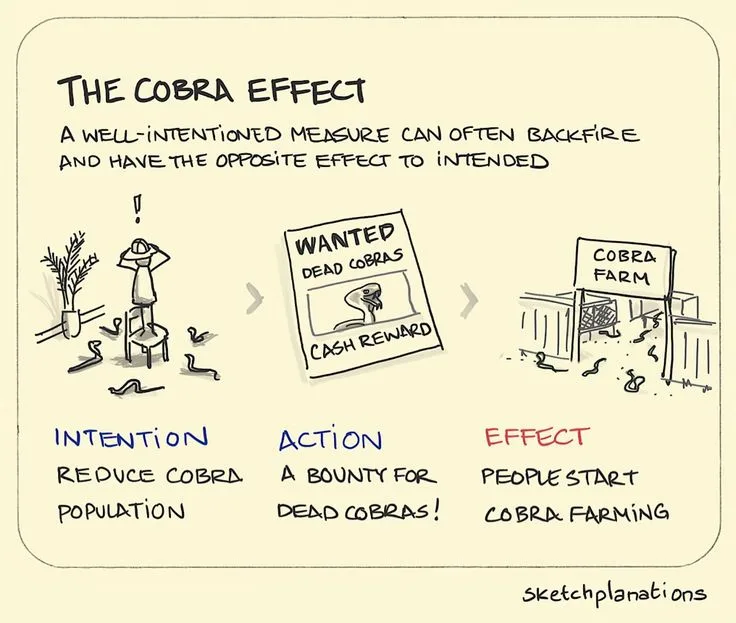
The original cobra effect refers to a historical episode during British colonial rule in India. Concerned about the number of venomous cobras in Delhi, the colonial government offered a bounty for every dead cobra brought in. The policy worked initially - people killed cobras and collected the reward.
But enterprising residents soon began breeding cobras specifically to collect the bounty. When the government discovered the scheme and canceled the program, the now-worthless captive cobras were released into the streets. The net result: more cobras than before the intervention.
The economist Horst Siebert popularized this story in his 2001 book Der Kobra-Effekt, using it to illustrate how well-intentioned interventions in complex systems frequently produce the opposite of their intended effect. The German psychologist Dietrich Dorner had already documented the same pattern experimentally.
In his landmark 1996 book The Logic of Failure, Dorner described studies in which participants managed simulated complex environments - a small town, an African village, a factory.
The participants who intervened most aggressively, making more decisions and implementing more programs, consistently produced worse outcomes than those who acted with restraint and precision.
"The more vigorously we tackle a problem, the more we can become entangled in it." - Dietrich Dorner, The Logic of Failure (1996)
Applying the Principle to Communication
The parallel to communication is direct. When you sense that a message might be misunderstood, the natural instinct is to add more: more context, more qualifications, more preemptive answers to possible objections. Each addition feels like it strengthens the message.
But each addition also increases cognitive load for the reader, dilutes the prominence of the core point, and introduces more opportunities for misinterpretation.
The Cobra Principle in communication: the effort to prevent misunderstanding by adding words frequently produces the misunderstanding it was trying to prevent.
This is not a metaphor. It is a measurable phenomenon with a substantial research base behind it.
The Psychology of Why People Over-Communicate
Fear of Being Wrong
Qualifications and hedges serve as psychological insurance. "I think this might possibly be a good approach, depending on the context" cannot be proven wrong in the same way that "this is the right approach" can. The speaker trades communicative power for personal safety.
The message becomes harder to challenge - but also harder to act on.
Psychologist Ellen Langer at Harvard demonstrated as early as 1978 that people respond more readily to clear, direct requests than to qualified ones, even when the qualification contains useful information.
Her famous "copy machine study" showed that simply adding "because I need to make copies" to a request to cut in line at a copy machine increased compliance from 60% to 94% - the same rate as when a genuine reason was provided.
Directness and structure matter more than content volume.
Fear of Missing Something
The urge toward comprehensive coverage feels responsible. If a project update might affect three departments, shouldn't the email mention all three? If there are exceptions to the general recommendation, shouldn't they be noted?
The answer depends on whether the recipient needs that information right now, for the specific purpose of this specific message.
Usually, they do not. The sender's desire for completeness serves the sender's anxiety, not the reader's understanding.
Signaling Effort and Thoroughness
In many organizational cultures, length functions as a proxy for effort. A two-page analysis feels more substantial than a half-page analysis, even if the half-page version contains the same conclusions with less noise.
Research by Daniel Oppenheimer at Princeton, published in a 2006 paper titled "Consequences of Erudite Vernacular Utilized Irrespective of Necessity," found that readers rated authors of simpler prose as more intelligent than authors of unnecessarily complex prose - even when the underlying content was identical.
The assumption that complex, lengthy communication signals expertise is empirically backwards.
Organizational Reinforcement
Many workplaces create feedback loops that reward verbosity. Employees learn that short emails get questioned ("Did you think this through?") while long emails get approved ("Very thorough"). Meeting contributions are valued by airtime rather than insight.
Reports are judged by page count. These cultural pressures create systemic over-communication that degrades collective decision-making over time.
What Research Says About Message Clarity
Processing Fluency: The Science of Easy Reading
Processing fluency is the ease with which information can be mentally absorbed and evaluated. A large body of research, much of it led by psychologist Norbert Schwarz at the University of Southern California, demonstrates that fluency has profound effects on judgment.
Messages that are easy to process are rated as more true, more intelligent, more credible, and more aesthetically pleasing than equivalent messages that are harder to process (Schwarz, 2004).
This effect operates below conscious awareness. People do not think "this was easy to read, therefore I believe it more." They simply experience the ease and attribute it to the quality of the content. The practical implication is stark: clarity is not just a stylistic preference - it is a credibility multiplier.
A 2012 study by Song and Schwarz published in Cognition found that instructions printed in harder-to-read fonts were judged as describing more difficult tasks, requiring more skill, and taking longer to complete - even though the actual instructions were identical.
The medium literally changed the perception of the message.
| Factor | Effect on Perceived Credibility |
|---|---|
| Simple vocabulary | Increases perceived intelligence of author |
| Short sentences | Increases perceived truthfulness of claims |
| Clear structure (headings, lists) | Increases information retention by 25-40% |
| Excessive hedging | Decreases perceived expertise |
| Jargon without necessity | Decreases perceived trustworthiness |
| Longer documents (beyond optimal) | Decreases likelihood of complete reading |
The Hedging Problem: When Qualifications Backfire
Linguistic hedges are phrases that soften or qualify assertions: "I might be wrong, but...", "it seems to me that perhaps...", "this could potentially be an issue..." Hedges are not inherently bad - genuine uncertainty should be communicated honestly.
But hedges used habitually as social lubrication rather than as genuine epistemic markers have well-documented costs.
Linguist Robin Lakoff identified hedging as a feature of what she called "powerless language" in her 1975 book Language and Woman's Place.
Her research showed that speakers who hedge extensively are rated as less knowledgeable and less authoritative, regardless of whether their substantive content is identical to speakers who do not hedge.
Subsequent research by Lawrence Hosman (1989) confirmed that hedging reduces perceived credibility across genders and contexts.
The practical cost is measurable. A 2018 study published in the Journal of Language and Social Psychology by Blankenship and Craig found that hedged arguments were rated as significantly less persuasive than direct arguments, even when participants agreed with the underlying position.
The hedge signals to the listener: "I am not confident in what I am about to say." That signal overrides the content.
Information Overload: The Point of Diminishing Returns
The relationship between information provided and decision quality is not linear. Researchers have consistently found an inverted-U curve: decision quality improves as information increases from zero, peaks at some optimal level, and then declines as additional information creates noise, confusion, and analysis paralysis.
Paul Schoemaker at the Wharton School demonstrated that people feel more confident in decisions made with more information, even when that additional information does not improve (and sometimes degrades) the quality of their choices (Schoemaker & Russo, 1993).
More information creates the subjective experience of thoroughness without the reality of it.
In a landmark 1974 study, psychologist Paul Slovic asked professional horse handicappers to predict race outcomes using 5, 10, 20, and 40 pieces of information about each horse. Their prediction accuracy peaked at 5 pieces of information and did not improve with 10, 20, or 40.
But their confidence in their predictions increased steadily with more information. More data made them more certain, not more correct.
The communication parallel is direct: adding more content to a message does not reliably increase the recipient's understanding.
Past the optimal level of detail, more information creates competition for attention between essential and peripheral content, signals that the sender has not determined what is essential, and reduces the prominence of the most important points.
Occam's Razor Applied to Writing
The Principle of Sufficient Explanation
William of Ockham, a 14th-century English Franciscan philosopher, is credited with the principle that "entities should not be multiplied beyond necessity" - the simplest explanation that adequately accounts for the evidence should be preferred.
Applied to communication, the principle becomes: use the fewest words necessary to convey the meaning accurately.
This is not an argument for oversimplification. Occam's Razor does not say explanations should be as simple as possible. It says they should be as simple as the subject requires. The target is sufficiency, not minimalism for its own sake.
A complex topic genuinely requires more words than a simple one. The discipline is ensuring that every word earns its place.
George Orwell articulated this discipline in his 1946 essay "Politics and the English Language" with six rules that remain the most practical writing guidelines ever published:
- Never use a long word where a short one will do.
- If it is possible to cut a word out, always cut it out.
- Never use the passive where you can use the active.
- Never use a foreign phrase, scientific word, or jargon if you can think of an everyday equivalent.
- Prefer the specific over the abstract.
- Break any of these rules before saying anything outright barbarous.
Rule 2 is the most frequently violated in professional communication. Most first drafts contain 20-30% redundancy - sentences that restate what was already said, transition phrases that could be removed, clauses that elaborate on things already clear.
William Zinsser, author of On Writing Well (1976), called this "the secret of good writing": the discipline of removing every sentence that does not serve the reader.
A Practical Guide to Cutting
| Verbose Phrasing | Simpler Alternative | Words Saved |
|---|---|---|
| "In order to" | "To" | 2 |
| "At this point in time" | "Now" | 4 |
| "Due to the fact that" | "Because" | 4 |
| "It is important to note that" | (Delete; just state it) | 6 |
| "Going forward" | "From now on" or (delete) | 1-2 |
| "In the event that" | "If" | 3 |
| "Utilize" | "Use" | 0 (but clearer) |
| "Per our previous conversation" | "As we discussed" or (delete) | 1-3 |
| "Please don't hesitate to reach out" | "Let me know" | 4 |
| "I wanted to circle back on" | "Following up on" | 3 |
These are not trivial gains. In a 500-word email, eliminating verbose phrasings typically removes 50-100 words - a 10-20% reduction that meaningfully increases readability and the likelihood that the recipient reads the entire message.
Executive Communication: What Senior Leaders Do Differently
The Pyramid Principle: Conclusion First
Barbara Minto, a consultant at McKinsey & Company in the 1960s and 1970s, developed the Pyramid Principle as a framework for professional communication.
Her insight, published in The Minto Pyramid Principle (1987), was that professional communication should begin with the conclusion, followed by supporting arguments, followed by the evidence underlying those arguments.
This is the inverse of how most people naturally organize their thinking. When solving a problem, you start with context, gather evidence, develop reasoning, and arrive at a conclusion. But communicating in that same sequence forces the reader to hold all the context and evidence in working memory without knowing why it matters.
By the time they reach the conclusion - if they reach it - they have either forgotten the early details or stopped reading.
An email that begins "I recommend we delay the launch by two weeks" and then explains why is far more effective than one that begins with three paragraphs of context and arrives at the recommendation in paragraph four. The first version respects the reader's time and attention.
The second version respects only the writer's thought process.
Directness Is Not Arrogance
A common objection to direct communication is that it feels arrogant or presumptuous, particularly in hierarchical cultures.
But there is a meaningful difference between directness (clear statement of a view held with appropriate confidence and openness to revision) and arrogance (closed to evidence and dismissive of alternatives).
The most effective communicators combine clear position-stating with genuine curiosity about counterarguments. They say "here is what I think and why" - not "here is what I think and I will not be moved."
Research by James Pennebaker at the University of Texas at Austin, analyzing language patterns across thousands of texts, found that effective leaders use fewer tentative words, more concrete language, and shorter sentences than less effective communicators (Pennebaker, 2011).
Directness correlates with perceived competence across cultures, even in high-context communication cultures like Japan, where indirectness operates through different mechanisms but directness in the appropriate context is still valued.
The Power of Silence
Many people are uncomfortable with silence in conversation and rush to fill it. Experienced negotiators - as documented in research by Neil Rackham in his studies of skilled negotiators (1988) - are significantly more comfortable with pauses.
A pause after asking a question invites the other person to fill the space, often with information they would not have volunteered otherwise. A pause after stating a position signals confidence without aggression.
The inability to tolerate silence leads to over-talking, excessive qualification, and the undoing of positions that would have held if the speaker had simply waited.
In feedback conversations, silence after delivering the core message gives the recipient space to process - something that additional words actively prevent.
Practical Applications for Everyday Communication
The One-Minute Rule for Email
Write the email you intend to send. Then read it aloud. If it takes more than sixty seconds to read, identify what can be removed. This is not about hitting exactly one minute - some messages legitimately require more.
The exercise forces a decision about what is genuinely necessary versus what serves the writer's need for completeness.
Most organizational emails contain predictable bloat:
- An opener that could be deleted ("I hope this finds you well")
- A restatement of prior conversation that adds nothing
- Qualifications reflecting the writer's anxiety rather than the reader's need
- A closing that restates an ask already made
- Boilerplate sign-off language
Remove these, and most emails become 30-50% shorter and significantly more effective. Boomerang, the email productivity company, analyzed over 40 million emails in 2016 and found that emails between 50 and 125 words had the highest response rates - above 50%. Emails over 2,500 words had response rates below 35%.
Front-Loading in Presentations
A 30-minute presentation that spends 15 minutes on background before reaching the point has used most of its audience's best attention on the lowest-value content.
Research on attention spans by neurobiologist John Medina, author of Brain Rules (2008), indicates that audience attention drops significantly after approximately 10 minutes unless re-engaged by something novel or emotionally significant.
The implication for presentation structure:
- Open with the conclusion or recommendation
- State why it matters to this specific audience
- Provide the evidence and analysis
- Close with the specific ask or next steps
The audience can always ask for more background. They rarely retain background delivered before they understand why they need it.
The Re-Read Test for Written Communication
Before sending any significant written communication, apply three questions:
- What is the single most important thing this message needs the reader to understand or do?
- Is that thing clear within the first three sentences?
- Does everything else serve that purpose, or does some of it serve the writer's need for completeness rather than the reader's need for clarity?
If the answer to question 2 is no, rewrite the opening. If question 3 reveals non-essential content, remove it. This test takes thirty seconds and prevents the majority of communication failures caused by burying the lead.
When More Is Actually the Right Call
The principle that less is more is powerful but not absolute. Several contexts genuinely require more information, more explanation, and more qualification:
Technical documentation requires comprehensive reference material. A user looking up how to configure an API endpoint needs every parameter documented. Omissions cause failures, downtime, and support tickets. The audience is not scanning for a main point - they are looking up specific details.
Legal and contractual communication demands precision and coverage of edge cases. Ambiguity in a contract is not elegant brevity - it is a liability. Legal language is verbose for functionally necessary reasons.
Teaching and mentoring requires explanation, context, and deliberate repetition. Learners need more scaffolding than experts. Ruthless brevity serves people who already understand a topic; it fails people who are trying to learn it for the first time.
Genuine uncertainty deserves honest signaling. When you are truly uncertain about something material, saying so is honest and valuable - not a weakness. The problem is not hedging per se but hedging as a habit rather than as a genuine signal of epistemic state.
Complex decisions with multiple stakeholders require comprehensive analysis of trade-offs, nuances, and alternatives. A decision-maker weighing a major strategic choice needs depth, not a one-line recommendation.
The discipline in these cases is ensuring every paragraph serves the decision-making process, not just filling space.
The governing principle is not minimalism. It is fit-for-purpose: delivering exactly what the recipient needs for the specific purpose of the communication, and nothing that does not serve that purpose.
The Deeper Lesson: Clarity Is a Form of Respect
The instinct to add more - more words, more qualifications, more context, more coverage - is nearly universal in professional communication. It comes from understandable places: fear of being wrong, desire to be thorough, cultures that reward comprehensiveness over clarity.
But the effects are well-documented and reliably negative: longer messages are less likely to be read carefully, hedged statements are less credible, and burying conclusions in context reduces the chance that key information is absorbed.
The Cobra Principle in communication is not a paradox. It is a consequence of how human attention and cognitive processing actually work. Adding length is easy.
Achieving clarity is hard. The discipline of removing everything that does not serve the communication's specific purpose is one of the most valuable and least taught skills in professional life.
As Blaise Pascal wrote in 1657: "I have made this longer than usual because I have not had time to make it shorter." That observation - that brevity requires more thought than length - remains the most important insight about effective communication ever articulated.
The next time you find yourself adding a qualifying clause, an additional paragraph of context, or a preemptive response to an objection no one has raised, pause. Ask whether the addition serves the reader or the writer. The answer will usually tell you whether to keep it or cut it.
Sources & Further Reading
- Dorner, Dietrich. The Logic of Failure: Recognizing and Avoiding Error in Complex Situations. Metropolitan Books, 1996.
- Oppenheimer, Daniel M. "Consequences of Erudite Vernacular Utilized Irrespective of Necessity: Problems with Using Long Words Needlessly." Applied Cognitive Psychology 20, no. 2 (2006): 139-156.
- Schwarz, Norbert. "Metacognitive Experiences in Consumer Judgment and Decision Making." Journal of Consumer Psychology 14, no. 4 (2004): 332-348.
- Song, Hyunjin, and Norbert Schwarz. "If It's Hard to Read, It's Hard to Do." Psychological Science 19, no. 10 (2008): 986-988.
- Lakoff, Robin. Language and Woman's Place. Harper & Row, 1975.
- Blankenship, Kevin L., and Traci Y. Craig. "Language and Persuasion: Tag Questions as Powerless Speech or as Interpreted in Context." Journal of Experimental Social Psychology 43, no. 1 (2007): 112-118.
- Minto, Barbara. The Minto Pyramid Principle: Logic in Writing, Thinking, and Problem Solving. Minto International, 1987.
- Orwell, George. "Politics and the English Language." Horizon, April 1946.
- Zinsser, William. On Writing Well: The Classic Guide to Writing Nonfiction. Harper Perennial, 1976.
- Pennebaker, James W. The Secret Life of Pronouns: What Our Words Say About Us. Bloomsbury Press, 2011.
- Medina, John. Brain Rules: 12 Principles for Surviving and Thriving at Work, Home, and School. Pear Press, 2008.
- Siebert, Horst. Der Kobra-Effekt: Wie man Irrwege der Wirtschaftspolitik vermeidet. Deutsche Verlags-Anstalt, 2001.