
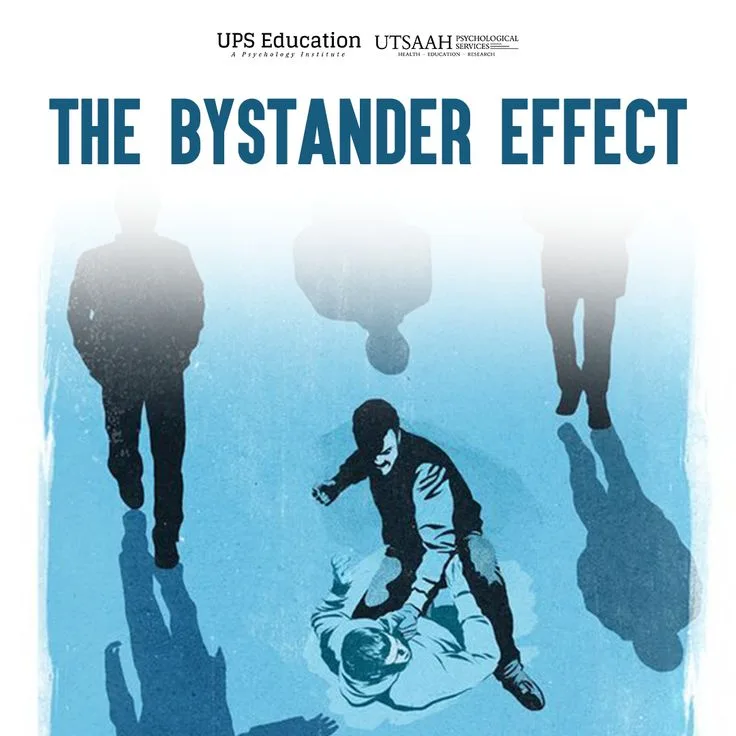
What Is the Bystander Effect?
The bystander effect is a social psychological phenomenon in which individuals are less likely to offer help or intervene in a problematic situation when other people are present, compared to when they are alone.
First systematically studied by psychologists Bibb Latane and John Darley following the 1964 Kitty Genovese case, the effect operates through two primary mechanisms: diffusion of responsibility (the assumption that someone else will act) and pluralistic ignorance (the misreading of others' inaction as evidence that no action is needed).
In workplace contexts, it manifests as teams failing to challenge flawed decisions, individuals not reporting misconduct, and collective silence in the face of problems that everyone privately recognizes.
In 1964, a woman named Kitty Genovese was attacked outside her New York apartment building. Dozens of neighbors reportedly heard the assault. Almost no one called the police.
The case sparked one of the most consequential research programs in social psychology and gave the world a name for a phenomenon most people had experienced but never quite understood: the bystander effect.
Decades later, the same psychological force plays out in open-plan offices, all-hands meetings, Slack channels, and boardrooms. An employee witnesses harassment and says nothing. A team watches a flawed plan move forward without raising the obvious objection.
A junior analyst sees financial irregularities in a report and assumes someone senior already knows. In each case, the presence of others does not increase the likelihood of action. It decreases it.
Understanding why this happens - and what organizations can actually do about it - is one of the more important challenges in building functional, ethical, high-performing workplaces.
It is worth noting that later research complicated the Genovese story. A 2007 reanalysis by sociologists Manning, Levine, and Collins found that the original media narrative was significantly exaggerated - far fewer neighbors witnessed the attack than reported, and several did act.[2]
The researchers argued that this correction matters because it shifts responsibility from individual bystanders back to the structural conditions that impede action. The bystander effect is real and well-documented - but individual cowardice is rarely the whole story.
The Psychology Behind the Bystander Effect
Latane and Darley's Original Research
Psychologists Bibb Latane and John Darley conducted the foundational research on the bystander effect in 1968, spurred directly by the Genovese case.[1] In one landmark experiment, participants believed they were having a conversation over an intercom when a confederate began simulating an epileptic seizure.
When participants believed they were the only one who could hear the seizure, 85 percent intervened. When they believed four other people could also hear, only 31 percent intervened - and many waited significantly longer before acting.
The researchers identified two primary psychological mechanisms:
Diffusion of responsibility is the sense that when many people are present, the moral and practical obligation to act is spread across all of them - diluting each individual's sense of personal duty. "Someone else will handle it" becomes a plausible thought precisely because the situation has many potential responders.
Pluralistic ignorance occurs when individuals privately disagree with or are alarmed by something but publicly remain silent, each assuming the others' silence reflects genuine agreement or comfort. Everyone looks calm, so everyone assumes everyone else is calm, so everyone stays calm - even when everyone is actually worried.
A third mechanism identified in later research is evaluation apprehension - the fear of being judged negatively for intervening. In ambiguous situations, the cost of intervening incorrectly (looking alarmist, officious, or wrong) can feel greater than the cost of staying silent.
This is particularly relevant in professional environments where status and reputation matter.
Why the Workplace Amplifies These Effects
The classic bystander experiments involved strangers in neutral settings. Workplaces introduce additional pressures that can intensify the effect:
- Hierarchy: Employees may defer to senior colleagues, assuming those with more authority or information have already assessed and approved a situation.
- Fear of retaliation: Speaking up can carry professional risk, especially when the concern involves a manager, a major client, or a strategic decision the organization has invested in.
- Role ambiguity: In organizations without clear ownership of ethical standards or reporting channels, employees genuinely may not know whose job it is to raise a concern.
- Social identity: People are less likely to challenge members of their own team or department, partly due to loyalty and partly due to the fear of damaging relationships they depend on.
- Normalization: When problematic behavior has been present for a long time, it can become normalized - the baseline against which new observations are compared, rather than the anomaly it would be to an outside observer.
What the Bystander Effect Looks Like at Work
Harassment and Misconduct
The most serious workplace manifestation of the bystander effect involves harassment, discrimination, and abuse of power. Studies consistently find that witnesses to workplace harassment significantly outnumber those who actually intervene.
A 2016 survey by the Equal Employment Opportunity Commission found that 75 percent of people who report workplace harassment experience retaliation - a figure that tells potential bystanders exactly what to expect if they act.[13]
Yet silence has costs. Harassment that is not challenged tends to escalate. Organizations that tolerate visible misconduct signal to all employees that certain behaviors are acceptable, shifting the entire culture downward.
Research by Cortina and Magley (2003) found that organizations where observers consistently fail to intervene in harassing behavior have significantly higher overall rates of hostile climate - suggesting that bystander silence contributes to culture, not merely reflects it.[6]
The #MeToo movement that emerged publicly in 2017 revealed the scale of bystander failure in professional environments.
Many high-profile misconduct cases involved not just an individual perpetrator but entire networks of colleagues, assistants, and supervisors who witnessed behavior and said nothing for years. The bystander effect was operating at institutional scale.
The Silent Meeting Problem
A subtler but pervasive form of the bystander effect plays out in meetings. Research by organizational psychologist Adam Grant and others shows that employees regularly withhold concerns, data, and dissenting views in group settings, even when they would speak up individually.
The mechanism is the same: each person assumes others with relevant knowledge will raise the concern, and each person's silence reinforces others' silence.
"In most organizations, the biggest threat to good decision-making isn't the presence of bad ideas - it's the absence of voices willing to challenge them."
Research by Sunstein and Hastie (2014) on group polarization found that when groups deliberate, they tend to move toward more extreme positions than the average of individual members' views - partly because the loudest and most confident voices dominate, and partly because members censor uncertainty and dissent in real time.[8]
The result is decisions that appear to have consensus but actually represent only a fraction of the available information and perspective in the room.
Escalating Commitment
The bystander effect also operates around failing projects and poor decisions. When a team has collectively invested in a strategy, the bystander dynamic discourages anyone from being the first to say it is not working.
The sunk cost fallacy and diffusion of responsibility combine: "It would be disruptive to raise this now, and surely someone more senior than me has already weighed the risks."
Barry Staw's research on escalating commitment (1976) established that groups and individuals systematically over-invest in failing courses of action - throwing good money after bad - partly to justify prior decisions and partly because no one wants to be the person who called it wrong.[7]
The bystander effect amplifies this: when responsibility is shared, each member can believe that if this were truly failing, someone would have said something by now.
Ethics Violations and Financial Misconduct
Perhaps the highest-stakes arena for workplace bystander behavior is ethics and financial misconduct.
The 2001 collapse of Enron, the 2008 financial crisis, the Boeing 737 MAX disasters, and numerous other organizational catastrophes share a common feature: people at multiple levels of the organization saw warning signs and said nothing, or said something quietly and were ignored.
A landmark study by Trevino and colleagues (2014) examining ethics in financial services found that 47 percent of employees in the sector had witnessed conduct that they believed was unethical, but that only 32 percent of those witnesses reported it through any formal or informal channel.[5]
The most common explanations: "I didn't think it would matter," "I feared professional consequences," and "I assumed my manager already knew." All three are bystander effect mechanisms operating in professional guise.
The Connection to Psychological Safety
What Google's Research Found
In 2012, Google launched Project Aristotle - an internal study to determine what made some teams dramatically more effective than others. The researchers examined 180 teams across the company, studying composition, personality types, technical skills, and structural variables.
The single strongest predictor of team performance was psychological safety: the shared belief that the team is safe for interpersonal risk-taking.
Teams with high psychological safety showed several specific behaviors relevant to the bystander problem:
- Members raised concerns about processes and outcomes without fear of being seen as troublemakers
- People acknowledged mistakes openly rather than concealing them
- Dissenting views were expressed in meetings rather than only in hallway conversations afterward
Amy Edmondson's foundational definition frames psychological safety as a team-level property, not an individual characteristic.[3] It is the shared perception that the environment will not punish interpersonal risk.
This means that it can shift - teams can move from low to high safety through leadership behavior, explicit norm-setting, and demonstrated consequences - but it cannot be manufactured through individual courage alone.
The Speak-Up Gap
Despite widespread awareness that speaking up is valuable, most organizations have a significant gap between what employees see and what they report. A 2019 Ethical Systems survey found that approximately 40 percent of employees who witnessed workplace misconduct said nothing to management.
The most common reasons given were "I didn't think anything would be done," "I feared retaliation," and "I didn't think it was my place."
This gap represents not a failure of individual courage but a failure of organizational design. When the structure of an organization - its incentives, its reporting channels, its response to those who do speak up - does not support intervention, the bystander effect operates as a systemic feature rather than an individual failing.
A critical signal that employees use to calibrate the speak-up gap is what happened to people who spoke up in the past. If the organization visibly supported those who raised concerns, the implicit message is that speaking up is safe.
If those people were marginalized, passed over for promotion, or ostracized, the implicit lesson is exactly the opposite - and it is learned not just by the person who was punished but by every colleague who observed the outcome.
Bystander Research in the Whistleblowing Literature
The decision to report serious misconduct - the high-stakes end of the bystander spectrum - has been studied extensively. Several consistent findings emerge:
| Factor | Effect on Likelihood of Reporting |
|---|---|
| Strong personal ethical values | Increases reporting likelihood |
| Clear and accessible reporting channels | Increases reporting likelihood |
| Perceived seriousness of the misconduct | Increases reporting likelihood |
| Fear of retaliation | Sharply decreases reporting likelihood |
| Belief that others already know | Decreases reporting likelihood |
| Lack of clear reporting ownership | Decreases reporting likelihood |
| Previous negative experience reporting | Strongly decreases future reporting |
| Perceived responsiveness of management | Strong positive effect when high |
| Organizational culture supporting ethics | Strong positive effect |
Research by Near and Miceli (1995), foundational in the whistleblowing literature, found that organizational factors - particularly the perceived responsiveness of management - were stronger predictors of reporting than individual ethical orientation.[4] In other words, brave people stay silent in broken systems.
A 2019 meta-analysis by Keenan found that perceived organizational support for ethics was the single strongest modifiable predictor of whistleblowing intention across cultures - stronger than individual ethical values, legal protections, or anonymous reporting channels.[15] Culture, in short, matters more than any specific mechanism.
High-profile cases like Enron, Boeing's 737 MAX, and the 2008 financial crisis all included employees who saw problems clearly and said nothing - or said something quietly and were ignored. The bystander effect operated at a massive, consequential scale.
"The failure at Enron was not primarily a failure of accounting or regulation. It was a failure of the dozens of people who saw what was happening and decided the cost of speaking was higher than the cost of silence." - Bethany McLean and Peter Elkind, The Smartest Guys in the Room (2003)[14]
How Organizations Can Counteract the Bystander Effect
Assign Explicit Ownership
One of the most direct ways to reduce diffusion of responsibility is to eliminate ambiguity about who is responsible for raising concerns. This does not mean one person carries the entire burden - it means organizations create clear, specific channels with named owners and defined processes.
"Report to your manager, HR, or the ethics hotline" is clearer than "we have an open-door policy."
Research on emergency response has found that the single most effective intervention for increasing bystander action is direct assignment of responsibility: "You - call an ambulance." The specificity eliminates diffusion of responsibility entirely.
Organizations can apply this principle by making expectations explicit: not just "everyone is responsible for ethical behavior" but "when you see X, the specific expectation is Y."
Make It Safe and Visible to Speak Up
Leaders model the norms others follow. When senior leaders openly acknowledge uncertainty, welcome bad news, thank people for raising difficult issues, and respond to concerns with curiosity rather than defensiveness, they signal that speaking up is safe.
When they react to problems with blame or dismissal, they teach everyone else to stay silent.
Training programs that address the psychology of bystander behavior explicitly - not just "here is the compliance policy" but "here is why it is psychologically difficult to act, and here are strategies that help" - have been shown to increase intervention rates.
A meta-analysis by Katz and colleagues (2011) of bystander training in educational settings found significant increases in both intention to intervene and actual intervening behavior after structured training, with effect sizes that persisted at follow-up assessments.[9]
Create Anonymous Channels That Are Actually Used
Anonymous reporting mechanisms reduce the personal risk of speaking up, but only if employees believe the reports are taken seriously and acted upon.
Organizations with ethics hotlines that visibly respond to reports - even if that response is simply confirming the issue was reviewed - have higher long-term utilization rates than those where reports seem to disappear.
Research by Kaptein (2011) on ethics reporting systems found that the perceived credibility of the channel - rather than its anonymity or accessibility - was the primary driver of utilization.[10]
Employees will use a named reporting process they trust; they will not use an anonymous one they believe is monitored for identifying the reporter or where reports go unactioned.
Reduce the Social Cost of Being First
The bystander effect is partly a social coordination problem. Once one person speaks up, it often becomes much easier for others to follow.
Organizations can engineer this by explicitly creating space in meetings for dissent: "Before we move on, does anyone have a concern they have not raised?" posed directly to specific individuals is more effective than a general open invitation, because it shifts the default from "only speak if you need to" to "we expect everyone to weigh in."
Assigning a devil's advocate role in strategic discussions - a rotating responsibility to challenge the emerging consensus - removes the personal social cost from the act of dissent. It is no longer a reflection of the individual's contrary nature; it is a role the organization has explicitly assigned.
Research on structured dissent by Nemeth and colleagues (2001) found that groups with designated devil's advocates generated more creative alternatives and better final decisions than groups without them, even when the devil's advocate arguments were not themselves superior.[11]
Recognize and Reward Constructive Dissent
Employees watch what gets rewarded and what gets punished. If the people who raise early warnings about projects are sidelined, and the people who wave through bad decisions are promoted, the bystander effect becomes rational self-preservation.
Organizations that want to change this need to make the reward structure visible and genuine - including protecting and publicly supporting those who speak up in difficult circumstances.
Practical Frameworks for Individuals
Even within organizations that have not solved the structural problem, individuals can counteract their own bystander tendencies.
The CARE Model
One framework used in bystander intervention training breaks the decision to act into four stages:
- Consider whether you are in a situation where intervention might be needed
- Assess the risk and your role - am I the best person to act here?
- Respond in a way appropriate to the situation - direct, delegated, or delayed
- Evaluate what happened and whether follow-up is needed
The model is useful because it combats the paralysis that often prevents action. People frequently do not intervene not because they lack values but because they are caught in a loop of uncertainty about whether they should act, whether they are the right person to act, and what acting would even look like.
When to Act Directly vs. Delegate
Not every situation calls for direct confrontation. Research on bystander intervention suggests three equally valid response modes:
Direct intervention: addressing the situation or person in the moment. Most effective when the situation is unambiguous and the personal risk is low.
Delegation: reporting to someone with more authority or information - a manager, HR, a compliance officer. Appropriate when the situation involves someone with power over you, or when formal processes are the right mechanism.
Distraction: defusing a situation by changing the subject, drawing attention elsewhere, or creating an interruption that breaks the dynamic without direct confrontation. Underappreciated but highly effective in ambiguous social situations.
Pre-Committing to Action
One evidence-based strategy for overcoming bystander tendencies is pre-commitment - deciding in advance, before you are in an ambiguous situation, what you will do in specific circumstances.
Research on implementation intentions by Gollwitzer and colleagues shows that if-then planning ("If I see X, I will do Y") significantly increases follow-through on intended behavior compared to general goal-setting ("I will speak up when I should").[12]
In practice, this might look like: "If I see a colleague being demeaned in a meeting, I will say something in the meeting." "If I see what looks like financial irregularities in a report I'm reviewing, I will raise it with the compliance team the same day." The specificity of the pre-commitment reduces the cognitive and emotional processing required in the moment, when social pressure and uncertainty are highest.
Beyond Individual Courage: A Systemic View
The bystander effect is often framed as a failure of individual moral courage. This framing is incomplete and, in many organizational contexts, actively misleading. It places the burden of behavior change entirely on individual employees while leaving intact the structural conditions that make silence rational.
The more useful framing is systemic: the bystander effect is a predictable output of organizations where the cost of speaking up exceeds the perceived benefit.
Changing that output requires changing that equation - through visible leadership modeling, genuine psychological safety, clear reporting structures, and consistent evidence that speaking up leads to action rather than retaliation.
The most powerful organizations that have reduced bystander behavior share a common feature: they have made speaking up socially normal and organizationally rewarded rather than unusual and risky. This is a culture change project, not an individual character project.
And culture is changed through repeated, consistent demonstrations of what the organization actually values when trade-offs arise - not through posters in the break room or annual compliance training.
Organizations that do this well do not rely on exceptional individual bravery. They build the conditions where ordinary people reliably do the right thing - not because they are unusually courageous, but because the structure makes courage easy.
Key Takeaways
- The bystander effect causes employees to assume others will act, reducing the likelihood that anyone does
- Diffusion of responsibility and pluralistic ignorance are the two core mechanisms; evaluation apprehension reinforces both
- Workplaces amplify the effect through hierarchy, fear of retaliation, and role ambiguity
- Psychological safety - the belief that speaking up is safe - is the most powerful organizational countermeasure
- Structural interventions (clear channels, explicit ownership, visible rewards for dissent) matter more than moral exhortation
- Research shows the perceived responsiveness of management is a stronger predictor of reporting than individual ethical values
- Individuals can use frameworks like CARE and pre-commitment strategies to overcome personal bystander tendencies
- The goal is not to find more courageous individuals but to build organizations where speaking up is the path of least resistance
Sources & Further Reading
- Latane, B., & Darley, J.M. (1968). Group inhibition of bystander intervention in emergencies. Journal of Personality and Social Psychology 10(3), 215-221.
- Manning, R., Levine, M., & Collins, A. (2007). The Kitty Genovese murder and the social psychology of helping. American Psychologist 62(6), 555-562.
- Edmondson, A. (1999). Psychological safety and learning behavior in work teams. Administrative Science Quarterly 44(2), 350-383.
- Near, J.P., & Miceli, M.P. (1995). Effective whistle-blowing. Academy of Management Review 20(3), 679-708.
- Trevino, L.K., den Nieuwenboer, N.A., & Kish-Gephart, J.J. (2014). (Un)ethical behavior in organizations. Annual Review of Psychology 65, 635-660.
- Cortina, L.M., & Magley, V.J. (2003). Raising voice, risking retaliation: Events following interpersonal mistreatment in the workplace. Journal of Occupational Health Psychology 8(4), 247-265.
- Staw, B.M. (1976). Knee-deep in the Big Muddy: A study of escalating commitment to a chosen course of action. Organizational Behavior and Human Performance 16(1), 27-44.
- Sunstein, C.R., & Hastie, R. (2014). Wiser: Getting Beyond Groupthink to Make Groups Smarter. Harvard Business Review Press.
- Katz, J., Heisterkamp, H.A., & Fleming, W.M. (2011). The social justice roots of the mentors in violence prevention model. Violence Against Women 17(6), 684-702.
- Kaptein, M. (2011). Understanding unethical behavior by unraveling ethical culture. Human Relations 64(6), 843-869.
- Nemeth, C.J., Brown, K., & Rogers, J. (2001). Devil's advocate versus authentic dissent: Stimulating quantity and quality. European Journal of Social Psychology 31(6), 707-720.
- Gollwitzer, P.M., & Sheeran, P. (2006). Implementation intentions and goal achievement: A meta-analysis of effects and processes. Advances in Experimental Social Psychology 38, 69-119.
- EEOC Select Task Force. (2016). Study of Harassment in the Workplace. U.S. Equal Employment Opportunity Commission.
- McLean, B., & Elkind, P. (2003). The Smartest Guys in the Room: The Amazing Rise and Scandalous Fall of Enron. Portfolio.
- Keenan, J.P. (2019). Predictors of ethical whistleblowing: A meta-analysis. Business Ethics Quarterly 29(4), 541-572.