
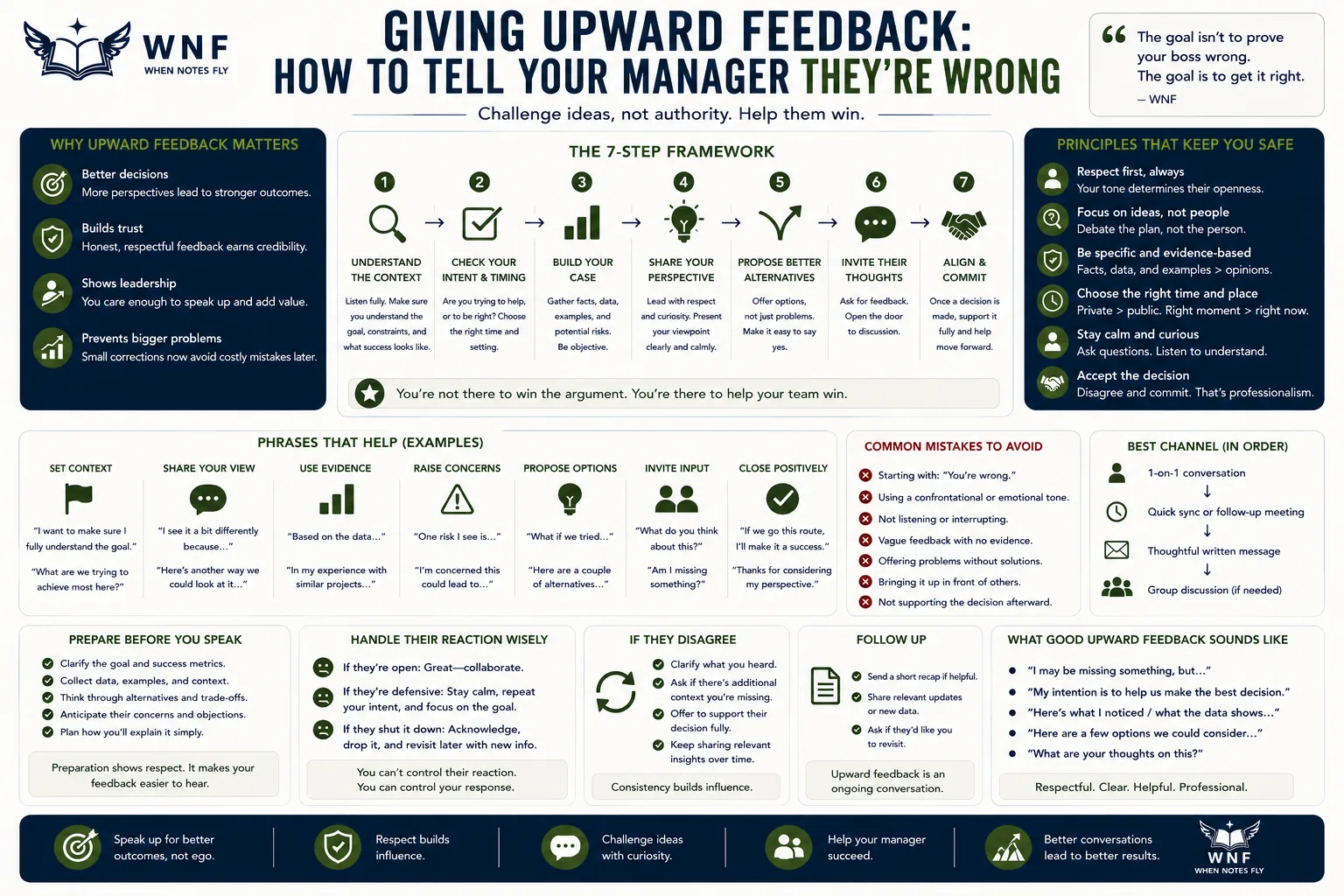
Telling a manager that a decision was wrong can be necessary when consequences are visible, but hierarchy makes the conversation difficult. Giving upward feedback requires a culture that treats dissent as useful information rather than a personal challenge to authority.
The situation arrives with predictable features. Your manager has made a decision, taken a stance, communicated something to the team, or handled a situation in a way that you believe was wrong. Not mildly suboptimal. Actually wrong, with consequences that are visible.
The feedback cultures at work have conditioned everyone to believe that feedback flows in all directions and that managers welcome input from their reports. The lived reality is messier.
Some feedback is genuinely welcomed. Some is accepted politely and ignored. Some is received with the kind of subtle shift in warmth that does not quite rise to formal retaliation but is nonetheless noted and remembered.
The research on upward feedback is extensive and worth taking seriously before you attempt to reshape your manager. The findings are mixed. Well-framed, well-timed, specific feedback about narrow topics delivered in trusted relationships often produces positive change.
Broad, critical, personality-focused feedback almost always produces defensive response regardless of how it is framed.
The distinction between these is substantial, and most failed upward feedback attempts fail not because managers cannot handle feedback but because the feedback was of the type that rarely produces change in anyone.
"The feedback that manages up successfully is narrow, specific, future-oriented, and framed as a request. Feedback that is broad, general, past-focused, and framed as judgment almost never works regardless of how thoughtful the giver is.
The content matters less than the frame." - Adam Grant, Think Again: The Power of Knowing What You Don't Know (2021)[1]
The First Filter: Is This Feedback Worth Giving
Not every frustration with a manager warrants feedback. The useful filter before investing in the conversation has several components.
Is this about a pattern or an incident? Feedback about patterns, especially patterns the manager has some interest in addressing, is more productive than feedback about single incidents. Single incidents are often idiosyncratic, context-dependent, and hard to generalize from. Patterns are different.
Is the thing you want changed actually within the manager's ability to change? Some things managers appear to do are actually expressions of organizational pressure, their own manager's expectations, or structural constraints. Feedback about things the manager cannot control produces defensiveness without utility.
Is your expertise or position relevant to the feedback? Feedback from a junior person about a senior person's stylistic choices is received differently than feedback about a specific domain where the junior person has expertise. Knowing where your standing supports the feedback matters.
What is the relationship trust level? High-trust relationships can absorb more direct feedback. Low-trust relationships cannot. Attempting feedback that exceeds the relationship's capacity usually damages the relationship.
Is there evidence the manager wants this kind of feedback? Managers who have explicitly invited feedback on specific topics, who reference their own development needs, or who model feedback-seeking behavior are different audiences than managers who have not sent any of those signals.
Feedback into a manager who has not signaled openness is riskier.
What is the cost of being wrong? If the feedback turns out to be uncalibrated or mistaken, what does that cost? If the feedback turns out to be correct and is received well, what does that benefit look like? The asymmetric analysis often reveals that the feedback is not worth giving.
| Factor | Give Feedback | Hold Feedback |
|---|---|---|
| Scope | Narrow, specific behavior | Broad personality traits |
| Pattern | Recurring issue with impact | One-off situation |
| Manager control | Within manager's autonomy | Structural or imposed on manager |
| Trust level | Established working relationship | Early or strained |
| Topic type | Future-oriented request | Past criticism |
| Invitation | Manager has asked for input | No explicit invitation |
The Framing That Works
The single largest determinant of how feedback lands is how it is framed. Specific linguistic and structural choices consistently produce better outcomes across contexts.
Request framing over critique framing. "Could I ask you to try X differently next time?" produces less defensiveness than "You handled X wrong." The content can be identical. The reception is substantially different.
Future tense over past tense. "Going forward, it would help me if we [specific request]" is more productive than "You should not have done X." The future framing invites change rather than inviting defense of the past.
Specific behavior over character attributes. "When you interrupt in meetings, it is hard for me to complete my thoughts" is actionable. "You are bad at listening" is not. The specificity of the behavior makes the feedback modifiable. Character framing makes it an attack.
Impact on you over judgment of them. "When X happens, I feel Y" is a report of your experience. "You are Z" is a judgment of who they are. The first invites empathy. The second invites defense.
One point at a time. Multiple concerns delivered together dilute each one and often signal accumulated frustration rather than specific feedback. A single clear point is more likely to produce change than a list.
Context that establishes your good intent. Beginning with a clear statement that you are trying to help them succeed or improve the working relationship shifts the reception. Manager defensiveness often starts from the assumption that feedback is criticism. Setting a different frame before the content helps.
The Timing and Setting
Where and when feedback is delivered affects its reception as much as how it is framed.
Private and calm. Feedback delivered in private, with both parties in a calm state, lands better than feedback delivered in front of others or in tense contexts. One-on-ones, scheduled conversations, and walks are all better contexts than live meetings.
After invitation if possible. When managers ask "is there anything I could do differently?" they have opened a specific window for feedback. Responding with something genuine and useful is different from raising feedback unprompted. Waiting for natural invitations produces better outcomes than forcing the conversation.
Not immediately after stress. Feedback given to a manager who has just received difficult news, had a hard meeting, or is visibly under pressure rarely lands well. Waiting for a calmer moment is worth the patience.
Not in response to feedback they gave you. Responding to the manager's feedback with feedback of your own almost always reads as defensive counter-attack regardless of validity. The two should be separated in time.
Not at the end of a difficult conversation. Feedback tacked onto a conversation that already covered significant ground is rarely absorbed. Giving feedback its own dedicated conversation produces better attention.
"The timing of difficult conversations is not secondary. It is primary. A well-framed piece of feedback delivered in the wrong moment often does more damage than no feedback at all. Patience about when to raise something is as important as the content of what you are raising." - Brené Brown, Dare to Lead (2018)[3]
The Scripts That Work
Specific scripts help with the mechanics of the conversation once you have decided to have it.
Opening that establishes frame: "I wanted to raise something for your awareness. I have been thinking about how we worked on [specific situation] last week, and I want to share some observations. This is not a complaint, and I am trying to help us work together better."
Delivering the specific point: "When [specific behavior] happened in [specific context], the impact was [specific outcome]. I think the situation could have gone differently if [specific alternative]. I wanted to flag it so we can handle similar situations well going forward."
Inviting response: "That is my perspective. I am curious how you see it, and whether there is context I am missing. I also want to know if there is anything you'd like me to do differently as part of handling this better together."
Closing the conversation: "Thank you for hearing me out. I appreciate that feedback like this can be hard to receive. I am committed to the working relationship and wanted to raise it directly with you rather than letting it accumulate."
The script elements serve specific purposes. The opening establishes that this is not an attack. The specific point gives the manager something concrete to engage.
The invitation for response creates dialogue rather than one-way delivery. The closing preserves the relationship and signals ongoing commitment.
Anticipating the Response
Managers respond to upward feedback in several common patterns. Being prepared for each helps you handle the conversation well.
Genuine acknowledgment and engagement. The manager receives the feedback thoughtfully, asks clarifying questions, and commits to specific changes. This is the best outcome and often happens with high-trust, self-aware managers.
The follow-up is to observe whether the committed changes actually materialize and, if they do, to reinforce the positive pattern.
Defensive deflection. The manager provides context that explains the behavior, identifies external factors, or suggests the feedback is based on misunderstanding. Some of this is legitimate context. Some is defensive.
The useful response is to listen, acknowledge the legitimate parts, and gently return to the core point if it still stands.
"That context is helpful, and I want to make sure the specific pattern we are discussing still gets addressed going forward."
Apology without behavior change. The manager apologizes, expresses regret, and does not subsequently change behavior. This is common and frustrating. The response is to note the pattern. If the behavior recurs, raising it a second time with explicit reference to the prior conversation is appropriate.
"When we spoke last month about X, you noted you wanted to handle it differently. I wanted to flag that the pattern came up again."
Turning feedback into a conversation about your performance. Some managers deflect upward feedback by redirecting to feedback about the report. If the redirect is substantive, engage with it. If it is purely defensive, a calm statement helps.
"I want to make sure we address both. I am happy to discuss my work, and I also want to come back to the specific thing I was raising."
Anger or visible displeasure. If the manager reacts with anger, the conversation has likely failed regardless of framing. The useful response is to disengage gracefully. "I may have raised this at the wrong time.
I wanted to share my perspective, and I understand if you'd like to step away from it for now." Continuing to press in the face of anger is rarely productive.
Silence and withdrawal. Some managers go quiet rather than engaging. The conversation produces no visible response, no questions, no commitments. The follow-up strategy is to give the manager time to process and to observe whether any behavioral changes emerge over subsequent weeks.
Sometimes silent processing produces change. Sometimes it does not.
The 360 and Formal Feedback Processes
When your organization has formal 360-degree feedback processes, those channels have specific dynamics worth understanding.
360 feedback is often less anonymous than people assume. Managers can often identify sources based on specific content, writing style, or known patterns of perception. Assuming anonymity in formal feedback is risky.
Aggregated feedback is more digestible than individual feedback. When several reports identify similar patterns, the feedback often produces change where individual feedback would not. If you suspect others share your observations, timing your feedback to align with a formal 360 cycle produces stronger aggregate signal.
The manager's own manager often sees the 360 results. Feedback in formal processes flows upward. This can produce change that informal feedback would not, but it also creates political dynamics that may not be ideal for the specific feedback you want to give.
Specific behavioral examples work better than ratings. When the process allows comments, specific examples are more useful than numerical ratings. "The manager tends to interrupt in meetings, such as in the planning meeting on April 3 where three people were cut off" is more actionable than a low score on listening.
For formal feedback processes, the same framing principles apply as for informal: narrow, specific, future-oriented, behavior-focused.
"Formal feedback processes amplify both the benefits and the risks of upward feedback. When the environment can absorb the process well, it produces manager development at scale. When it cannot, it produces subtle retaliation and team fragmentation.
Knowing which environment you are in determines how you engage with the process." - Amy Edmondson, The Fearless Organization (2019)[2]
The Manager Who Cannot Receive Feedback
Some managers, for reasons related to personality, insecurity, or learned patterns, genuinely cannot receive upward feedback productively. The signals are consistent:
Feedback is received with immediate counter-feedback about the giver. The response to any input about the manager's behavior is to redirect to the report's behavior. This pattern rarely changes regardless of framing.
Multiple reports have tried feedback and given up. When the environment has a track record of attempted feedback producing no change, the specific manager is demonstrating a limitation that individual skill cannot overcome.
The manager's own manager does not coach them on these issues. Skip-level managers who could address the pattern do not. This may reflect organizational tolerance for the behavior or awareness that attempts to address it have not worked.
Retaliation follows feedback attempts. Subtle or not-so-subtle negative consequences after feedback attempts demonstrate that the environment is not safe for the behavior.
When the pattern is clear, the strategic move is to stop investing in reshaping the manager and to focus on either working around them or building optionality for exit. Continued feedback attempts in environments that cannot absorb them often hurt the report more than they help.
The Broader Strategy
Upward feedback is one tool among several for managing the relationship with your manager. Over-relying on it is a mistake, because most change in managers comes from their own experiences rather than from their reports' feedback.
The broader strategy includes:
Working effectively within current constraints. Accept that the manager you have is the manager you have. Adapt your approach to their style. Solve the problems that are within your control.
Building relationships with skip-level leaders. Direct relationships with your manager's manager, peers of your manager, and leaders across the organization create redundancy. If the direct manager relationship is imperfect, other channels matter.
Developing external optionality. Credentials, market visibility, and network relationships outside the company create alternatives. Alternatives reduce the psychological weight of any single manager relationship.
Documenting your own contributions independently. Self-advocacy artifacts, including outcome logs, written project summaries, and external visibility, protect your career regardless of manager quality.
The analytical assessment tools atWhen to Stop Investing
Every feedback attempt has an opportunity cost. Time spent trying to reshape a manager is time not spent on your own work, development, or relationships that produce more return.
Professional energy is finite, and allocating too much to a limited-return activity damages overall career progress.
The signals that it is time to stop investing in manager feedback:
Multiple attempts have produced no change. You have tried different framings, different timings, different specific topics. Nothing has shifted. The probability of the next attempt producing change is low.
Your own energy and focus are being damaged. The frustration is leaking into your work, your relationships, or your health. The cost is exceeding the possible benefit.
The manager is not changing, and you cannot change your situation. If you are stuck with a manager who cannot receive feedback and you cannot transfer or exit, the sustainable strategy is to protect your psychological energy rather than continuing to invest in an unchanging situation.
Other paths offer better returns. Internal transfer, external search, or structural changes in your role might produce the outcomes you want faster than continued feedback attempts would.
Clear written communication with clients becomes especially important in independent work, and the resources atThe Long-Term Pattern
Over a full career, most professionals develop calibrated instincts about when upward feedback is worth giving and when it is not. The calibration comes from experience, both the successful attempts and the failed ones. Early in a career, over-estimating what feedback can accomplish is common.
Late in a career, the pattern usually reverses toward under-estimating, sometimes to the point of missing opportunities to help managers who were genuinely open.
The balanced pattern is to offer small, well-framed pieces of feedback routinely, especially when invited, and to reserve significant feedback investment for situations where the relationship, the topic, and the timing all align.
The professionals who get this calibration right over years tend to be trusted voices in their organizations because their feedback is consistently useful when delivered, and they do not waste political capital on feedback that cannot produce change.
The reader who wants to develop this calibration should treat the next feedback opportunity as a small experiment. What works? What does not?
What signals did you read correctly? What did you miss? Each iteration teaches something, and over dozens of iterations the skill compounds into something that looks like natural ability.
See also: How to Disagree With Your Boss Without Getting Fired | How to Handle Micromanagement Without Quitting
Sources & Further Reading
- Grant, A. (2021). Think Again: The Power of Knowing What You Don't Know. Viking.
- Edmondson, A. (2019). The Fearless Organization. Wiley.
- Brown, B. (2018). Dare to Lead. Random House.
- Stone, D., & Heen, S. (2014). Thanks for the Feedback: The Science and Art of Receiving Feedback Well. Viking.
- Harvard Business Review. (2016). "How to Give Your Boss Feedback." View source
- Detert, J. R., & Burris, E. R. (2007). "Leadership Behavior and Employee Voice: Is the Door Really Open?" Academy of Management Journal, 50(4), 869-884. DOI: 10.5465/amj.2007.26279183
- Scott, K. (2017). Radical Candor. St. Martin's Press.
- Morrison, E. W. (2014). "Employee Voice and Silence." Annual Review of Organizational Psychology and Organizational Behavior, 1, 173-197. DOI: 10.1146/annurev-orgpsych-031413-091328