
In 1994, organizational psychologist Karen Jehn made a finding that overturned decades of management wisdom: not all conflict is bad.[1]
Her research on groups in the textile and furniture industries showed that moderate levels of task conflict - disagreement about how to do the work - was associated with better performance and satisfaction in complex, non-routine jobs. The teams with zero conflict were not performing well.
They were avoiding hard questions.
This distinction - between the conflict that improves decisions and the conflict that damages relationships - is one of the most practically important findings in organizational psychology.[9] Understanding it changes how you approach disagreements at work: not as problems to be eliminated, but as phenomena to be managed well.
Conflict at work is inevitable. Research suggests managers spend an average of 20-40% of their time dealing with it. How it is handled - whether it surfaces useful information and leads to better decisions, or escalates into personal damage and organizational dysfunction - depends on skills that are largely learnable.
The Scale of the Problem
Before examining solutions, it is worth establishing just how prevalent and costly workplace conflict is. A 2008 CPP Inc. study found that U.S. employees spend an average of 2.8 hours per week dealing with conflict, amounting to approximately $359 billion in lost productive time annually.[8]
A 2021 Gallup report on the American workplace found that only 36% of employees are engaged at work - and disengagement is strongly correlated with unresolved interpersonal conflict.[14]
The human costs are equally significant. A 2011 study by Nixon and colleagues published in the Journal of Occupational Health Psychology found that interpersonal conflict at work was among the most robust predictors of burnout, emotional exhaustion, and intent to leave - stronger, in many analyses, than objective workload.[13]
People do not primarily burn out from too much work; they burn out from too much unresolved conflict and too little relational support.
These numbers make a case for investing seriously in conflict management skills - not as a nice-to-have interpersonal development topic, but as a core organizational competency with measurable returns.
The Five Conflict Modes: Thomas-Kilmann
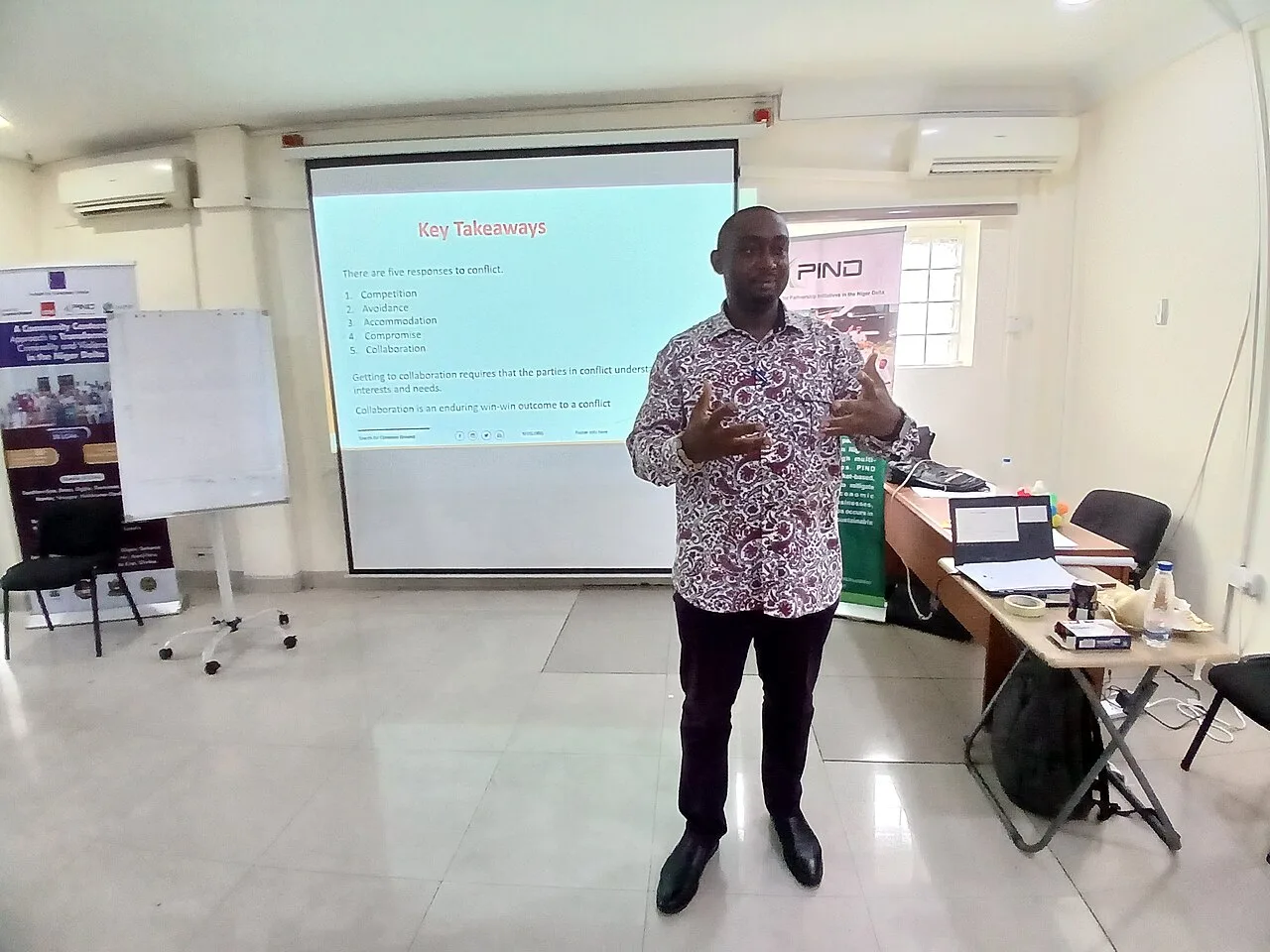
The most widely used framework for understanding conflict behavior is the Thomas-Kilmann Conflict Mode Instrument (TKI), developed in 1974 by Kenneth Thomas and Ralph Kilmann.[2] It describes conflict behavior along two dimensions:
- Assertiveness: the degree to which you pursue your own concerns
- Cooperativeness: the degree to which you attend to the other party's concerns
These two dimensions produce five distinct conflict modes:
| Mode | Assertiveness | Cooperativeness | Core Orientation |
|---|---|---|---|
| Competing | High | Low | "I win, you lose" |
| Collaborating | High | High | "We can both win" |
| Compromising | Medium | Medium | "We both give a little" |
| Accommodating | Low | High | "You win, I yield" |
| Avoiding | Low | Low | "We don't engage" |
No single mode is universally best. Each is appropriate in different situations:
Competing is appropriate when a decision must be made quickly, when you have authority and expertise, or when unpopular but necessary action (cutting costs, enforcing a policy) must be taken. It is destructive when used habitually in peer relationships or when the issue is one where the other party has legitimate expertise.
Collaborating is appropriate when both parties' interests are important, when the relationship matters long-term, and when creative solutions are possible. It requires time and psychological safety; using it when either is absent wastes resources.
Compromising is appropriate when collaboration has not produced a solution and a good-enough outcome is better than continued impasse. Both parties walk away partially satisfied. The risk is that compromise becomes the default mode - splitting every difference rather than seeking genuinely better solutions.
Accommodating is appropriate when the issue matters more to the other person than to you, when you want to preserve a relationship and the stakes are low, or when you recognize you were wrong. As a default mode, it produces resentment and allows bad decisions to stand unchallenged.
Avoiding is appropriate when a conflict is genuinely not worth engaging - trivial issues, situations where you need time to prepare, or conflicts where the environment is too heated for productive dialogue. As a chronic pattern, avoiding destroys trust and allows problems to compound.
Most people have default modes they reach for regardless of context. The TKI research shows that organizational performance is better when leaders can flex across modes as situations require, rather than applying one mode habitually.
Mode Flexibility: The Underappreciated Skill
Research by Runde and Flanagan (2007) found that the most effective conflict managers were not those who had mastered a single sophisticated mode - they were those who accurately diagnosed which mode a situation called for and shifted fluidly between modes as circumstances evolved.[12]
A negotiation might call for competing at the outset (to establish a credible position), then transitioning to collaboration (when both parties have stated their real interests), then compromising (when a fully collaborative solution proves unworkable).
The practical development path is: identify your default mode under stress (most people have one), identify the situations where that default is counterproductive, and practice the modes you typically avoid.
Task Conflict vs. Relationship Conflict
The distinction that Karen Jehn's research established - and that subsequent work has elaborated - is between two fundamentally different types of workplace conflict.[11]
Task Conflict
Task conflict is disagreement about work content: the goals, the strategy, the method, the allocation of resources, the interpretation of data.
"I think we should price this product at $99, not $79." "Your analysis of the customer data is reaching the wrong conclusion." "We should prioritize the enterprise segment, not the SMB market."
Research consistently finds that moderate task conflict improves decision quality in complex, non-routine work. The mechanism is information processing: groups with diverse views expose more considerations, challenge more assumptions, and are less susceptible to groupthink. The optimal level of task conflict is not zero.
The conditions under which task conflict is beneficial:
- The work is complex and has no obvious correct answer
- The team has sufficient trust and safety to disagree without it feeling personal
- There is a process for resolving disagreements based on evidence and reasoning
- The conflict is time-limited and reaches resolution
When these conditions are absent, task conflict degrades into relationship conflict. This is the most common failure mode of poorly managed disagreement.
Relationship Conflict
Relationship conflict is personal animosity, distrust, dislike, or interpersonal friction - conflict that has moved from ideas to identities. "He's always trying to undermine me." "She never actually listens." "This team is completely dysfunctional."
Relationship conflict is almost uniformly harmful:
- It reduces performance by consuming cognitive resources that would otherwise be devoted to work
- It impairs information sharing (people withhold information from those they distrust or dislike)
- It elevates stress hormones and degrades physical health over extended periods
- It increases turnover - workers in high-relationship-conflict teams leave at higher rates
The most important insight about the relationship between task conflict and relationship conflict is that task conflict easily becomes relationship conflict when it is handled poorly.[10]
When task disagreements become personal - when challenging someone's analysis is heard as an attack on their competence, when disagreeing with a decision is heard as political maneuvering - task conflict transforms into relationship conflict.
This transformation is why many organizations suppress all conflict: they cannot reliably keep disagreements in the task domain.
"The absence of conflict is not harmony - it is either apathy or fear. The goal is not to eliminate conflict but to keep it in the task domain." - Amy Edmondson, Harvard Business School
Process Conflict: A Third Type
Jehn's later research, and work by colleagues including Simons and Peterson (2000), identified a third type: process conflict - disagreement about how to get work done rather than what work to do. Process conflict encompasses disputes about scheduling, resource allocation, responsibility assignment, and workflow.
Like relationship conflict, process conflict is generally harmful to performance, primarily because it consumes attention and energy without improving decision quality. Low-level process conflict - teams negotiating how to divide work, clarifying ownership - is manageable.
High-level process conflict about fundamental operating procedures tends to be as corrosive as relationship conflict.
Having Difficult Conversations
Douglas Stone, Bruce Patton, and Sheila Heen at the Harvard Negotiation Project spent years analyzing what happens when difficult conversations go wrong and why.[3] Their book Difficult Conversations (1999) identified a structure underlying every conflict conversation that explains why these conversations are so hard and what to do about it.
Every difficult conversation actually contains three simultaneous conversations:
The "What Happened" Conversation: Both parties believe their version of events is objectively true. They argue about facts, intentions, and who is to blame.
The reality is that each person has a partial, perspective-shaped view of what happened, filtered through their own assumptions and interpretive frameworks. Treating your account as objective truth is itself an error that makes difficult conversations harder.
The Feelings Conversation: Even when we are trying to have a rational conversation about work issues, emotions are present. These feelings often go unaddressed because they feel unprofessional or because neither party knows how to raise them constructively.
But the feelings leak - in tone, in escalation, in the inability to hear the other person - and unacknowledged feelings make resolution almost impossible.
The Identity Conversation: For both parties, something is at stake about who they are. A challenge to your work may feel like a challenge to your competence. A performance conversation may feel like a verdict on your worth. When the identity conversation is threatening, people stop hearing information and start defending themselves.
A Framework for Difficult Conversations
The Harvard framework recommends:
Move from certainty to curiosity. Replace "you did X" with "I noticed X - help me understand what was behind that." This is not weakness; it is accurate epistemology. You probably do not know all the relevant context, and acting as though you do closes the conversation.
Separate impact from intent. "When you didn't share that information, I was left scrambling" (impact) is different from "You deliberately withheld that information to make me look bad" (assumed intent). Most harmful behaviors have innocent or misaligned explanations.
Naming the impact without attributing intent opens rather than closes the conversation.
Acknowledge the identity threat. When you recognize that the other person is protecting something about their self-image, naming it can defuse it: "I know this kind of feedback can feel like a critique of your judgment - that's not my intent." Explicitly separating the feedback from the identity threat reduces defensiveness.
Listen before persuading. The most common mistake in difficult conversations is advocating before adequately understanding the other person's perspective. People who feel unheard do not become persuadable.
Genuine listening - paraphrasing, asking follow-up questions, checking your understanding - dramatically changes what becomes possible later in the conversation.
The Preparation Question
Research on difficult conversation outcomes consistently shows that preparation improves results - but that many people prepare in the wrong direction. They rehearse what they are going to say. Effective preparation focuses on what you need to understand: What might the other person's perspective be?
What are the strongest arguments for their position? What do you not yet know about the situation? What would you need to discover to change your view?
This reorientation - from "how do I make my case?" to "what do I need to learn?" - transforms the quality of the conversation before it begins.
De-escalation Research
When a conversation has already become heated, de-escalation is the priority before any productive exchange is possible. The research on de-escalation draws from hostage negotiation, therapeutic crisis intervention, and organizational psychology.
Physical calming first. Emotional flooding - the physiological state of high arousal in which adrenaline and cortisol impair the prefrontal cortex - prevents constructive conversation. John Gottman's research in couples found that once physiological arousal exceeds a certain level, people cannot process neutral information as neutral.
De-escalation may require literally pausing the conversation: "I want to continue this conversation - I need 20 minutes first."
Gottman's research also identified specific communication patterns that reliably predict whether a difficult conversation will escalate or resolve.[7]
The four patterns most predictive of destructive escalation - which he called the Four Horsemen - are criticism (attacking character rather than behavior), contempt (expressing disgust or superiority), defensiveness (responding to complaints with counter-complaints), and stonewalling (emotional withdrawal from the conversation).
Recognizing these patterns in yourself during a conversation is a signal to de-escalate before continuing.
Name the dynamic, not the person. "I notice this conversation has gotten heated" is different from "You're being aggressive." Naming what is happening in the room invites both parties to observe it together rather than accuse.
This shift from inside the conflict to observing the conflict is a powerful de-escalation move.
Lower the stakes. Conflict escalates partly because people unconsciously inflate the significance of the immediate interaction into a referendum on their identity, the relationship, or their future.
Explicitly reducing stakes - "I don't think this needs to be a make-or-break conversation; we're trying to solve a specific problem" - can interrupt this escalation dynamic.
Find and acknowledge agreement. In most conflicts, the parties share significant common ground that the heat of disagreement obscures. Explicitly locating and acknowledging shared goals or values - "We both want this project to succeed" - re-establishes relational ground before addressing the specific disagreement.
Separate now from always. Conflict language is generalized: "You never tell me what's happening." "You always do this." Generalized always/never language activates defensiveness because it is an attack on character rather than behavior.
Redirecting to the specific incident - "In this case, I found out about the change very late" - keeps the conversation manageable.
Negotiation: Getting to Interests, Not Positions
One of the most practically useful frameworks for resolving substantive workplace conflict comes from the field of negotiation.
Roger Fisher and William Ury's Getting to Yes (1981), produced by the Harvard Negotiation Project, introduced the distinction between positions and interests that underlies much of modern conflict resolution practice.[4]
A position is what someone says they want: "I need this project completed by Friday." An interest is why they want it: "I need to present to the client on Monday and the analysis has to be ready beforehand." Positions are often incompatible. Interests frequently are not.
The practical move in conflict is to ask "why?" repeatedly - not to challenge, but to discover the underlying interest that the stated position is designed to serve. Once both parties' interests are visible, the space of possible solutions typically expands dramatically.
A solution might exist that satisfies both parties' underlying interests even though their stated positions were irreconcilable.
| Element | Position-Based Approach | Interest-Based Approach |
|---|---|---|
| Focus | What each party says they want | Why each party wants it |
| Typical outcome | Compromise or impasse | Creative solutions |
| Relationship impact | Often damaging | Typically constructive |
| Information required | Stated demands | Underlying motivations |
| Best for | Simple, one-time transactions | Ongoing relationships |
This interest-based approach is well supported empirically. A meta-analysis by De Dreu and Weingart (2003) found that integrative (interest-based) negotiation produced significantly higher joint outcomes and higher individual satisfaction than distributive (position-based) negotiation, particularly in relationships where the parties would continue working together.
When to Involve a Third Party
Some workplace conflicts cannot be resolved directly between the parties involved. The conditions that indicate a need for facilitation or escalation:
- The conflict has reached a level where either party no longer feels safe in the direct conversation
- Multiple failed attempts at direct resolution have occurred
- The conflict involves a power imbalance that prevents genuine negotiation
- There are legal or policy dimensions (harassment, discrimination)
- One or both parties lack the conflict resolution skills needed for the conversation
- The conflict is generating collateral damage to the broader team or organization
Peer mediation uses a trained colleague to facilitate the conversation without having authority to impose a decision. It works well for conflicts that are fundamentally about communication or misunderstanding.
Manager involvement is appropriate when the conflict affects performance, team function, or when the direct parties cannot reach resolution. A good manager in this role facilitates rather than adjudicates - helping the parties hear each other and reach their own resolution when possible.
Imposing a solution typically produces compliance without resolution.
HR involvement is appropriate when the conflict has policy or legal dimensions, or when the manager is one of the parties in conflict.
External mediation - engaging a professional mediator from outside the organization - is appropriate for serious conflicts involving senior leaders, long-standing interpersonal dysfunction, or situations where internal processes have lost credibility with one or more parties.
Building a Culture Where Conflict Is Healthy
The research of Amy Edmondson on psychological safety - the shared belief that it is safe to take interpersonal risks in a team - illuminates why most organizations default to conflict avoidance rather than healthy disagreement.[5]
When team members fear that raising concerns, asking questions, or challenging decisions will result in punishment, humiliation, or exclusion, they stay silent. The team appears conflict-free. In reality, it is generating bad decisions through suppressed information.
Patrick Lencioni's team dysfunction pyramid identifies the absence of conflict - specifically, the absence of productive ideological debate - as the second of five dysfunctions, following the absence of trust.[6] Teams that trust each other engage in conflict.
Teams that do not trust each other perform conflict theater: surface agreement in meetings followed by hallway vetoes.
Building a culture of healthy conflict requires:
Leaders who model it. Teams learn what is safe by watching how leaders respond when people disagree. A leader who publicly welcomes challenges to their thinking, acknowledges when they changed their mind based on a colleague's argument, and does not retaliate against dissent creates a context where disagreement is safe.
Separating debate from decisions. Making clear that the purpose of a meeting is to fully explore the problem before committing to a solution - that disagreement during exploration is welcome and does not persist as personal opposition after a decision is made - reduces the psychological cost of voicing concerns.
Naming the work as conflict. Explicitly saying "we want to make sure we're challenging each other's assumptions here" before a strategy discussion gives permission for disagreement that might otherwise be suppressed by social norms toward harmony.
Explicit norms around conflict behavior. High-performing teams in research by Jehn and Mannix (2001) had explicit norms about how conflict would be conducted - that disagreements would be focused on ideas rather than people, that everyone's view would be sought, that decisions would be revisited if new information emerged.
These norms did not eliminate conflict; they channeled it toward productive forms.
The goal is not a workplace full of strife. It is a workplace where people say what they actually think, where problems are visible before they become crises, and where the best idea wins rather than the most powerful person's idea. Managed well, conflict is not the enemy of high performance. It is one of its engines.
Sources & Further Reading
- Jehn, K.A. (1994). Enhancing effectiveness: An investigation of advantages and disadvantages of value-based intragroup conflict. International Journal of Conflict Management 5(3), 223-238.
- Thomas, K.W., & Kilmann, R.H. (1974). Thomas-Kilmann Conflict Mode Instrument. Xicom.
- Stone, D., Patton, B., & Heen, S. (1999). Difficult Conversations: How to Discuss What Matters Most. Viking.
- Fisher, R., & Ury, W. (1981). Getting to Yes: Negotiating Agreement Without Giving In. Penguin.
- Edmondson, A.C. (1999). Psychological safety and learning behavior in work teams. Administrative Science Quarterly 44(2), 350-383.
- Lencioni, P. (2002). The Five Dysfunctions of a Team. Jossey-Bass.
- Gottman, J.M. (1994). Why Marriages Succeed or Fail. Simon & Schuster.
- CPP Inc. (2008). Workplace Conflict and How Businesses Can Harness It to Thrive. CPP Global Human Capital Report.
- De Dreu, C.K.W., & Weingart, L.R. (2003). Task versus relationship conflict, team performance, and team member satisfaction: A meta-analysis. Journal of Applied Psychology 88(4), 741-749.
- Simons, T.L., & Peterson, R.S. (2000). Task conflict and relationship conflict in top management teams: The pivotal role of intragroup trust. Journal of Applied Psychology 85(1), 102-111.
- Jehn, K.A., & Mannix, E.A. (2001). The dynamic nature of conflict: A longitudinal study of intragroup conflict and group performance. Academy of Management Journal 44(2), 238-251.
- Runde, C.E., & Flanagan, T.A. (2007). Becoming a Conflict Competent Leader. Jossey-Bass.
- Nixon, A.E., Mazzola, J.J., Bauer, J., Krueger, J.R., & Spector, P.E. (2011). Can work make you sick? A meta-analysis of the relationships between job stressors and physical symptoms. Work and Stress 25(1), 1-22.
- Gallup. (2021). State of the Global Workplace: 2021 Report. Gallup Press.