
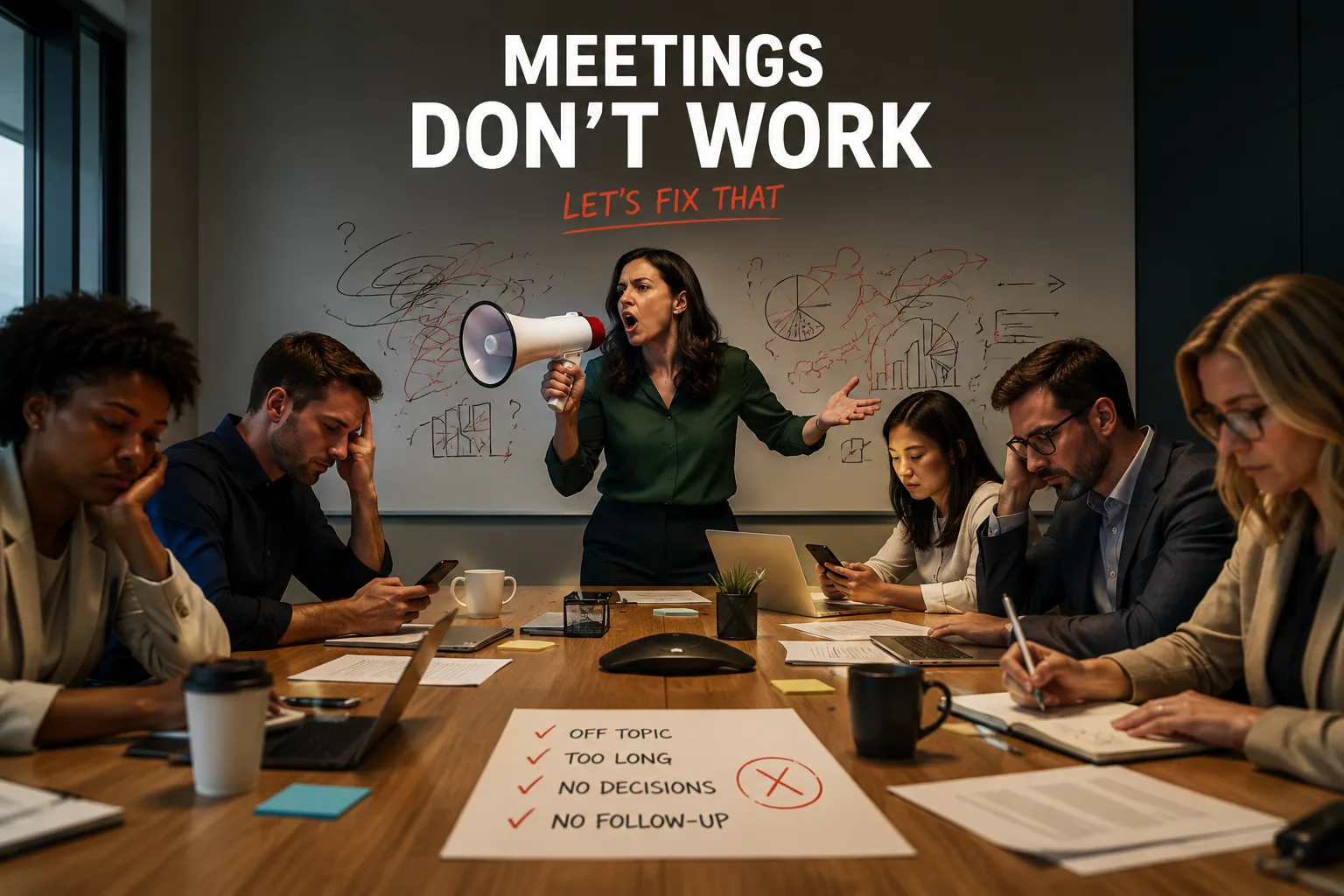
Meetings waste time when they convene without a specific outcome, omit needed decision-makers, include unnecessary attendees, or lack an agenda and follow-through. Meeting communication mistakes can be reduced by stating the purpose before scheduling, assigning roles, distributing a timed agenda, documenting decisions and action owners, and using asynchronous updates where discussion does not require a group gathering.
A product team at a mid-size SaaS company held a weekly "sync" meeting every Monday at 10 AM. Twelve people attended. There was no agenda.
The meeting organizer would open with "So, what should we talk about today?" and the next sixty minutes would unfold as a meandering conversation touching on whatever someone happened to mention.
The engineering lead would give a ten-minute monologue about technical blockers. The designer would ask questions about requirements that should have been clarified days ago.
The product manager would attempt to make a decision about feature priorities, but two of the three stakeholders whose input was needed were not in the room. The meeting would end with "Good discussion, let's pick this up next week." No decisions documented.
No action items assigned. No one quite sure why they had spent an hour in a conference room instead of doing their actual work.
This meeting ran for eighteen months before a new VP of Engineering joined the company and asked a simple question: "What decisions have been made in this meeting in the last three months?" The team could not name a single one.
The VP cancelled the meeting and replaced it with a fifteen-minute standup three times per week with a fixed format, required pre-reads, and mandatory documentation of decisions and action items. Productivity on the team measurably improved within two weeks.
Meeting communication mistakes are among the most expensive and pervasive failures in modern organizations.[4] The average professional spends over fifteen hours per week in meetings, and research consistently shows that executives consider more than half of that time wasted.[1]
The cost is staggering - not just in direct time, but in context-switching, decision delays, participant frustration, and the slow erosion of organizational trust that occurs when people repeatedly experience meetings as pointless.[3]
This article examines the most common meeting communication failures, how to design meetings that respect participants' time, when meetings should be replaced with asynchronous communication, strategies for managing participation imbalance, and the tradeoffs involved in recording meetings.
The Most Common Meeting Communication Failures
Failure 1: No Clear Purpose or Desired Outcome
The single most damaging meeting mistake is convening people without a defined reason. Vague meeting invites like "Project X sync" or "Quick touch base" signal that the organizer has not thought about what needs to happen.
Without a clear purpose, the meeting has no direction, no way to measure success, and no reason to end at any particular point.
Why this happens: Meetings become habits rather than tools. Recurring meetings continue long after their original purpose has been served. Organizers default to scheduling meetings because it feels productive, even when the objective is unclear.
The cost: Twelve people in a purposeless one-hour meeting represents twelve hours of organizational productivity consumed with nothing to show for it. Multiply this across every team, every week, and the waste is enormous.[2]
The fix: Every meeting invitation should answer one question before it is sent: "What specific outcome do we need from this meeting?" If you cannot articulate the outcome, the meeting should not happen.
Examples of clear purposes include "Decide between vendor A and vendor B," "Align on Q3 priorities," or "Resolve the disagreement between engineering and design on the checkout flow."
Failure 2: Wrong People in the Room
Meetings fail when the people who need to make decisions are absent and people who have no role in the discussion are present. Decision-makers who are not in the room create a situation where the group discusses extensively but cannot resolve anything.
Unnecessary attendees waste their own time and often derail conversations with tangential input.
Why this happens: Meeting organizers invite broadly out of political caution ("I don't want anyone to feel excluded") or laziness (adding the entire team distribution list rather than identifying specific participants). Meanwhile, the actual decision-maker is often a senior leader whose calendar is too full to attend.
The fix: For every meeting, identify three categories of participants: decision-makers (must attend or the meeting should be rescheduled), input-givers (have expertise or information needed for the decision), and FYI recipients (need to know the outcome but do not need to attend).
Only the first two categories should be in the room. FYI recipients receive meeting notes afterward.
Failure 3: No Agenda or Structure
A meeting without an agenda is a conversation without direction. Topics meander. Time is consumed by whoever speaks loudest or longest. Critical items are rushed at the end or never reached. Participants cannot prepare because they do not know what will be discussed.
Why this happens: Creating an agenda requires forethought, and many meeting organizers treat scheduling the meeting as the extent of their responsibility. Some believe that agendas are overly formal or constrain "organic discussion."
The fix: Every meeting should have a written agenda distributed at least twenty-four hours in advance. Each agenda item should include the topic, the time allocated, the person leading the discussion, and the desired outcome (decision, input, or information sharing).
The agenda is a contract with participants: this is what we will cover, in this order, in this time.
Example: A product planning meeting agenda might read: "1. Review customer feedback themes (10 min, Sarah presents, goal: shared understanding). 2. Discuss Q4 feature candidates (20 min, open discussion, goal: identify top 3). 3.
Prioritize and decide (15 min, PM facilitates, goal: ranked priority list). 4. Action items and owners (5 min)."
Failure 4: Participation Imbalance
In most meetings, a small number of people do most of the talking while others remain silent. Research on group dynamics consistently shows that the person who talks most in a meeting is perceived as the leader, regardless of whether they are contributing the most valuable information.
Meanwhile, quieter participants - who may have critical expertise or important dissenting views - go unheard.
| Participation Pattern | What It Looks Like | What Gets Lost |
|---|---|---|
| Dominant speaker monopolizes | One person talks 60%+ of the time | Diverse perspectives and expertise |
| HiPPO effect | Most senior person's view goes unchallenged | Data-driven decision-making |
| Silent disagreement | People nod but privately disagree | Genuine buy-in and commitment |
| Interruption patterns | Certain voices consistently cut off | Psychological safety and trust |
| Round-robin reporting | Each person gives update sequentially | Actual discussion and problem-solving |
The fix: Active facilitation is the antidote to participation imbalance.[10] Facilitators should explicitly invite quieter participants to share their views ("We haven't heard from you yet - what's your perspective?"), and set speaking limits for chronic dominators.
Use round-robin formats for critical decisions where everyone speaks once before anyone speaks twice, and collect written input before or during the meeting to reduce the pressure of real-time speaking.
Failure 5: Burying the Lede
The same mistake that plagues written communication - starting with background and building toward the point rather than leading with the conclusion - is equally destructive in meetings.
A presenter who spends twenty minutes on context before reaching the actual question forces the audience to sit through material that may be irrelevant to the decision at hand.
The fix: Every presenter in every meeting should state their recommendation or key message in the first thirty seconds, then provide supporting evidence. Executive audiences in particular expect the conclusion first and will become impatient with extensive preamble.
"If I had more time, I would have written a shorter letter." - attributed to Blaise Pascal
Designing Meetings That Respect Participants' Time
The Before-During-After Framework
Effective meetings are not accidents. They result from deliberate design across three phases: preparation before the meeting, facilitation during the meeting, and follow-through after the meeting. Most meeting failures occur because one or more of these phases is neglected entirely.
Before the Meeting:
1. Determine whether a meeting is truly necessary. Could this be handled asynchronously through email, a shared document, or a brief Slack thread? If the answer is yes, cancel the meeting and use the appropriate asynchronous channel instead.
2. Define the purpose and desired outcome. Write it in the calendar invitation. If you cannot articulate the outcome in one sentence, the meeting is not ready to be scheduled.
3. Invite only the people who need to be there. Decision-makers and input-givers attend. Everyone else receives notes. Smaller meetings are almost always more productive than larger ones.
4. Create and distribute a structured agenda with time allocations for each item. Include any pre-read materials so participants can prepare and arrive ready to discuss rather than absorb.
5. Prepare thoroughly as the organizer. Know what questions you need answered, what decisions you need made, and what information participants need to make those decisions.
During the Meeting:
1. Start on time, without waiting for latecomers. Waiting for late arrivals punishes the people who showed up on time and signals that punctuality does not matter.
2. Facilitate actively. Keep the discussion on track. Redirect tangents ("That's important, but let's address it separately"). Balance participation. Watch the clock and enforce time limits on agenda items.
3. Lead with conclusions rather than chronology. Whether presenting information or soliciting input, start with the bottom line and provide context only as needed.
4. Make decisions explicit. When a decision is reached, state it clearly and get verbal confirmation: "We've decided to go with Vendor A. Does everyone agree?" Do not let decisions be implied or assumed.
5. End with clear action items: who is doing what, by when. Every action item needs a specific owner (a name, not "the team") and a specific deadline (a date, not "soon").
After the Meeting:
1. Send a written summary within twenty-four hours. Include decisions made, action items with owners and deadlines, and any items tabled for future discussion.
2. Follow up on action items. A meeting that produces commitments no one tracks is worse than no meeting at all, because it creates the illusion of progress while nothing actually happens.[7]
The Meeting Design Checklist
Before scheduling any meeting, answer these questions:
| Question | If No... |
|---|---|
| Is synchronous discussion necessary? | Use async communication instead |
| Can I state the desired outcome in one sentence? | Meeting is not ready to be scheduled |
| Are the right decision-makers available? | Reschedule to when they can attend |
| Have I created an agenda with time allocations? | Create one before sending the invite |
| Have I distributed pre-read materials? | Send them at least 24 hours before |
| Is the meeting the right length? | Default to 25 or 50 minutes, not 30 or 60 |
When Meetings Should Be Emails
The Async-First Decision Rule
The simplest and most impactful improvement most organizations can make to their meeting culture is adopting an async-first default: assume every communication should be asynchronous unless there is a specific reason it needs to be synchronous.[12]
This inverts the typical default, where meetings are scheduled reflexively and asynchronous alternatives are considered only as afterthoughts.
A meeting should be asynchronous communication if:
1. You are sharing information with no discussion needed. Status updates, announcements, and FYIs do not require everyone to be in the same room at the same time. A well-structured email or document conveys the information more efficiently and creates a durable record.
2. It is a recurring meeting with no clear agenda. If the organizer opens with "What should we discuss today?" the meeting has outlived its purpose.
3. You are seeking simple approval or input. A yes/no decision or a request for feedback on a document does not require a meeting. Send the document, specify what feedback you need, and set a deadline.
4. Everyone would give parallel, independent updates. Round-robin status meetings where each person reports sequentially are among the least efficient uses of synchronous time. Each person is relevant for only their own update and idle for everyone else's.
5. Participants are in vastly different time zones. Requiring someone to attend a meeting at 11 PM their time for information that could be shared asynchronously is disrespectful of their time and wellbeing.
When Synchronous Meetings Are Necessary
Meetings earn their cost when they involve complex debate requiring real-time exchange of perspectives, conflict or sensitive topics that need the nuance of voice and facial expressions, decisions with significant tradeoffs that benefit from live discussion, relationship-building that requires personal interaction, or situations where asynchronous communication has already failed to resolve the issue.
Example: At Basecamp, the software company known for its remote work practices, meetings are treated as a last resort. Project kickoffs, creative brainstorms, and complex problem-solving happen synchronously. Status updates, routine decisions, and information sharing happen through written communication in their project management tool.
The company reports that this approach saves the equivalent of thousands of meeting hours per year while improving decision quality through the discipline of writing things down.
"Meetings are a symptom of bad organization. The fewer meetings the better." - Peter Drucker[5]
Managing Participation Imbalance
Why Some People Dominate and Others Stay Silent
Participation imbalance in meetings is not random. It follows predictable patterns driven by personality, power dynamics, cultural norms, and meeting structure.
People who dominate meetings often do so because they are extroverts who think by talking, because their seniority makes them feel entitled to more airtime, because the meeting lacks facilitation that would distribute participation, or because they are genuinely passionate about the topic and lose awareness of how much space they are taking.
People who stay silent often do so because they are introverts who process internally before speaking, because the power dynamics make them feel their input is unwelcome, because the conversation moves too quickly for them to find an opening, because they disagree but do not feel psychologically safe expressing dissent, or because cultural norms discourage them from speaking up in group settings.[8]
Strategies for Balancing Participation
1. Collect input before the meeting. Ask participants to submit their thoughts, concerns, or ideas in writing before the meeting begins.
This removes the real-time speaking pressure, ensures that introverts and those who process internally have equal opportunity to contribute, and gives the facilitator material to draw from during discussion.
2. Use structured participation formats. Round-robin (everyone speaks once before anyone speaks twice), silent brainstorming (everyone writes ideas simultaneously, then shares), and nominal group technique (independent idea generation followed by group discussion) all prevent the loudest voice from dominating.
3. Explicitly invite quiet participants. "We haven't heard from everyone yet. Sarah, you've dealt with a similar situation before - what's your perspective?" This is not putting people on the spot if done respectfully; it is signaling that their input is valued and expected.
4. Manage chronic dominators. Interrupt politely but firmly: "Let me pause you there - I want to make sure we hear from others on this." For repeat offenders, provide private feedback: "Your contributions are valuable, but I need you to create more space for others in meetings.[11]
Can you limit your comments to two minutes each?"
5. Have senior people speak last. When the most senior person in the room shares their opinion first, it anchors the discussion and suppresses dissent. Having junior team members speak first produces more diverse perspectives and more honest input.
Amazon's practice of having the most senior person speak last in many meetings is designed precisely to counter the HiPPO effect.
6. Use anonymous input tools. For sensitive topics where people may fear speaking up, anonymous polling, chat-based input, or written submissions allow honest perspectives to surface without social risk.
Death by PowerPoint and Other Presentation Failures
The Slide Deck Problem
Presentation failures in meetings fall into predictable categories, all of which waste time and undermine communication effectiveness.
Too many slides. A forty-slide presentation for a thirty-minute meeting is a document disguised as a presentation. The presenter reads from slides while the audience reads ahead, creating a bizarre situation where everyone is processing different information simultaneously.
The solution is ruthless reduction: three to five slides for a thirty-minute meeting, with detailed analysis in an appendix shown only if requested.
Slides as speaker notes. When every slide contains multiple paragraphs of text, the slides are serving the presenter (as a script) rather than the audience (as a visual aid). Slides should contain key data points, frameworks, or visuals that complement what the presenter is saying - not duplicate it.
No narrative structure. A presentation that moves through disconnected topics without a clear throughline loses the audience within minutes. Every presentation should answer three questions in order: What is the situation? What do I recommend? What do I need from you?
Reading the slides aloud. Nothing signals disrespect for the audience's intelligence more effectively than reading text that they can see on the screen. If the information can be read, send it as a document. If it requires a presentation, speak to the ideas while using visuals to reinforce key points.
Example: Jeff Bezos famously banned PowerPoint presentations at Amazon in favor of six-page narrative memos.[9] Meeting participants spend the first fifteen to twenty minutes reading the memo silently, then discuss.
This approach forces the presenter to think through their argument clearly (narrative writing requires more rigor than bullet points), ensures all participants have the same information, and focuses discussion time on questions and decisions rather than information transfer.
Recording Meetings: Benefits, Costs, and Best Practices
The Tradeoffs of Meeting Recordings
The rise of video conferencing and AI transcription tools has made meeting recording technically trivial. But the decision to record involves significant tradeoffs that most organizations do not consider carefully enough.
| Factor | Benefit of Recording | Cost of Recording |
|---|---|---|
| Documentation | Permanent record of decisions and rationale | Reduced psychological safety |
| Accessibility | Async viewing for absent participants | Over-reliance on recordings vs. engagement |
| Training | New hires can understand historical context | Privacy and storage concerns |
| Accuracy | Captures exact statements, not memory | Potential for misuse or out-of-context quotes |
| AI capabilities | Searchable transcripts and summaries | False sense of thoroughness replacing good notes |
When to Record and When Not To
Record when: Decisions have long-term implications and the rationale needs to be preserved. Asynchronous viewing is genuinely valuable (large meetings, different time zones). Training or onboarding purposes require historical context. Legal or compliance requirements mandate documentation.
Do not record when: Brainstorming or ideation sessions require psychological safety for half-formed ideas. Sensitive personnel discussions, performance feedback, or conflict resolution could be chilled by recording. The meeting is a routine working session where recording adds no value.
Best practices for recording: Always ask explicit permission before recording. State the purpose and intended use clearly. Create designated "off the record" moments when needed. Provide written summaries regardless - recordings supplement but do not replace good documentation.
Manage access and retention policies (who can view, how long recordings are kept).
Building a Better Meeting Culture
Organizational Meeting Hygiene
Individual meeting improvements matter, but lasting change requires organizational norms and accountability.
1. Meeting-free blocks. Designate specific times when no meetings can be scheduled - typically mornings or specific days of the week. This protects focused work time and forces meetings into defined windows.
2. Default shorter meetings. Change calendar defaults from thirty and sixty minutes to twenty-five and fifty minutes.[6] The five-minute buffer between meetings prevents the cascading lateness that plagues most organizations and gives participants time to transition and prepare.
3. Required agenda policy. Establish an organizational norm that meetings without agendas can be declined. This creates accountability for meeting organizers and empowers participants to protect their time.
4. Regular meeting audits. Quarterly reviews of recurring meetings to assess whether they are still necessary, whether the right people attend, and whether they produce measurable value. Cancel ruthlessly.
5. Meeting cost awareness. Some organizations display the cost of meetings (calculated from attendee salaries and time) to make the expense visible. A one-hour meeting with twelve senior professionals may cost the organization over two thousand dollars in direct labor costs alone.
"The least productive people are usually the ones who are most in favor of holding meetings." - Thomas Sowell
Key Takeaways
1. The most common meeting communication failures are lack of clear purpose, wrong attendees, no agenda, participation imbalance, and burying the main point. Each is preventable with deliberate meeting design.
2. Effective meetings require preparation before (purpose, agenda, right people), facilitation during (time management, balanced participation, explicit decisions), and follow-through after (written summary, action item tracking).
3. Default to asynchronous communication. Meetings should be used only when synchronous discussion is genuinely necessary - for complex debate, sensitive topics, decisions with significant tradeoffs, or relationship-building.
4. Manage participation imbalance through structured formats, pre-meeting input collection, explicit invitations to quiet participants, private coaching for dominators, and having senior people speak last.
5. Build organizational meeting culture through meeting-free blocks, shorter defaults, required agendas, regular audits, and cost awareness. Individual improvements are insufficient without systemic cultural change.
Sources & Further Reading
Rogelberg, S. G. "The Surprising Science of Meetings." Oxford University Press, 2019.
Perlow, L., Hadley, C. & Eun, E. "Stop the Meeting Madness." Harvard Business Review, July-August 2017.
Allen, J. A. & Rogelberg, S. G. "Manager-Led Group Meetings: A Context for Promoting Employee Engagement." Group & Organization Management, 2013.
Mroz, J. E., Allen, J. A., Verhoeven, D. C. & Shuffler, M. L. "Do We Really Need Another Meeting? The Science of Workplace Meetings." Current Directions in Psychological Science, 2018.
Drucker, P. "The Effective Executive." Harper Business, 2006.
Fried, J. & Hansson, D. H. "It Doesn't Have to Be Crazy at Work." Harper Business, 2018.
Lencioni, P. "Death by Meeting." Jossey-Bass, 2004.
Edmondson, A. C. "The Fearless Organization." Wiley, 2018.
Bezos, J. "Letter to Shareholders." Amazon, 2018.
Schwarz, R. "Smart Leaders, Smarter Teams." Jossey-Bass, 2013.
Scott, K. "Radical Candor." St. Martin's Press, 2017.
Newport, C. "A World Without Email." Portfolio, 2021.
What the Research Shows About Meeting Costs and Effectiveness
The empirical study of organizational meetings has produced findings that should directly challenge the assumptions most professionals hold about when meetings add value.
Steven Rogelberg at the University of North Carolina Charlotte is the leading academic researcher on meeting science.
His 2019 book The Surprising Science of Meetings, drawing on 20 years of his own research, summarizes a consistent finding: professionals consistently underestimate how much they dislike meetings and overestimate how much they accomplish in them.
In one of Rogelberg's studies, employees reported that 71% of their meetings were unproductive.
Yet when asked to reflect on whether their own meetings were valuable, the same employees rated them significantly higher - because we judge others' meetings as an attendee and our own as the organizer who sees the purpose more clearly.
This asymmetry is a structural barrier to reform: meeting organizers lack the feedback signal that would tell them their meetings are failing.
Leslie Perlow at Harvard Business School published research in Harvard Business Review (2017) showing that 65% of senior managers reported meetings keep them from completing their own work. 71% said meetings are unproductive and inefficient.
64% said meetings come at the expense of deep thinking. Perlow's intervention study at Boston Consulting Group introduced "predictable time off" - scheduled periods of guaranteed meeting-free time - and found that teams with protected focus blocks increased productivity, job satisfaction, and work product quality simultaneously.
The mechanism was not the time itself but the cultural signal: when meetings are no longer the default, people start questioning whether each individual meeting deserves to exist.
Joseph Allen at the University of Arkansas has documented the relationship between meeting load and employee wellbeing through a series of studies published in Group Dynamics: Theory, Research, and Practice (2012-2019).
Allen's research found that the number of meetings employees attend correlates negatively with their sense of productivity, autonomy, and job satisfaction - independent of whether those meetings are considered useful.
Even "good" meetings carry overhead costs in context-switching, preparation, and the loss of flow states.
Allen's team found that employees who attended more than three hours of meetings per day reported significantly elevated levels of work exhaustion and emotional depletion.
The implication for meeting design is not just improving meeting quality but actively reducing meeting quantity, because quantity has costs even when quality is adequate.
Joseph Allen and colleagues have documented what they call "meeting recovery syndrome" - the period after meetings where employees must regain the concentration and momentum they had before the meeting. Based on Gloria Mark's research on interruptions, it takes roughly 23 minutes to refocus after a disruption.
This means a 30-minute meeting with 10 attendees costs not 300 person-minutes but closer to 530 person-minutes when recovery time is included.
For organizations running 20 meetings per day, this represents thousands of wasted person-hours weekly that never appear in any meeting cost calculation.
Case Studies: Organizations That Reformed Their Meeting Culture
Shopify's 2023 Calendar Purge represents one of the most decisive organizational responses to meeting overload documented in recent business history.
In January 2023, Shopify's COO Kaz Nejatian sent a company-wide notice cancelling all recurring meetings with more than two people and blocking out Wednesdays as a meeting-free day for all employees.
The policy deleted an estimated 12,000 meetings from employee calendars in a single action. Shopify reported that the change freed up an average of two hours per employee per day.
The internal metric the company tracked was "time to first meaningful work" each morning - the time between arriving at work and doing substantive productive work. After the calendar purge, this metric improved by 40%.
Shopify maintained the policy through 2024, reporting improved employee satisfaction scores and no measurable decrease in coordination quality, suggesting that the majority of the cancelled meetings had not been providing coordination value that justified their cost.
Asana's research on meeting waste, conducted through the company's Work Innovation Lab and published in its annual "Anatomy of Work" report (2022), surveyed 10,000 knowledge workers globally and found that employees spend an average of 58% of their working day on work about work - meetings, status updates, and coordination activities - rather than skilled work.
The report found that companies with the highest "work about work" percentages had lower employee satisfaction and higher turnover, independent of compensation.
Asana's own internal reforms, which included mandatory written pre-reads for all meetings with more than four people and a prohibition on recurring meetings without quarterly justification audits, reduced meeting time by 30% within one year.
The company attributed a portion of its product velocity improvement to the time freed from meetings.
Intel's No-Meeting Fridays policy, implemented in the 1990s under Andy Grove and documented in Grove's High Output Management (1983), created one of the earliest systematic protections of deep work time in a technology company.
Grove's reasoning was explicit: the highest-value activities in knowledge work - design, analysis, problem-solving - require extended uninterrupted concentration that meetings systematically prevent.
Intel's engineers reported that Friday protected time produced a disproportionate share of their most important technical work.
The policy was eventually expanded to cover mornings across the entire week, with meetings confined to afternoons.
Grove's framework for evaluating any meeting was straightforward: "Does this meeting produce output that justifies the sum of all participants' hourly rates plus the opportunity cost of their alternative activities?" Applying this test, Grove estimated that 40% of Intel's meetings failed the threshold and should not have been scheduled.