
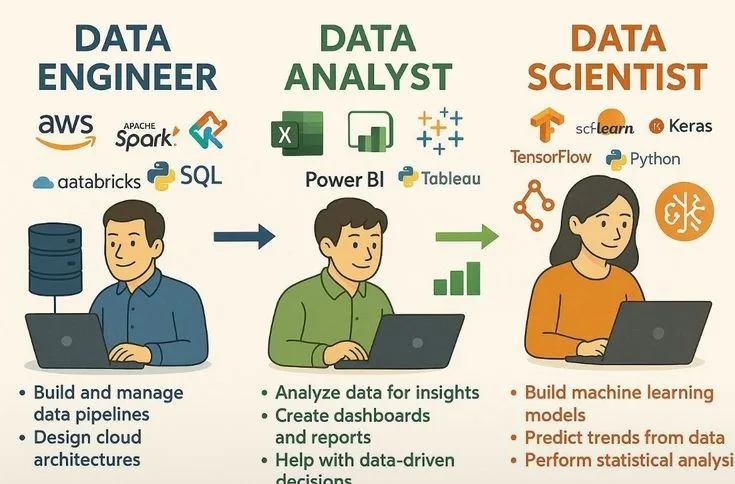
Data scientist, data analyst, and data engineer are three distinct roles in the data profession that serve different functions, require different skill sets, and follow different career trajectories - yet companies use these titles so inconsistently that choosing the right path requires looking far beyond the job title itself.
A data scientist at a 30-person startup may spend 60% of their time building ETL pipelines. A data analyst at Google may do work equivalent to a data scientist at a mid-size company.
A data engineer at a fintech firm may need more statistical knowledge than some data scientists at other organizations.
Understanding the real differences matters for more than navigating job boards. Each role has a different skill ceiling, a different salary trajectory, a different relationship to engineering and business teams, and a fundamentally different type of daily work.
Choosing the wrong one - even when starting salaries look similar - can lock you into a career that misaligns with your strengths or interests for years.
The clearest way to distinguish the three: the data analyst asks "what happened and why?" The data scientist asks "what will happen and what should we do about it?" The data engineer asks "how do we build systems that provide reliable data so either question can be answered at all?"
"Data science is not just about building models. The real work - the work that determines whether your predictions are any good - happens in data engineering. If the data is wrong, the model is wrong.
There is no machine learning algorithm that corrects for bad inputs." - Monica Rogati, former VP of Data at Jawbone, writing on her "AI Hierarchy of Needs," 2017
Key Definitions
Data analyst: A professional who uses SQL, spreadsheets, and business intelligence tools to answer defined business questions using existing data. The analytical focus is on descriptive analysis (what happened) and diagnostic analysis (why it happened).
Data scientist: A professional who applies statistical modeling, machine learning, and experimental design to build predictive or prescriptive frameworks. The work involves developing models that answer questions not yet fully formed and quantifying the uncertainty in those answers.
Data engineer: A professional who designs, builds, and maintains the data infrastructure - pipelines, warehouses, lakes, and processing systems - that makes data accessible and reliable for analysts and scientists.
ETL/ELT (Extract, Transform, Load / Extract, Load, Transform): The process of pulling data from source systems, transforming it into usable formats, and loading it into a destination like a data warehouse. Data engineers own most ETL/ELT work.
The shift from ETL to ELT (loading raw data first, then transforming inside the warehouse) has been driven by the falling cost of cloud warehouse compute.
Feature engineering: The process of creating new input variables for machine learning models from raw data. Often cited as the single most impactful skill in applied data science - more important than algorithm selection in most business contexts.
dbt (data build tool): An open-source tool that has become standard in modern data stacks for managing SQL-based data transformations inside the warehouse. dbt has created a new hybrid role - the analytics engineer - that sits between data engineering and data analysis.
Role Comparison at a Glance
| Dimension | Data Analyst | Data Scientist | Data Engineer |
|---|---|---|---|
| Primary question | What happened? Why? | What will happen? What should we do? | How do we have reliable data at scale? |
| Core tools | SQL, BI tools (Tableau, Looker, Power BI), Excel | Python, scikit-learn, PyTorch/TensorFlow, SQL | Python/Scala, Airflow/Dagster, Spark, dbt |
| Statistics depth | Working literacy | Deep expertise required | Limited, focused on data quality |
| Software engineering | Limited | Moderate | Strong |
| Business context | Deep and specific | Moderate | Broad but less deep |
| ML modeling | Rarely | Central to the role | Rarely (ML platform/infra sometimes) |
| Communication focus | Stakeholder-facing | Technical + stakeholder | Engineering teams |
| Typical team placement | Within business units | Centralized data team or product | Platform or infrastructure team |
| Entry salary (US, 2025) | $60,000-$80,000 | $90,000-$120,000 | $90,000-$115,000 |
| Senior salary (US, 2025) | $110,000-$145,000 | $165,000-$220,000 | $165,000-$210,000 |
| Top-tier total comp | $150,000-$190,000 | $250,000-$450,000+ | $240,000-$400,000+ |
Sources: Glassdoor (2025), Levels.fyi (2025), LinkedIn Salary Insights (2025), Bureau of Labor Statistics Occupational Outlook Handbook (2024).
What a Data Analyst Actually Does
The Daily Reality
The data analyst's role is fundamentally about answering questions that someone else has already defined. A product manager wants to understand why mobile conversion dropped 12% last week. A finance director needs customer acquisition cost broken down by marketing channel and cohort.
An operations lead wants to know which support ticket categories take the longest to resolve and whether resolution time correlates with customer churn.
The analyst handles these requests by writing SQL queries against the company's data warehouse, pulling results into spreadsheet or BI tools, creating visualizations that communicate patterns, and presenting findings to stakeholders who will make decisions based on the analysis.
A significant portion of the job - often 30-50% by practitioner estimates - involves data validation: checking whether the numbers make sense, tracking down discrepancies between data sources, and understanding the provenance of the metrics being reported.
Professor Ben Jones, founder of Data Literacy LLC and author of Avoiding Data Pitfalls (2019), describes the analyst's core skill as "translation": the ability to convert a vague business question into a precise data question, execute the analysis, and convert the results back into a business recommendation that a non-technical decision-maker can act on.
Technical Stack
The technical requirements for most analyst roles are narrower than the other two paths:
- SQL: Non-negotiable. Analysts write more SQL than anyone else in the data organization. Proficiency means not just SELECT statements but window functions, CTEs, subqueries, and understanding query performance.
- Business intelligence tools: At least one of Tableau, Looker, Power BI, or Metabase. The specific tool varies by company, but the underlying skills (data modeling for visualization, dashboard design, metric definition) transfer across tools.
- Excel/Google Sheets: Still standard for ad-hoc analysis, financial modeling, and quick data manipulation.
- Python or R: Increasingly expected at tech companies for statistical testing, cohort analysis, and automation. Not universally required but becoming a differentiator.
The Most Underrated Analyst Skill
Communication. The ability to translate a complex multi-variable analysis into a clear, actionable recommendation for a non-technical executive is genuinely difficult.
It requires understanding not just what the data says but what the stakeholder needs to hear, what level of detail is appropriate, and how to present uncertainty without undermining confidence in the conclusion.
Analysts who master this skill advance faster than analysts who are technically superior but struggle to communicate findings.
As the McKinsey Global Institute noted in their 2023 report on data-driven organizations: "The bottleneck in most companies is not generating insights - it is ensuring those insights reach the right decision-makers in a form they can act on."
Career Trajectory and Salary
| Level | Base Salary Range (US, 2025) | Typical Experience |
|---|---|---|
| Entry-level analyst | $60,000-$80,000 | 0-2 years |
| Mid-level analyst | $85,000-$110,000 | 2-5 years |
| Senior analyst | $110,000-$145,000 | 5-8 years |
| Lead/Staff analyst (top tech) | $150,000-$190,000 total comp | 8+ years |
| Analytics manager | $130,000-$180,000 | 6-10 years |
The analyst career path historically had a lower ceiling than data science or engineering, but the emergence of the analytics engineer role - combining analyst SQL skills with software engineering practices via dbt - has opened a higher-compensation track for analytically-minded professionals who also enjoy building data infrastructure.
What a Data Scientist Actually Does
The Daily Reality
Data scientists are brought in when the question itself is ambiguous, when the answer requires building something predictive rather than reporting what already happened, or when the scale and complexity of the data exceeds what standard analytical approaches can handle.
In practice, a data scientist at a technology company might spend weeks exploring a dataset to understand whether a relationship between user behavior and churn is real and actionable before beginning to model it.
The statistical rigor required is substantially higher than in analysis work - understanding statistical power, confounding variables, model validation, overfitting, selection bias, and the difference between correlation and causation is essential.
A typical data science project follows what practitioners call the CRISP-DM framework (Cross-Industry Standard Process for Data Mining, first published in 1999 by a consortium including SPSS, Teradata, and Daimler-Benz): business understanding, data understanding, data preparation, modeling, evaluation, and deployment.
The dirty secret of data science is that 60-80% of the time goes to data understanding and preparation - not the modeling that most people associate with the role.
Machine learning is central to most data scientist roles today, but precision about what that means is important. The majority of applied data science jobs involve applying established algorithms - gradient boosting (XGBoost, LightGBM), logistic regression, random forests, neural networks - to business problems using existing libraries.
The emphasis is on feature engineering (which input variables to create and how), model selection (which algorithm fits the problem structure), validation methodology (how to honestly assess model performance), and communicating uncertainty to stakeholders.
Andrew Ng, co-founder of Coursera and founding lead of Google Brain, has repeatedly emphasized that "applied ML is 90% data engineering and feature engineering, and 10% algorithm selection." In a 2021 talk at NeurIPS, he introduced the concept of data-centric AI - the idea that improving data quality produces better models than improving algorithms, which has become an influential framework in applied data science.
Technical Stack
- Python: The dominant language. pandas for data manipulation, scikit-learn for classical ML, PyTorch or TensorFlow for deep learning, statsmodels for statistical testing.
- SQL: Essential for data access, though scientists typically write less SQL than analysts.
- Experiment tracking: MLflow, Weights & Biases, or Neptune for versioning models, tracking metrics, and ensuring reproducibility.
- Cloud ML platforms: AWS SageMaker, GCP Vertex AI, or Azure ML for training and deploying models at scale.
- Version control: Git is expected, though data scientists' code quality is often a tension point with engineering teams.
Career Trajectory and Salary
| Level | Base Salary Range (US, 2025) | Typical Experience |
|---|---|---|
| Entry-level data scientist | $90,000-$120,000 | 0-2 years |
| Mid-level data scientist | $130,000-$165,000 | 2-5 years |
| Senior data scientist | $165,000-$220,000 | 5-8 years |
| Staff/Principal (top tech) | $250,000-$450,000+ total comp | 8+ years |
| ML engineer (applied) | $140,000-$250,000 | 3-7 years |
| Research scientist | $150,000-$300,000 | PhD + 2-5 years |
The data science salary premium over analysts reflects the deeper technical requirements and the direct revenue impact of well-built predictive models. At Meta, for example, a data scientist who improves the news feed ranking algorithm by 0.1% affects billions of daily sessions - the business leverage of the role is enormous.
What a Data Engineer Actually Does
The Daily Reality
Data engineers build and maintain the infrastructure that makes data work possible. Without reliable data engineering, analysts cannot query trustworthy tables and scientists cannot train models on current, clean data.
Monica Rogati's "AI Hierarchy of Needs" - a pyramid model she published in 2017 - places data engineering at the foundation: you cannot build machine learning without reliable data collection, storage, and processing, just as you cannot build the upper floors of a building without the foundation.
A typical data engineer's work involves:
- Building data pipelines that extract data from application databases, third-party APIs, event streams, and file systems
- Designing data warehouse schemas (star schemas, snowflake schemas, wide denormalized tables) optimized for analytical query patterns
- Implementing data quality testing - checking for null values, schema changes, freshness, uniqueness, and referential integrity
- Managing the computational resources required to process terabytes of data within acceptable time windows
- Maintaining data catalogs and documentation so that analysts and scientists can discover and understand available datasets
Technical Stack
The data engineer's technical stack is closer to software engineering than data analysis:
- Python or Scala: For pipeline logic, data transformation, and orchestration.
- SQL and data modeling: Deep knowledge of warehouse-specific SQL dialects (Snowflake SQL, BigQuery SQL, Redshift SQL), slowly changing dimensions, and modeling patterns.
- Workflow orchestration: Apache Airflow (the most widely used), Prefect, or Dagster for scheduling and managing pipeline dependencies.
- Data warehouse platforms: Snowflake, Google BigQuery, Amazon Redshift, or Databricks.
- dbt: For managing SQL-based transformations within the warehouse. dbt Labs' Analytics Engineering Guide (2024) reports that dbt adoption grew from approximately 5,000 active projects in 2020 to over 40,000 in 2024.
- Streaming systems: Apache Kafka, Apache Flink, or Amazon Kinesis for real-time data pipelines.
- Cloud infrastructure: IAM permissions, storage systems (S3, GCS), networking, and increasingly Terraform or Pulumi for infrastructure as code.
The Engineer-Scientist Relationship
The collaboration between data engineers and data scientists is often the most important - and most friction-prone - relationship in a data organization. Scientists need data that is clean, documented, timely, and accessible.
Engineers need scientists to communicate data requirements clearly and early, not after they have been exploring ad-hoc queries against production databases for three weeks.
Joe Reis and Matt Housley, in their influential book Fundamentals of Data Engineering (O'Reilly, 2022), describe this as the "data engineering lifecycle" - a framework that positions the engineer as providing services to downstream consumers (analysts, scientists, ML engineers) rather than building infrastructure in isolation.
Career Trajectory and Salary
| Level | Base Salary Range (US, 2025) | Typical Experience |
|---|---|---|
| Entry-level data engineer | $90,000-$115,000 | 0-2 years |
| Mid-level data engineer | $130,000-$165,000 | 2-5 years |
| Senior data engineer | $165,000-$210,000 | 5-8 years |
| Staff/Principal (top tech) | $240,000-$400,000+ total comp | 8+ years |
| Data platform engineer | $150,000-$230,000 | 4-8 years |
Data engineering is consistently cited as one of the fastest-growing and most undersupplied roles in technology. LinkedIn's 2024 Jobs on the Rise report listed data engineering among the top 10 fastest-growing job titles for the fourth consecutive year.
The shortage of engineers who understand both software engineering practices and the data domain means the role commands strong compensation and job security.
Skill Overlaps and Where They Diverge
All three roles share SQL as a foundation. Every data professional benefits from writing clean, efficient queries, understanding database structure, and reasoning about data at scale.
Python is also increasingly shared, though the flavors differ:
- Analysts use Python for automation, data cleaning, and statistical testing
- Scientists use Python for modeling, exploration, and experiment analysis
- Engineers use Python for pipeline construction, data transformation, and tooling
Where the roles diverge sharply:
Statistics and probability: Data scientists need the deepest grounding - hypothesis testing, probability distributions, Bayesian inference, model evaluation metrics, experimental design (A/B testing, causal inference).
Analysts need working statistical literacy: understanding p-values, confidence intervals, and when a result is "significant" versus just "interesting." Engineers need much less statistics, though understanding data distributions and quality metrics is valuable.
Software engineering: Data engineers need the strongest practices - writing maintainable, tested, production-quality code with proper error handling, logging, and monitoring.
Scientists benefit from good engineering habits but are typically not held to the same standards; their code is often more exploratory. Analysts write the least production code.
Business domain knowledge: Analysts typically have the deepest business context because they interact most directly with stakeholders and answer domain-specific questions daily. Scientists need enough context to scope meaningful projects and communicate findings.
Engineers often work across multiple product areas and need breadth more than depth.
Infrastructure and systems: Engineers need deep knowledge of distributed systems, cloud platforms, and operational reliability - territory shared more with backend engineers than with analysts or scientists.
How Companies Define These Roles Inconsistently
The same title means dramatically different things across companies. This reflects the size, structure, and data maturity of each organization.
Early-stage startups (10-50 people): A "data scientist" does everything - pipeline building, dashboard creation, analysis, and occasional modeling. There is no engineering team to build infrastructure, so the scientist does it themselves.
These roles develop broad skills but can embed bad habits if the scientist never experiences proper engineering discipline or statistical rigor.
Mid-size companies (50-500 people): Roles begin to specialize. A data engineer handles pipelines, analysts handle reporting, scientists handle modeling. But boundaries remain fuzzy - scientists often have to fix their own data pipeline issues because engineering bandwidth is limited.
Large tech companies (500+ people): Role definitions become strict. Google distinguishes between "data analysts," "data scientists," "research scientists," and "ML engineers" with different interview processes, leveling systems, and compensation bands.
Meta has similar distinctions. Amazon's "applied scientist" focuses on ML deployment rather than pure research.
When reading job postings, look past the title: If a "data scientist" role requires Airflow, Kafka, and Terraform, it is actually a data engineering role. If a "data analyst" role requires PyTorch and paper reading, it is closer to a research scientist role.
If a "data engineer" role asks for A/B testing expertise, the company probably does not know what it wants.
Which Role to Choose Based on Your Background
Strong math or statistics background with limited programming: Start with data science. Your statistical foundation is the hardest part to acquire and is already in place. Focus on Python proficiency and SQL to fill the technical gaps. Consider the data scientist career path article for a detailed roadmap.
Strong programming background with limited statistics: Data engineering is a natural fit. You can leverage your software skills immediately while learning data-specific tools (Airflow, dbt, warehouse platforms). Moving to data science later requires significant investment in statistics and experimental design.
Business or finance background with strong Excel/SQL skills: Data analyst is the right entry point. Your domain knowledge and communication skills are genuine assets that most STEM graduates lack. Python can be added over time. The transition to analytics engineer (via dbt) or to data science is well-worn.
Computer science graduate with ML coursework: Either data science or ML engineering depending on whether you prefer working on models or infrastructure. Both paths are accessible; choose based on whether you find intellectual satisfaction in algorithm design and statistical reasoning or in building reliable systems at scale.
Career changers from non-technical backgrounds: The analyst path has the lowest barrier to entry. SQL can be learned in 2-3 months of focused study. Business intelligence tools in another month. An entry-level analyst role provides a foundation from which all other data roles become accessible.
How to Switch Between These Roles
Analyst to data scientist: The most common transition. Analysts who add Python proficiency, statistics beyond basic significance testing (Bayesian methods, regression, classification), and at least one end-to-end ML project to their portfolio regularly make this move within 2-3 years.
Kaggle competitions, while imperfect proxies for real work, provide structured practice and portfolio evidence.
Data scientist to data engineer: Less common but increasingly valuable. The key gap to fill is software engineering discipline - writing tested, maintainable, production-quality code rather than exploratory Jupyter notebooks. Learning Airflow, dbt, and cloud infrastructure (AWS/GCP/Azure) is the technical bridge.
Data engineer to data scientist: Requires significant investment in statistics and ML that most engineers do not acquire through normal work. This transition typically takes 2-3 years of deliberate study and project work.
The advantage: engineers who become scientists write better code and understand data infrastructure deeply, making them highly effective in production ML contexts.
Analyst to data engineer: Growing in popularity via the analytics engineer role. dbt proficiency, SQL mastery, and learning Python for pipeline work create a natural bridge. This path often leads to higher compensation than the analyst track without requiring the statistical depth of data science.
The Impact of AI on Data Roles
Large language models and AI coding assistants are already reshaping all three roles, though the impact varies:
Analysts: AI tools (ChatGPT, GitHub Copilot, natural-language-to-SQL tools) can generate basic SQL queries and simple analyses, compressing routine work. But the analyst's core value - understanding business context, asking the right questions, and communicating findings to decision-makers - remains difficult to automate.
The analysts most at risk are those whose work consists primarily of running predefined queries and updating dashboards.
Data scientists: AI accelerates exploratory data analysis and code generation but does not replace the judgment needed for experiment design, model validation, and interpreting results in business context.
If anything, how AI is changing data science is raising the bar: organizations expect data scientists to deliver more with AI-assisted tools, not less.
Data engineers: AI can generate boilerplate pipeline code and suggest optimizations, but the core challenges of data engineering - designing reliable distributed systems, debugging production pipeline failures at 2 AM, managing schema evolution across dozens of upstream sources - remain deeply human problems that require systems thinking and operational judgment.
Practical Takeaways
Read the job description, not the title. The actual requirements reveal the true role more reliably than the label.
All three roles benefit from strong SQL. If you are entering any data field, treat SQL fluency as a non-negotiable baseline. It is the lingua franca of data work.
The analyst-to-scientist transition is accessible and well-worn. A structured 6-12 month learning plan (Python, statistics, one end-to-end ML project) is a realistic path for motivated analysts.
Data engineering is underappreciated and well-compensated. The critical nature of infrastructure work and the shortage of engineers who also understand the data domain means the role commands strong pay, job security, and growing organizational influence.
Specialization pays more; generalization employs more. At senior levels, deep expertise in one domain (ML infrastructure, real-time data systems, causal inference) commands higher compensation than broad-but-shallow data generalism. But generalists have more job options and adapt more easily to organizational changes.
Sources & Further Reading
- Rogati, M. (2017). The AI Hierarchy of Needs. Hackernoon. View source
- Reis, J., & Housley, M. (2022). Fundamentals of Data Engineering. O'Reilly Media.
- Grus, J. (2019). Data Science from Scratch (2nd ed.). O'Reilly Media.
- Ng, A. (2021). A Chat with Andrew on MLOps: From Model-centric to Data-centric AI. NeurIPS 2021 keynote.
- Jones, B. (2019). Avoiding Data Pitfalls: How to Steer Clear of Common Blunders When Working with Data and Presenting Analysis and Visualizations. Wiley.
- Bureau of Labor Statistics. (2024). Occupational Outlook Handbook: Data Scientists. US Department of Labor.
- Glassdoor. (2025). Data Analyst, Data Scientist, and Data Engineer Salary Reports.
- Levels.fyi. (2025). Compensation data for data roles at US tech companies.
- dbt Labs. (2024). The Analytics Engineering Guide. View source
- McKinsey Global Institute. (2023). The Data-Driven Enterprise of 2025.
- Kaggle. (2024). State of Data Science and Machine Learning Survey.
- LinkedIn Economic Graph. (2024). Jobs on the Rise: Data Roles in Demand.
- Chapman, P., et al. (1999). CRISP-DM 1.0: Step-by-step Data Mining Guide. SPSS/Teradata/Daimler-Benz.
- Google. (2024). Careers: Data Science and Analytics Role Descriptions. Google Careers.
- Harris, J., & Murphy, J. (2020). The Business of Artificial Intelligence. Harvard Business Review Press.