
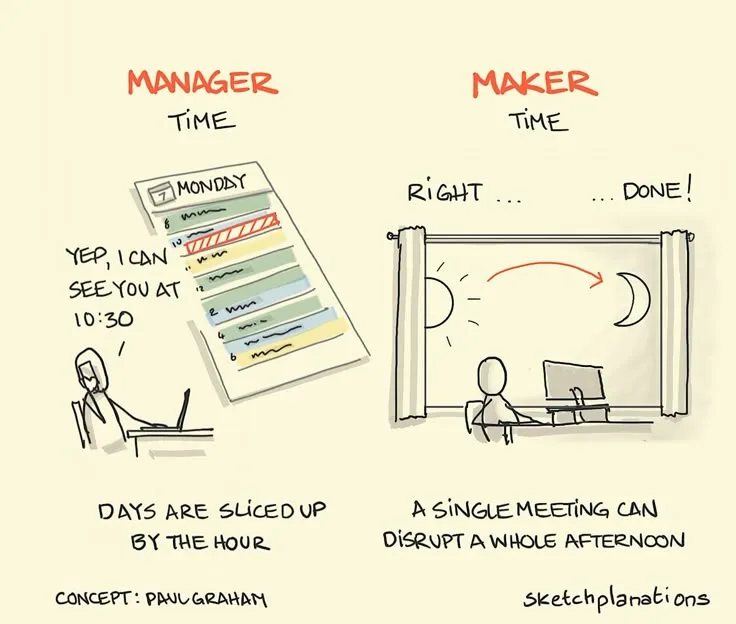
The job description for a product manager typically reads like a manifesto: "define the vision, drive strategy, align stakeholders, own the roadmap, lead without authority, represent the customer voice." All of that is technically accurate and almost entirely uninformative.
It tells you nothing about where a PM's time actually goes on a Tuesday in February when two engineers are blocked on a spec question, the head of sales has just escalated a customer complaint, there are three back-to-back review meetings on the calendar, and the quarterly roadmap presentation to leadership is due on Thursday.
The reality of product management is a job built almost entirely out of interruptions, conversations, and documents - and the skill is surviving that reality while still making the decisions that matter.
The popular mythology around product management - that PMs spend their days in product strategy sessions, drawing user journey maps, and having breakthrough conversations with customers - reflects perhaps 20% of the actual role.
The other 80% is coordination: answering questions from engineers who need context, updating stakeholders who want status, handling escalations from sales, reviewing designs, writing and revising requirements, and sitting in meetings whose value you will often question.
This is not a failure of the role; it is the role. The PM is the connective tissue of a product team, and connective tissue spends most of its time under tension.
"If you're doing PM right, you spend most of your time in conversations, not making products. The conversations are the work." - Julie Zhuo, former VP of Product Design at Meta and author of 'The Making of a Manager'[3]
Key Definitions
Discovery work: The set of activities aimed at understanding what to build - user interviews, usability testing, survey design, analysis of usage data, competitive research. Discovery is the upstream, exploratory phase of product work.
Delivery work: The set of activities involved in building and shipping something - writing specs, participating in sprint planning, reviewing engineering work, coordinating QA, managing launches. Delivery is the downstream, execution phase.
Sprint ceremony: A recurring meeting within an agile engineering team - sprint planning, daily standup, sprint review, and retrospective. PMs typically attend some or all of these, depending on team norms.
Escalation: A situation where a decision or problem is elevated to higher organisational levels because it cannot be resolved at the PM level. Escalation management - knowing which problems to resolve yourself versus which to escalate - is a significant and underappreciated PM skill.
PRD (Product Requirements Document): A document the PM writes to specify what a feature or product should do. PRDs range from brief one-pagers to extensive multi-page specifications and are the primary written artefact of the PM role.
OKRs (Objectives and Key Results): A goal-setting framework widely used in product organizations, in which qualitative objectives are paired with measurable key results.[16] PMs typically own or contribute to OKRs for their product area and report against them on a quarterly basis.
How a PM's Time Is Actually Allocated
Research from Reforge's 2023 PM Skills Benchmark, which surveyed more than 2,000 product managers across company types, found the following approximate time allocation for mid-level PMs:[1]
| Activity | Approximate Share of Time |
|---|---|
| Meetings and synchronous communication | 55-65% |
| Writing (PRDs, strategy docs, roadmap updates, one-pagers) | 15-20% |
| Data analysis and metrics review | 10-15% |
| Customer and user research | 5-10% |
| Deep strategic thinking and planning | 5-10% |
The most common complaint among practising PMs is the gap between the last two categories and the first three. The activities that PMs find most valuable - customer research, strategic thinking, deep analysis - receive the least dedicated time.
The activities that drive the most frustration - routine alignment meetings, status updates, escalation handling - receive the most.[11]
This allocation is not entirely fixable. Much of the meeting load is structural: a PM who sits at the intersection of engineering, design, sales, marketing, and leadership is going to have a lot of conversations.
But PMs who deliberately protect time for discovery work - blocking calendar time, delegating some stakeholder communication, reducing unnecessary synchronous touchpoints - report higher job satisfaction and, over time, better outcomes.
A complementary survey by Mind the Product (2023), covering 1,340 product managers globally, found that PMs who blocked at least 10 hours per week for non-meeting focused work reported 29% higher job satisfaction and were significantly more likely to report feeling effective in their role - despite no significant difference in total output measures.[6]
The implication is that focus time matters to PM wellbeing even when its productivity gains are hard to quantify.
A Typical Mid-Level PM Day at a 300-Person SaaS Company
The following is a composite account drawn from documented PM day-in-the-life accounts published in Lenny's Newsletter (2022-2024) and the Mind the Product community.
8:30 AM: Reviews overnight support tickets and usage data. Notices an unusual spike in errors at one specific feature touchpoint. Flags it to the engineering lead via Slack; they discuss briefly and agree to monitor for 24 hours before treating it as a P1.
9:00 AM: Daily standup with the engineering and design team. 15 minutes. Two engineers are blocked on a spec ambiguity about empty states. PM clarifies immediately; notes the ambiguity in the spec for future reference.
9:30 AM: Writes and sends a brief weekly update to the head of product and the VP of Engineering: what shipped last week, what is in progress this week, what is blocked and why, what decisions are pending.
10:00 AM: Design review for a new onboarding flow. 60 minutes. PM comes prepared with three specific concerns from user research conducted two weeks prior. One significant design change is agreed.
11:00 AM: Heads-up call with the head of sales. A large enterprise prospect has requested a feature the PM deprioritised three months ago. PM explains the tradeoff and offers a realistic timeline. Declines to reprioritise on the spot; says they will revisit in the next quarterly planning cycle. This is uncomfortable but necessary.
12:00 PM: Lunch. Does not work through lunch.
1:00 PM: 90 minutes of writing time (calendar blocked). Works on the PRD for a new integration feature. Gets through roughly half of it before a Slack message from an engineer requires a 15-minute detour to clarify a data schema question.
2:30 PM: Sprint planning for the next two-week cycle. 90 minutes with engineering and design. Goes through prioritised backlog, aligns on capacity, assigns stories. Three stories are still too vague to estimate; PM agrees to refine them before tomorrow.
4:00 PM: Customer interview. PM conducts a 40-minute structured interview with a user who submitted a detailed support ticket last week. Documents findings immediately afterward while they are fresh.
5:00 PM: Finishes refining the three vague sprint stories. Reviews metrics dashboard; notes that a feature shipped three weeks ago is showing a 12% improvement in the target metric, which is below the 20% hypothesis. Makes a note to schedule a post-launch review.
This kind of day - dense with communication, interspersed with writing, punctuated by a single block of focused work and one customer conversation - is more representative than any description that emphasises strategy or vision.[2]
The Art of the PRD: Writing That Actually Guides Teams
The Product Requirements Document is the central written artifact of product management, and the quality of a PM's writing has direct downstream effects on engineering output. Yet PRD craft receives surprisingly little systematic attention in PM training.
A 2022 survey by Productboard of 430 engineering leaders found that poorly written specifications were cited as the leading cause of sprint delays (ahead of scope creep, technical debt, and resource constraints).[13] Engineers blocked by ambiguous requirements lose productive time and generate friction that erodes team morale.
What separates a useful PRD from an unhelpful one:
Problem statement before solution: The best PRDs lead with a crisp statement of the user problem being solved and why it is worth solving now, before specifying any solution. Engineers and designers who understand the problem can catch cases where the specified solution does not solve it.
Success criteria: How will you know the feature worked? Specific measurable outcomes - retention rate improvement, task completion rate, support contact reduction - give the team a test of success and focus testing efforts.
Out of scope section: An explicit list of what is not being built in this iteration, and why. Without it, "but what about..." scope questions consume disproportionate meeting time.
Edge case specification: The details that implementation requires: empty states, error conditions, permission variations, international and accessibility considerations.
Decision log: What alternatives were considered and why the specified approach was chosen. This reduces future re-litigation of decisions already made.
Marty Cagan, author of "Inspired" (2018), argues that the shift from output-focused PRDs ("build this feature") to outcome-focused product briefs ("solve this problem for these users, measurable by this metric") is the single most important process change available to most product teams.[4]
Teams briefed on outcomes rather than outputs consistently demonstrate more innovative solutions and better business results, because engineers and designers are empowered to bring their judgment to the problem rather than simply executing a specification.
How Senior PM Days Differ
Senior PMs and above operate at a different altitude. The defining difference is scope: where a mid-level PM is focused on a feature set or a single product, a senior PM is thinking about a product area, a business objective, or a cross-functional strategy.
| Dimension | Junior/Mid PM | Senior PM | Director of Product |
|---|---|---|---|
| Scope | Single feature or squad | Product area | Multiple product areas |
| PRD writing | Owns most directly | Reviews others' work | Sets frameworks |
| Customer interaction | Feature-level research | Strategic accounts | Advisory boards |
| Stakeholder management | Engineering, design | Org-wide alignment | Executive, board |
| Meetings | 4-6/day | 5-8/day | 6-10/day |
| Strategic planning | Quarterly roadmap | Annual strategy input | Company-level planning |
| Key metric | Feature-level KPIs | Product area OKRs | Business-level outcomes |
Senior PM time tends to involve more leadership and executive communication, more organisational navigation, less direct execution involvement, and more external representation - customer advisory board meetings, executive briefings with strategic accounts, market analysis presentations.
The irony noted by many senior PMs is that the work becomes less directly connected to the product itself the more senior you get. By the director level, the job is almost entirely organisational.
The Transition from Execution to Strategy
Teresa Torres, author of "Continuous Discovery Habits" (2021), identifies a specific inflection point in PM development she calls the shift from "task completion orientation" to "outcome orientation": junior PMs measure success by shipping features; senior PMs measure success by the behavior change in users that those features produce.
This is not a trivial distinction. A PM who ships on schedule but ships the wrong thing is objectively performing less well than a PM who delays a launch to validate that the solution addresses the actual problem.
Yet in most organizational cultures, the on-time delivery is more visibly rewarded than the delay-for-validation, which creates a systematic pressure toward output over outcome throughout the PM career path.
Companies that have successfully cultivated outcome orientation - notably Basecamp, Intercom, and Spotify in their documented approaches - describe the cultural shift as requiring not just PM development but explicit support from executive leadership: celebrating well-validated delays alongside on-time launches.
PM at a Startup vs Big Tech vs B2B SaaS
Context shapes the PM role more than almost any other profession. The same title at three different companies can describe three almost entirely different jobs.
Early-stage startup (1-30 employees)
There is often only one PM, who does everything: strategy, discovery, spec writing, customer interviews, data analysis, go-to-market coordination, and sometimes QA. The startup PM's biggest challenge is saying no in an environment where every direction seems equally important. The learning is compressed and intense.
Research by First Round Capital's review of 300 seed-stage startups found that the #1 predictor of product team effectiveness was the founder's or PM's willingness to talk directly to customers at least once per week - not the sophistication of their analytics stack or the quality of their sprint process.[8]
This finding aligns with Paul Graham's canonical startup advice ("do things that don't scale") and Teresa Torres's continuous discovery framework.[5]
Big tech (1,000+ employees)
The PM role at a large technology company is narrower in scope but more complex in organisational dynamics. A PM at Google might own a single feature within a single product within a single surface - a very small slice of the company's output.
But executing even that small slice requires navigating multiple engineering teams, product councils, design systems, legal reviews, privacy assessments, and leadership approvals. The skill at big tech is organisational, not breadth-oriented.
Compensation at big tech is substantially higher than equivalently titled roles elsewhere. According to Levels.fyi 2024 data, a mid-level PM (L5 at Google, E5 at Meta) earns total compensation in the range of $250,000 to $400,000 when equity is included - roughly two to three times the equivalent compensation at a 200-person SaaS company.
The tradeoff is impact latitude: big tech PMs often have less influence over what gets built than their titles suggest.
B2B SaaS (50-500 employees)
B2B SaaS PM is arguably the most common PM environment and the least glamorous. The customer base is businesses, not consumers, which means the PM spends significant time in customer calls with enterprise buyers, navigating feature requests from large accounts, balancing roadmap with contractual commitments, and managing relationships with customer success teams.
The work develops strong commercial instincts that pure consumer-product experience does not.
A specific tension in B2B SaaS PM is the chronic pressure from enterprise customers to build bespoke features. A single enterprise account paying $500,000 per year has significant leverage to direct roadmap in ways that may not benefit the other 99% of the customer base.
PMs who lack a clear framework for evaluating custom feature requests against product strategy consistently find their roadmaps fragmented and their products becoming increasingly incoherent.
The discipline of saying no to enterprise customization in service of a coherent product strategy is one of the most important skills a B2B SaaS PM develops.
The Measurements That Matter: Metrics and PM Accountability
One of the defining features of the PM role is accountability for product outcomes measured in data. Understanding which metrics to track, how to interpret them, and how to act on them is foundational PM competence.
The OKR Framework in Practice
Most modern technology companies use Objectives and Key Results as their primary goal-setting and accountability framework, and PMs are typically responsible for setting and reporting on OKRs for their product area.
A well-formed product OKR:
Objective: Increase the value experienced by users in the first 30 days after signup.
Key Results:
- Improve 30-day user activation rate from 43% to 60%
- Increase percentage of users completing core action within 7 days from 28% to 45%
- Reduce support contacts in first 30 days from 2.1 per new user to 1.0
This objective is user-focused rather than feature-focused (it does not say "ship onboarding redesign"), the key results are measurable with defined baselines and targets, and the timescale is specified. A PM reporting against this OKR can demonstrate progress or lack thereof with data rather than anecdote.
The most common OKR failures documented by Lenny Rachitsky's research (2023) are: objectives that are output-oriented ("ship three features") rather than outcome-oriented ("improve retention"), key results that are not measurable with available data, and quarterly target-setting without a baseline measurement at the start of the period.[17]
Using Data Without Drowning in It
A persistent trap in data-rich product environments is measurement theater: tracking dozens of metrics, building elaborate dashboards, and spending significant time in data analysis without making better decisions.
Product managers at high-performing companies describe a discipline of maintaining a "north star" metric (the single number that best represents product value to users) alongside three to five supporting metrics, and resisting the proliferation of reporting that obscures rather than illuminates.
Amplitude's 2023 Digital Analytics Report, based on data from 1,000+ companies, found that product teams tracking more than eight simultaneous metrics showed no improvement in product outcomes compared to teams tracking three to five well-chosen metrics - while spending significantly more time on data review.[14]
Quantity of measurement does not substitute for clarity of focus.
Why Product Management Is Not Actually About Building Products
This sounds counterintuitive, but it is something many experienced PMs say in retrospect: the job is fundamentally about people, not products. Products are built by engineers and designers.
PMs create the conditions - the clarity of purpose, the alignment among stakeholders, the well-understood priorities, the customer insight - that allow other people to build the right thing.
The "product manager as CEO of the product" metaphor is widely critiqued by experienced practitioners. A better framing: the PM is the person who ensures that everyone on the team is working on the right problem and has what they need to solve it.[7] That is less about inspiration and more about operational clarity.
Leading Without Authority
The phrase "leading without authority" appears in virtually every PM job description, but few descriptions explain what this actually means in practice.
Authority means the ability to require action - a manager telling a direct report to do something. A PM has no such authority over engineers, designers, or any other function.
They influence behavior through the quality of their arguments, the strength of their relationships, the clarity of their customer insights, and the credibility they have built through consistent follow-through.
Practical techniques for influence without authority, documented in the PM literature:
Make the work visible: Engineers and designers work harder on features they understand the purpose of. PMs who invest time in explaining the user problem - sharing research, playing user interview recordings, walking through customer journeys - get more engagement and better solutions than those who issue specifications without context.
Reduce friction on the things you want done: If you want engineers to write tests, make writing tests easier. If you want design to explore multiple directions, create a lightweight process for rapid ideation. Making the desired behavior the path of least resistance is more durable than persuasion.
Build bilateral trust: Trust is the substrate of PM influence. Engineers who believe the PM will represent their technical concerns accurately to leadership, shield them from chaotic requirements changes, and fight for technical debt time will work more collaboratively on product priorities than engineers who do not have that trust.
Common PM Failure Modes
Understanding where product managers fail is as instructive as understanding what they do well. The documented failure patterns share common structural features.
The feature factory trap: Melissa Perri's term in "Escaping the Build Trap" (2018) describes organizations where PMs measure success by the volume of features shipped rather than the value delivered to users.[10]
Feature factory PMs are responsive to stakeholder requests, produce high-velocity output, and create increasingly incoherent products that fail to retain users.
Requirements completeness over discovery: PMs who spend the majority of their time writing detailed specifications before validating the underlying assumptions are doing delivery work that may be entirely wasted if the assumptions are wrong. Shreyas Doshi's "outputs vs.
outcomes" framework is a widely-cited diagnostic for this failure mode.[9]
Stakeholder management avoidance: Handling a difficult sales escalation, delivering bad news to the leadership team, or maintaining a firm no to a large customer are uncomfortable. PMs who defer, obfuscate, or avoid these conversations in the short term create significantly larger problems in the long term.
Experienced PMs describe comfort with difficult conversations as one of the most important and least natural skills to develop.
Missing the north star: PMs who respond to every stakeholder request without a clear framework for evaluation gradually produce roadmaps that are incoherent - a collection of individual stakeholder accommodations rather than a strategy.
The discipline of maintaining and communicating a clear product vision that connects to business outcomes is the foundation of credible roadmap management.
The PM and AI: How the Role Is Changing
The emergence of capable AI tools has affected product management in ways that are distinct from their effect on engineering or design. For PMs, the most significant changes are in two areas: the nature of discovery work and the speed of documentation.
AI-Assisted Discovery
AI tools have accelerated the analysis of qualitative research data. A PM who previously spent four to six hours synthesising 15 customer interview transcripts into a coherent findings document can now use AI-assisted synthesis tools (Dovetail AI, Notion AI, or purpose-built research analysis tools) to generate an initial thematic clustering in 30-40 minutes, which the PM then validates, refines, and interprets.
The caveat is significant: AI synthesis tools identify surface-level patterns but miss the contextual interpretation that distinguishes research analysis from research summarization. A PM who accepts an AI-generated synthesis without interrogating its categories is producing research outputs that look complete but may be superficial.
The judgment layer - deciding which patterns matter and why, and what they imply for product direction - remains entirely human.
Survey analysis has been similarly accelerated. Analyzing a 500-response customer survey that would previously have required a data analyst's involvement can now be conducted by a PM using AI tools to identify response clusters and surface unexpected segments.
AI and PRD Writing
AI writing assistance has accelerated the mechanics of PRD drafting. PMs who use tools like ChatGPT or Claude to generate initial document structure, draft edge case sections from a brief description of the feature, or write out acceptance criteria from user story descriptions report saving two to four hours per PRD.
The risk is the same as in research: the AI produces plausible-sounding text that lacks the judgment and organizational context that make a PRD actually useful.
PMs who over-rely on AI-drafted PRDs produce documents that read well but miss the organizational constraints, the strategic context, and the specific tradeoffs that the engineering team needs to make good implementation decisions.
The document is the easy part; the thinking is the hard part, and that remains unautomated.
A 2024 ProductPlan survey of 800 product managers found that 68% were using AI tools for at least one PM task, with documentation assistance and meeting summarization being the most common applications.[21]
The same survey found that PMs reported saving a median of six hours per week through AI tool adoption - time that, when tracked, was most commonly redirected to customer conversations and strategic work rather than absorbed by new administrative tasks.
Managing Conflict and Difficult Stakeholders
No honest account of the product management day can omit the emotional labor involved in managing stakeholders with competing interests and strong opinions about product direction. This is one of the most demanding and least-discussed dimensions of the PM role.
The Anatomy of a Stakeholder Conflict
A typical stakeholder conflict in product management involves a party external to the product team - a senior sales leader, an executive sponsor, a major customer account - advocating for a product decision that contradicts the PM's judgment about what is right for the product.
The most common versions:
The sales-driven feature request: A sales VP with a quota and an enterprise deal on the line requests a bespoke feature that the PM believes will not benefit other customers and will fragment the product. The sales leader has organizational authority and short-term leverage; the PM has product authority and long-term perspective.
The HiPPO problem: The Highest Paid Person's Opinion (HiPPO) is a documented phenomenon in product organizations where executive opinions about product direction override user evidence and PM judgment simply due to hierarchy.
Managing up - respectfully presenting data that contradicts the CEO's product instincts - is one of the most politically delicate skills in the PM toolkit.
The cross-functional scope dispute: Two teams disagree about which owns a customer-facing surface, leading to either conflicting designs being shipped simultaneously or work grinding to a halt waiting for organizational resolution.
Strategies That Work
Experienced PMs who have written about stakeholder management consistently emphasize several approaches:
Pre-wire important decisions. Rather than presenting a controversial product decision in a meeting and hoping for approval, senior PMs share the decision context with key stakeholders individually before the group discussion.
This allows objections to be heard and addressed before the formal meeting, dramatically increasing the probability of alignment. Julie Zhuo describes this as "never letting a meeting be the first place someone hears something important."[22]
Separate the person from the position. Sales leaders who escalate on customer requests are typically doing their jobs correctly - their incentive structure makes customer satisfaction paramount.
Understanding that structural incentive, and responding to it with empathy while holding to product principles, is more effective than treating the escalation as an attack.
Document disagreements. When stakeholders override a PM's judgment on a product decision, professional PMs document the disagreement, the data presented, and the decision made, and track the outcome.
This creates an institutional record that enables post-mortem analysis and, over time, builds the PM's credibility when their predictions about outcomes prove accurate.
A 2022 study in the Journal of Product Innovation Management (Cooper and Sommer) examining decision quality in 283 product teams found that teams where PMs explicitly documented decision rationale and tracked outcomes against predictions showed 22% higher rates of outcome accuracy on subsequent predictions - a compounding accuracy effect that created significant organizational trust over time.[18]
The Career Path Beyond PM: Where Product Managers Go
The PM career trajectory is one of the most bifurcated in the technology industry. The vast majority of product managers plateau at mid-level; a small proportion advance to director and VP of Product; an even smaller proportion transition to general management or founding roles.
The Senior PM / Director Transition
The transition from senior PM to director involves a fundamental shift from managing products to managing PMs.[12]
Like the design management transition, this requires explicitly developing a new skill set - people development, hiring, organizational design, executive communication - while the product intuitions built over years of practice become less directly applicable to daily work.
A 2023 survey by Reforge of 1,200 product leaders found that 54% of directors of product reported that the transition from senior IC to first management role was the most challenging career transition they had experienced - harder than entering product management from a different discipline.[19]
The challenge is not the organizational authority (which increases), but the distance from the work they were hired to do well.
PM to Founder
Product management is one of the most common backgrounds for technology founders, and for structurally sound reasons: PMs develop market intuition, stakeholder alignment skills, technical fluency, and the ability to navigate resource constraints - all capabilities directly relevant to early-stage company building.
Paul Graham's observation that the best founders are "those who could have gotten any job they wanted" maps closely onto the profile of senior PMs, who have typically been selected for analytical ability, communication skill, and creative problem-solving across many years.
First Round Capital's analysis of founder backgrounds (2023) found that former product managers had 40% higher rates of company survival at five years than founders from engineering backgrounds, and comparable rates to founders from business development backgrounds.[20]
The PM's breadth of cross-functional experience appears to be a durable advantage in the generalist challenge of early-stage company building.
Compensation Trajectory
Product management is among the highest-compensated non-technical functions in the technology industry. The compensation trajectory, according to Levels.fyi 2024 data:[15]
| PM Level | Years Experience | Median US Total Comp |
|---|---|---|
| Associate PM | 0-2 | $130,000-$160,000 |
| PM | 2-5 | $160,000-$240,000 |
| Senior PM | 5-9 | $220,000-$350,000 |
| Director of Product | 9-14 | $300,000-$500,000 |
| VP of Product | 14+ | $400,000-$700,000+ |
These figures reflect compensation at top-tier technology companies and include equity. At B2B SaaS companies under 500 employees, compensation is typically 40-60% lower at equivalent titles.
The trajectory, however, is consistent: product management is one of the few non-engineering paths where total compensation at senior levels is comparable to staff and principal engineering roles.
Practical Takeaways
If you are drawn to product management because you want to make strategic decisions and shape product vision, be honest with yourself about how much of your day you are willing to spend on meetings, documents, and stakeholder management.
The PMs who thrive are generally those who find genuine satisfaction in the communication and coordination work - not just the rare moments of strategic insight.
If you are already in product management and struggling with the meeting load, the most effective interventions documented across PM communities are: auditing all recurring meetings quarterly and cutting any where your participation is not genuinely necessary; replacing synchronous status updates with asynchronous written ones; and blocking at least two-hour chunks three days per week for focused writing and thinking work.
Develop your data fluency deliberately. The PM role is increasingly analytical, and PMs who can not independently formulate hypotheses, query usage data, and interpret statistical results are at a significant disadvantage relative to those who can.
Even basic SQL and a working understanding of statistical significance can meaningfully differentiate a PM's ability to act on product data.
Invest heavily in customer access. The single greatest predictor of PM effectiveness in the long run is frequency of direct customer contact. Block time for customer interviews. Sit in on support calls. Read the unfiltered support tickets.
The further PMs get from direct customer contact, the more their decisions are based on second-hand interpretations of customer needs, which degrades over time.
Build your stakeholder management skills deliberately. The ability to handle difficult conversations with grace, to pre-wire important decisions, and to maintain productive relationships with stakeholders who disagree with you is not a soft skill - it is the core operational competency of the PM role.
Seek feedback on your stakeholder relationships as deliberately as you seek feedback on your product decisions.
Sources & Further Reading
- Reforge. 'PM Skills Benchmark Report 2023.' Reforge.com, 2023.
- Rachitsky, L. 'A Day in the Life of a Product Manager.' Lenny's Newsletter, 2022.
- Zhuo, J. 'The Making of a Manager: What to Do When Everyone Looks to You.' Portfolio/Penguin, 2019.
- Cagan, M. 'Inspired: How to Create Tech Products Customers Love.' Wiley, 2nd edition, 2018.
- Torres, T. 'Continuous Discovery Habits.' Product Talk, 2021.
- Mind the Product. 'State of Product Management 2023.' MindTheProduct.com, 2023.
- Horowitz, B. 'Good Product Manager / Bad Product Manager.' Andreessen Horowitz, 1996/2010.
- First Round Review. 'The PM Job Is Mostly Communication.' First Round Capital, 2021.
- Doshi, S. 'Outcomes vs Outputs: The Hidden PM Failure Mode.' Shreyas.com, 2021.
- Perri, M. 'Escaping the Build Trap.' O'Reilly Media, 2018.
- Product Coalition. 'Survey: How PMs Actually Spend Their Time.' Medium, 2023.
- Banfield, R., Eriksson, M., & Walkingshaw, N. 'Product Leadership.' O'Reilly Media, 2017.
- Productboard. (2022). Engineering Leadership Survey: Causes of Sprint Delays. productboard.com
- Amplitude. (2023). Digital Analytics Report 2023. amplitude.com/blog
- Levels.fyi. (2024). Product Manager Compensation Data 2024. levels.fyi
- Doerr, J. (2018). Measure What Matters: OKRs - The Simple Idea that Drives 10x Growth. Portfolio/Penguin.
- Rachitsky, L. (2023). The Most Common OKR Mistakes. Lenny's Newsletter.
- Cooper, R.G., & Sommer, A.F. (2022). Decision quality and outcome accuracy in product teams. Journal of Product Innovation Management, 39(2), 145-168.
- Reforge. (2023). Product Leadership Transitions Survey 2023. reforge.com
- First Round Capital. (2023). Founder Backgrounds and Startup Outcomes. firstround.com/review
- ProductPlan. (2024). State of Product Management: AI Adoption Survey 2024. productplan.com
- Zhuo, J. (2019). The Making of a Manager. Portfolio/Penguin.
Further Reading
- First Round Capital. (2021). The 30 Best Pieces of Advice for Entrepreneurs. firstround.com/review