
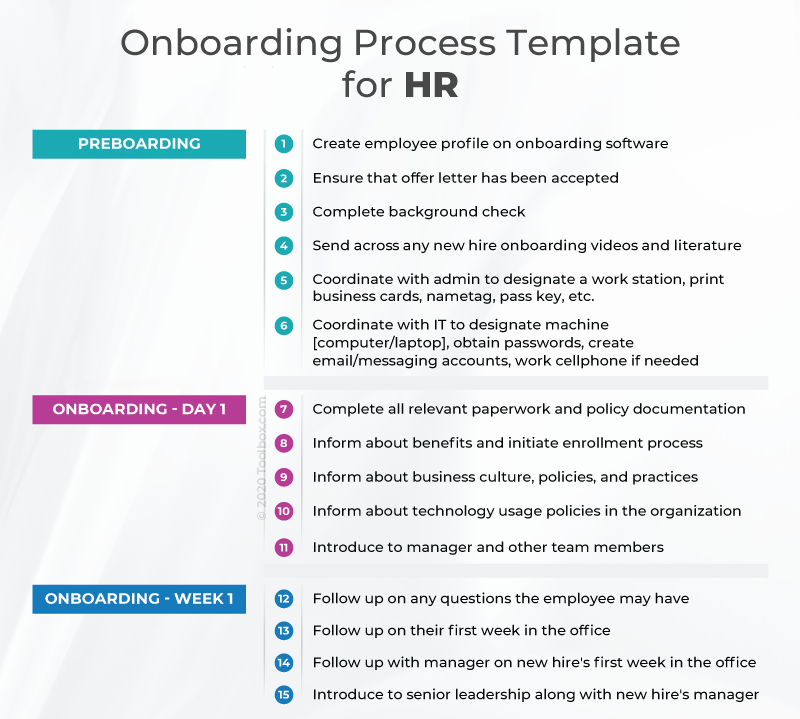
Onboarding explained as a broader process than orientation helps new hires understand how to succeed, not merely complete administrative tasks. Strong programs clarify role expectations, teach actual culture, build useful relationships, and provide training over weeks or months. Treating a short compliance session as full onboarding leaves employees uncertain, disconnected, and more likely to disengage or leave early.
Every organization has an onboarding process. Most of them are inadequate. Employee onboarding is the structured process by which new hires are integrated into an organization's culture, practices, relationships, and role requirements - encompassing everything from pre-hire communication and administrative paperwork to technical training, relationship-building, performance expectation-setting, and cultural acculturation.
When done well, onboarding transforms a talented stranger into a productive, connected team member. When done poorly - which is the norm - it produces confusion, disengagement, and early departure.
A new hire's first weeks represent one of the highest-stakes periods in the employment relationship. Research by BambooHR (2023) found that one in five employees leave within the first 45 days of a new job - not because they were wrong for the role, but because the organization failed to integrate them effectively.
Gallup, in its State of the American Workplace report (2022), found that only 12 percent of employees strongly agree that their organization does a great job onboarding.
The Society for Human Resource Management (SHRM) estimates that replacing an employee costs between 50 and 200 percent of their annual salary, depending on the role's seniority and specialization. When organizations invest heavily in recruiting and then fumble the handoff, they are destroying value they spent months creating.
Understanding what good onboarding looks like - and why so much onboarding fails - begins with understanding what onboarding actually is and what it is not.
Onboarding vs. Orientation: A Critical Distinction
These terms are used interchangeably in most organizations, but they describe fundamentally different things:
Orientation is the first component of onboarding - typically one to three days covering administrative necessities: completing paperwork, setting up IT access, learning office logistics, and meeting HR. It is logistical and compliance-focused. Orientation answers the question: "What do I need to sign, and where is the bathroom?"
Onboarding is the broader process that begins before the first day and extends for weeks or months. It encompasses orientation but also includes the training, cultural integration, relationship-building, and performance coaching that determine whether a new employee becomes fully effective.
Onboarding answers a much harder question: "How do I succeed here?"
Organizations that treat orientation as onboarding - and this describes the majority - leave new hires to figure out everything else on their own. Many fail to do so.
They spend weeks uncertain about what success looks like, reluctant to ask basic questions that they feel they should already know the answers to, and gradually forming the conclusion that they made a poor choice.
By the time the organization notices the problem, the employee is already mentally out the door.
"Culture is not the most important thing - it is the only thing. And the first weeks of a new employee's experience are when they decide whether the culture you described during recruiting actually exists." - Jim Collins, adapted from remarks on organizational culture
The 4Cs Framework: How to Think About Onboarding Quality
Researcher Talya Bauer at Portland State University developed the most widely used framework for evaluating onboarding effectiveness. The 4Cs model, published in her 2010 SHRM Foundation report Onboarding New Employees: Maximizing Success, identifies four levels at which organizations can invest in new hire integration:
| 4Cs Level | Focus | Typical Format | Often Neglected? |
|---|---|---|---|
| Compliance | Legal requirements, company policies, admin procedures | Forms, HR briefings, safety training | No - usually overdone |
| Clarification | Role expectations, performance standards, success criteria | Manager meetings, job documentation | Yes - frequently unclear |
| Culture | Norms, values, unwritten rules, ways of working | Informal exposure, storytelling, mentoring | Yes - rarely structured |
| Connection | Relationships, networks, social integration | Introductions, social events, buddy programs | Yes - left entirely to chance |
Compliance (Level 1)
This is the floor - basic legal requirements, company policies, and administrative procedures. Safety training, harassment prevention, benefits enrollment, payroll setup. Every organization addresses this level because regulations require it.
The problem is not that organizations do too little at this level; it is that many organizations do only this.
Clarification (Level 2)
Ensuring new employees understand their role expectations, performance standards, how their work contributes to team and organizational goals, and what success looks like at 30, 60, and 90 days. This level is chronically underdeveloped.
Managers assume new hires will figure out what is expected, and new hires are reluctant to ask - producing a mutual silence that can persist for months.
A 2023 Gallup study found that only 50 percent of employees strongly agree they know what is expected of them at work, and the figure is substantially lower for employees in their first 90 days.
Culture (Level 3)
Helping new employees understand the organization's actual values, norms, unwritten rules, and ways of working.
This includes formal elements (mission statements, strategic priorities) and informal ones (how decisions are really made, what kinds of behavior are rewarded, how to navigate organizational politics, which meetings matter and which do not).
Culture is absorbed through observation in physical offices, but it must be deliberately taught when the informal learning channel is absent or when the organization is large enough that subcultures vary significantly across teams.
Connection (Level 4)
Building the relationships and networks that allow new employees to do their jobs effectively. Work happens through relationships.
A technically skilled person who does not know who to ask for help, who the key influencers are, or how to navigate cross-functional dependencies will underperform relative to their capability - sometimes dramatically.
Research by Rob Cross at Babson College (2021) on organizational network analysis has shown that the speed at which new hires build effective internal networks is one of the strongest predictors of their long-term performance and retention.
Bauer's research consistently finds that organizations concentrate most energy on Compliance and least on Connection and Clarification. But the research equally consistently shows that Clarification and Connection are most strongly correlated with new hire performance and retention.
The Onboarding Timeline: Before, During, and After
Preboarding: The Period That Most Companies Waste
Preboarding is the period between when a candidate accepts an offer and their official start date. This window - which might be two weeks or two months - is one of the most neglected opportunities in talent management.
New hires in this period are excited, motivated, and anxious. They have just made a significant life decision. They may have declined competing offers. They are wondering whether they made the right choice.
Research on psychological contract theory (Denise Rousseau, 1989) suggests that the expectations formed during this period - about what the organization will provide and what will be expected in return - powerfully shape how the new hire interprets their early experiences.
Organizations that do nothing during this period miss the chance to:
- Complete administrative work (paperwork, background checks, equipment ordering) before the first day, reducing day-one overwhelm
- Share culture materials - team bios, company history, strategic priorities - that help new hires arrive with context rather than arriving cold
- Introduce the new hire to their manager and key colleagues before day one, converting strangers into familiar names
- Set expectations about what the first week will look like, reducing the anxiety that comes from walking into the unknown
A LinkedIn Talent Trends study found that new hires who received structured preboarding content were significantly more likely to still be employed at the six-month mark. Organizations including Amazon, Google, and Stripe use this window extensively, with some beginning cultural onboarding two to four weeks before the official start date.
The First Week: First Impressions Are Not Recoverable
The first week establishes patterns, expectations, and emotional tone that are extraordinarily difficult to revise later.
New hires are paying close attention to everything: how organized the welcome was, whether their equipment was ready, whether their manager had time for them, how colleagues treated them, whether the reality of the job matched what they were told during recruiting.
A CareerBuilder survey (2019) found that 35 percent of employees had a negative first day, citing problems including unclear instructions (40 percent), no one to show them around (30 percent), and an absent or unavailable manager (28 percent).
These are not minor inconveniences - they are signals that the organization is either disorganized or indifferent, and new hires correctly interpret them as such.
Best practices for the first week, drawn from organizations with the strongest onboarding track records:
- Equipment and system access fully ready before day one (not configured on day one while the new hire watches)
- A structured schedule for the first three to five days, so the new hire is never left wondering what to do next
- A substantive meeting with the manager on day one to establish the relationship and communicate near-term priorities
- Clear assignment of a buddy or onboarding mentor for logistical and informal questions
- A welcome from senior leadership - even brief - that communicates why the role and the person matter to the organization
The 30-60-90 Day Plan
The 30-60-90 day plan is a structured framework for setting progressive expectations and milestones during the onboarding period.
The structure is simple, but the discipline it creates is valuable: it forces both manager and new hire to articulate what success looks like at each stage, creating shared clarity rather than unspoken assumptions.
Days 1-30: Learning phase. The primary goal is absorption - understanding the role, the organization, the team, the tools, and the key relationships. Performance expectations during this period should emphasize learning over output.
Success metrics: Can the new hire articulate what their role involves? Do they know who the key stakeholders are? Can they explain how the team operates?
Days 31-60: Contributing phase. The new hire begins taking on real work, ideally with defined outcomes and regular feedback. They are connecting what they learned in the first month with actual practice. Success metrics: Has the new hire completed defined training milestones?
Are they contributing meaningfully to team output? Are they asking increasingly sophisticated questions?
Days 61-90: Performing phase. The new hire should be operating with increasing independence, making decisions within their scope, and building toward the performance standards for someone fully settled in the role. Success metrics: Are key performance indicators trending in the right direction?
Is the new hire resolving problems independently? Are they beginning to identify improvements, not just execute existing processes?
The 30-60-90 framework is not a rigid checklist - it is a conversation structure between manager and new hire that creates shared clarity about the trajectory. The value is not in the document but in the recurring conversations it generates.
The Buddy System: High Impact, Low Cost
One of the most consistently effective and low-cost onboarding interventions is the onboarding buddy: an existing employee assigned to a new hire as an informal resource, guide, and social connection.
Microsoft conducted a rigorous internal study of its buddy program (published by Microsoft Research, 2019) and found that new hires with an assigned buddy were 23 percent more satisfied with their onboarding experience at the 90-day mark.
More notably, the impact scaled dramatically with buddy engagement: new hires who met with their buddy more than eight times in the first 90 days were 97 percent more satisfied than those who never met their buddy at all.
The study also found that buddies helped new hires understand organizational context - the kind of informal knowledge that formal training cannot transmit.
Effective buddy programs share several characteristics:
- Buddies are volunteers, not conscripts. Mandatory buddy assignments produce resentful mentors and awkward interactions.
- Buddies are not the new hire's manager, preserving a low-stakes relationship where "dumb questions" are safe
- The buddy's role is explicitly defined: answering informal questions, making introductions, explaining unwritten rules, providing social connection
- Buddy pairs are matched thoughtfully - considering team proximity, personality, and the buddy's own onboarding experience
- The program has a defined duration (typically 90 days) with scheduled check-in points
The buddy system works because it addresses the Connection level of Bauer's 4Cs framework directly and inexpensively. New hires who have one person they can reliably ask anything - without judgment and without it reflecting on their performance review - navigate the first months with dramatically less anxiety and faster learning.
What Makes Onboarding Fail
The research literature on onboarding failures points to a consistent set of root causes. Understanding these failure modes is valuable because most organizations exhibit several simultaneously.
1. Treating Onboarding as an Event Rather Than a Process
The most common failure is treating orientation as onboarding - a one- or two-day administrative process followed by the assumption that the new hire can figure out the rest. This leaves the high-impact elements (clarification, culture, connection) completely unaddressed.
A SHRM survey (2022) found that 58 percent of organizations described their onboarding program as primarily focused on "processes and paperwork."
2. Manager Disengagement
The most important relationship in onboarding is between new hire and direct manager. When managers are too busy, too passive, or simply not trained to support new hires, the onboarding process fails regardless of what HR provides.
A Gallup meta-analysis (2023) confirmed that manager quality is the single largest factor in new hire retention and performance, accounting for at least 70 percent of the variance in employee engagement scores.
Yet most organizations provide no specific training to managers on how to onboard their direct reports.
3. Information Overload Without Context
Many organizations compensate for poor onboarding process by overwhelming new hires with information in the first week: readings, training modules, policy documents, tool tutorials, video walkthroughs. Without context about what matters most, this produces anxiety and cognitive overload rather than competence.
The new hire cannot distinguish essential information from background noise, and attempts to absorb everything produce retention of nothing.
4. Insufficient Role Clarity
New hires consistently report that one of their primary anxieties is not knowing whether they are performing adequately. Managers who are vague about expectations, avoid early performance conversations, and give only general positive feedback ("You're doing great!") leave new hires unable to calibrate.
Clear, specific, early feedback is protective. Research by Maurer and colleagues (2003) found that role clarity at 30 days was the single strongest predictor of new hire retention at 12 months.
5. Recruiting-Reality Misalignment
When the job a new hire accepted is significantly different from the job they find when they arrive - in terms of scope, team dynamics, culture, or growth opportunities - they experience what researchers call reality shock (Hughes, 1958). Many never recover from it.
Realistic job previews during recruiting, which include honest discussions of challenges and limitations alongside benefits, reduce this effect. Research by Jean Phillips (1998) demonstrated that realistic previews modestly reduce initial acceptance rates but substantially improve retention among those who do accept.
6. Neglecting the Social Dimension
Work requires relationships. A new hire who does not know who to go to for different kinds of help, who cannot get informal feedback from colleagues, and who feels disconnected from their team will underperform even if they are technically competent.
Onboarding programs that focus only on technical training neglect the social infrastructure that makes technical work possible.
Granovetter's (1973) classic research on the "strength of weak ties" applies directly: it is often peripheral contacts, not close colleagues, who provide the most valuable information and opportunities - and new hires have no peripheral contacts at all.
Remote Onboarding: The Additional Challenges
The shift to remote and hybrid work since 2020 has made the already-challenging onboarding problem substantially more difficult. Three specific challenges dominate:
Relationship isolation: In an office, relationships form through proximity - shared lunches, corridor conversations, overhearing how colleagues handle problems. Remote new hires miss all of this spontaneous relationship-building.
The informal connection that office workers take for granted must be deliberately engineered in remote environments, at significant effort and cost.
Visibility deficit: New hires in offices learn by observation - watching how meetings run, how conflict gets handled, how leadership communicates, which behaviors are rewarded. Remote new hires have limited visibility into these informal organizational patterns.
They know the formal version of the culture (the values statement), not the actual one (how decisions really get made).
Technology friction: Remote onboarding is entirely dependent on technology. A delayed laptop, broken VPN access, or misconfigured software systems can derail the first week completely. The dependency on digital tools means that setup failures have an outsized impact on first impressions.
Effective remote onboarding addresses these challenges with deliberate substitutes:
| In-Person Default | Remote Equivalent |
|---|---|
| Corridor conversations | Scheduled informal "coffee chats" with 5-8 colleagues across teams |
| Observing meetings naturally | Explicit invitation to observe key meetings as a learning activity |
| Organic team connection | Structured virtual social activities with defined frequency |
| Technology set up at desk | Equipment and access delivered and fully tested before day one |
| Finding a buddy naturally | Assigned buddy with explicit brief and scheduled check-ins |
| Overhearing organizational norms | Deliberate narration of culture and unwritten rules by manager and buddy |
GitLab, which operates fully remote with employees in more than 65 countries, has developed what is arguably the most comprehensive onboarding documentation in existence.
Their publicly available onboarding handbook runs to tens of thousands of words and provides explicit guidance on everything from how to set up your workspace to how to navigate internal communication norms.
It represents an extreme example of what becomes necessary when physical proximity is entirely absent - but the underlying principle applies to any organization with remote employees: what was once learned informally must now be taught deliberately.
Buffer, another fully remote company, reported in their 2023 State of Remote Work survey that 45 percent of remote workers cited difficulty with collaboration and communication as their top challenge - a challenge that is most acute during the onboarding period when new hires lack the relational context to interpret ambiguous communications.
Measuring Onboarding Effectiveness
Many organizations invest in onboarding without measuring whether it works. The following metrics, tracked consistently, provide actionable data:
Time to productivity: How long does it take a new hire to reach full performance? This is organization- and role-specific but can be benchmarked against previous hires and industry norms. Aberdeen Group research found that organizations with strong onboarding programs achieve 54 percent greater new hire productivity.
New hire retention rate at 90 days, 6 months, and 12 months: Early attrition is one of the most direct indicators of onboarding failure. The Bureau of Labor Statistics reports that average annual turnover across industries is approximately 47 percent, with a disproportionate share occurring in the first year.
Manager satisfaction with new hire readiness: Manager ratings at 30 and 90 days indicate whether onboarding is successfully transferring the right skills, knowledge, and context.
New hire satisfaction surveys: Regular pulse surveys at 30, 60, and 90 days that ask specifically about onboarding quality - not general job satisfaction - provide the most actionable feedback.
Questions should map to Bauer's 4Cs: "Do you understand what is expected of you?" (Clarification), "Do you understand the unwritten rules of how things work here?" (Culture), "Do you have the relationships you need to do your job effectively?" (Connection).
Role clarity scores: Asking new hires at 30 days whether they understand their role, performance expectations, and how to succeed provides direct measurement of the Clarification dimension. As noted above, this metric is one of the strongest predictors of long-term retention.
The Business Case for Better Onboarding
The economic case for investing in onboarding is straightforward. If replacing an employee costs 50-200 percent of their annual salary, and better onboarding reduces early attrition by even a modest fraction, the return on investment is substantial.
For a company hiring 100 employees per year at an average salary of $80,000, reducing first-year attrition from 25 percent to 15 percent saves between $400,000 and $1,600,000 annually in replacement costs alone.
Beyond retention, the productivity impact is significant. New hires who reach full performance faster - through better clarification of expectations, earlier access to key relationships, and more effective knowledge transfer - produce more value during their entire tenure.
BambooHR found that effective onboarding increases employee performance by 11 percent and reduces time to full productivity by approximately 34 percent. Compounded across an entire workforce over multiple years, these gains are substantial.
The organizations that do onboarding best - Google (which calls it "Noogler" onboarding), Microsoft, Zappos (which famously offers new hires $2,000 to quit during onboarding as a commitment test), and Netflix - are not doing it out of altruism.
They treat onboarding as an investment in the asset they spend significant resources acquiring: human capability. The ROI is real, measurable, and large enough that investing in career development from day one pays for itself many times over.
Most organizations know their onboarding is inadequate. The gap between knowing and improving remains one of the largest unexploited opportunities in organizational management - not because the solutions are complex, but because onboarding improvement requires sustained attention from managers who are already busy managing their existing teams.
Sources & Further Reading
- Bauer, T. N. (2010). Onboarding New Employees: Maximizing Success. SHRM Foundation.
- BambooHR. (2023). The Definitive Guide to Onboarding. bamboohr.com
- Gallup. (2022). State of the American Workplace Report. gallup.com
- Society for Human Resource Management. (2022). SHRM Customized Talent Acquisition Benchmarking Report. shrm.org
- Cross, R., & Thomas, R. J. (2021). Driving Results Through Social Networks. Jossey-Bass.
- Rousseau, D. M. (1989). Psychological and implied contracts in organizations. Employee Responsibilities and Rights Journal, 2(2), 121-139.
- Microsoft Research. (2019). The Effects of Onboarding Buddies on New Hire Performance. microsoft.com/research
- Phillips, J. M. (1998). Effects of realistic job previews on multiple organizational outcomes. Academy of Management Journal, 41(6), 673-690.
- Granovetter, M. S. (1973). The strength of weak ties. American Journal of Sociology, 78(6), 1360-1380.
- Aberdeen Group. (2018). Onboarding 2018: A New Look at New Hires. aberdeen.com
- GitLab. (2024). GitLab Onboarding Handbook. View source
- Buffer. (2023). State of Remote Work 2023. buffer.com/state-of-remote-work