
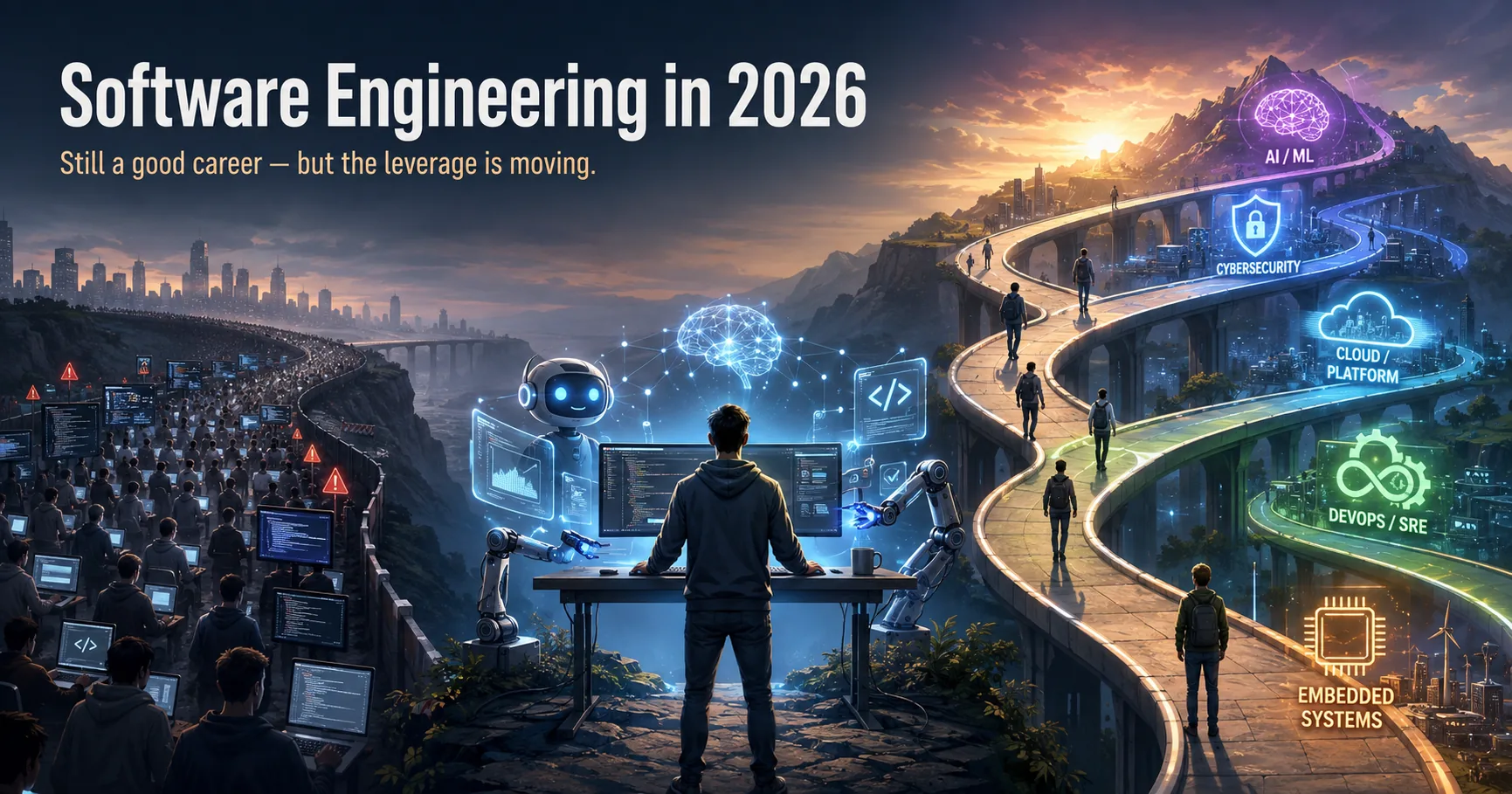
Software engineering is a profession in which practitioners design, build, test, and maintain software systems - and in 2026, it remains one of the highest-paying and most in-demand career paths in the global economy, despite a turbulent period of layoffs, AI disruption fears, and a sharp correction from the hiring frenzy of 2020-2021.
The Bureau of Labor Statistics projects 26% growth in software developer employment through 2032, categorized as "much faster than average," representing approximately 400,000 new positions in the United States alone.
But the career landscape has shifted meaningfully since the pandemic era, and anyone making a career decision today needs an honest picture - not the mythology of 2021 and not the doom narrative of 2023.
From roughly 2020 through early 2022, software engineering occupied an almost mythological position in career advice culture: the field that would never have a bad job market, that AI would never disrupt, that combined intellectual engagement with compensation so extraordinary it made lawyers look modestly paid.
That mythology had a foundation in real data. Compensation was indeed extraordinary, hiring was frenzied, and the profession was expanding into every industry from agriculture to healthcare. But the mythology also contained the seeds of a correction, and the correction arrived with notable severity.
This article provides a clear-eyed 2026 assessment: what the job market data actually shows, which specializations are growing and which are stagnant, what AI disruption means in practical rather than speculative terms, and the genuine advantages and disadvantages for someone evaluating this career path today.
"The best engineers I know are the ones who treat continuous change as a feature rather than a bug. Technology has always changed the nature of software engineering work without reducing the demand for software engineers."
- Kelsey Hightower, developer advocate at Google and Kubernetes advocate, KubeCon 2023
The 2022-2024 Layoff Wave: What Actually Happened
To assess the current state of software engineering, it is necessary to understand the 2022-2024 contraction accurately rather than emotionally. The numbers were real and the human cost was significant, but the causes tell a very different story than "software engineering is dying."
The Over-Hiring Correction
During 2020 and 2021, technology companies - particularly consumer technology companies (Meta, Snap, Netflix) and e-commerce platforms (Amazon, Shopify) - dramatically over-hired software engineers. The assumption was that pandemic-accelerated digitization would be permanent.
Interest rates were at historic lows, venture capital was abundantly available, and the prevailing view was that any additional engineer hired could be productively employed building the digital-first future.
By mid-2022, three conditions changed simultaneously. The Federal Reserve began aggressive interest rate increases that raised the cost of capital and changed the discount rate applied to future cash flows, reducing valuations dramatically.
Advertising revenue softened as post-pandemic spending patterns normalized. And e-commerce growth returned to pre-pandemic trend lines, erasing the assumption that the 2020-2021 surge was the new baseline.
The result: over 350,000 layoffs at technology companies between January 2022 and December 2024, according to Layoffs.fyi tracking data. Major employers including Google, Meta, Amazon, Microsoft, and Salesforce reduced engineering headcount by 5-20%.
New graduate hiring programs contracted sharply. The narrative shifted from "software engineering is bulletproof" to "software engineering is over," with AI-driven automation serving as the post-hoc explanation for what was primarily an over-hiring correction driven by macroeconomic forces.
Why the Layoffs Were Not a Structural Decline
The companies conducting the largest layoffs continued hiring for specific high-priority roles throughout the reduction period. Amazon's January 2023 layoff of approximately 18,000 workers occurred simultaneously with continued hiring for AWS infrastructure and AI roles.
Meta reduced headcount by 21,000 between November 2022 and May 2023, then began hiring aggressively for AI engineering positions in late 2023. Google laid off 12,000 workers in January 2023 while expanding its DeepMind and cloud engineering teams.
This pattern - simultaneous layoffs and hiring - is characteristic of a portfolio rebalancing, not a structural demand decline.
Companies were shedding roles in areas where growth had stalled (social features, consumer products, speculative moonshots) while investing in areas where growth was accelerating (AI infrastructure, cloud services, cybersecurity).
Roger Lee, who founded the Layoffs.fyi tracker, noted in a 2024 interview with CNBC that the layoff wave was "the correction of a two-year hiring binge, not a signal that technology companies don't need engineers."
The Long-Term Demand Signal: BLS Projections and Structural Drivers
The Bureau of Labor Statistics 2022-2032 Occupational Outlook Handbook projected 26% growth in software developer and software quality assurance analyst employment over the decade - a "much faster than average" designation representing approximately 400,000 new jobs.
This projection was made using structural economic modeling, not extrapolation from a single year's hiring conditions.
The Underlying Drivers
The structural forces driving software engineering demand have not weakened during the layoff period. If anything, they have intensified:
Healthcare digitization continues to require massive engineering investment. Electronic health records, telehealth platforms, AI diagnostic tools, medical device software, and pharmaceutical research infrastructure all need software engineers.
The healthcare IT market was valued at $394 billion in 2024 and is projected to reach $974 billion by 2032, according to Fortune Business Insights.
Manufacturing and industrial automation is undergoing a software-driven transformation. Every factory that installs sensors, every supply chain that adds real-time tracking, every warehouse that deploys autonomous systems creates demand for engineers who understand both software and physical systems.
Cybersecurity expands with every connected device. The attack surface of digital systems grows continuously, and the 2023 Microsoft Digital Defense Report documented continued escalation in both the frequency and sophistication of cyberattacks. Every breach creates hiring demand for security engineers.
AI infrastructure is the most visible growth driver. Every new AI capability - from large language models to computer vision systems to recommendation engines - requires substantial engineering investment to train, deploy, monitor, and maintain in production.
The McKinsey Global Institute estimated in 2023 that generative AI alone could add $2.6-4.4 trillion annually to the global economy, and every dollar of that value requires engineering to realize.
Cloud migration remains incomplete. Gartner estimated in 2024 that global spending on public cloud services would exceed $679 billion, growing at approximately 20% annually. The migration of enterprise workloads from on-premises infrastructure to cloud platforms is a multi-decade engineering project that is roughly at its midpoint.
Job Market Reality by Specialization in 2026
Not all software engineering roles are created equal in the current market. The 2022-2024 contraction affected specializations very differently, and the recovery has been uneven. Understanding which areas are growing and which are stagnant is essential for anyone planning a career in this field.
| Specialization | Demand Trend | Competition | Compensation Premium vs. Generalist |
|---|---|---|---|
| AI/ML Engineering and MLOps | Strong growth | Low | +20-40% |
| Cybersecurity Engineering | Strong growth | Low | +15-30% |
| Cloud / Platform Engineering | Growing | Low-moderate | +10-25% |
| Embedded / Automotive Software | Growing | Low | +10-20% |
| DevOps / SRE | Stable-growing | Moderate | +10-20% |
| Mobile (iOS/Android) | Stable | Moderate | +5-15% |
| Generalist Web Development | Flat-declining | High | Baseline |
AI/ML Engineering and MLOps
This is the clearest growth area in 2026. The transition from "AI is interesting" to "AI needs to work reliably in production" has created substantial demand for engineers who understand both machine learning concepts and production software engineering.
MLOps engineers - who build and maintain the infrastructure for training and serving models - are among the most sought-after professionals in the industry.
The compensation premium for ML engineering over generalist backend engineering is approximately 20-40% at top-tier companies, according to Levels.fyi 2024 data.
AI safety engineering has emerged as a formal discipline at model developers including Anthropic, OpenAI, and Google DeepMind, with compensation competitive with senior infrastructure roles.
Stanford's 2024 AI Index Report documented that AI-related job postings in the United States grew by 36% between 2022 and 2024, even as overall software engineering job postings declined by approximately 15% over the same period.
The divergence between AI engineering demand and generalist engineering demand is one of the defining features of the current market.
Cybersecurity Engineering
Cybersecurity engineering demand continues to outstrip supply regardless of broader tech market conditions. The BLS projects 32% growth in information security analyst roles through 2032 - faster than software development overall.
ISC2's 2023 Cybersecurity Workforce Study estimated a global shortfall of approximately 4 million cybersecurity professionals.
Security-focused software engineers - those who can build secure systems, not just audit them - command significant premiums and operate in a market segment where the skills shortage is structural and unlikely to resolve within this decade.
Cloud and Platform Engineering
Cloud engineering (AWS, Azure, GCP) and platform engineering (building internal developer platforms that make other engineers more productive) are both growth areas.
The global cloud computing market continues growing at approximately 15-20% annually according to Gartner's 2024 forecasts, and every percentage of that growth requires engineering talent to build and operate cloud infrastructure.
Platform engineering has emerged as a distinct discipline since 2022, driven by the realization that large engineering organizations need dedicated teams to build the internal tools, CI/CD pipelines, and developer experiences that make application engineers productive.
Gartner predicted in 2023 that 80% of large software engineering organizations would establish platform engineering teams by 2026.
Embedded and Hardware-Adjacent Engineering
Embedded systems engineering - writing software for devices rather than servers - has been persistently under-supplied for years and has grown further with the expansion of automotive software (particularly for electric vehicles and autonomous driving), medical devices, and consumer IoT.
The skill set (C, C++, real-time operating systems, hardware debugging) is different enough from web software engineering that the market is partially insulated from web engineering cycles.
Tesla, Rivian, Waymo, and the automotive divisions of Apple and Sony are among the most aggressive hirers of embedded engineers. The U.S. CHIPS and Science Act of 2022 allocated $52.7 billion for semiconductor manufacturing and research, creating additional demand for engineers who work at the hardware-software boundary.
Generalist Web Development
This is the segment that has felt the contraction most sharply. Mid-tier full-stack web development - building features in established frameworks on established infrastructure - is the most competitive part of the market in 2025-2026. It is also still a large and legitimate market; there are more of these jobs than any other kind.
But the ratio of candidates to openings has increased substantially from the 2021 peak, and compensation has not recovered to 2021 levels at most non-top-tier companies.
The GitHub 2023 Octoverse report noted that JavaScript remains the most-used programming language globally, and the Stack Overflow 2024 Developer Survey found that web development remains the most common developer activity. The market is not disappearing - it is normalizing after an extraordinary bubble.
The AI Threat Assessment: Separating Signal from Noise
A realistic AI threat assessment for software engineering in 2026 requires distinguishing between what is happening now and what might happen in five to ten years. The distinction matters enormously for career planning.
What Is Happening Now
AI tools are significantly accelerating certain categories of software engineering work. GitHub Copilot, released in 2022 and now used by over 1.3 million developers according to GitHub's 2023 report, measurably increases coding speed for boilerplate generation, documentation, test scaffolding, and routine implementation tasks.
A 2022 study by GitHub found that developers using Copilot completed tasks approximately 55% faster than those without it.
This productivity increase has real labor market implications. When each engineer can produce more output, companies may need fewer engineers for the same workload.
Entry-level hiring has contracted partly - though not entirely - because AI tools allow senior engineers to handle more of the work that previously required junior contributors.
What Is Speculative
Complete replacement of software engineers by AI systems within a predictable timeframe remains speculative. The tasks that AI handles well are the most mechanical and well-defined: generating code from clear specifications, writing documentation, creating test cases for existing functions.
The tasks that require the most judgment - system architecture, debugging emergent failures in distributed systems, translating ambiguous product requirements into technical specifications, navigating organizational politics to ship the right product - remain outside current AI capability.
Dario Amodei, CEO of Anthropic, wrote in his 2024 essay "Machines of Loving Grace" that AI could perform a significant fraction of software engineering work within the next few years. This is a serious prediction by a credible expert.
It is also a prediction about a future state, not a description of current conditions. Preparing for this possibility is prudent; abandoning a software engineering career based on it now would be premature.
The Historical Pattern
Computer science professor Frederick Brooks observed in his 1986 paper "No Silver Bullet" that there is no single technology innovation that produces an order-of-magnitude improvement in software engineering productivity within a decade.
Every previous productivity-enhancing technology - compilers, high-level languages, object-oriented programming, cloud computing, agile methodologies - changed the nature of software engineering work without reducing the total demand for software engineers.
Each time, the productivity improvement was absorbed by an expansion in the scope of what software was expected to do.
Whether AI will break this pattern is genuinely uncertain. But the pattern has held for seven decades, and betting against it requires a high degree of confidence in an unprecedented outcome.
Compensation: The Honest Numbers
Software engineering compensation remains exceptional relative to most professional fields, but the distribution is wider than popular narratives suggest.
The Broad Market
The BLS reported a median annual wage of $132,270 for software developers in 2024. This figure is meaningful: it represents the actual midpoint of all software developer earnings in the United States, including those at small companies, non-tech industries, and lower cost-of-living areas.
For context, the median annual wage across all occupations was $48,060 in 2024. Software engineering pays approximately 2.75 times the national median - a premium that has remained remarkably stable over two decades despite periodic market fluctuations.
The Top Tier
At major technology companies (Google, Meta, Amazon, Apple, Microsoft, Netflix) and competitive startups, total compensation for senior engineers (L5/E5 level, typically 5-10 years of experience) ranges from approximately $300,000 to $500,000 annually, including base salary, stock grants, and bonuses.
Staff and principal engineers at these companies can exceed $600,000-$1,000,000 in total compensation.
These figures are real but represent a small fraction of total software engineering employment. Levels.fyi data shows that approximately 15-20% of software engineers in the United States work at companies offering this compensation tier.
The Specialization Premium
The compensation advantage of specialized roles over generalist roles has increased since 2022. An ML engineer at a top-tier company earns approximately 20-40% more than a generalist backend engineer at the same company and level. A cybersecurity engineer with relevant certifications and experience commands a similar premium.
This specialization premium reflects the supply-demand imbalance in high-growth areas and is one of the strongest career signals in the current market.
Honest Pros and Cons in 2026
Pros
Compensation remains exceptional. Even with the post-2021 compression, a senior software engineer's total compensation at a technology company exceeds that of most comparable-credential professionals in law, medicine (excluding specialists), or finance (excluding investment banking and quantitative roles).
The profession offers upper-middle-class to upper-class income without the debt burden of medical or law school.
The work is inherently interesting for the right temperament. Software engineering involves continuous problem-solving across domains, and the variety of industries now dependent on software means that an engineer can work on healthcare diagnostics, financial infrastructure, consumer entertainment, autonomous vehicles, or climate technology with the same foundational skill set.
Remote work prevalence exceeds nearly any other profession. The Stack Overflow 2024 Developer Survey found that approximately 42% of developers work fully remotely and an additional 40% work in hybrid arrangements.
Companies that initially mandated return-to-office have found software engineering roles more resistant to full mandates than other functions, partly because the talent competition creates leverage for engineers who prefer flexibility.
Global demand provides geographic flexibility. Software engineering skills are transferable across countries and industries. An engineer in the United States, Europe, or Asia with strong fundamentals can find employment in virtually any developed economy, and remote work has further expanded this geographic optionality.
Cons
Burnout rates are among the highest in any professional field. The Yerbo 2022 State of Burnout in Tech report found that 62% of technology workers reported feeling physically and emotionally drained, with software engineers reporting some of the highest rates.
The structural causes - on-call burden, perpetual urgency, cognitive load, and rapid context-switching - are not trending toward improvement.
Continuous relearning is mandatory, not optional. The half-life of specific technology skills is roughly three to five years. Technologies that were market-leading in 2018 (certain JavaScript frameworks, specific cloud architectures, particular deployment patterns) are legacy debt in 2026.
Engineers who find continuous learning energizing thrive; those who want a stable skill set find this exhausting.
The compensation advantage is concentrated. The magnificent compensation that makes the profession famous is concentrated at FAANG-tier companies and competitive startups - a small fraction of total engineering employment.
The median software engineer at a non-tech company in a mid-tier city earns well by national standards but not the $400,000+ figures that dominate online discourse.
Ageism is a documented concern. While explicit age discrimination is illegal, the technology industry's cultural preference for younger workers is well-documented.
A 2023 study published in the Journal of Business and Psychology found that age bias in technology hiring begins as early as age 40. Engineers who plan for a 30-40 year career must navigate this structural challenge.
Who Should and Should Not Enter This Field
Software engineering in 2026 remains an excellent career choice for people who have genuine curiosity about how systems work, can tolerate continuous change and relearning, find problem-solving intrinsically satisfying, and are willing to invest the time - two to five years of serious learning - to reach a level of competency that the job market rewards well.
It is a poor choice for people who are primarily motivated by the 2021 compensation stories and not the actual content of the work, want a stable skill set that will not require continuous investment to maintain, are uncomfortable with ambiguity and the absence of definitive "right answers" in most technical decisions, or need a career that will not occasionally interrupt evenings and weekends for production incidents.
The decision should also account for opportunity cost. A career in software engineering competes with careers in data science, product management, cybersecurity (a related but distinct field), and other technology-adjacent professions that share some of the same advantages without identical trade-offs.
Practical Guidance for 2026 Entrants
Specialize Sooner Than You Think You Should
The years of "be a generalist and figure it out later" career advice made more sense in 2019 than it does in 2026.
The market rewards specialization, and building deep expertise in AI/ML engineering, security, or cloud infrastructure while the demand for those skills is high is the most reliable path to the upper end of the compensation distribution.
Integrate AI Tools Into Your Workflow
Engineers who are uncomfortable with or resistant to AI coding tools are producing less than their peers who have integrated them. GitHub Copilot, Claude, ChatGPT, and domain-specific AI tools are part of the modern engineering workflow.
Integrate them, develop critical evaluation skills for AI output, and focus your learning energy on the domains where AI cannot replace you - system design, architecture, debugging, and product judgment.
Build Portfolio Evidence, Not Just Credentials
The value of a computer science degree has not disappeared, but the correlation between credentials and hiring outcomes has weakened. Open-source contributions, portfolio projects, technical writing, and demonstrated expertise in a specific domain carry increasing weight relative to institutional credentials.
The 2024 Stack Overflow Developer Survey found that 26% of professional developers do not have a bachelor's degree in computer science.
Make Long-Term Decisions on Long-Term Data
The long-term demand signal from the BLS and from the structural needs of the global economy is positive. Short-term market conditions in any single year are poor predictors of the ten-year arc of the career. The future of work involves more software, not less, and the engineers who build and maintain that software will remain in demand.
If you are weighing this career against alternatives, consider also reading about whether a college degree is worth the investment and the future of jobs and the skills gap.
Sources & Further Reading
- Bureau of Labor Statistics. (2024). Occupational Outlook Handbook: Software Developers, Quality Assurance Analysts, and Testers. bls.gov/ooh/computer-and-information-technology/software-developers.htm
- Layoffs.fyi. (2024). Tech Layoff Tracker 2022-2024. layoffs.fyi
- Gartner. (2024). Forecast: Public Cloud Services, Worldwide, 2024-2028. gartner.com
- Microsoft. (2023). Microsoft Digital Defense Report 2023. microsoft.com/security
- Levels.fyi. (2024). End of Year Pay Report 2024. levels.fyi
- Amodei, Dario. (2025). "Machines of Loving Grace." darioamodei.com/machines-of-loving-grace
- McKinsey Global Institute. (2023). The Economic Potential of Generative AI. mckinsey.com
- GitHub. (2023). Octoverse 2023: The State of Open Source. github.blog/octoverse
- Stack Overflow. (2024). Developer Survey 2024. survey.stackoverflow.co/2024
- Stanford University. (2024). AI Index Report 2024. aiindex.stanford.edu
- ISC2. (2023). Cybersecurity Workforce Study 2023. isc2.org/research
- Brooks, Frederick P. (1986). "No Silver Bullet - Essence and Accident in Software Engineering." Proceedings of the IFIP Tenth World Computing Conference.
- Fortune Business Insights. (2024). Healthcare IT Market Size and Forecast. fortunebusinessinsights.com
- LinkedIn Economic Graph. (2024). Jobs on the Rise 2025. linkedin.com
- Hightower, Kelsey. (2023). Keynote at KubeCon + CloudNativeCon North America 2023.