
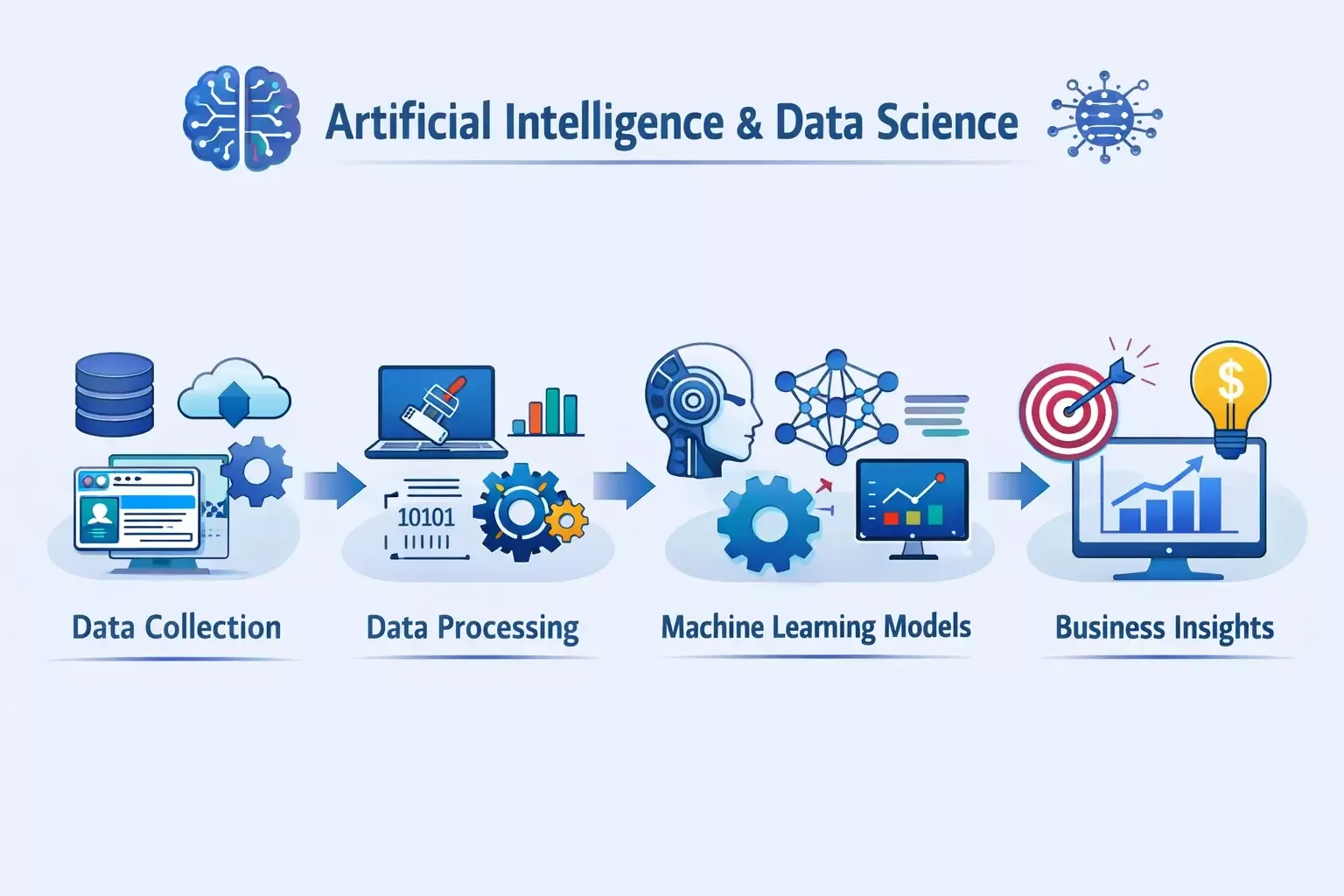
No technology wave in the past decade has reshaped the data science profession as rapidly or as confusingly as the generative AI explosion that followed the release of ChatGPT in late 2022.
In the space of 18 months, the entire discourse around data science shifted: from 'data is the new oil' to heated debates about whether data scientists still have a job at all. The truth is more interesting and more nuanced than either the panic or the hype suggests.
AI tools are genuinely changing what data scientists spend their time on, which skills provide the most leverage, and what new roles are emerging around the intersection of AI capabilities and data work. Some things data scientists used to do manually can now be done faster with AI assistance.
Some traditional data science tasks are being superseded by LLM-based approaches. And entirely new categories of work have emerged that barely existed three years ago.
This article examines the specific mechanisms through which AI is transforming data science: the role of AutoML in structured data problems, how LLMs have displaced traditional NLP pipelines, what the 'AI engineer' role actually is, what data scientists need to know about working with LLMs, and which parts of the data science job are genuinely resistant to automation.
"I don't think AI is replacing data scientists. I think it's replacing the data scientists who weren't very good at their jobs to begin with - the ones whose primary value was knowing scikit-learn's API better than their colleagues. The real work was never about knowing the API."
- Vicki Boykis, machine learning engineer and author of 'What Are Embeddings?', 2024[1]
Key Definitions
AutoML (Automated Machine Learning): Systems that automate portions of the ML pipeline - feature selection, algorithm selection, hyperparameter optimisation - to produce predictive models with reduced manual effort. Examples include Google AutoML, H2O.ai, DataRobot, and AutoGluon.
RAG (Retrieval-Augmented Generation): An architectural pattern for LLM applications that retrieves relevant context from a knowledge base at query time and includes it in the prompt, enabling models to answer questions about specific domain data without full fine-tuning.
Fine-tuning: The process of continuing to train a pre-trained model on domain-specific data to adapt its behaviour for a particular task or style, as distinct from using the base model through prompting alone.
Foundation model: A large model trained on broad data that serves as a base for fine-tuning or prompting for specific applications.[2] GPT-4, Llama 3, Claude, and Gemini are foundation models.
AI engineer: A practitioner who builds production applications using foundation models - through API calls, fine-tuning, RAG pipelines, and evaluation frameworks - combining software engineering and ML knowledge without necessarily having deep statistical modelling expertise.
Hallucination: The phenomenon where LLMs generate plausible-sounding but factually incorrect content with apparent confidence. A critical failure mode for any data application that requires factual accuracy.
The AI Transformation of Data Science: What Has Actually Changed
| Workflow Area | Pre-2022 Approach | Post-LLM Wave Approach |
|---|---|---|
| Text classification | TF-IDF + trained classifier, days of work | Prompt engineering + API call, hours of work |
| Baseline modelling | Manual algorithm selection and tuning | AutoML for initial baseline, human refinement |
| SQL and pandas code | Written manually by analyst | AI-assisted generation, human review |
| Document Q&A | Search + manual reading | RAG pipeline over knowledge base |
| Report writing | Manual text, hours per report | LLM-assisted draft, human editing |
| Exploratory data analysis | Manual notebook work | AI-assisted with tools like pandas-ai |
| Model evaluation | Standard classification metrics | Custom eval frameworks, harder for generative output |
| Traditional NLP pipeline | Tokenise, embed, train classifier | Foundation model API, evaluate, optionally fine-tune |
AutoML: What It Actually Does and Does Not Do
AutoML has been promised as a democratising technology since the mid-2010s. The reality is that it has genuinely delivered on a specific, narrower version of that promise: it can produce reasonable predictive models for well-structured tabular classification and regression problems faster than a human starting from scratch.[8]
H2O AutoML, Google AutoML Tables, and AWS AutoPilot can search across multiple algorithms (gradient boosting, neural networks, linear models, ensemble methods), run cross-validation, and return a ranked model performance report in the time it would take a human to set up their first training run.[7]
For organisations that need a quick baseline, this is genuinely useful and the time savings are real.
DataRobot and similar platforms have extended this further into enterprise workflows, automating not just model training but also deployment pipelines and monitoring dashboards.[13] For well-resourced data teams, AutoML handles the repetitive model iteration work that used to consume significant analyst time.
What AutoML Does Not Do
Frame the problem: AutoML requires a labelled dataset with a clearly defined target variable. Determining which problem is worth solving, which outcome to predict, and which business metric the model should optimise for requires human judgment that AutoML cannot provide.
The highest-leverage data science skill has always been asking the right question.
Ensure data quality: AutoML will build a model on whatever data you give it. If the training data has leakage (future information), biased sampling, or systematic errors, AutoML will not detect them - it will produce a high-performing model that fails in production for reasons the tool never warned you about.
Garbage in, garbage out remains fully operational.
Handle novel data structures: AutoML works best on clean tabular data with defined schema. Text, time series, images, graphs, and multi-modal data require more specialised approaches that general AutoML platforms handle poorly or not at all. The majority of interesting data problems involve at least one of these.
Translate results to decisions: A model with 82% accuracy on the validation set means different things in different business contexts. Whether that is good enough, what the error cases cost, and how to operationalise the predictions requires domain knowledge and stakeholder communication skills.
Monitor and maintain deployed models: AutoML is primarily a training-time tool. Production model monitoring, drift detection, and retraining decisions still require human oversight.[12] Models that are trained once and deployed indefinitely degrade in ways that AutoML does not alert you to.
The practical implication: AutoML has made the first 20% of the data science workflow faster for common problem types. It has not automated the parts of the work that require judgment, domain knowledge, or communication.
"AutoML automates the mechanics of model fitting. It does not automate insight - which is why data scientist salaries did not drop when AutoML platforms became widely available."
- Claudia Perlich, Chief Scientist at Dstillery, Data Science Weekly, 2023
How LLMs Replaced Traditional NLP Pipelines
This is where the disruption to existing data science practice has been most concrete. The traditional NLP workflow - tokenisation, TF-IDF or word embeddings, trained classifiers - has been largely superseded for most production text understanding tasks by LLM-based approaches.
In 2019, building a sentiment classifier for product reviews required: preprocessing (lowercasing, punctuation removal, stopword removal), feature extraction (TF-IDF vectors or trained word embeddings), a trained classifier (logistic regression or gradient boosting), and extensive evaluation on domain-specific test sets.
A reasonably good implementation took days of work and required careful tuning for each new domain.
In 2024, the same task is typically approached by: writing a prompt that defines the classification task, calling a foundation model API, evaluating output quality on a sample, and optionally fine-tuning on domain-specific examples if the base prompt performance is insufficient.
The time investment is measured in hours, and the performance is often better - particularly for nuanced or context-dependent classifications where understanding the full sentence context matters.
The traditional NLP workflow is not entirely gone. It is faster for low-latency applications where calling an API adds unacceptable latency, it is cheaper at very high volume, and it remains more controllable in some regulated environments.
But for the majority of text classification, extraction, and summarisation tasks, the LLM-based approach has become the default.
Implications for NLP Practitioners
Data scientists whose primary specialisation was traditional NLP face a genuine transition. The skills that need to be developed:
- Understanding transformer architecture at a conceptual level (attention mechanisms, tokenisation, context windows)[11]
- Working with the Hugging Face Transformers ecosystem for both inference and fine-tuning[3]
- Evaluation methodology for LLM outputs (which is harder and less standardised than classification metrics)
- Understanding RAG architectures for knowledge-grounded applications
- Prompt engineering beyond the superficial level - understanding how context length, instruction clarity, and example selection affect output quality
The career transition is real but manageable. NLP practitioners who have spent years understanding text data at a deep level have significant advantages in building LLM applications - they understand the failure modes, evaluation challenges, and domain specifics that newcomers lack.
The Rise of the AI Engineer
The AI engineer role has emerged as one of the most in-demand technical positions in the market since 2023.[14] It sits between software engineering and data science, and it is defined more by what practitioners do than by a shared background.
AI engineers build applications using foundation models: customer service bots, document Q&A systems, code generation assistants, multimodal search, and AI-augmented workflows. The work involves a specific cluster of skills that differ meaningfully from traditional data science.
Core AI Engineer Skills
Prompt design and system prompt engineering: Understanding how to structure instructions to foundation models to achieve reliable, high-quality output consistently - including how to handle edge cases, format constraints, and safety requirements.
RAG architecture: Building pipelines that chunk, embed, and index knowledge bases, then retrieve relevant context at query time to ground LLM responses in specific information.[4] Choosing the right chunking strategy, embedding model, and retrieval algorithm significantly affects output quality.
Evaluation frameworks: Defining what 'good' looks like for LLM application output and building systematic evaluation pipelines. Standard classification metrics do not apply to open-ended generation, which requires custom approaches - often using other LLMs as judges, which introduces its own reliability questions.
Model selection and cost optimisation: Choosing between different foundation models based on capability, latency, and cost requires understanding the tradeoffs across providers. GPT-4 vs GPT-4o vs Claude vs Gemini vs open-source models involves real cost and capability differences.
Fine-tuning and PEFT methods: Adapting base models to specific styles, domains, or task formats using parameter-efficient fine-tuning methods (LoRA, QLoRA) when prompt engineering is insufficient.[5] This requires understanding when fine-tuning is actually necessary vs. when better prompting would suffice.
AI Engineer vs Data Scientist Comparison
| Dimension | AI Engineer | Data Scientist |
|---|---|---|
| Core skill emphasis | Software engineering, API integration | Statistics, experimental design |
| Model interaction | API calls, fine-tuning, RAG | Training models from data |
| Primary tools | LangChain, OpenAI SDK, Hugging Face | scikit-learn, pandas, statsmodels |
| Evaluation approach | Custom eval frameworks, LLM-as-judge | Classification metrics, A/B testing |
| Production focus | Application reliability and latency | Model performance and fairness |
| Data requirement | Minimal (uses pre-trained) | Large labelled datasets |
| Entry via | Software engineering background | Statistics or ML background |
| Salary (senior, US) | $160,000-$250,000 | $150,000-$220,000 |
Many practitioners are developing both skill sets. The 'AI-enabled data scientist' who can build LLM-augmented workflows while maintaining statistical rigour is an increasingly valuable profile - and the one with the broadest range of applicable problems.
What Data Scientists Need to Know About LLMs
Even for data scientists who are not building LLM applications, understanding how language models work is increasingly necessary for their existing work.
LLMs as Data Tools
LLMs are being integrated into data science workflows in ways that affect practitioners regardless of specialisation:
Code generation: GitHub Copilot and its successors accelerate writing pandas, SQL, and scikit-learn code. Using these tools effectively requires enough expertise to recognise when generated code is wrong - which happens regularly in non-trivial cases.
Automated EDA: Tools like pandas-ai and similar libraries use LLMs to generate exploratory analyses from natural language queries. Understanding the reliability and limitations of these outputs is important; LLM-generated insights sometimes confuse correlation with causation or overlook obvious data quality issues.
Synthetic data generation: LLMs can generate synthetic tabular data for testing and augmentation. The statistical properties of LLM-generated data differ from real data in ways that matter for model training - distributions, correlations, and rare events are not reliably preserved.
Understanding LLM Failure Modes
Data scientists evaluating LLM-powered systems need to understand the characteristic ways LLMs fail:[9]
Hallucination: LLMs generate plausible-sounding but factually incorrect content confidently. Systems that require factual accuracy need verification layers - retrieval augmentation, fact-checking pipelines, or human review.
Context window limitations: Long documents or conversations that exceed a model's context window are truncated in ways that can dramatically affect output quality. The behaviour at context boundaries is not always predictable.
Sensitivity to prompt wording: Small changes in prompt phrasing can produce significantly different outputs. Evaluation should test prompts with variations to assess sensitivity and identify fragile formulations.
Evaluation difficulty: Unlike classification problems where precision and recall are well-defined, evaluating LLM output quality requires building custom evaluation frameworks, often using other LLMs as judges - which introduces its own reliability questions and should itself be validated.
Which Parts of Data Science Are Resistant to Automation
Understanding where automation resistance lies is critical for career planning. The picture that emerges from analysis of current AI capabilities is that the most automation-resistant work is the work that requires organisational context, relationship intelligence, and ethical judgment.
High Automation Resistance
Problem framing and scoping: Deciding which questions are worth answering, translating ambiguous business requests into answerable analytical problems, and understanding when the data is simply insufficient to support the conclusions being requested.
This requires organisational context, domain expertise, and the relationship intelligence to know what the stakeholder actually needs rather than what they asked for.
Experimental design: Designing A/B tests and quasi-experiments that will produce trustworthy causal conclusions requires statistical judgment about effect sizes, power, confounders, and the specific context of the business.
AI tools can assist but not replace the design judgment that distinguishes a valid experiment from an uninterpretable one.
Data quality investigation: Understanding why a metric changed unexpectedly requires knowledge of the organisation's data systems, recent product changes, and the history of the data. This institutional knowledge is not available to AI tools and cannot be retrieved from a documentation search.
Stakeholder communication and trust-building: Presenting uncertain results to executives in ways that drive good decisions rather than false confidence, pushing back diplomatically when stakeholders interpret data incorrectly, and building the credibility to have your recommendations acted upon are relationship skills that develop over years.
Ethical review and bias assessment: Evaluating whether a model's behaviour is appropriate for a specific deployment context - considering disparate impact, privacy implications, and accountability structures - requires human judgment about organisational and social values that AI cannot supply.[10]
Moderate Automation Resistance
Feature engineering: AI tools can suggest features from a description of the problem, but domain expertise for non-obvious features and judgment about which features are likely to be stable over time remains human-intensive. AI-suggested features often reflect statistical patterns rather than causal mechanisms.
Model evaluation and selection: AI tools can run automated model comparisons, but interpreting what the evaluation results mean in the context of production deployment requirements - latency constraints, fairness considerations, failure mode costs - still requires human judgment.
Lower Automation Resistance
Routine data cleaning: Standardised data quality issues (deduplication, null handling, type coercion) are increasingly automatable and increasingly being automated.
Boilerplate code writing: SQL queries, pandas operations, and standard model training code is accelerated significantly by AI coding tools. The time to write standard analytical code has dropped 40-60% with effective AI assistance.[6]
Dashboard creation: Basic analytical dashboards with standard metrics are increasingly within reach of low-code and AI-assisted tools for non-data scientists. The democratisation of dashboards is real and reduces demand for analysts doing exclusively operational reporting.
Practical Takeaways
Use AutoML deliberately. It is a legitimate time-saving tool for appropriate problems - primarily structured tabular prediction tasks with clear target variables and reasonable data quality. Do not avoid it out of professional pride, and do not assume it replaces judgment about what problem to solve.
Invest in understanding LLMs at a conceptual level even if your work does not currently involve them. The integration of LLM-based tools into all aspects of data work is ongoing, and practitioners who understand the tools are more effective than those who treat them as black boxes.
The minimum useful knowledge: transformer architecture basics, prompt engineering, RAG concepts, and LLM failure modes.
The AI engineer role is a real opportunity for data scientists who want to develop stronger software engineering skills. Compensation is strong ($160,000-$250,000 senior in the US), demand exceeds supply, and the skill set is adjacent to existing data science knowledge.
The transition requires developing software engineering discipline and evaluation methodology for generative systems.
Focus development on automation-resistant skills: problem framing, experimental design, stakeholder communication, and domain expertise. These are the highest-value areas and the ones where the gap between AI-assisted and genuinely skilled human performance remains largest and most consequential.
Sources & Further Reading
- Boykis, V. (2024). What Are Embeddings? vickiboykis.com/what_are_embeddings/
- Bommasani, R., et al. (2022). On the Opportunities and Risks of Foundation Models. Stanford CRFM Technical Report.
- Wolf, T., et al. (2020). Transformers: State-of-the-Art Natural Language Processing. EMNLP 2020.
- Lewis, P., et al. (2020). Retrieval-Augmented Generation for Knowledge-Intensive NLP Tasks. NeurIPS 2020.
- Hu, E., et al. (2022). LoRA: Low-Rank Adaptation of Large Language Models. ICLR 2022.
- McKinsey Global Institute. (2023). The Economic Potential of Generative AI.
- Google. (2024). AutoML Tables Documentation. Google Cloud.
- H2O.ai. (2024). AutoML Reference Guide. docs.h2o.ai
- Weidinger, L., et al. (2022). Taxonomy of Risks Posed by Language Models. FAccT 2022.
- Hendrycks, D., et al. (2023). Aligning AI With Shared Human Values. arXiv.
- Karpathy, A. (2023). State of GPT. Microsoft Build Keynote.
- Huyen, C. (2022). Designing Machine Learning Systems. O'Reilly Media.
- Gartner. (2024). Magic Quadrant for Data Science and Machine Learning Platforms. gartner.com
- LinkedIn Economic Graph. (2024). Jobs on the Rise: AI Engineer. linkedin.com/pulse