
A manager is someone who achieves results through other people. Unlike individual contributors who produce outputs directly, managers plan work, organize resources, set direction, motivate their teams, and develop the people who report to them.
This definition sounds simple, but the practice of management is one of the most studied and least understood activities in organizational life.
Research spanning nearly a century - from Peter Drucker's foundational work in the 1950s to Google's Project Oxygen in 2008 - consistently identifies a specific set of behaviors that separate effective managers from ineffective ones.
The gap between what those behaviors require and what most first-time managers expect is the source of most management dysfunction in modern organizations.
Ask ten people what a manager does and you will get ten different answers, most of them vague.
"They support the team." "They remove blockers." "They make sure work gets done." None of these is wrong, exactly, but none of them explains why management is hard, why so many people do it poorly, and why the skills required have almost nothing in common with the skills that got most managers their jobs.
"Management is doing things right; leadership is doing the right things." - Peter Drucker
The Foundations: What Peter Drucker Taught Us
Peter Drucker, often called the father of modern management, provided the most enduring framework for the manager's role in his 1954 book The Practice of Management.
Writing at a time when management was still considered an intuitive art rather than a learnable discipline, Drucker identified five core functions that define what managers actually do - not in terms of their industry or technical domain, but in terms of their fundamental responsibilities as managers:
Setting objectives - Determining what the goals are and communicating them to the people responsible for achieving them. Effective objectives are specific, measurable, and connected to the organization's broader purpose.
Drucker later formalized this into Management by Objectives (MBO), a framework that influenced the development of modern goal-setting systems like OKRs (Objectives and Key Results), popularized by Andy Grove at Intel and later adopted by Google through John Doerr.
Organizing - Analyzing the work that needs to be done, dividing it into manageable activities, and assigning it to people with the right skills. This includes designing team structures, defining roles, and ensuring the right resources are available.
Motivating and communicating - Making people understand, through communication, incentive, and the job's own design, why their work matters and how to do it well. Drucker recognized that motivation is not primarily about compensation - it is about meaning, autonomy, and the experience of competence.
Measuring performance - Establishing yardsticks for performance, ensuring everyone has access to those yardsticks, and analyzing and evaluating results. The emphasis is on measurement as a tool for improvement, not for punishment.
Developing people - Treating people as resources capable of growth, and investing in that growth through feedback, coaching, and stretch assignments. Drucker argued that a manager who does not develop their people is not doing their job, regardless of how well the team's current numbers look.
Drucker's framework has held up remarkably well across seven decades. Modern management research has expanded and nuanced each of these functions, but none of the subsequent research has found a reason to remove any of them from the list.
What the research has added is specificity: which of these functions matters most, under which conditions, and what excellent execution of each function actually looks like.
"The productivity of work is not the responsibility of the worker but of the manager." - Peter Drucker, The Practice of Management, 1954
What Google Learned About Good Managers
In 2008, Google launched Project Oxygen, an internal research initiative that would become one of the most cited studies in contemporary management literature. The study was born from a provocative internal hypothesis: do managers matter at all?
Google's engineering culture had long been skeptical of management, viewing it as bureaucratic overhead that slowed down talented engineers.
Google had access to an unusual data asset: years of structured performance reviews, upward feedback surveys, and team effectiveness measurements for thousands of managers across the company.
The research team, led by Laszlo Bock (then VP of People Operations), asked a deliberately open question: what behaviors distinguish Google's most effective managers from its least effective ones?
The answer was unequivocal: managers matter enormously. Teams with high-scoring managers reported higher satisfaction, lower turnover, and better performance. The analysis identified eight behaviors - later expanded to ten - that predicted manager effectiveness with statistical reliability:
| Rank | Behavior | Why It Matters |
|---|---|---|
| 1 | Is a good coach | Direct feedback, both positive and developmental, delivered regularly rather than withheld for annual reviews |
| 2 | Empowers the team rather than micromanaging | Provides autonomy and shows trust; removes obstacles rather than controlling methods |
| 3 | Creates an inclusive team environment | Builds psychological safety; values diverse perspectives; does not allow dominant voices to suppress others |
| 4 | Is productive and results-oriented | Models the work ethic and focus they expect from the team |
| 5 | Is a good communicator and listens to the team | Shares information proactively; holds space for team concerns and input |
| 6 | Supports career development and discusses performance | Invests time in where team members are going, not just what they are currently delivering |
| 7 | Has a clear vision and strategy for the team | Connects day-to-day work to the organization's larger purpose |
| 8 | Has key technical skills to help advise the team | Credible enough in the domain to understand challenges and advise on approaches |
| 9 | Collaborates across the organization | Breaks down silos; builds relationships with other teams |
| 10 | Is a strong decision-maker | Makes decisions with appropriate speed; explains reasoning |
Two findings from Project Oxygen are particularly worth noting. First, technical expertise ranked near the bottom among the predictors of manager effectiveness. This runs directly counter to how most organizations promote people into management - by promoting their best individual contributors.
Second, the single most important behavior was being a good coach, which most managers receive no training in whatsoever.
Google followed Project Oxygen with Project Aristotle (2012), which studied what makes teams effective. The most important finding: psychological safety - team members' belief that they can take interpersonal risks without punishment - was the strongest predictor of team performance.
This finding, building on the work of Amy Edmondson at Harvard Business School (1999), placed the manager's role in creating safe team environments at the center of effective management.
The Individual Contributor to Manager Transition
The most disorienting career transition in professional life is the move from individual contributor (IC) to manager. Research by Linda Hill of Harvard Business School, documented in her landmark study Becoming a Manager (2003), found that this transition is far more difficult than most new managers anticipate.
The skills, habits, and identity that made someone excellent as an individual contributor are not just insufficient for management - they can actively interfere with it.
What Changes
As an individual contributor, success means:
- Producing high-quality work directly
- Developing deep expertise in a specific domain
- Being relied upon for your own output
- Measuring your day by tangible tasks completed
As a manager, success means:
- Enabling others to produce high-quality work
- Developing enough expertise to coach, not enough to do every task yourself
- Being relied upon to create conditions for others' output
- Measuring your week by the trajectory of your team, not your own task list
This transition is psychologically challenging because the behaviors that earned recognition - personal mastery, deep involvement in the work, hands-on problem-solving - become actively counterproductive when applied to managing others.
A manager who personally rewrites the team's work is not ensuring quality; they are signaling that the team's judgment cannot be trusted, undermining the autonomy that drives engagement, and bottlenecking every output through a single person.
Marshall Goldsmith, one of the most influential executive coaches in the world, captured this dynamic in the title of his 2007 book: What Got You Here Won't Get You There. The very strengths that earned the promotion become weaknesses in the new role.
The Delegation Problem
Delegation is the core management skill that most new managers struggle with most. The difficulty is not conceptual - people understand what delegation is. The difficulty is psychological: delegating meaningful work requires tolerating a period of uncertainty while someone else learns to do something you could do faster yourself.
Hill's research found that new managers consistently underestimated the time needed for people-related responsibilities - coaching, feedback, conflict resolution, career conversations - and overestimated how much they would be able to contribute directly to the technical work.
The result was managers who were technically effective and managerially absent, doing the work instead of developing the people.
A study by Gallup (2015) found that managers who spend at least six hours per week in development-focused conversations with their direct reports see 12 percent higher productivity, 27 percent lower absenteeism, and 40 percent higher engagement scores compared to managers who spend little time on development.
The return on investing time in people is measurable and substantial.
The Time Allocation Shift
Henry Mintzberg, one of the most influential management scholars of the 20th century, conducted observational studies of managers (published in The Nature of Managerial Work, 1973) and found that the typical manager's day bears little resemblance to the orderly cycle of planning, organizing, and controlling described in management textbooks.
Instead, managers work at a relentless pace, their activities are characterized by brevity, variety, and fragmentation, and they strongly prefer oral communication to written reports.
Mintzberg's work revealed that a typical manager's day includes:
| Activity | Percentage of Time | Purpose |
|---|---|---|
| Scheduled meetings | 30-40% | Decision-making, alignment, information sharing |
| Unscheduled conversations | 15-25% | Problem-solving, coaching, relationship maintenance |
| Administrative tasks (email, reports) | 15-20% | Documentation, communication, compliance |
| Individual thinking and planning | 10-15% | Strategy, reflection, preparation |
| External interactions | 5-15% | Cross-team collaboration, stakeholder management |
The scarcest resource for most managers is uninterrupted thinking time. The most common failure mode is spending too much time on administrative tasks and too little on coaching and development.
The One-on-One Meeting
The one-on-one meeting (1:1) is the most important management practice that most managers do inconsistently or poorly. A 1:1 is a regular, private meeting between a manager and each direct report - typically weekly, 30 to 60 minutes, recurring and protected from cancellation.
The 1:1 is not a status update meeting. Status can be communicated asynchronously through project management tools or written updates.
The 1:1 exists for purposes that require conversation: surfacing concerns that would not be raised in a group setting, discussing development goals, providing and receiving honest feedback, and maintaining the relationship that makes difficult conversations possible when they are needed.
The meeting belongs to the employee, not the manager. The employee sets the agenda. The manager's job is to be present, to listen, to ask good questions, and to remove obstacles.
Managers who treat 1:1s as report-outs - where they do most of the talking and the employee updates them on task completion - are running the meeting backwards.
Andy Grove, former CEO of Intel and author of High Output Management (1983), argued that a manager spending one hour per week with each direct report could have more impact on that person's effectiveness than almost any other investment of time:
"Ninety minutes of your time can enhance the quality of your subordinate's work for two weeks, or for some eighty-plus hours." - Andy Grove, High Output Management, 1983
A manager with ten direct reports who consistently runs high-quality 1:1s is doing ten hours of potentially transformative management work per week.
Common 1:1 mistakes:
- Canceling them when calendars get busy (signals that people are less important than other meetings)
- Turning them into status reports rather than development conversations
- Using them only to discuss immediate work, never development or career trajectory
- Doing all the talking and failing to listen
- Not taking notes or following up on commitments made in the meeting
- Holding them in public spaces where the employee cannot be candid
Kim Scott, author of Radical Candor (2017), recommends that managers use a simple framework for 1:1 structure: start by asking how the person is doing personally, then discuss their most important priorities, then address any coaching or development topics, and end by asking what you (the manager) can do differently.
Performance Management: The Most Avoided Responsibility
Performance management is the set of processes by which managers set expectations, track progress, give feedback, and address performance that falls below expectations. It is one of the most avoided management responsibilities and one of the most consequential.
The research on feedback delivery is extensive and consistent on one key finding: feedback is most effective when it is frequent, specific, and timely. Annual performance reviews, which remain standard at most large organizations, score poorly on all three dimensions.
They are infrequent (once a year), often vague ("you need to work on your communication"), and significantly delayed from the events they address (months old).
A Deloitte study (2015) found that 58 percent of executives believed their current performance management approach drove neither employee engagement nor high performance.
In response, major companies including Adobe, Microsoft, General Electric, and Accenture have abandoned annual reviews in favor of more frequent, conversation-based feedback systems.
The Feedback Failure
Despite the evidence, most managers give too little feedback rather than too much.
Research by Jack Zenger and Joseph Folkman (2014), based on a dataset of over 900 employees, found that 69 percent of employees said they would work harder if their efforts were better recognized, and 65 percent of employees reported wanting more feedback than they received.
The hesitation comes from several sources: fear of damaging the relationship, uncertainty about how to deliver critical feedback constructively, lack of training in feedback conversations, and the discomfort of raising difficult topics with people you see every day.
Kim Scott, in Radical Candor (2017), frames the failure mode as ruinous empathy: being nice to someone in the moment at the cost of their long-term effectiveness.
A manager who withholds honest feedback about poor performance is not protecting the employee - they are letting the employee continue underperforming while ensuring the eventual consequences (a poor review, a missed promotion, termination) come as a surprise.
Scott's framework maps feedback approaches on two axes - Care Personally and Challenge Directly - creating four quadrants:
| Low Care | High Care | |
|---|---|---|
| High Challenge | Obnoxious Aggression (harsh truth without empathy) | Radical Candor (honest feedback with genuine concern) |
| Low Challenge | Manipulative Insincerity (neither honest nor caring) | Ruinous Empathy (caring without honesty) |
The goal is the upper-right quadrant: challenging people directly because you care about their growth.
Performance Improvement Plans
When an employee's performance is genuinely below expectations after coaching and feedback, the formal instrument is a Performance Improvement Plan (PIP).
A PIP documents specific performance deficiencies, defines the standards required to remain in the role, sets a timeline for improvement (typically 30-90 days), and specifies the consequences if improvement does not occur.
PIPs are widely misunderstood. In healthy organizations, they are legitimate tools for structured improvement support.
In dysfunctional ones, they have become a documentation mechanism for predetermined terminations - which is both ethically problematic and counterproductive, since employees placed on PIPs in this way lose trust in the process and in management.
A SHRM survey (2019) found that only 27 percent of employees placed on PIPs successfully met improvement targets, which suggests that many PIPs begin too late, after the relationship and performance problems have become entrenched.
Psychological Safety: The Foundation of High-Performing Teams
Perhaps the most important concept in modern management science is psychological safety - the shared belief that the team is safe for interpersonal risk-taking. The term was coined by Amy Edmondson of Harvard Business School in her 1999 paper "Psychological Safety and Learning Behavior in Work Teams."
Edmondson's research, later confirmed by Google's Project Aristotle (2012), found that teams with high psychological safety:
- Ask more questions and admit mistakes more readily
- Experiment more and learn faster from failures
- Raise concerns earlier, preventing small problems from becoming large ones
- Share knowledge more freely across team boundaries
- Report higher engagement and lower burnout
The manager's role in creating psychological safety is direct and irreplaceable. When a manager responds to a mistake with curiosity rather than blame, the team learns that mistakes are learning opportunities. When a manager punishes the messenger, the team learns to hide problems.
The pattern is established quickly and reinforced constantly through small interactions that most managers do not even notice.
Why Management Is Hard
Management is hard in ways that are difficult to appreciate from the outside. Several structural features of the role create persistent difficulty:
You are responsible for outcomes you do not directly control. A manager's performance is measured by their team's results, but the manager is rarely the one doing the work. This requires the ability to influence - through communication, culture, structure, and coaching - rather than to execute directly.
The feedback loop is long. An individual contributor often knows within hours whether they did their job well. A manager may not know whether a coaching conversation, a hiring decision, or a team structure change had the intended effect for months or years.
You manage people, and people are complicated. Every management technique that works well for one person works differently or not at all for another. The management research is full of averages, but a manager works with specific people - specific histories, specific motivations, specific fears - not with average employees.
The role is emotionally demanding in ways that are rarely acknowledged. Managers absorb stress from above and below. They deliver bad news they did not create. They hold confidences they cannot share. They advocate for their teams in processes where they have limited power.
The emotional labor of management is substantial and frequently invisible. A 2021 study by Microsoft's WorkLab found that 54 percent of managers reported feeling overworked and 39 percent reported feeling exhausted.
Most people become managers without training. A 2019 study by Grovo found that 87 percent of managers said they wished they had more management training when they first became a manager. The path to management runs through technical or functional excellence, not management readiness - and the organization rarely fills the gap.
The Chartered Management Institute (UK, 2018) estimated that untrained managers cost the UK economy approximately 84 billion pounds annually in lost productivity.
The Difference Between Managing and Leading
The relationship between management and leadership has generated an enormous literature, much of it unhelpful. The clearest distinction, offered by management scholars John Kotter (1990) and Warren Bennis (1989), is:
- Management is about coping with complexity: bringing order and predictability to a system through planning, budgeting, organizing, staffing, and controlling.
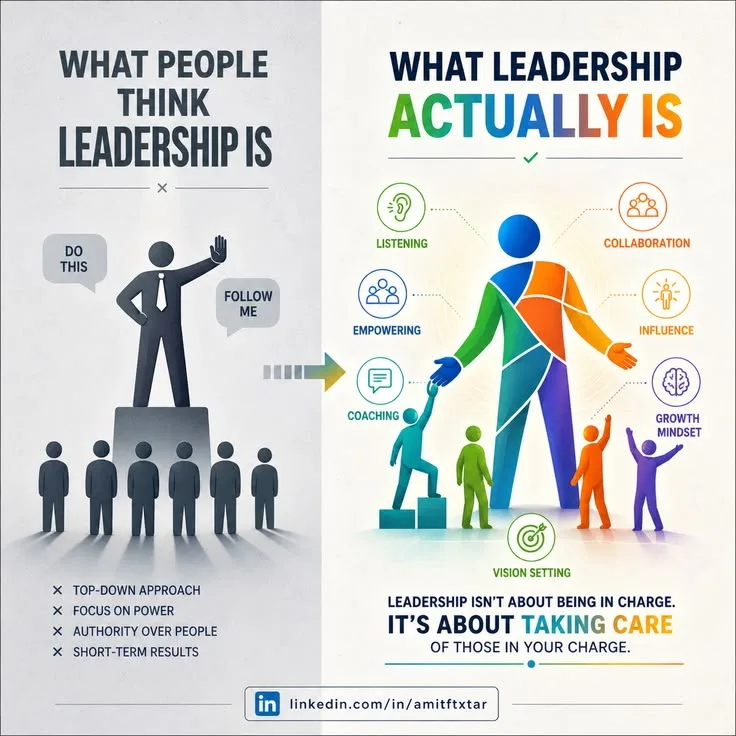
- Leadership is about coping with change: setting a direction, aligning people around that direction, and motivating them to overcome obstacles.
Both are necessary. An organization with strong leadership and weak management will have an inspiring vision and chaotic execution. An organization with strong management and weak leadership will execute efficiently toward goals that are increasingly irrelevant in a changing environment.
In practice, most people in management roles need both. The proportion varies by level: frontline managers spend more time on management functions; senior executives spend more time on leadership functions. The mistake is treating the two as synonymous, which leads to promoting people who excel at one into roles that require the other.
Measuring Management Effectiveness
If management quality matters - and the evidence is overwhelming that it does - then organizations need ways to measure it. The standard approaches include:
| Measurement | What It Reveals | Limitations |
|---|---|---|
| Team engagement surveys | How employees experience their manager | Self-report; influenced by factors outside manager control |
| Upward feedback (360 reviews) | Employee ratings of specific management behaviors | Gaming risk; requires psychological safety to be honest |
| Team performance metrics | Output, quality, and delivery against goals | Manager contribution hard to isolate from team composition |
| Voluntary attrition data | Whether good people are leaving the team | Lagging indicator; exit interviews often incomplete |
| Promotion/development rates | Whether the team develops future leaders | Long time horizon; influenced by opportunity, not just development |
| Skip-level meetings | Direct reports' reports share unfiltered feedback | Requires trust; can feel threatening to the manager |
No single measure captures management quality. The most reliable signal is a combination: consistent upward feedback indicating specific behaviors, low voluntary attrition of high performers, and team performance that holds up across changing membership - suggesting that the manager is building capacity rather than just extracting it from existing talent.
Gallup's ongoing employee engagement research, spanning over 2.7 million employees across 100,000 teams (2017), consistently finds that the manager relationship accounts for at least 70 percent of the variance in employee engagement scores.
The difference between a great manager and a poor one, applied to a team of ten over five years, compounds into an enormous difference in human capital and organizational results.
That is what management is. Not a title or a salary band, but a practice - demanding, learnable, and consequential.
For related topics, see how to communicate clearly, what is active listening, how to make better decisions, and how to write a business plan.
Sources & Further Reading
- Drucker, Peter F. (1954). The Practice of Management. Harper & Row.
- Grove, Andrew S. (1983). High Output Management. Random House.
- Hill, Linda A. (2003). Becoming a Manager: How New Managers Master the Challenges of Leadership. Harvard Business School Press.
- Scott, Kim. (2017). Radical Candor: Be a Kick-Ass Boss Without Losing Your Humanity. St. Martin's Press.
- Goldsmith, Marshall. (2007). What Got You Here Won't Get You There. Hyperion.
- Mintzberg, Henry. (1973). The Nature of Managerial Work. Harper & Row.
- Edmondson, Amy C. (1999). Psychological Safety and Learning Behavior in Work Teams. Administrative Science Quarterly, 44(2), 350-383.
- Buckingham, Marcus & Coffman, Curt. (1999). First, Break All the Rules: What the World's Greatest Managers Do Differently. Simon & Schuster (Gallup Press).
- Kotter, John P. (1990). A Force for Change: How Leadership Differs from Management. Free Press.
- Garvin, David A. (2013). How Google Sold Its Engineers on Management. Harvard Business Review, December 2013. View source
- Zenger, Jack & Folkman, Joseph. (2014). Your Employees Want the Negative Feedback You Hate to Give. Harvard Business Review. View source