
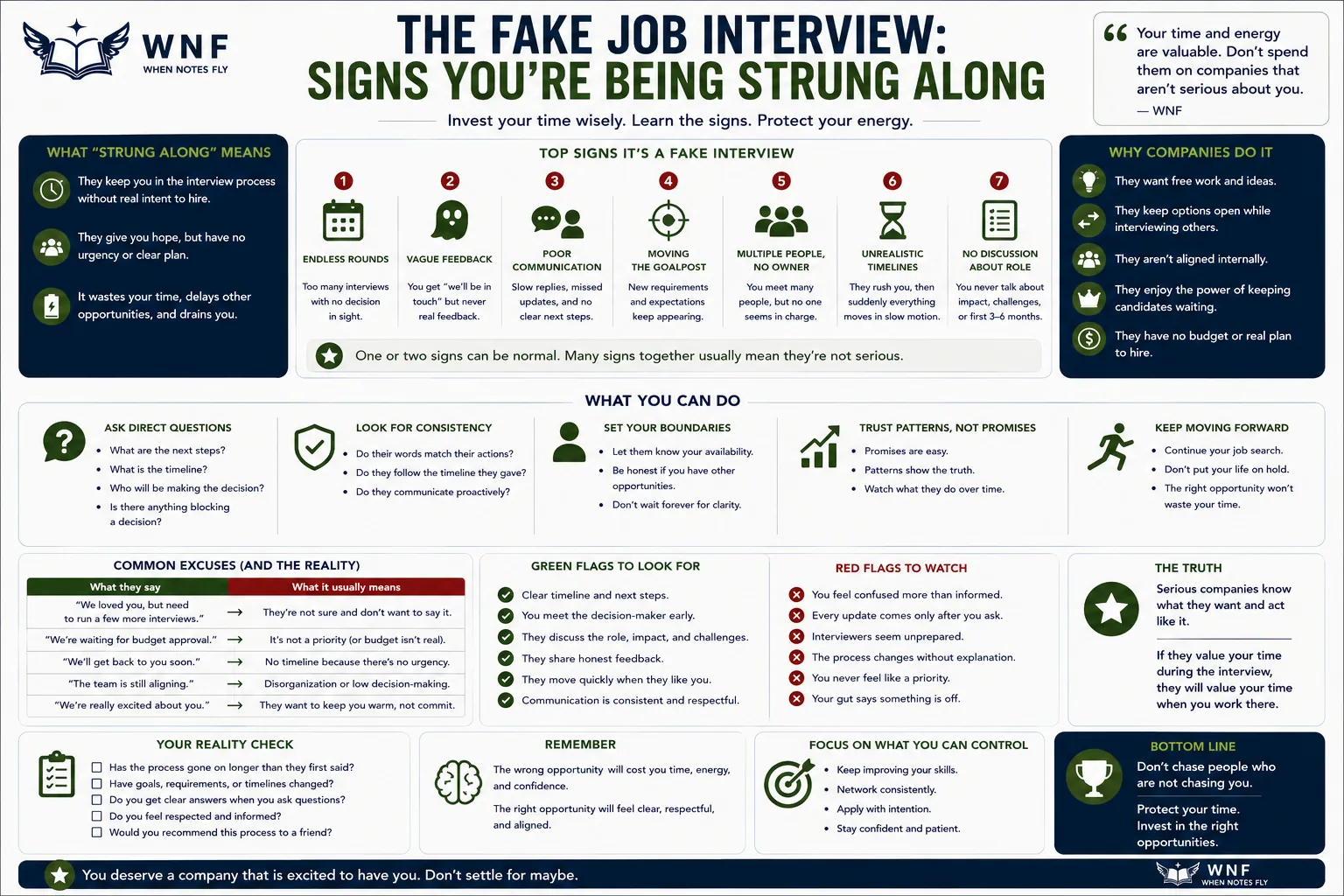
Signs: You are three interview rounds in. The recruiter is friendly. The hiring manager liked you. They want to schedule the panel loop next week. You are already mentally rearranging your life around the role, calculating commute, imagining the team.
And somewhere under the optimism is a small signal you keep dismissing: the job was posted four months ago. The timeline keeps shifting. The hiring manager's questions felt generic. The requirements in the posting read strangely specific, as if they were written around a person rather than for a role.
Job search fatigue makes these signals easy to ignore. You want the offer. The process feels promising. Walking away costs the weeks you have invested. So you keep going, until the process either concludes without the offer or the offer comes in a shape that does not match what you thought you were interviewing for.
The research on the actual behavior of hiring processes, though scattered, is consistent.
A meaningful fraction of job interviews that feel real are conducted for roles that are already decided internally, pipeline-building purposes, compliance requirements, or budget placeholders that were never going to convert.
Spotting the pattern early saves weeks of effort and keeps you searching in places where offers actually emerge.
"The hiring process is not a neutral evaluation. It is a series of decisions made by people under constraints, including legal requirements, internal politics, budget uncertainties, and relationship considerations that have nothing to do with the candidate's fit.
Candidates who model the process realistically outperform candidates who assume good faith." - Adam Grant, Originals (2016)[3]
Why Fake and Partial-Faith Processes Exist
Before scoring any individual process, it helps to understand why companies run interviews that are not genuinely aimed at hiring the best external candidate.
Compliance-driven internal hires. Many companies require external postings and interviews for roles that are effectively earmarked for a specific internal candidate.
This is particularly common in regulated industries, in government and government-adjacent organizations, and in companies with formal policies around posting transparency. The external interviews are real interviews, but the outcome is substantially predetermined.
Pipeline building. Talent-acquisition teams at larger companies maintain ongoing relationships with strong candidates in case a role opens.
Interviews conducted under this premise can feel real because the recruiter's interest is genuine, but the role the candidate is nominally interviewing for may not materialize on the timeline the candidate expects, or may not materialize at all.
Budget placeholders. Hiring managers sometimes post roles to keep budget slots visible during planning cycles, without immediate intent to hire. If business conditions shift, the posting becomes real. If conditions do not shift, the posting is quietly removed or left open indefinitely.
Frozen searches. Searches that were legitimate at inception but became deprioritized due to hiring freezes, restructuring, or strategy shifts. The posting remains up because no one has taken it down. The interview process continues for a while with decreasing urgency before fizzling.
Legitimate but slow. Some real processes simply take a long time due to organizational complexity, calendar issues, or internal disagreement about requirements. These are not fake, but they share some signals with the fake version, which is why pattern recognition matters.
| Process Type | Intent | Typical Outcome | Key Signal |
|---|---|---|---|
| Genuine external search | Hire the best external candidate | Offer within 4-8 weeks | Clear timeline, responsive communication |
| Compliance-driven internal earmark | Document external process, hire internal | External candidates rejected or slow-walked | Role posted with unusual specificity |
| Pipeline building | Maintain future candidate relationships | No offer, maybe future opportunity | Vague job scope, no specific start date |
| Budget placeholder | Preserve headcount slot | Role quietly closes or stays open | Posted long ago, low urgency |
| Frozen after legitimate start | Originally real, now stalled | Process fizzles without resolution | Initial momentum then decay |
| Slow but real | Real hire, complex org | Offer eventually, often late | Specific timeline promised, occasionally missed |
Signals From the Posting Itself
Before you apply, and certainly before you invest interview cycles, the posting itself carries signals.
Unusually specific requirements that combine narrowly. A role that wants five to seven years of experience, one specific niche tool, a particular industry vertical, and a rare language combination is often a role written around a known candidate.
Genuine external searches are typically broader in their requirements because hiring managers want to see a wider candidate pool.
Very long posting duration. Roles that have been posted for more than 90 days without being refreshed are more likely to be budget placeholders or frozen searches. The exception is roles that are genuinely hard to fill due to market scarcity, which typically still see recruiter-side activity on LinkedIn that reveals legitimacy.
Mismatched level signaling. A role posted at senior level with compensation that fits a mid-level band, or vice versa. The mismatch often reflects a posting generated by a template or by a planning document that has not been reconciled with reality.
Location flexibility that does not match company norms. A remote posting at a company that has been requiring return to office signals that the role may be a placeholder or may be earmarked for someone whose remote arrangement is being pre-approved.
Absent details that would matter for a real hire. Missing information about reporting structure, specific team context, recent team size changes, or concrete project examples suggests a posting that was not carefully scoped for external candidates.
Signals During the First Recruiter Screen
The recruiter screen is the highest-signal conversation for assessing whether a process is real.
Recruiters know more about the underlying reality of a search than any other person the candidate will speak with, and their incentives, at least within reasonable behavior norms, push toward honesty because their metrics are tied to hires completed rather than interviews conducted.
The questions that produce useful answers in the screen:
"Can you tell me about how this role was created, and what prompted the search?" Honest recruiters describe the business context, the team's current state, and the specific gap being filled. Evasive answers that stay at the level of "we are growing and need strong people" often indicate a less concrete search.
"Are there internal candidates being considered alongside external candidates?" This question is professional and common. Honest recruiters will answer truthfully. A yes that does not elaborate is a meaningful negative signal. A yes with context about how external candidates are competitive is more reassuring than a flat no.
"What is the expected timeline from now to a decision?" Genuine searches usually have rough timelines, even if they slip. Very vague answers here, or very long timelines, are signals.
"How long has this role been open, and what has the process looked like so far?" Recruiters sometimes share this directly. A role that has been interviewing candidates for three months without an offer is more likely to be structurally problematic than a role that just started interviewing.
"What does the hiring manager care most about in this role?" Specific, concrete answers from recruiters who have talked with the hiring manager reflect real searches. Generic answers that could apply to any role at the level suggest less recruiter-to-manager alignment, which correlates with less real process.
"The recruiter who will tell you the truth about whether a role is real is the same recruiter who does good work generally. Ask the questions directly and listen carefully to the texture of the answers.
You can usually tell from the recruiter's own engagement whether they believe in the search." - Julie Zhuo, The Making of a Manager (2019)[5]
Signals During Interview Loops
Once you are in the interview process, additional signals emerge.
Generic interview questions without role-specific depth. Interviewers who ask standard behavioral questions without probing for role-specific fit are either not prepared or not deeply invested in the search.
This is not always fatal, since some companies use generic frameworks for consistency, but combined with other signals it is meaningful.
Multiple reschedules without clear reason. Three or more reschedules in a single process typically indicate either deprioritization or internal uncertainty about the role. Occasional reschedules are normal. Systematic reschedules are a pattern worth noting.
Panel members who seem unaware of your background. In a serious process, panel interviewers are briefed on the candidate's resume and prior round notes. Interviewers who appear to be meeting you cold, asking questions already covered in earlier rounds, suggest that the process is being conducted loosely.
Lack of specific discussion about start date, compensation range, or onboarding. In genuine late-stage processes, the conversation shifts toward practical details. Processes that stay abstract through what should be late stages are often not converging on an offer.
Hiring manager questions that feel exploratory rather than evaluative. Hiring managers who ask you what you would do rather than what you have done, and who engage your responses curiously rather than testing them against specific standards, may be in learning mode rather than hiring mode.
This is especially common in pipeline-building interviews.
Post-loop silence longer than two weeks without update. Real processes at companies with functioning recruiting operations communicate status within a week or two of the final loop. Longer silence without communication is a signal the process has either concluded negatively or is not converging.
The Direct Question You Can Ask
At any point when signals are accumulating, a calibrated direct question is appropriate. The question is not confrontational. It is operational.
Script to the recruiter, mid-process: "I want to make sure I am investing the right amount of time in this process. Can you give me a realistic read on where things stand, including any considerations that might slow things down? I have other processes moving in parallel and I want to plan accordingly."
This question does several things. It signals that you have alternatives, which shifts the recruiter's incentive. It explicitly invites honest assessment, which professional recruiters often respond to. It frames the question as about your planning rather than about their honesty, which reduces defensiveness.
The responses that are reassuring: specific timelines, concrete next steps, explicit commitment to communicate promptly on outcome. The responses that are not reassuring: vague reassurances, evasion about timeline, no specific next step, or encouragement to "keep in touch" without scheduling anything concrete.
Protecting Your Search in Parallel
The single most important discipline during a drawn-out interview process is continuing to search. The pattern that damages job searches most is reducing other activity because one process feels promising, then discovering the promising process concludes without an offer. By then, several weeks of other search activity have been lost.
The rule is simple: do not slow down your search until you have a signed offer. Verbal offers, strong interest, and late-stage feedback are not equivalent to signed offers. Multiple candidates have experienced the final-stage reversal, the budget pull, or the internal-candidate selection, often with no warning.
Practical implications. Keep applying to new roles throughout the process. Maintain informational conversations. Take other interviews when they come in, even if the timing is awkward. Hold multiple processes in parallel until at least one converts to a written offer.
This parallel-track discipline also strengthens your negotiating position in the process that does convert. Candidates with multiple live processes tend to receive better initial offers and have more leverage for negotiation, regardless of whether they ever disclose the other processes explicitly.
The analytical self-assessment tools atManaging the Emotional Cost
The emotional cost of drawn-out job searches is real and documented. Research on job search outcomes and mental health, including work by Connie Wanberg at the University of Minnesota, consistently shows elevated anxiety and depression during extended search periods, particularly for candidates who have experienced rejection at late stages.[2]
The interventions that help: structured daily or weekly search routines that prevent the search from consuming the whole day, explicit boundaries on when to check email and when to stop, ongoing activities unrelated to search that produce small wins, and social connection that is not centered on search status.
A specific technique worth using: keep a running list of processes and their status, updated weekly, with the explicit understanding that any individual process may not convert. The list creates distance from the emotional investment in any single opportunity.
It also makes it easier to spot when you are over-investing in a process that is not converging.
"Job searches are best understood as portfolio problems, not single-shot decisions. The goal is to maintain a portfolio of live opportunities, any one of which may or may not produce an offer.
Investing too much in any single opportunity creates the same concentration risk that ruins investment portfolios." - Morgan Housel, The Psychology of Money (2020)[7]
The Scams and Outright Fakes
Beyond companies running partial-faith processes, there is a smaller but growing category of outright fake job listings. Scams designed to collect personal information, recruit for multi-level marketing schemes, or extract unpaid work under the guise of interviews.
Signals of outright scams: requests for personal information beyond what a normal application requires, interview requests conducted entirely over chat without phone or video, compensation that is significantly above market without clear reason, and requests to pay for training or materials as a condition of employment.
Any of these is a reason to terminate the process immediately.
Legitimate companies do not ask for social security numbers, bank information, or payment before a signed offer. Legitimate interviews involve video or phone contact with people whose identities can be verified against the company. Legitimate offers come with offer letters that can be reviewed.
When to Walk Away From a Process
The decision to disengage from a process you suspect is fake is legitimate and sometimes the right move. The framing matters.
Signals that walking away is appropriate: multiple reschedules without clear reason, months of process without convergence, clear indication of strong internal candidate, generic engagement from interviewers that feels like going through motions, and mismatch between the role described and the actual conversations.
Script for graceful withdrawal: "Thank you for the time you have invested in this process. After reflection, I have decided to focus my energy on other opportunities that align more closely with what I am currently prioritizing.
I appreciate the conversation and wish the team well." This preserves the relationship without explaining or justifying.
The alternative is to remain in the process passively, deprioritizing it mentally while still accepting any movement. This is sometimes appropriate when the cost of continued participation is very low. It becomes damaging when the process starts consuming disproportionate emotional energy relative to its probability of conversion.
The Post-Rejection Analysis
If a process you invested in concludes without an offer, the useful move is a brief post-mortem. Not to relitigate the outcome, but to calibrate your signal-reading for future processes.
Questions worth asking: Which signals were present early that I should have weighted more heavily? What feedback, if any, can I extract from the recruiter? What patterns did I miss? What would I do differently in a similar process next time? The post-mortem takes 20 minutes and improves pattern recognition for subsequent searches.
When feedback is available, ask for it. Script: "I appreciate the decision.
For my own growth, if there is any specific feedback you can share on where the fit was not right or where I could strengthen for similar roles, I would find it valuable." Not every recruiter provides feedback, but some do, and the feedback is usually useful regardless.
See also: Salary Negotiation Scripts That Actually Work | How to Ask for a Raise When You Have No Leverage
Sources & Further Reading
- Clarify Capital. (2023). "Ghost Jobs Report: How Common Are Fake Job Postings?" View source
- Wanberg, C. R. (2012). "The Individual Experience of Unemployment." Annual Review of Psychology, 63, 369-396. DOI: 10.1146/annurev-psych-120710-100500
- Grant, A. (2016). Originals: How Non-Conformists Move the World. Viking.
- Greenhouse. (2022). "Candidate Experience Research Report."
- Zhuo, J. (2019). The Making of a Manager. Portfolio.
- Harvard Business Review. (2022). "The Rise of the Ghost Job."
- Housel, M. (2020). The Psychology of Money. Harriman House.
- Society for Human Resource Management. (2023). "Talent Acquisition Benchmark Report."