
James Clears Atomic Habits, published in 2018, sold more than 15 million copies and became the reference text for practical behavior change in the English-speaking world. The book works because Clear is a careful synthesizer.
The Four Laws, the identity-based framing, the habit stacking formula, and the plateau of latent potential are not original discoveries.
They are distillations of research by BJ Fogg at Stanford, Wendy Wood at USC, Phillippa Lally at UCL, Peter Gollwitzer at NYU, and others, presented in language and examples that a general reader can use.
The book also sometimes streamlines the underlying research to the point of losing accuracy, which is worth knowing if you want to go beyond the cheat sheet.
This piece is the cheat sheet with the research context. It covers what the book says, what the research actually supports, where they diverge, and how to use the framework without overclaiming what it can do.
"You do not rise to the level of your goals. You fall to the level of your systems. The quality of our lives often depends on the quality of our habits. With the same habits, you will end up with the same results. But with better habits, anything is possible." - James Clear, Atomic Habits (2018)
The Core Model: Cue, Craving, Response, Reward
Clears four-stage habit loop is the foundation of the books practical framework.[1] The stages describe how habits function at the behavioral and psychological level.
Cue: The trigger that starts the habit. External (a time, place, preceding action, visible object) or internal (emotion, bodily state). The cue is what the brain learns to associate with the reward.
Craving: The motivational state produced by the cue. Not the habit itself, but the desire for the reward the habit delivers. Without craving, the cue does not lead to action.
Response: The actual behavior performed. This can be an action (exercising, eating, checking a phone) or a thought (ruminating, planning). The response is what the craving drives.
Reward: The outcome that reinforces the habit. Physical (a dopamine response, satiation), emotional (relief from anxiety, social approval), or cognitive (a solved problem, a completed task).
The four-stage model is not original. It is a reorganization of operant conditioning (Skinner), cue-based habit research (Wendy Wood, Neal and colleagues), and the cue-routine-reward framing Charles Duhigg popularized in The Power of Habit.[8]
The specific choice of four stages rather than three or five is pedagogical, not empirical. The research supports the components more cleanly than the exact staged structure.
The Four Laws of Behavior Change
Each stage of the habit loop maps to a law for building or breaking habits. The four laws for building good habits:
| Law | What It Means | Practical Moves |
|---|---|---|
| Make it obvious (cue) | The cue must be visible and specific | Environment design; implementation intentions; habit stacking |
| Make it attractive (craving) | The anticipation must be appealing | Temptation bundling; social environments; reframing |
| Make it easy (response) | The friction to perform must be low | 2-minute rule; pre-commitment; reduced steps |
| Make it satisfying (reward) | Immediate positive reinforcement | Habit tracking; micro-rewards; celebration |
To break bad habits, invert each law: make it invisible, make it unattractive, make it difficult, make it unsatisfying.
The laws are practical but the research underneath them has more nuance than the four-law structure suggests. Here is the breakdown.
Make it obvious. The research on implementation intentions by Peter Gollwitzer at NYU, with meta-analyses across 94 studies showing medium-to-large effect sizes, is among the strongest behavior change findings in psychology.[5] Specifying when and where a behavior will occur dramatically increases follow-through.
Clears specific recommendation, the I will [behavior] at [time] in [location] formula, is a direct application of Gollwitzers implementation intentions research.
Habit stacking (after I [current habit], I will [new habit]) extends the same principle by using an existing habit as the specific cue. Both are well-supported.
Make it attractive. The craving component is the least cleanly supported of the four laws. The underlying research is on dopamine, anticipation, and motivation, much of it addressed in our dopamine detox piece.
The specific techniques Clear recommends (temptation bundling, joining groups where the desired behavior is normal) are supported by adjacent research.
Temptation bundling (pairing a wanted activity with a needed one) was specifically tested by Katy Milkman at Wharton with gym attendance and found to produce modest gains.[6] Group membership effects on behavior are well-documented in social psychology.
Make it easy. The friction research is strong. Shai Davidais work on default bias and Richard Thalers work on choice architecture both support the claim that small reductions in friction produce large changes in behavior.
The two-minute rule (scale the habit down until it can be performed in two minutes) directly applies BJ Foggs Tiny Habits framework.
The underlying principle is that consistency beats intensity in early habit formation, and consistency requires low friction.
Make it satisfying. The reinforcement research is classical behaviorism plus more recent neuroimaging on reward. Clears specific techniques (habit tracking, visible progress, celebration) are well-supported as mechanisms for providing immediate positive feedback that compensates for the delayed external rewards most habits produce.
The key insight is that habits requiring delayed gratification (saving money, exercising for long-term health) often fail because the reward arrives too far from the behavior to reinforce it. Manufactured immediate rewards bridge the gap.
Identity-Based Habits: The Deeper Layer
Clears most distinctive contribution is the identity frame. Most habit change, he argues, targets outcomes (lose 20 pounds, write a book, learn French). Outcome-based habit change produces short-term compliance and long-term drift because outcomes fluctuate and identity does not.
Identity-based habit change targets the self-concept (I am a runner, I am a writer, I am someone who learns languages). The actions follow from the identity rather than driving toward it.
The research base for identity-based behavior change is scattered across several traditions. Self-determination theory (Deci and Ryan) identifies intrinsic motivation, connected to autonomous self-expression, as more durable than extrinsic motivation.
Self-affirmation theory (Claude Steele) documents the stability effects of identity consistency. Research on self-signaling (George Loewenstein and colleagues) shows that people adjust behavior to match their view of themselves, including views they have publicly committed to.
The practical move is casting each habit as a vote for the identity you are building. Each run is a vote for the runner identity. Each page written is a vote for the writer identity.
The identity does not require a majority of votes to be adopted; it emerges over time as enough votes accumulate to make the identity feel genuine rather than aspirational.
The caveat the research supports: identity adoption has to be authentic rather than imposed. Stating an identity you do not endorse produces cognitive dissonance without producing behavior change. The identity needs to be something you actually want to become, not something you think you should want.
For readers working on long-horizon identity shifts (career changes, relationship patterns, core behaviors), the identity frame integrates with broader work on self-concept.
"Every action you take is a vote for the type of person you wish to become. No single instance will transform your beliefs, but as the votes build up, so does the evidence of your new identity." - James Clear, Atomic Habits (2018)
The Plateau of Latent Potential
The plateau of latent potential is Clears framing for a real phenomenon: habit-driven results often accumulate invisibly before they appear visibly. During the plateau period, effort produces no obvious external outcome, which is where most people quit.
The underlying science is partly about skill acquisition and partly about the measurement sensitivity of the outcomes being tracked.
Anders Ericssons research on deliberate practice found that early skill gains often occur in underlying processing (pattern recognition, motor programming, schema development) that does not produce visible performance changes until a threshold is crossed.[7]
Exercise physiology shows similar patterns: cardiovascular and muscular adaptations accumulate for weeks before producing measurable performance improvements in most untrained individuals.
The practical implication is to judge habit work by the leading indicator (is the practice happening consistently?) rather than the lagging indicator (has the outcome arrived?). The leading indicator is under direct control.
The lagging indicator is not, and attaching motivation to it produces cycles of hope and disappointment that undermine the practice itself.
The plateau framing is supported but oversimplified. Many habits do produce fairly rapid visible improvement (diet changes for weight, sleep changes for energy, simple skill acquisition). Others produce slow continuous improvement with no dramatic plateau (walking for cardiovascular health).
The plateau is one common pattern, not the universal shape of habit-driven change.
Habit Stacking: The Practical Core
Habit stacking is the most directly applicable tool in the book. The formula is: after I [existing habit], I will [new habit]. The existing habit serves as the cue for the new one, borrowing its automaticity.
BJ Foggs Tiny Habits research at Stanford developed the underlying method, which Fogg called the anchor-behavior-celebration pattern.[4] Clears naming (habit stacking) and specific formula popularized it for general audiences.
The method works because it solves the cue problem: rather than relying on intention alone, it ties the new behavior to a reliable environmental or action trigger.
The criteria for a good anchor habit:
Actually automatic. The anchor must already be performed without conscious decision. Vague candidates (starting work, getting home) often are not as automatic as they feel. Strong candidates (morning coffee, brushing teeth) are genuinely automatic.
Right frequency. A once-weekly anchor cannot support a daily stack. The anchor must occur at the frequency you want the new habit.
Matching context. Habits are context-dependent. The anchor and new habit should share a physical environment or an action context. Brushing teeth can support a two-minute stretching habit because both happen in the bathroom. It does not easily support a 30-minute workout because the transition breaks.
Low friction transition. The move from anchor to new habit should have minimal activation cost. If the new habit requires equipment, preparation, or travel, the stacking effect weakens.
| Anchor Habit | Good Stacks | Bad Stacks |
|---|---|---|
| Morning coffee | 5 minutes reading while coffee brews | 45-minute run |
| Brushing teeth | 2 minutes of stretching | Journaling session |
| Sitting down at desk | Writing tomorrows priorities | Long workout |
| Lunch | 10 minute walk | Complex meal prep |
| Putting kids to bed | 5 minute meditation | Detailed planning |
The 66-Day Reality Versus the 21-Day Myth
The 21-day figure widely cited in popular writing has no empirical basis. It appears to originate from a 1960 book on plastic surgery by Maxwell Maltz, who observed that his patients typically took about 21 days to adjust to their changed appearance.
The observation had nothing to do with habit formation. Through a series of loose citations over decades, the 21-day figure detached from its original context and became a habit formation claim.
Phillippa Lallys 2010 study at University College London is the best available empirical data. Lally and colleagues followed 96 volunteers adopting a daily habit of their choice and measured automaticity over time using the Self-Report Habit Index.[3]
The average time to reach automaticity was 66 days, with a range from 18 to 254 days. Simple habits (drinking water after breakfast) automated faster; complex habits (doing 50 sit-ups after morning coffee) took substantially longer. Missing one day did not reset the progress; missing several consecutive days did slow it.
The practical implication is that 2 to 3 months of conscious effort is a realistic expectation for most habits to become automatic, with longer timelines for more complex behaviors. The 21-day claim sets expectations that produce disappointment and quitting right around the time the habit is starting to stabilize.
Environment Design: The Understated Hero
Wendy Woods research at USC, summarized in Good Habits, Bad Habits (2019), places context at the center of habit formation in a way Clears book acknowledges but does not fully emphasize. Woods research found that roughly 43 percent of daily behavior is habitual, meaning performed in stable contexts with minimal conscious decision.[2]
The context does much of the work. Change the context, and the habit weakens; preserve the context, and the habit persists even through changes in explicit intention.
The practical applications of environment design for habit change:
Remove friction for wanted behaviors. Put the running shoes by the door. Put the book on the pillow. Put the guitar on a stand in the living room. Reduce the number of steps between cue and action.
Add friction for unwanted behaviors. Remove social media apps from the home screen. Keep junk food out of the house rather than relying on willpower. Unplug the TV rather than leaving it available by remote.
Redesign contexts for transitions. Moving, starting a new job, or traveling breaks existing habit contexts, which is why these periods are both risks (existing good habits collapse) and opportunities (new habits can be installed more easily).
Use visual cues deliberately. The objects visible in your environment signal what to do. A desk covered in project files cues work. A desk covered in snack wrappers cues eating. The visual field is a cue field.
The Wood framework, combined with Clears laws, produces the most complete practical picture. Environment design is how you operationalize most of the laws.
"Most of the time, we think we are making choices, but we are actually following scripts. The scripts are written by our environments, which our brains have learned to respond to automatically.
Redesigning the environment is a more reliable method of behavior change than trying to override the scripts through willpower." - Wendy Wood, Good Habits, Bad Habits (2019)
The Two-Minute Rule and Scaling
The two-minute rule states that any new habit should be scalable to a form that can be performed in two minutes or less. This is counterintuitive for people who want to immediately start the full version of the habit.
The rule is based on BJ Foggs Tiny Habits research, which found that tiny habits performed consistently build the neural and behavioral pattern more reliably than larger habits performed inconsistently.
Examples of two-minute versions:
- "Read before bed" becomes "open the book to the current page"
- "Exercise daily" becomes "put on workout clothes"
- "Meditate" becomes "sit on the cushion and take three breaths"
- "Write a book" becomes "write one sentence"
- "Run a marathon" becomes "put on running shoes and walk to the end of the driveway"
The tiny version feels trivially easy, which is the point. The goal of the first few weeks is to establish the cue-action link, not to achieve the eventual performance level. Once the tiny version is automatic, it naturally extends.
The person who has put on running shoes for 30 consecutive days often finds themselves running a few minutes because they are already in the shoes.
The person who struggled to run three times a week because the full workout felt overwhelming often succeeds at 30 days of put-on-shoes-and-walk.
The scaling that follows the tiny phase is gradual. Fogg recommends scaling only when the current version feels easy. Clear recommends similar: add duration or intensity when the current level is automatic, not when you feel motivated.
Habit Tracking: Light Rather Than Heavy
Habit tracking provides the immediate satisfaction (fourth law) that most habits otherwise lack. The visible progress produces reinforcement that bridges the gap between action and the eventual real-world reward.
The research on tracking is mixed on heavy instrumentation. Detailed tracking systems (elaborate spreadsheets, multi-variable tracking, streak-focused apps) sometimes produce the opposite of intended effects when streaks become the goal and the habit becomes gaming the tracker.
The research on self-monitoring in health behavior change, particularly in weight loss, suggests that moderate tracking outperforms both no tracking and excessive tracking.
The lightweight version Clear recommends is practical: a simple calendar or tracker where completion is marked daily. The visible chain of checkmarks provides reinforcement. Seinfeld reportedly used this method for writing jokes, which popularized the "dont break the chain" framing.
The research supports the simple version more than elaborate versions.
The failure mode to avoid is binary-streak thinking. Missing a single day reset as total failure produces quitting spirals. The healthier pattern is missing a day and returning the next day without penalty, which preserves the habit through the variations real life produces.
Clears recommendation is never miss twice, which captures this principle.
The Practical Cheat Sheet
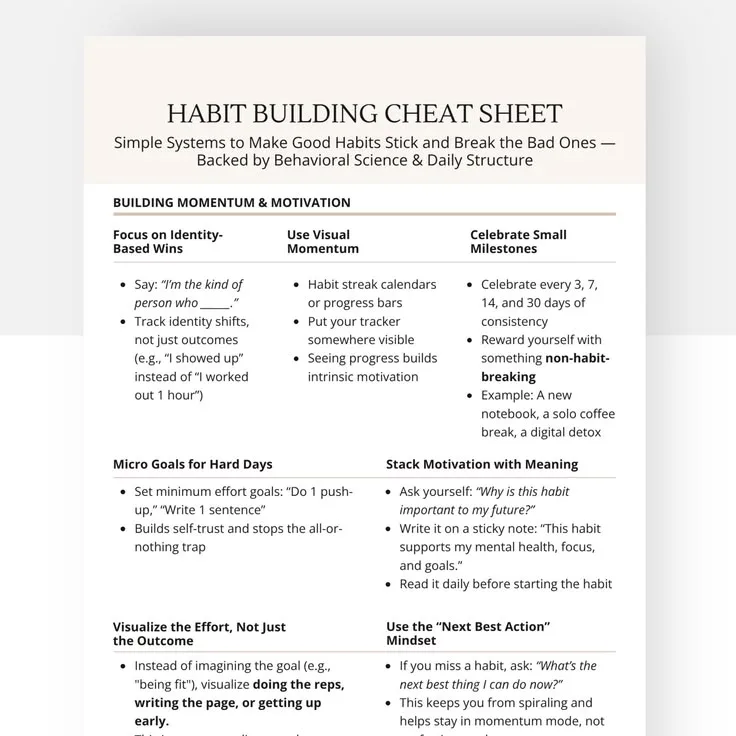
Collapsed to its operational core, the framework comes down to a small number of moves worth memorizing.
- Start tiny. Make the first version of the habit performable in two minutes or less.
- Stack on an existing habit. Use after I [current], I will [new].
- Design the environment. Reduce friction for wanted behaviors, add friction for unwanted ones.
- Use implementation intentions. I will [behavior] at [time] in [location].
- Track lightly. Mark completion; do not obsess.
- Never miss twice. One miss is a variation. Two misses in a row is a pattern.
- Vote for identity. Frame each action as evidence of the person you are becoming.
- Expect months, not weeks. Automaticity averages 66 days. Plan for the plateau.
See also: Habit Stacking: How to Build Routines That Actually Stick | Flow State: How to Enter Deep Focus on Demand
Sources & Further Reading
- Clear, J. (2018). Atomic Habits: An Easy and Proven Way to Build Good Habits and Break Bad Ones. Avery.
- Wood, W. (2019). Good Habits, Bad Habits: The Science of Making Positive Changes That Stick. Farrar, Straus and Giroux.
- Lally, P., van Jaarsveld, C. H. M., Potts, H. W. W., & Wardle, J. (2010). "How Are Habits Formed: Modelling Habit Formation in the Real World." European Journal of Social Psychology, 40(6), 998-1009. DOI: 10.1002/ejsp.674
- Fogg, B. J. (2020). Tiny Habits: The Small Changes That Change Everything. Houghton Mifflin Harcourt.
- Gollwitzer, P. M., & Sheeran, P. (2006). "Implementation Intentions and Goal Achievement: A Meta-Analysis of Effects and Processes." Advances in Experimental Social Psychology, 38, 69-119. DOI: 10.1016/S0065-2601(06)38002-1
- Milkman, K. L., Minson, J. A., & Volpp, K. G. M. (2014). "Holding the Hunger Games Hostage at the Gym: An Evaluation of Temptation Bundling." Management Science, 60(2), 283-299. DOI: 10.1287/mnsc.2013.1784
- Ericsson, K. A., & Pool, R. (2016). Peak: Secrets from the New Science of Expertise. Houghton Mifflin Harcourt.
- Duhigg, C. (2012). The Power of Habit: Why We Do What We Do in Life and Business. Random House.