
Cognitive: You are halfway through writing a difficult email when a Slack notification arrives. You glance at it, feel slightly anxious about what it says, and turn back to the email. The sentence you were writing has evaporated. You spend the next 30 seconds trying to reconstruct where you were.
Before you fully find it, another notification arrives. By the end of the afternoon, you have the vague sense that you worked hard, and also that nothing quite got finished. The specific email you were writing at 2 p.m. remains unsent at 5 p.m. You did, however, check email approximately forty-seven times.
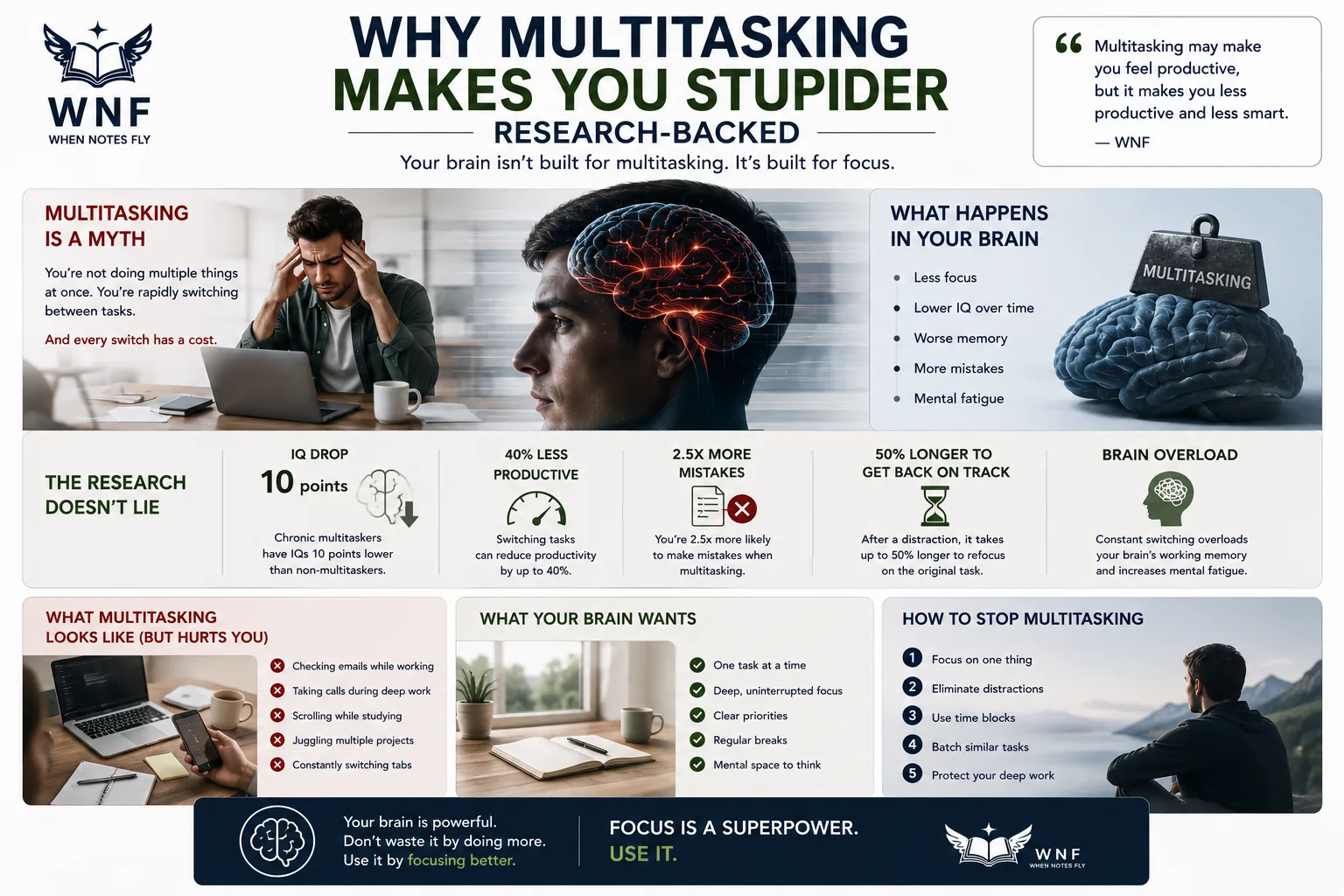
The research on this pattern is substantial and remarkably consistent. Multitasking, as humans actually practice it, produces measurable cognitive costs that exceed what the people doing it realize.
The loss of cognitive capacity is real, the error rates are higher, the completion times are longer, and the subjective feeling of productivity is usually wrong.
The research is old enough and replicated enough that the question is not whether these effects exist. The question is why, given that the effects are known, people continue to multitask as if they were the exception.
"What we call multitasking is actually a misnomer. Humans do not process multiple streams of high-attention information in parallel. They switch between them rapidly, and each switch has a cost.
The cost is real, it is measurable, and it compounds over a day into substantial loss of cognitive capacity." - Cal Newport, Deep Work: Rules for Focused Success in a Distracted World (2016)
The Nass Research and What It Found
Clifford Nass and colleagues at Stanford published a landmark 2009 paper in the Proceedings of the National Academy of Sciences that substantially shaped subsequent research on multitasking. The paper was provocatively titled "Cognitive Control in Media Multitaskers" and its findings surprised even the researchers.
The study compared heavy media multitaskers, who regularly consumed multiple streams of media simultaneously, with light multitaskers who did not. The expectation was that heavy multitaskers would have developed specific skills through practice that would make them better at multitasking tasks.
The results showed the opposite. Heavy multitaskers performed worse than light multitaskers on every measured task, including:[1]
Filtering relevant from irrelevant information. Heavy multitaskers were more distracted by irrelevant stimuli and had more difficulty ignoring information that was not relevant to the current task.
Managing working memory. Heavy multitaskers performed worse on working memory tasks, suggesting their capacity to hold relevant information in mind was reduced.
Switching between tasks. Counterintuitively, heavy multitaskers were slower and more error-prone on task switching itself. The skill they should have practiced most was the one they performed worst on.
Nass himself was quoted saying that the data had fundamentally changed his view of multitasking. His team had expected to find specific cognitive advantages in heavy multitaskers that would justify the behavior. They found instead that heavy multitasking correlated with broadly impaired cognitive function across domains.
The Attention Residue Research
Sophie Leroy's research at the University of Washington documented a specific phenomenon she named attention residue.[2]
Her 2009 paper in Organizational Behavior and Human Decision Processes showed that when people switch from task A to task B, part of their cognitive capacity remains engaged with task A for some time. The capacity available for task B is reduced for minutes after the switch.
The implication is that brief interruptions impose larger costs than the time they occupy. Checking email for two minutes in the middle of deep work does not cost two minutes.
It costs the two minutes plus the time to return to full cognitive engagement with the original task plus the ongoing residue during the remainder of the original work.
Specific findings from attention residue research. Performance on task B was measurably worse after switching from task A than when starting task B fresh.
The residue was particularly strong when task A was not completed before the switch, suggesting unfinished cognitive commitments persist longer than completed ones. The residue effect scaled with task complexity, meaning more demanding tasks produced larger residue effects.
Practical implications. Time-blocking, where substantial periods are dedicated to single tasks without switching, substantially reduces the residue cost. Notifications and interruptions impose cognitive costs that compound over a day. Completing smaller tasks before moving to others reduces residue relative to leaving them partly done.
The Wilson IQ Study
A 2005 study by Glenn Wilson at the University of London, commissioned by HP and subsequently reported extensively in the press, examined the cognitive impact of working in a continuously distracted environment.[6]
The study found that workers who were continuously distracted by email and phone notifications performed worse on cognitive tasks by an amount equivalent to a 10-point reduction in IQ, which was larger than the cognitive effect of smoking marijuana.
The study has been critiqued for methodology and the specific IQ comparison is contested, but the broader finding of substantial cognitive impairment from continuous distraction has been replicated in numerous subsequent studies.
The magnitude of the effect, whether it is exactly 10 IQ points or not, is substantial enough to matter for any work requiring cognitive output.
Subsequent research has clarified the mechanisms. Continuous availability to distractions produces chronic partial attention, where cognitive resources are continuously allocated to monitoring for distractions rather than engaging fully with the primary task.
The monitoring itself is cognitively expensive even when no actual interruption occurs.
| Research Finding | Source | Implication |
|---|---|---|
| Heavy multitaskers perform worse across tasks | Nass et al. (2009) | Practice does not eliminate costs |
| Attention residue persists after task switches | Leroy (2009) | Brief interruptions impose outsized costs |
| Distraction equivalent to ~10 IQ points | Wilson (2005) | Environment matters, not just behavior |
| 30-50% more errors when multitasking | Multiple studies | Output quality degrades substantially |
| Multitasking feels more productive than it is | Self-report vs performance research | Subjective experience is miscalibrated |
| Recovery time between tasks is 15-25 minutes | Mark research at UC Irvine | Full re-engagement takes longer than assumed |
The Gloria Mark Research
Gloria Mark's research at UC Irvine has extensively documented how attention operates in actual workplaces.[4] Her studies, using continuous monitoring of workers' attention, have found several consistent patterns.
Task switching frequency. Workers in observed office environments switch tasks on average every 3 to 11 minutes, depending on the study and population. The majority of switches are self-interrupted rather than externally imposed.
Recovery time. After an interruption, workers take an average of 23 minutes to return to the original task at full cognitive engagement. Not 23 seconds. 23 minutes.
Compensation through faster work. Workers compensate for interruptions by working faster and experiencing more stress and frustration. The time pressure is partly self-imposed through the habits of interruption.
Health and well-being effects. Chronic multitasking correlates with elevated stress hormones, increased error rates, and reduced well-being beyond the direct productivity effects.
The Mark research extended the theoretical findings into observational reality. It showed that the laboratory studies of multitasking costs were not exaggerating the effects; if anything, the real-world costs were larger because the interruption environments were more varied and sustained than laboratory conditions.
What Feels Like Multitasking Often Is Not
The research does distinguish cases where apparent multitasking is actually a combination of attentive work and automated activity. William James, in Principles of Psychology (1890), discussed habituated skills that no longer require conscious attention. Subsequent research has confirmed and extended this distinction.
Automaticity. Well-practiced skills can run largely automatically, freeing conscious attention for other tasks. Walking while having a conversation is not multitasking in the cognitive sense because walking is automated.
Driving and media. The research on driving and media consumption is nuanced. Driving a familiar route in light traffic while listening to a podcast is often fine for experienced drivers. Driving in complex conditions while attempting a phone call is dangerous.
David Strayer's research at Utah has extensively documented the performance costs of distracted driving, including research showing phone conversations while driving produce impairment equivalent to legal alcohol intoxication.[5]
Exercise and entertainment. Moderate exercise combined with audiobook listening or light entertainment is a common case where attention can be divided without meaningful cost. The exercise does not require cognitive capacity and the entertainment does not require physical coordination.
Cooking and conversation. Depending on the cooking complexity, this can be light multitasking without substantial cost, or it can produce lower quality on both fronts if the cooking is demanding.
The distinction that matters is whether both tasks require attentional resources. When both do, the costs are real. When one is automated, the costs are minimal.
The Supertasker Question
A small body of research has identified what researchers have called supertaskers, individuals who appear to show minimal cost when multitasking. David Strayer's research identified approximately 2 percent of the population as fitting this description in specific laboratory tasks.
The research on supertaskers has significant caveats. The ability appears to be specific to certain task combinations rather than general. The effects are smaller than multitasking advocates often suggest. And the 98 percent who do not show this ability cannot develop it through practice.
For practical purposes, the safe assumption is that you are not a supertasker. The base rate of true supertaskers is low enough that assuming you are one, when self-assessment of multitasking ability is consistently unreliable, is usually wrong. Even if you are, the range of tasks where the ability applies is narrow.
"The research on perceived multitasking ability versus actual multitasking ability is consistent. People who believe they are good at multitasking are usually wrong. The feeling of being good at it comes from liking the stimulation, not from better performance.
This is one of the more humbling findings in cognitive research." - Daniel Goleman, Focus: The Hidden Driver of Excellence (2013)[7]
Why the Multitasking Feels Productive
Several specific mechanisms produce the illusion that multitasking is productive even when objective measures show it is not.
Novelty-driven dopamine. Task switching produces small bursts of dopamine through novelty. Each new task feels rewarding at the moment of engagement. The reward is not tied to accomplishment but to novelty.
Feedback frequency. Multitasking produces more frequent completion signals, including sent messages, dismissed notifications, and briefly touched tasks. The feedback loop is faster than deep work, which feels more productive even when less is actually produced.
Activity versus productivity conflation. Being busy feels like being productive. The subjective sense of activity is high during multitasking. The objective output per unit of time is usually lower than during single-tasking, but the subjective experience often obscures this.
Avoidance of harder work. Multitasking often serves as avoidance of the most demanding task on the list. Easier tasks, including email and small requests, feel accessible while the harder task is avoided. The multitasking is partly procrastination in a form that feels virtuous.
Social signaling. Visible multitasking, especially in open offices, signals importance and business. The signal is valued independently of whether the actual work is better.
Misread metacognition. The cognitive systems that would normally tell you that you are performing poorly are themselves impaired during multitasking.[8] You feel confident you are handling things well because the parts of your brain that would notice otherwise are operating at reduced capacity.
The Single-Tasking Alternative
The research-supported alternative to multitasking is single-tasking with time-blocking. The approach has been developed extensively by researchers and practitioners including Cal Newport, Tim Ferriss, and others.[3]
Time-blocking structure. Specific blocks of time dedicated to specific tasks. Blocks for deep work, blocks for email and communication, blocks for meetings, blocks for shallow tasks. The blocks are committed to the calendar rather than loose intentions.
Notification hygiene. Notifications off during deep work blocks. Email checked in scheduled windows rather than continuously. Slack and similar messaging tools paused during focus time. The environmental design reduces the constant monitoring load.
Task batching. Similar small tasks batched into specific periods. All email at 11 a.m. and 3 p.m. rather than continuously. All administrative work Thursday afternoon. The batching reduces task switching frequency.
Deep work blocks. Ninety to 120 minute blocks dedicated to the most cognitively demanding work. Research on peak performance consistently identifies this range as the natural cognitive cycle. Shorter blocks produce less depth. Longer blocks produce fatigue.
Recovery between blocks. Deep work is cognitively expensive. Short breaks between blocks support sustained performance throughout the day. Scheduled breaks outperform impromptu breaks because they prevent fatigue rather than responding to it.
Priority ordering. Most demanding work early in the day, when cognitive capacity is highest for most chronotypes. Lower-demand work scheduled for cognitive valleys. This maximizes the quality-to-cost ratio of the available cognitive capacity.
The Practical Implementation
Transitioning from multitasking to single-tasking is not instantaneous. The habits of multitasking are often years deep and are reinforced by the environment. Specific practices support the transition.
Environmental modification. Close email clients, close Slack, close browser tabs not needed for the current work. Visible distraction accessibility produces more switching than invisible accessibility.
Single-task commitment. At the start of a work block, write down the single task for the block. Commit to completing or advancing that task during the block without switching.
Notification delays. Set notification delivery to batch every 30 or 60 minutes rather than continuous. Urgent channels, like phone calls, remain available. Most communication does not actually require continuous attention.
Closed loops. When a task is interrupted, note where you were before switching. This reduces the cognitive cost of returning by providing external memory that does not rely on the residue of attention.
Explicit breaks. Schedule breaks between blocks. Walk, stretch, look away from the screen. The breaks are not multitasking; they are recovery that sustains subsequent single-tasking.
Resistance to the urge. The urge to check email, messages, or social media arises regularly during deep work. Acknowledging the urge without acting on it builds the capacity to sustain focus. Each successful resistance strengthens the capacity.
The cognitive assessment tools atThe Team and Organizational Dimension
Individual focus practices operate within team and organizational contexts that can either support or undermine them. Team norms about response times, meeting structures, and communication expectations shape how much individual focus is actually possible.
Response time expectations. Teams with norms of near-instant response produce continuous attention costs for members. Explicit conversations about acceptable response times, often in hours rather than minutes, create space for focus.
Meeting design. Meeting-heavy schedules fragment the day into periods too short for deep work. Teams that consolidate meetings into specific days or time blocks produce more deep work capacity for all members.
Asynchronous communication norms. Teams that default to written, asynchronous communication produce less continuous attention demand than teams that default to real-time chat. The research on asynchronous communication, including work by Darja Smite and others, consistently shows productivity benefits.
Protected focus time. Explicit team norms that certain times or days are for deep work, with reduced meeting and message expectations, create space for demanding work. Microsoft's research on their own teams documented measurable benefits of Focus Time features.
For readers building independent practices where they have more control over these dynamics, the business formation and operational coverage atThe Specific Cases Worth Addressing
A few specific multitasking patterns are common enough and damaging enough to warrant separate attention.
Meeting multitasking. Laptop open during video meetings, responding to email while nominally listening. The meeting content is missed, the email responses are poorer quality, and the social signal to the meeting participants is negative even when they cannot see the screen.
Closing the laptop during meetings produces better meeting outcomes and more recovered focus afterward.
Email during deep work. The single most common multitasking pattern. Deep work on a difficult problem, interrupted every 5 to 15 minutes by email checks. The deep work progresses slowly because each check imposes residue costs. Closing email during deep work blocks, and checking at scheduled times only, produces measurable improvement.
Social media during breaks. Breaks that involve social media often do not produce actual cognitive recovery because the media requires attention and produces emotional activation. Breaks that involve physical movement, brief conversation, or just looking away from screens produce more recovery.
Reading while tired. Reading as secondary activity while half-attending to something else produces worse retention and comprehension than either reading alone or not reading. The time spent feels productive but produces little actual learning. Reserving reading for periods of genuine attention produces better outcomes.
The Long-Term Perspective
Over a career, the accumulation of multitasking effects is substantial. Workers who sustain single-tasking practices through their careers produce more, have less stress, and maintain cognitive function longer than those who maintain heavy multitasking patterns.
The research on cognitive aging, including work by Denise Park and others, suggests that sustained cognitive engagement in demanding single-tasking contexts supports long-term cognitive health in ways that fragmented attention does not.
For the individual reader, the compounding effect means that the choice to reduce multitasking is not just about today's productivity. It shapes cognitive capacity over decades. The investment in single-tasking practices pays off through both better immediate output and sustained cognitive capacity over time.
"The most important cognitive skill in knowledge work is the ability to focus on one thing, deeply, for extended periods. This skill is rare, increasingly so, and disproportionately valuable. People who develop it outperform people who do not by substantial margins over careers." - Cal Newport, Deep Work (2016)
The Starting Point
For the reader finishing this and wanting to begin reducing multitasking, one specific change produces most of the benefit for most people. Pick one two-hour block in your day. During that block, single-task on your most demanding work.
Notifications off, email closed, phone in another room, browser tabs closed except for what is needed. Hold this for four weeks.
The block does not need to be at a specific time. It does not need to be the entire day. It just needs to be consistent, protected, and truly single-tasking. Four weeks is enough to observe the difference in both output and subjective experience.
Most people find after four weeks that the block produces more output than the surrounding multitasking hours combined, which motivates further expansion of single-tasking practice.
See also: Why Your Morning Routine Fails (And What Actually Works) | Atomic Habits vs Deep Work: Which Framework to Start
Sources & Further Reading
- Ophir, E., Nass, C., & Wagner, A. D. (2009). "Cognitive Control in Media Multitaskers." Proceedings of the National Academy of Sciences, 106(37), 15583-15587. DOI: 10.1073/pnas.0903620106
- Leroy, S. (2009). "Why Is It So Hard to Do My Work? The Challenge of Attention Residue When Switching Between Work Tasks." Organizational Behavior and Human Decision Processes, 109(2), 168-181. DOI: 10.1016/j.obhdp.2009.04.002
- Newport, C. (2016). Deep Work: Rules for Focused Success in a Distracted World. Grand Central Publishing.
- Mark, G., Gudith, D., & Klocke, U. (2008). "The Cost of Interrupted Work: More Speed and Stress." CHI 2008 Proceedings. DOI: 10.1145/1357054.1357072
- Strayer, D. L., & Drews, F. A. (2007). "Cell-Phone Induced Driver Distraction." Current Directions in Psychological Science, 16(3), 128-131. DOI: 10.1111/j.1467-8721.2007.00489.x
- Wilson, G. (2005). "Infomania Study for HP." Reported in BBC News and subsequent coverage.
- Goleman, D. (2013). Focus: The Hidden Driver of Excellence. HarperCollins.
- Harvard Business Review. (2017). "What Multitasking Does to Your Brain."