
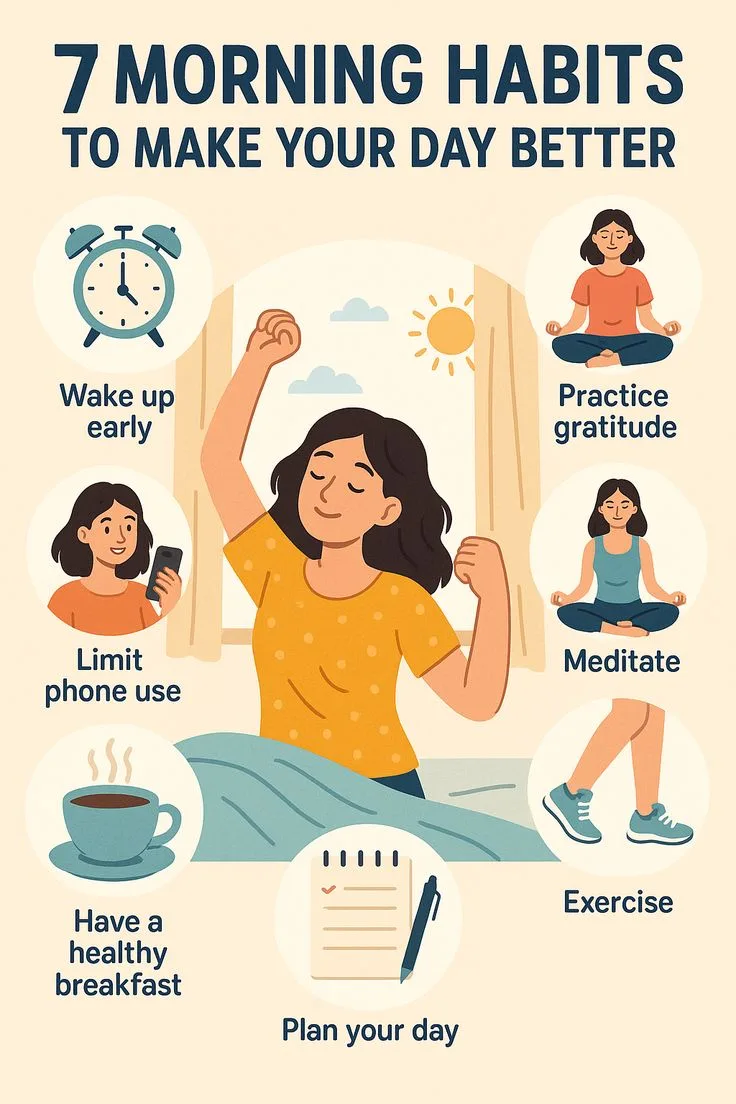
Morning routines that fail are often designed against chronotype, overloaded with new behaviors, dependent on variable motivation, or built on insufficient sleep. A durable routine fits actual constraints, uses environmental cues and low friction, begins with a small number of behaviors, and tolerates partial adherence. The goal is not an idealized early schedule but a design compatible with biology, commitments, and ordinary disruptions.
The pattern is familiar. You watch a YouTube video about someone's six-step morning ritual, save it in your notes, and on Sunday night you design the version you are going to implement.
Monday morning you wake up at 5:30, hydrate, meditate for ten minutes, exercise for thirty, journal for fifteen, cold shower, then fuel up with a carefully planned breakfast before tackling deep work by 8 a.m. Tuesday morning is still pretty good. By Friday the alarm is getting snoozed twice.
By the following Wednesday the routine is officially abandoned, and the feeling of failure is as familiar as the initial optimism.
The research on why routines collapse is substantial and identifies specific patterns. The collapses are not primarily failures of willpower or character. They are design failures.
The routines people attempt to install are often engineered against their biology, overpack fragile time windows, and depend on the single resource, motivation, that is least reliable.
Understanding what actually makes routines stick requires looking at the specific mechanics of habit formation, sleep physiology, and the realistic constraints of modern life.
The person who has a morning routine that works is almost never the person with the most willpower. They are the person whose routine is best designed for their biology, environment, and existing commitments.
Willpower is what you fall back on when design has failed - a principle at the heart of behavior-design approaches like James Clear's Atomic Habits.[1]
Why Most Morning Routines Fail
The research on habit formation and routine maintenance identifies several specific reasons morning routines collapse, almost regardless of the specific content.
Designed against chronotype. Chronotype is your biological disposition toward morning or evening orientation, largely determined by genetics. The research by Till Roenneberg at Ludwig Maximilian University Munich and others has documented substantial variation in chronotype across populations.[4]
Forcing a morning-oriented routine on someone whose natural rhythm is evening-oriented produces chronic sleep debt, cognitive impairment, and eventual collapse. Roughly 20 to 30 percent of adults have late chronotypes that make 5 or 6 a.m. wake times biologically expensive.
Too many new behaviors at once. Habit research consistently shows that installing multiple new behaviors simultaneously produces lower adherence than installing one or two. Each new behavior requires conscious attention until it automates.[3]
When the morning routine requires fifteen minutes of novel behavior, the cumulative cognitive load is large and the routine becomes fragile to any disruption.
Dependence on motivation. Behaviors that require motivation to initiate fail on days when motivation is lower. Everyone has days of reduced motivation.
Routines that depend on motivation have built-in collapse points that arrive regularly. Routines that depend on environmental cues and reduced friction survive motivation fluctuations.[7]
All-or-nothing mentality. The belief that the full routine must be completed or else the day is lost creates a fragility where any disruption produces complete abandonment. If one step is missed, the whole sequence is abandoned.
Research on habit resilience, including work by Wendy Wood at USC, shows that partial adherence sustains habits better than strict adherence with periodic total collapses.[5]
Ignoring existing life constraints. Morning routines designed without accounting for young children, late work shifts, caregiving responsibilities, or other existing constraints often require fictional hours and produce guilt when reality intrudes.
A routine that fits actual life conditions is sustainable. A routine that requires ideal conditions that rarely occur is not.
Insufficient underlying sleep. Many morning routines are constructed on top of chronic sleep deprivation. The routine itself, particularly early wake times, extracts more sleep.
Over weeks, the accumulated sleep debt degrades everything including the cognitive function needed to maintain the routine. The routine collapses not because of willpower failure but because the underlying sleep foundation has eroded.
| Failure Mode | Cause | Signal | Fix |
|---|---|---|---|
| Chronotype misalignment | Biological mismatch | Persistent fatigue, weekend overshooting | Align wake time to chronotype |
| Too many new behaviors | Cognitive overload | Routine collapses after 2-3 weeks | Start with minimum viable routine |
| Motivation-dependent | No environmental design | Fails on low-energy days | Reduce friction, automate cues |
| All-or-nothing | Binary framing | Full abandonment after single miss | Accept partial adherence |
| Life constraint blind | Designed for fictional life | Guilt when reality intrudes | Design for actual constraints |
| Sleep-debt bottom | Insufficient sleep foundation | Accumulating fatigue | Fix sleep before morning behaviors |
The Chronotype Problem
The 5 a.m. club and related productivity movements have created a cultural expectation that successful people wake early. The research on chronotypes shows this expectation is largely misaligned with biological reality for many people.
Chronotype is influenced by several factors, including genetics (approximately 50 percent of variation), age (most people shift toward earlier rising as they age), and geographic latitude. The result is a distribution of natural sleep-wake preferences that is not uniform across the population.
Roughly 25 percent of adults have early chronotypes, 50 percent have intermediate chronotypes, and 25 percent have late chronotypes.
For early chronotypes, a 5 a.m. wake time may be natural and sustainable. For late chronotypes, it may be biologically equivalent to forcing someone with an early chronotype to wake at 1 a.m. The cognitive, emotional, and health consequences of sustained mismatch are substantial.
Signals that you may have a late chronotype. Naturally staying up past midnight without fatigue. Feeling most alert and creative in the evening. Experiencing morning fatigue that takes hours to clear regardless of sleep duration. Performing worse on cognitive tasks in the morning than in the afternoon.
Preferring weekend wake times 90 minutes or more later than weekday wake times (weekend behavior often reveals natural rhythm).
Signals that you may have an early chronotype. Waking spontaneously before alarms. Feeling tired in early evening. Performing best on cognitive tasks in morning hours. Having little preference for sleeping later on weekends. Feeling refreshed after relatively few hours of sleep if wake is early.
The implication is that morning routines should be designed for your actual chronotype rather than for an idealized early schedule.[8]
For late chronotypes, a routine that starts at 7 or 8 a.m. with substantive cognitive work in the late morning or early afternoon is often more sustainable and more productive than a forced 5 a.m. routine.
What Actually Works: The Minimum Viable Routine
The research-supported minimum morning routine has three components. Starting with these alone, stabilizing them over weeks, and adding other components once the foundation is stable, produces substantially higher long-term adherence than attempting a full routine from the start.
Consistent wake time. Waking within 30 minutes of the same time every day, including weekends, anchors the circadian system. Sleep research consistently shows that consistency of wake time matters more than consistency of bedtime for circadian stability.
The 30-minute window allows for reasonable flexibility without disrupting the pattern.
Immediate hydration. A glass of water upon waking rehydrates after overnight fluid loss and cues the digestive and metabolic systems to activate.
The behavior requires minimal effort and has modest direct benefits. More importantly, it establishes an initial action that begins the routine without requiring significant willpower.
Light exposure within the first hour. Light, particularly natural sunlight, is the strongest circadian cue available. Ten to twenty minutes of light exposure in the first hour after waking helps set the circadian rhythm and supports cognitive alertness for the rest of the day.
Outside if possible, but window light or bright indoor lighting also helps.
These three components require minimal willpower, have research support, and address the fundamental circadian and hydration needs of starting the day. Once these are stable over 4 to 6 weeks, additional components can be added.
Adding Components Without Collapsing
Once the minimum routine is stable, specific components can be added based on individual goals and chronotype. The research on habit stacking, developed extensively by BJ Fogg at Stanford and James Clear, provides the methodology.[6]
Habit stacking. Adding new behaviors by anchoring them to existing ones. "After I finish my morning water, I will put on my running shoes." "After I stretch for two minutes, I will meditate for five." The anchor reduces the cognitive cost of deciding when to perform the new behavior.
Start absurdly small. New behaviors should be small enough that there is almost no resistance to starting. Two minutes of exercise, not forty-five. One page of reading, not a chapter. Small behaviors build consistency, which builds the capacity for larger behaviors over time.
The common mistake is adding full-sized behaviors that create resistance and produce collapse.
One new behavior at a time. Add a single component, stabilize it over 4 to 6 weeks, and only then add the next. Attempting to add multiple components simultaneously recreates the overload problem that causes initial failures.
Environmental preparation the night before. Setting out the workout clothes, placing the meditation cushion visibly, preparing the coffee maker to start automatically. The environmental preparation reduces the morning friction that otherwise produces collapse on low-motivation days.
Fail gracefully. Missing a day is normal and not a reason to abandon the routine. Two missed days in a row are a signal to diagnose the cause. Three missed days are a signal that the routine may be overreaching. Treating occasional misses as information rather than failure sustains the overall routine.
One useful principle from habit-formation writing is the "never miss twice" rule: missing a single day rarely derails a habit, but missing two days in a row is where routines tend to unravel. Treating an occasional miss as recoverable rather than as failure keeps the overall routine intact.
The Exercise Question
Exercise in the morning is often recommended as a universal best practice. The research supports morning exercise for some people and contexts and not others.
Benefits of morning exercise. Better mood regulation throughout the day. Better sleep the following night, assuming the exercise is not too close to bed.
Higher adherence over time, because the rest of the day cannot crowd out the commitment. Some cognitive benefits from the post-exercise state during morning work hours.
Drawbacks of morning exercise. Consumes the morning window, which is cognitively peak for some people. Requires significant willpower in the early morning for people whose chronotype is not morning-oriented. Can produce fatigue during the morning work block if intensity is high.
Individual variation matters. People whose cognitive peak is early morning should consider whether exercise is best placed elsewhere in the day. People whose cognitive peak is later should consider whether morning exercise might leverage an otherwise unproductive window.
The intensity question. Moderate-intensity exercise, including walking, cycling, or easy strength work, produces many of the benefits without the fatigue cost of high-intensity exercise. Starting with moderate intensity and escalating only if the routine is stable produces better long-term adherence.
For readers building habits around exercise as part of broader well-being, the specific design considerations interact with other productivity and habit-formation patterns.
The Meditation Question
Meditation has substantial research support for stress reduction, attention improvement, and emotional regulation. The question is not whether to meditate but when, and whether the morning specifically is the right time.
Morning meditation benefits. Sets a deliberate tone for the day. Produces a baseline calm that carries into subsequent activities. Uses a time before the day's complications interrupt the practice.
Morning meditation risks. Adds cognitive and time load to an already fragile morning routine. Competes with other high-value morning activities. Can feel like an obligation rather than a refuge, which undermines the benefits.
Evening meditation as an alternative. Produces many of the same benefits with different timing. Supports sleep quality and emotional regulation at a different point in the day. Often has higher adherence because evening has more flexibility than morning.
The evidence does not strongly favor morning over evening meditation for most outcomes. The key variable is consistency, and consistency is easier to achieve when the practice fits the schedule that actually works rather than the schedule that seems impressive.
The Role of Sleep
The single largest variable in morning routine success is sleep quality and quantity the night before. A routine built on top of insufficient or poor-quality sleep will eventually collapse regardless of design.
The research by Matthew Walker at Berkeley and others consistently establishes that most adults need seven to nine hours of sleep for optimal cognitive and emotional function.[2] Sleeping less than seven hours chronically produces measurable impairments in cognitive function, mood regulation, and behavioral adherence.
Sleep hygiene practices that support morning routines. Consistent bedtime within 60 minutes each night. No screens for the final hour before bed or use of blue-light blockers. Bedroom cool, dark, and quiet. No caffeine within 8 hours of bedtime for sensitive individuals. Limited alcohol, which disrupts sleep architecture.
The sleep debt problem. Small nightly deficits compound. Sleeping an hour short each night for a week produces seven hours of cumulative deficit, which affects everything including cognitive function needed to maintain the morning routine. Sustainable routines require sustainable sleep first.
Prioritizing sleep over early rising. For most people, getting one extra hour of sleep is more productivity-enhancing than waking an hour earlier to have a longer morning routine. The tradeoff is usually in favor of sleep.
Sleep-protective study design consistently outperforms sleep-sacrificing approaches in long-term retention.The Realistic Design
A realistic morning routine that accounts for chronotype, existing constraints, and habit formation mechanics looks different from the aspirational versions that populate productivity content.
Step 1: Determine chronotype. Observe your natural sleep-wake patterns over two to four weeks, particularly on weekends and vacations when external constraints are minimal. This reveals your biological preference.
Step 2: Set a sustainable wake time. Aligned with your chronotype rather than with an aspirational schedule. Consistent within 30 minutes across all days.
Step 3: Establish the minimum viable routine. Consistent wake time, hydration, light exposure. Hold this alone for 4 to 6 weeks.
Step 4: Add one component. Based on your priorities. Exercise, meditation, journaling, reading, planning, or other. Add only one and stabilize it before considering additions.
Step 5: Accept imperfection. Miss days without catastrophizing. Adjust components that are not working. Treat the routine as a practice rather than a contract.
Step 6: Revisit regularly. Chronotype shifts with age. Life circumstances change. The routine that worked at 25 may not work at 45. Periodic recalibration sustains long-term adherence.
This approach produces a morning routine that may look unimpressive compared to the social media versions. It also survives for years rather than collapsing after weeks.
The Work Component
For many readers, the purpose of the morning routine is to support productive work. The routine interacts with the work in specific ways that deserve explicit design.
Deep work timing. The cognitive peak hours for most adults are the first few hours after the circadian rise, which for most chronotypes is late morning. Protecting this window for demanding cognitive work, with the morning routine preparing for it rather than consuming it, produces the best work output.
Email and shallow work timing. Responding to email and handling shallow tasks in the low-cognition windows of the day preserves cognitive peak for deep work. Many people invert this by doing email first thing in the morning, which consumes cognitive capacity for tasks that could be done with much less.
Transitions between routine and work. Explicit transitions between morning routine and work beginning reduce the blurring that often produces distracted starts.
A specific ritual of putting away morning materials, settling into the work space, and beginning the first deep task within a defined time window builds the muscle for focused starts.
Protected time for priority work. Regardless of when the cognitive peak occurs, blocking that time for work that matters most, and protecting it from meetings and interruptions, produces disproportionate returns. The morning routine that fails to preserve this time fails to serve the work purpose.
The communication patterns that enable independent practitioners to protect focus time are discussed further at →The Family and Caregiver Case
Morning routines become substantially more complex for readers with children, caregiving responsibilities, or other significant morning constraints. The design principles still apply but the implementation shifts.
Realistic assessment of controllable time. How much time genuinely belongs to you in the morning? For parents of young children, this may be 20 to 40 minutes before or after the children's needs. Designing a routine for that actual window rather than an aspirational longer one.
Layered with caregiving activities. The morning routine can include elements that work alongside caregiving. Light exposure while making breakfast. Walking while a child is in a stroller. Simple movement or stretching that can be interrupted and resumed.
Shorter and more consistent. Fifteen minutes of routine that happens every day outperforms an hour of routine that happens three days a week. For parents and caregivers, the shorter consistent routine is often more achievable and more beneficial.
Partnership negotiation. For two-parent households, explicit negotiation about who covers morning caregiving on which days often produces more routine time than assuming equal distribution without conversation.
The Long View
Morning routines are tools, not identities. The routine that serves you at one stage of life may not serve you at another. The routine that works during a steady work period may need modification during a crisis period. Flexibility in the design is a strength rather than a weakness.
The research on long-term behavior change consistently shows that the people who maintain productive routines over decades are the ones who treat the routines as adaptive systems rather than rigid contracts. They adjust when circumstances change.
They protect the core while modifying the peripherals. They do not abandon the whole project when one component stops working.
For the reader who finishes this with the specific goal of rebuilding a morning routine that has collapsed, the starting move is small. Determine your actual chronotype over the next two weeks. Set a consistent wake time within 30 minutes every day.
Hydrate and get light exposure. That is enough for the first month. Anything else can wait until the foundation is stable.
See also: Morning Routines of Highly Productive People | Atomic Habits Cheat Sheet
Sources & Further Reading
- Clear, J. (2018). Atomic Habits: An Easy & Proven Way to Build Good Habits & Break Bad Ones. Avery.
- Walker, M. (2017). Why We Sleep: Unlocking the Power of Sleep and Dreams. Scribner.
- Lally, P., van Jaarsveld, C. H. M., Potts, H. W. W., & Wardle, J. (2010). "How Are Habits Formed: Modelling Habit Formation in the Real World." European Journal of Social Psychology, 40(6), 998-1009. DOI: 10.1002/ejsp.674
- Roenneberg, T., Wirz-Justice, A., & Merrow, M. (2003). "Life Between Clocks: Daily Temporal Patterns of Human Chronotypes." Journal of Biological Rhythms, 18(1), 80-90. DOI: 10.1177/0748730402239679
- Wood, W., & Neal, D. T. (2016). "Healthy through Habit: Interventions for Initiating & Maintaining Health Behavior Change." Behavioral Science & Policy, 2(1), 71-83. DOI: 10.1353/bsp.2016.0008
- Fogg, B. J. (2019). Tiny Habits: The Small Changes That Change Everything. Houghton Mifflin Harcourt.
- Duhigg, C. (2012). The Power of Habit: Why We Do What We Do in Life and Business. Random House.
- Harvard Business Review. (2020). "What to Do When You're Not a Morning Person."