
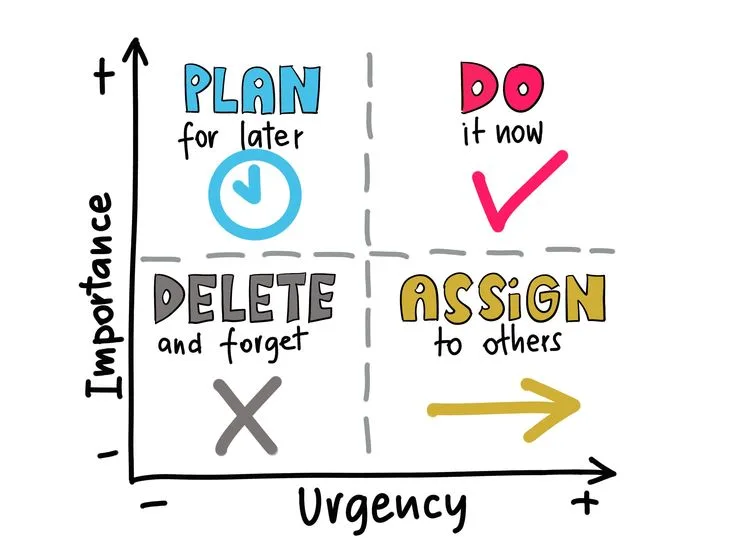
The sentence that generated an entire productivity framework was spoken in a 1954 speech at Northwestern University. Dwight D. Eisenhower, then in his first term as president, quoted a former college president whose identity has been lost to history, saying: "I have two kinds of problems, the urgent and the important. The urgent are not important, and the important are never urgent." The quote is commonly attributed to Eisenhower himself, which is inaccurate; he was quoting someone else and saying so at the time. The distinction, however, became associated with him because of how thoroughly he used it in his own leadership.
Eisenhower's presidency was, from a time-management perspective, an extraordinary exercise in the distinction. He inherited an administration in which most of the work was crisis response. The Cold War required continuous attention to urgent matters. Yet Eisenhower consistently protected time for strategic thinking, for relationships with allies, for the long-horizon planning that turned out to define his presidency historically. The interstate highway system, the creation of NASA, the careful management of the McCarthy era, and the decision to intervene militarily or not in various global crises all reflected an executive who refused to be consumed by what was most urgent on any given day.
The formal four-quadrant matrix now associated with his name came later, primarily through Stephen Covey's 1989 book The 7 Habits of Highly Effective People. Covey took the urgent-important distinction, formed it into a 2x2 grid, and made the case that highly effective people systematically spend disproportionate time in what he called Quadrant 2: important but not urgent activities. The framework resonated because it diagnosed a pattern everyone recognized: the tendency to spend most of the day putting out fires while the work that actually matters waits indefinitely for a free moment that never arrives.
"Most of us spend too much time on what is urgent and not enough time on what is important. The key is not to prioritize what's on your schedule, but to schedule your priorities. The successful person has the habit of doing the things failures don't like to do. They don't like doing them either necessarily, but their disliking is subordinated to the strength of their purpose." -- Stephen Covey, The 7 Habits of Highly Effective People (1989)
Key Definitions
Urgent: Tasks that demand immediate attention based on their deadline or deadline-like pressure. Urgency is a property of timing, not of intrinsic value. Many urgent tasks are not important. Many important tasks do not appear urgent.
Important: Tasks that advance your long-term goals, responsibilities, and values. Importance is a property of outcomes, not of timing. Important tasks contribute to durable outcomes regardless of when they are performed.
The matrix: A 2x2 grid with urgency on one axis and importance on the other, producing four quadrants. Quadrant 1: urgent and important. Quadrant 2: not urgent but important. Quadrant 3: urgent but not important. Quadrant 4: neither urgent nor important.
Mere urgency effect: Meng Zhu and colleagues' 2018 term for the tendency to select tasks with shorter deadlines over objectively more valuable tasks with longer deadlines, independent of actual consequences.
Opportunity cost: The value of the next-best alternative use of time foregone when a task is selected. The hidden cost of every urgent task is whatever important work was not done during that time.
Reactive work: Tasks performed in response to external prompts, typically urgent ones, without deliberate selection. Most knowledge workers operate in reactive mode most of the day.
The Four Quadrants in Depth
Quadrant 1: Urgent and Important. Crises, tight deadlines, acute problems. A production outage. A client emergency. A legal deadline. A health problem that cannot wait. These tasks demand attention and they deserve it. The pathological pattern is living entirely in Quadrant 1, which produces burnout and prevents the strategic work that would reduce future Quadrant 1 volume. Some Quadrant 1 time is unavoidable in any serious role. Constant Quadrant 1 time is a sign of a failing system.
Quadrant 2: Not Urgent and Important. Strategic planning, relationship building, skill development, preventive maintenance, exercise, reading, thinking. The activities that produce the most durable value typically live here. They are not pressing today, which means they routinely lose to urgent competitors in unstructured schedules. Covey's central claim is that effective people deliberately protect Quadrant 2 time against the constant pressure to shift attention to urgent matters, and this protection is the key discipline of executive effectiveness. The matrix fails in practice for people who cannot or will not protect Quadrant 2.
Quadrant 3: Urgent but Not Important. Many meetings. Most instant messages. Most emails. Phone calls about things that feel pressing but do not advance your important goals. These are the deceptive tasks. They feel important because they are urgent, and urgency has been conflated with importance in most work cultures. Clear examination often reveals that the urgency is real but the outcomes are marginal. Covey's recommendation is delegation when possible, elimination when not.
Quadrant 4: Not Urgent and Not Important. Time-wasters, trivia, excessive social media, busywork disguised as productivity. These activities produce neither near-term nor long-term value. They fill time without meaningful output. Some Quadrant 4 time is restorative and legitimate, particularly for mental recovery. Quadrant 4 becomes pathological when it expands to consume substantial blocks of discretionary time that could have gone to Quadrant 2.
| Quadrant | Typical Activities | Strategic Response |
|---|---|---|
| Q1: Urgent + Important | Crises, emergencies, tight deadlines | Do, but reduce volume through Q2 investment |
| Q2: Not Urgent + Important | Planning, development, relationships | Schedule proactively, protect fiercely |
| Q3: Urgent + Not Important | Interruptions, some meetings, reactive email | Delegate, batch, decline, or automate |
| Q4: Not Urgent + Not Important | Time-wasters, low-value busywork | Eliminate or restrict to deliberate recovery |
The Research on Priority Distortion
Meng Zhu and colleagues at Johns Hopkins University published a 2018 paper that provided experimental evidence for a pattern Covey had described intuitively thirty years earlier. Across a series of experiments, Zhu showed that participants reliably chose tasks with shorter deadlines over objectively more valuable tasks with longer deadlines, even when the value difference was explicit and the deadline extension was modest. They called the phenomenon the mere urgency effect.
The studies used carefully controlled scenarios in which participants could choose between two tasks, one with a shorter deadline and lower payoff, one with a longer deadline and higher payoff. The mere urgency effect predicted that participants would choose the shorter-deadline task even when the rational choice was the longer-deadline higher-payoff task. The prediction held across multiple experiments, with effect sizes that surprised the researchers.
The mechanism appears to involve cognitive ease. Urgent tasks have clearer completion criteria, provide immediate feedback upon completion, and reduce the cognitive load of carrying an unfinished obligation. Important-but-not-urgent tasks, by contrast, require deliberate selection against constant urgency competitors, have less clear completion criteria, and provide delayed feedback. The choice architecture favors urgency by default.
The implication for priority frameworks is important. The matrix is not a tool for people who already prioritize correctly. It is a tool for overcoming a measurable cognitive bias that pushes attention toward urgent tasks regardless of value. The framework's persistent popularity reflects that it diagnoses the real problem most professionals face.
Why Quadrant 2 Is the Hardest
Every productivity expert since Covey has converged on the observation that Quadrant 2 is simultaneously the most valuable quadrant and the most difficult to protect. The reasons are structural, not motivational.
Quadrant 2 activities have no built-in prompts. No one will call to remind you to do your annual health planning. No calendar notification will tell you to spend an hour thinking about your career trajectory. The preventive maintenance on your relationships, health, skills, and strategic position will not announce itself. If you do not schedule it deliberately, it does not happen.
Quadrant 2 activities produce delayed feedback. The value of a thirty-minute strategic planning session is not visible today. The value of a difficult conversation with a colleague that prevents a larger conflict six months from now is not visible today. The value of reading a technical book that shifts your career direction in two years is not visible today. The human reinforcement system, which responds strongly to immediate feedback and weakly to delayed feedback, does not reward Quadrant 2 work in the way that urgent work rewards itself through completion.
Quadrant 2 activities compete with everything. Every urgent email, every meeting request, every phone call, every colleague's problem is a competitor for Quadrant 2 time. Unless Quadrant 2 blocks are treated as non-negotiable in the same way that important meetings are, they get eaten by the urgency stream.
The practical protection moves include blocking Quadrant 2 time on the calendar before the week fills, treating the blocks as non-negotiable in the same way you would treat a client meeting, and building the identity of being someone who does Quadrant 2 work. The identity shift matters because it reframes the protection from a tactical choice to a personal commitment that feels worth defending.
For knowledge workers whose Quadrant 2 work includes substantial deep-concentration tasks, the integration with the deep work framework matters. Most Quadrant 2 work is also deep work. Protecting Quadrant 2 time and protecting deep work time are overlapping disciplines. For extended guidance on structuring cognitively demanding work and the research behind concentration capacity, the practice protocols at pass4-sure.us and the structured learning approaches documented there help translate Quadrant 2 investment into measurable skill outcomes.
The Weekly Protocol
The practical use of the matrix is typically weekly rather than daily. Daily task-sorting has diminishing returns because most daily tasks are already committed by Tuesday morning. Weekly review allows deliberate insertion of Quadrant 2 time before the reactive work consumes the available hours.
A weekly review session takes 30 to 45 minutes. The structure has four stages.
Review the previous week. What actually happened. Which quadrant got most of the time. Which Quadrant 2 items were intended and not completed, and why. Which Quadrant 3 items absorbed disproportionate time that could have been delegated, batched, or declined.
Identify this week's Quadrant 2 priorities. Three to five items that must happen this week for important progress. These items get scheduled first, before the rest of the calendar. If they do not fit, something else gives.
Schedule the Quadrant 2 blocks. Specific times on specific days. Typically 90 minutes to 2 hours each. Calendar them as real commitments.
Plan the rest of the week around the Quadrant 2 blocks. Urgent work goes in the remaining time. If urgent work does not fit, the week has too much urgent work, which is a separate problem to address systematically.
The habit takes four to eight weeks to solidify. Early attempts typically fail because the weekly review itself is a Quadrant 2 activity that loses to urgent competitors. The rescue move is to schedule the weekly review at a consistent time that cannot be bumped, such as Sunday evening or Friday afternoon, and protect it as non-negotiable. Once the review itself is automatic, the rest of the practice stabilizes.
The Delegation Problem
Covey's recommendation for Quadrant 3 is delegation. The challenge is that most knowledge workers either do not have people to delegate to or have not developed the delegation skill sufficiently to make delegation cheaper than doing the task themselves.
For individual contributors, Quadrant 3 management is usually not about delegation at all. It is about four moves: eliminate, automate, batch, and decline.
Eliminate. Many Quadrant 3 tasks exist because no one has questioned whether they need to exist. The recurring meeting that produces no decision. The report that no one reads. The status update that is always identical. Eliminating tasks requires permission from whoever requested them; often the permission is available but never asked for.
Automate. Tasks that are genuinely necessary but not cognitively demanding are candidates for automation, including scripts, scheduling tools, and now AI assistants. The investment to automate a task pays back when the task is performed frequently, and the return compounds over time.
Batch. Similar Quadrant 3 tasks combined into single sessions impose less attention-residue cost than the same tasks spread through the day. Email, for example, is reliably better handled in two or three batches per day than continuously.
Decline. Many Quadrant 3 requests can be declined or deferred without meaningful consequence. The widely cited advice to say no more often is often accurate; the social cost of saying no is typically smaller than the time cost of saying yes, and the professional relationships that depend on you never saying no are usually not worth preserving anyway.
For managers with direct reports, delegation becomes viable and valuable. The research on effective delegation, including the work of Julian Birkinshaw and others, shows that most managers delegate too little, too late, and with too much supervision. The barrier is rarely the absence of delegate capacity; it is the manager's discomfort with the transition period during which the delegate performs the task less well than the manager would. For those moving into management roles or considering starting their own business with team-building implications, the operational guides at corpy.xyz include the delegation structure and task design decisions that shape how much of your time can shift to Quadrant 2 work as the organization grows.
The Trap of Urgency Culture
Some organizations have developed urgency as a cultural identity. Everything is labeled urgent. Meetings are scheduled for tomorrow rather than next week. Responses are expected within hours rather than days. Calendars are booked solid with reactive work. The urgency feels normal because everyone participates in it.
The research on urgency culture, including work by organizational behavior scholars like Leslie Perlow at Harvard Business School, shows that much of it is structurally unnecessary. Perlow's interventions at consulting firms, where she introduced protected time away from urgent work, produced substantial improvements in both individual satisfaction and organizational output. The urgency people thought was necessary turned out largely not to be.
The individual response in a high-urgency culture is complicated by the cultural expectations. Simply protecting Quadrant 2 time against expectations of immediate response can have professional consequences, including the perception of being uncommitted or unresponsive. The strategic approach involves either shifting the culture from within, which requires leadership authority, or accepting that the individual-level matrix application will be limited and focusing on Quadrant 2 outside core work hours.
For professionals working in toxic urgency cultures, the decision framework for leaving or staying involves the same analysis covered in the toxic workplace signs piece. Chronic Quadrant 1 operation correlates strongly with the burnout patterns discussed in that context.
The Strategic Executive Example
Eisenhower's own use of the urgency-importance distinction is instructive beyond the personal productivity application. His presidency was consequential in ways that are hard to appreciate without a view of what he refused to do.
He refused to engage the McCarthyist pressure to remove suspect communists from government, instead letting McCarthy's overreach destroy his political standing. He refused to intervene militarily at Dien Bien Phu in 1954 despite pressure from parts of his administration. He refused to match Soviet rhetorical escalation during the most intense Cold War crises, preferring careful language that preserved room for de-escalation. Each refusal was a refusal of an urgent demand in favor of an important strategic position.
The interstate highway system, approved in 1956, is a particularly clear Quadrant 2 accomplishment. The system did not need to be built in 1956. It could have been deferred indefinitely. Eisenhower, having seen the German autobahn as supreme Allied commander, believed the American equivalent would be economically and strategically valuable for generations. The decision to build it when no urgency required it is a textbook Quadrant 2 move. Seven decades later, the system remains the backbone of American commercial transportation.
For executives and leaders making similar Quadrant 2 decisions about infrastructure, processes, or organizational capability, the durable value often outstrips the visible urgent wins. The judgment to recognize which long-horizon investments will matter in five or ten years is a distinct skill, supported by the cognitive assessments and decision-making research examined at whats-your-iq.com.
"Plans are worthless, but planning is everything. There is a very great distinction because when you are planning for an emergency you must start with this one thing: the very definition of 'emergency' is that it is unexpected, therefore it is not going to happen the way you are planning. But that planning, that thinking, gives you a familiarity with the problem and a sense of what should be done." -- Dwight D. Eisenhower, speech to the National Defense Executive Reserve Conference (1957)
Alternative Frameworks
The Eisenhower matrix is simple and useful, but it is not the only priority framework in use, and the alternatives fit some contexts better.
MoSCoW is a requirements-prioritization framework used primarily in project management. Must have, Should have, Could have, Won't have (this time). It is useful for defining scope in multi-stakeholder projects where agreement on what will and will not be included matters more than individual task importance.
RICE scoring is used in product prioritization. Reach times Impact times Confidence divided by Effort produces a numerical score that makes backlog ordering explicit. It is useful when many comparable features compete for limited development time and the team benefits from explicit shared criteria.
ICE scoring, a simplified version of RICE (Impact, Confidence, Ease), is popular in marketing and growth contexts where fast directional judgment beats precise analysis.
Warren Buffett's 5/25 rule asks you to list your 25 most important goals, circle the top 5, and then avoid the remaining 20 at all costs. The framework makes the opportunity cost of non-priority work explicit in a way that the Eisenhower matrix does not.
Jeff Bezos's regret minimization framework asks you to project yourself into old age and assess which decisions you would regret not making. The framework is calibrated to major life decisions rather than weekly prioritization.
Each framework has a domain where it fits. The Eisenhower matrix dominates in the personal productivity and executive time-allocation domain precisely because of its simplicity. For more specific project management or product decisions, the more elaborate frameworks sometimes fit better.
The Cognitive Load Consideration
The matrix has a hidden advantage: it reduces cognitive load at decision time. Without a framework, priority decisions require considering many dimensions simultaneously, often leading to paralysis or default to the easiest option. The matrix reduces the decision to two yes-or-no questions: Is this urgent? Is this important? The resulting quadrant assignment suggests the strategic response.
This simplicity has been identified in decision research as a feature of robust heuristics. Gerd Gigerenzer's work on fast-and-frugal heuristics shows that simple decision rules often outperform more complex optimization approaches in real-world conditions, partly because the simple rules are more consistently applied. A tool that gets used is better than a tool that is theoretically superior but rarely deployed.
The practical consequence is that matrix users benefit from treating it as a default rather than a complete framework. Most decisions that can be resolved by the matrix should be resolved by the matrix. Decisions that genuinely exceed the matrix's resolution, such as complex investment trade-offs or multi-stakeholder project scoping, deserve more elaborate analysis.
The Writing Angle
For professionals whose important work involves writing, whether reports, code, articles, or correspondence, the matrix has a specific writing application. Writing tasks that are both important and not urgent are the hardest to protect time for and often the most valuable. The first-draft writing of a significant piece, the structural thinking that shapes a report, and the careful revision that makes writing actually clear all benefit from protected Quadrant 2 time.
The writing resources at evolang.info cover the craft side of the writing work itself, which is what Quadrant 2 writing time should produce. The protection of the time is only half the problem; the use of the time matters as much.
The Animal Dimension
Priority-setting in non-human animals provides instructive parallels. Predators that must balance immediate threats against strategic patience, such as wolves selecting which prey to pursue based on energetic return rather than proximity, show something like urgency-importance reasoning. Corvids caching food show extended planning over periods of weeks and months, which is essentially Quadrant 2 work with no immediate reward. Elephant matriarchs making decisions about water sources and migration routes integrate urgent (current thirst) with important (long-horizon survival) considerations in ways that look remarkably like executive decision-making. The comparative perspective at strangeanimals.info includes coverage of foresight and planning across species.
Practical Implications
For individuals: Do a weekly review. Sort upcoming tasks into quadrants. Schedule Quadrant 2 blocks before the week fills. Eliminate, automate, batch, or decline Quadrant 3 tasks aggressively.
For managers: Protect your team's Quadrant 2 time actively. If every week is consumed by urgent work, the team is building no durable capability, and the compounding effect is large. Model the discipline yourself.
For organizations: Urgency culture is usually optional. Leslie Perlow's research shows that deliberate interventions can reduce urgency without reducing output, sometimes increasing it. The competitive advantage of an organization that can think strategically while competitors firefight is substantial.
For students and learners: Study is mostly Quadrant 2 work. It competes with social urgency, distraction urgency, and casual entertainment. The protection of study time against these competitors, rather than the study technique itself, is often the decisive variable in learning outcomes.
Related Resources
See also: Deep Work vs Shallow Work | Habit Stacking | Signs of a Toxic Workplace
For professionals blocking time across multiple teams and time zones during weekly planning, the timestamp converter at file-converter-free.com handles cross-zone scheduling. For coworking environments that support the protected Quadrant 2 time blocks, the cafe and remote work venue profiles at downundercafe.com map which settings actually protect deep work time. Teams using QR-linked weekly agendas can build a consistent planning ritual with persistent links generated at qr-bar-code.com.
References
- Zhu, M., Yang, Y., & Hsee, C. K. (2018). "The Mere Urgency Effect." Journal of Consumer Research, 45(3), 673-690. https://doi.org/10.1093/jcr/ucy008
- Covey, S. R. (1989). The 7 Habits of Highly Effective People. Simon & Schuster.
- Perlow, L. A. (1999). "The Time Famine: Toward a Sociology of Work Time." Administrative Science Quarterly, 44(1), 57-81. https://doi.org/10.2307/2667031
- Gigerenzer, G., & Gaissmaier, W. (2011). "Heuristic Decision Making." Annual Review of Psychology, 62, 451-482. https://doi.org/10.1146/annurev-psych-120709-145346
- Locke, E. A., & Latham, G. P. (2002). "Building a Practically Useful Theory of Goal Setting and Task Motivation." American Psychologist, 57(9), 705-717. https://doi.org/10.1037/0003-066X.57.9.705
- Eisenhower, D. D. (1954). Address at the Second Assembly of the World Council of Churches. Public Papers of the Presidents: Dwight D. Eisenhower, 1954. https://doi.org/10.2307/2668064
- Birkinshaw, J., & Cohen, J. (2013). "Make Time for the Work That Matters." Harvard Business Review, 91(9), 115-118. https://doi.org/10.2307/23463949
- Ariely, D., & Wertenbroch, K. (2002). "Procrastination, Deadlines, and Performance: Self-Control by Precommitment." Psychological Science, 13(3), 219-224. https://doi.org/10.1111/1467-9280.00441
Frequently Asked Questions
Did Eisenhower actually invent the matrix?
Not quite. Dwight D. Eisenhower frequently quoted a former college president who distinguished urgent from important, saying in a 1954 speech: 'I have two kinds of problems, the urgent and the important. The urgent are not important, and the important are never urgent.' The quote was attributed to a former college president whose identity is disputed. Eisenhower used the distinction in his own leadership but did not produce the four-quadrant matrix form popular today. That form was developed later, most influentially by Stephen Covey in The 7 Habits of Highly Effective People (1989), which applied the urgent-important distinction to a 2x2 grid and gave the quadrants explicit labels and strategic guidance.
What goes in each quadrant?
Quadrant 1 is urgent and important: crises, deadline-driven problems, pressing issues. Quadrant 2 is not urgent but important: planning, relationship-building, skill development, preventive maintenance, strategic work. Quadrant 3 is urgent but not important: interruptions, some meetings, some phone calls, many emails that demand attention but do not advance important goals. Quadrant 4 is not urgent and not important: time-wasters, trivia, excessive social media, busywork. Covey's central argument is that most effective people spend disproportionate time in Quadrant 2, the area that distinguishes strategic actors from reactive ones.
Why do we spend so much time on urgent but unimportant tasks?
Because urgency hijacks attention. Meng Zhu and colleagues' 2018 research at Johns Hopkins demonstrated what they called the mere urgency effect: people select tasks with shorter deadlines over objectively more valuable tasks with longer deadlines, even when they explicitly know the longer-deadline tasks are more important. The mechanism appears to be cognitive ease; urgent tasks have clearer completion criteria and immediate feedback, while important-but-not-urgent tasks require deliberate prioritization against constant urgency competitors. The matrix works because it makes the distortion explicit and forces a decision.
Is delegation the right answer for Quadrant 3?
Usually, with caveats. Covey's framework places Quadrant 3 in the delegation category because the tasks need to be done but do not require your specific attention. In practice, delegation assumes you have people to delegate to and the management overhead of delegating is lower than doing the task yourself. For individual contributors without direct reports, Quadrant 3 management is more about batching, setting limits, and declining low-return tasks than classical delegation. Eliminating, automating, or absorbing into low-cost workflows often makes more sense than delegating to nonexistent delegates.
How often should you use the matrix?
Weekly planning is the most common cadence and the one Covey recommended. A weekly review of upcoming tasks, sorting into quadrants, and deliberately scheduling Quadrant 2 time before the week fills with reactive work produces measurable gains. Daily use for every task is overkill and creates decision fatigue. Monthly use is too infrequent to catch drift. The weekly cadence matches the natural rhythm of most professional contexts and fits within a 30 to 45 minute weekly planning session.
Does the matrix work for people without control over their schedule?
Partially. Workers in roles where urgency is externally imposed, such as customer support, emergency services, or bedside clinical work, have limited ability to shift work into Quadrant 2 during their work hours. The matrix still applies to their Quadrant 2 activities outside core work hours: skill development, career planning, health maintenance, relationships. The framework is not a cure for structurally high-urgency jobs, but it helps identify what fraction of urgency is genuinely necessary and what fraction is organizational dysfunction that could be reduced with better systems.
What is the difference between the Eisenhower matrix and other priority frameworks?
The matrix is simpler than most competitors and trades precision for usability. Alternatives like MoSCoW (Must, Should, Could, Won't), ICE scoring (Impact, Confidence, Ease), and RICE scoring (Reach, Impact, Confidence, Effort) use more dimensions and produce more granular rankings. They are better suited to product prioritization and team backlogs. The Eisenhower matrix is best for personal prioritization and executive time allocation, where the two-dimensional simplicity is a feature rather than a bug. The matrix's enduring popularity reflects that it captures the main distortion people actually face, which is reactive urgency, in a form that fits on a napkin.