
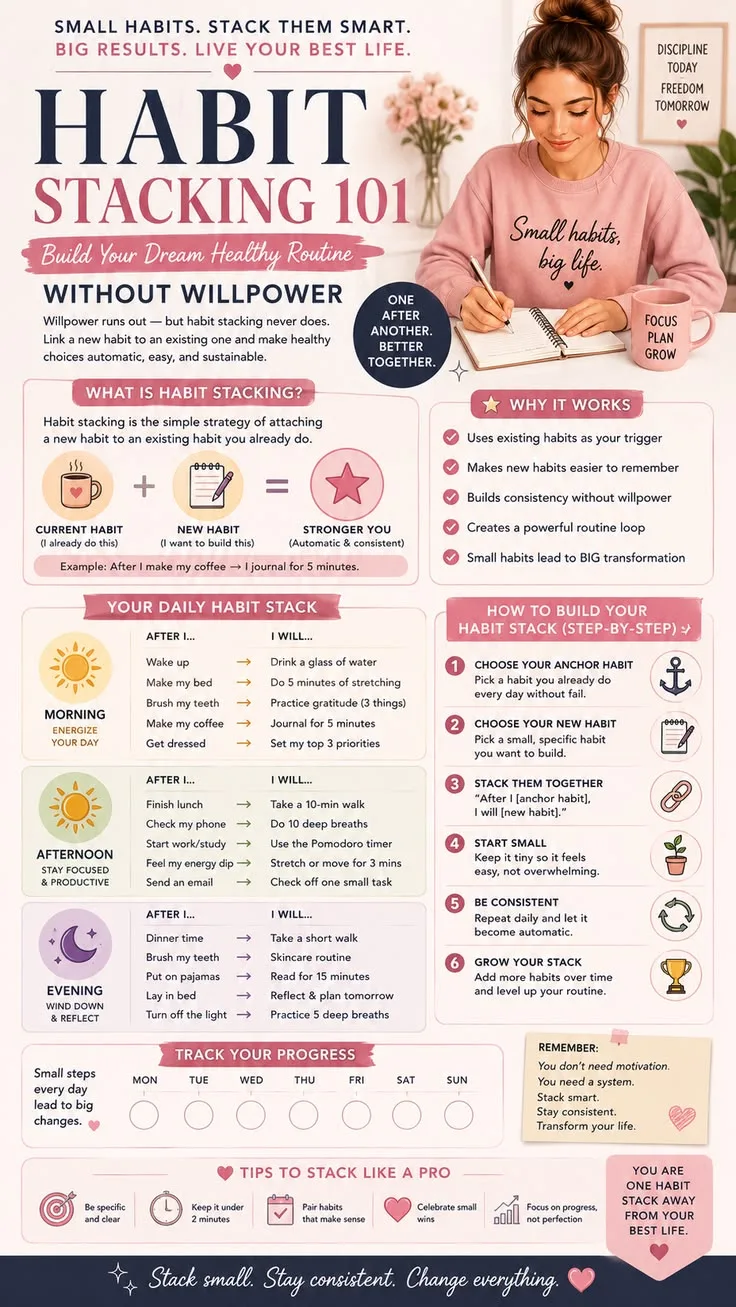
The idea is almost too simple to be useful, which is part of why it works. You take a behavior that is already automatic, something you perform every day without thinking, and you attach a new behavior to it. After the existing habit, you do the new thing.
The old habit becomes the trigger. You do not need to remember the new habit, because the old habit reminds you. You do not need to decide to do it, because the decision has been made in advance. The architecture bypasses the two failure points of most behavior change attempts: forgetting and deciding.
James Clear popularized the term habit stacking in his 2018 book Atomic Habits, but the underlying mechanics come from older behavioral research.[7] BJ Fogg, a Stanford behavior scientist who has been studying behavior change since the 1990s, calls the same technique anchoring in his Tiny Habits method.[6]
Peter Gollwitzer's work on implementation intentions, beginning in the early 1990s, provides the experimental foundation.
The core finding of that research line, replicated across hundreds of studies, is that specifying when and where a behavior will occur more than doubles follow-through compared to general intentions. Habit stacking operationalizes that specification into a formula that ordinary people can apply.
The formula is this: after I [existing habit], I will [new habit]. That is the entire technique. The implementation requires care. The selection of the anchor matters. The size of the new habit matters. The stability of the context matters.
But the core move is a single sentence, and the benefit is that it replaces a general intention with a specific trigger.
"The problem with implementing new habits is not motivation but poor prompts. When your new habit has no trigger, it falls between the cracks of your day. When it has a reliable trigger, it becomes part of your life the same way other habits did.
Habit stacking gives you a trigger on demand. You are not inventing a new cue. You are using a cue that is already working." - BJ Fogg, Tiny Habits (2019)
Key Definitions
Habit: A behavior performed automatically in response to a contextual cue, with minimal conscious decision.[3] Wendy Wood's research at USC estimates that approximately 43 percent of daily behavior meets this definition, far more than most people realize.[4]
Cue-routine-reward loop: The three-part structure Charles Duhigg described in The Power of Habit, based on prior neuroscience of habit learning.[8] A cue triggers a behavior, the behavior is performed, and some form of reward reinforces the cue-behavior association. Basal ganglia circuitry is heavily involved.
Implementation intention: Peter Gollwitzer's term for a specific if-then plan specifying the situation in which a goal-directed behavior will occur. "When I finish dinner, I will take my vitamins" is an implementation intention. "I will take vitamins more often" is a goal intention.
Automaticity: The degree to which a behavior is performed without conscious awareness, control, or intention. Measured by the Self-Report Habit Index or the Self-Report Behavioral Automaticity Index. The benchmark for a fully automatic habit is typically around 66 days of consistent performance, per Lally et al.
Anchor habit: A pre-existing, reliable, daily behavior used as the trigger for a new habit in the stacking technique. Also called an existing behavior, a trigger habit, or simply the cue.
Habit chain: A series of behaviors linked sequentially so that each one triggers the next. A morning routine is typically a habit chain. Large chains are powerful when they work and fragile when a single link breaks.
The Research Foundation
Peter Gollwitzer and colleagues have published more than 100 papers on implementation intentions since the early 1990s. The core experimental paradigm is simple. Participants are assigned a goal such as writing a report, exercising, eating vegetables, or voting.
One group forms a general goal intention: I will do this. The other group forms an implementation intention: I will do this in this specific context at this specific time. Follow-through is measured.
The results are strikingly consistent. Across meta-analyses, implementation intentions produce a medium-to-large effect size on goal attainment, equivalent to approximately doubling the probability of follow-through.[1]
The effect is largest for goals people endorse but often fail to enact, which is the category most behavior change attempts fall into.
The effect is smaller for goals people do not actually care about, which makes sense because no technique can produce behavior people do not want.
Wendy Wood's research at the University of Southern California has mapped the surprising extent to which daily behavior is habitual. In experience sampling studies with hundreds of participants, Wood found that roughly 43 percent of behaviors were performed in the same context most days and reported as minimally consciously decided.
The implication is significant: most of what we do is not the product of moment-by-moment motivation but of situational regularity. When context changes, behavior changes. When context is stable, behavior is stable.
Phillippa Lally and colleagues at University College London published a widely cited 2010 study on habit formation timelines. Ninety-six volunteers chose a new behavior to perform daily in a consistent context and logged automaticity ratings.
The average time to reach asymptotic automaticity was 66 days.[2] The range was 18 to 254 days. The widely repeated 21-day figure, which originated from plastic surgeon Maxwell Maltz's 1960 book about patients adjusting to new facial features, has no experimental support for habit formation.
| Behavior Type | Typical Days to Automaticity | Example |
|---|---|---|
| Simple consumable | 18 to 30 | Drinking water after waking |
| Brief motor routine | 30 to 60 | Two minutes of stretching |
| Cognitive micro-habit | 45 to 75 | Reading one page |
| Moderate activity | 60 to 120 | Twenty-minute walk |
| Complex routine | 90 to 180+ | Thirty-minute workout |
| Behavior requiring planning | 120 to 254 | Weekly review, meal prep |
The Anchor Selection Problem
Most failed habit stacks fail at anchor selection rather than at execution. The anchor needs to meet criteria that are easy to overlook.
First, it must be genuinely automatic. People often select anchors that feel automatic but are not. "After I start work" sounds like a trigger, but starting work is not a consistent discrete moment. "After I finish lunch" is better, but only if lunch happens at a similar time in a similar place each day.
The best anchors are physically discrete acts that occur in the same location at roughly the same time daily: brewing coffee, brushing teeth, putting on shoes, closing the laptop at the end of the work day.
Second, the anchor must match the frequency of the desired habit. A once-weekly anchor cannot support a daily behavior. Many people try to stack daily gym visits onto anchors that happen once or twice a week and are surprised when the stack does not hold. Match the grain.
Third, the physical and cognitive transition from anchor to new behavior should be smooth. If the anchor is brushing teeth in the bathroom and the new habit is two minutes of stretching, the transition is smooth because stretching can begin in the bathroom.
If the anchor is brushing teeth and the new habit is answering three important emails, the context shift is large and the stack is fragile.
Fourth, the anchor should be stable across weekends, travel, and life disruptions. A coffee-making anchor that occurs seven days a week is more durable than a commute-based anchor that disappears on weekends.
Life event fragility predicts stack failure, and stacks built on Monday-through-Friday anchors often collapse during vacations and do not recover.
The Tiny Habits Adjustment
BJ Fogg's insight, developed through his Tiny Habits research, is that the size of the new behavior matters enormously at the installation stage. Most habits fail because they are too big to reliably perform on low-motivation days. The solution is to shrink the habit below the threshold of motivation dependency.
Not twenty pushups after brushing teeth. Two pushups. Not ten minutes of meditation after coffee. One mindful breath. Not reading for thirty minutes before bed. Reading the title page of a book. The initial version of the habit is absurdly small on purpose.
The goal at the installation stage is not the behavior's intrinsic value. It is the automaticity of the trigger-behavior link.
This runs counter to most motivational framing of habit change, which emphasizes ambitious targets and visualization of transformed future selves. The Fogg approach treats ambition as the enemy of installation.
Ambition produces high-variance performance: great on high-motivation days, absent on low-motivation days, and the absences break the streak that automaticity requires.
Once the micro-habit is stable over several weeks, natural expansion tends to occur. Two pushups often become five, then ten, without conscious effort. The behavior has become contextually triggered, and the trigger does not care about the quantity.
The expansion happens because the person is already doing the behavior, and doing more is easier than starting.
For professionals building study habits for certifications, this is particularly relevant. The conventional approach is to schedule two-hour study blocks. The installation-first approach is to stack a five-minute review onto an existing anchor for the first two weeks, then expand.
The Context Dependency
Habits are dramatically more context-dependent than people realize. Wood's research, along with work by David Neal and others, shows that habits cue off of physical location, time of day, emotional state, preceding behavior, and surrounding people. Change any of these and the habit attenuates.
The practical consequence is that habit stacks survive best when the entire context stack is preserved. A morning routine that works at home may not work in a hotel room. A post-lunch walk that works at one office may not work at another. A post-work reading habit that works in one apartment may not work after moving.
This is why so many carefully built habit routines collapse during life transitions: new jobs, moves, children, illness, travel. The individual has not changed, but the context has, and the habits were cued by the context. Rebuilding after a transition requires roughly similar time and effort to the original installation.
Recognizing the context dependency leads to two practical principles. First, when you design a habit, design the context along with the behavior. Where specifically will this happen. What objects are involved. What will be visible. Build the context deliberately.
Second, when you anticipate a context change, plan in advance which habits you will explicitly re-install in the new context, and which you will let go. Trying to preserve every habit through every transition leads to diffuse failure.
For remote workers and digital nomads whose context changes frequently, this problem is acute.
Sample Stacks That Work
Selected examples of stacks that have held up well in research and clinical use, adapted to illustrative pairings.
Morning hydration stack: After I pour my morning coffee, I will drink one glass of water. Anchor is daily, discrete, and in the same location. New habit takes 15 seconds. Reliable.
Evening review stack: After I close my laptop at the end of the work day, I will write three sentences in a daily notebook describing what I worked on and what comes next. Anchor is a discrete physical action. New habit takes 90 seconds. Transitions from work mode into non-work mode, reinforcing the closure.
Transition reading stack: After I brush my teeth before bed, I will read one page of a non-fiction book. Anchor is reliable and nightly. New habit starts minuscule but often expands naturally into 15 to 30 minutes of reading as the cue-behavior link solidifies.
Health check stack: After I sit down for lunch, I will take my vitamins. Anchor is predictable, transitions from preparation to consumption are natural, vitamins are stored in the kitchen.
Writing stack: After I pour my second cup of morning coffee, I will open my writing document and add at least one sentence. Anchor is tied to a specific cup number. New habit is absurdly small at installation and expands into real writing sessions as the trigger-behavior link strengthens.
Wind-down stack: After I dim the main living room light at 10 pm, I will set my phone on the charger in another room. Anchor is deliberate and timer-based. New habit breaks the late-night phone-scrolling loop by relocating the device outside arm's reach.
| Anchor | New Habit | Failure Mode to Watch |
|---|---|---|
| Morning coffee brewing | Drink water | Anchor skipped on sleep-in days |
| Laptop close at EOD | Write three-sentence log | EOD time inconsistent |
| Brush teeth | Two minutes stretching | New habit too vague about which stretches |
| Sit down for lunch | Take vitamins | Lunch skipped, stack breaks |
| Close front door on arrival | Put keys in bowl, change clothes | Stack too long for low-motivation day |
| Dim living room light | Phone to charger | Habit undone when guests visit |
The Dark Side of Stacking
Stacking works equally well for behaviors you do not want. Most people have automatic habit chains that deliver them from the couch to the refrigerator to the TV over and over. The mechanism is identical: one behavior cues the next. Sitting down on the couch cues picking up the phone.
Opening the phone cues opening the social feed. Opening the feed cues twenty minutes of scrolling. The chain is automatic and difficult to interrupt at any single link.
Wendy Wood's work on breaking bad habits emphasizes that willpower-based interruption rarely works because the chain operates below the threshold of conscious decision. The effective interventions are structural: removing the cue, making the behavior more effortful, or introducing a competing stack at the same trigger.
The competing-stack approach is especially useful. Instead of trying not to scroll on the couch, install a different habit at the couch-sitting trigger: picking up a book that is pre-positioned on the side table, stretching, or a small productive task.
The new habit displaces the old one at the same cue. Over time, the cue-behavior link shifts.
"Approximately 43 percent of everyday behavior is performed habitually, in the same locations, at the same times, with minimal thought. This means we spend much of our day enacting scripts rather than making decisions.
When we understand this, we stop asking how to have more willpower and start asking how to redesign the contexts that run our behavior." - Wendy Wood, Good Habits, Bad Habits (2019)
The Rebuild After a Break
Habit stacks break. Travel, illness, emotional crisis, or plain drift will eventually interrupt a chain. The standard response is self-criticism and either an attempt to force the chain back immediately or abandonment of the practice entirely. Both are suboptimal.
The evidence-based response is the rebuild protocol. When a chain breaks, acknowledge that the break has occurred without moral weight. Then perform a micro-version of the chain as soon as possible, not the full version. The goal of the first rebuild performance is not the intrinsic value of the behavior.
It is the reconnection of the cue-behavior link. A single missed day followed by a full return the next day has minimal effect on automaticity.
A week of misses followed by an expectation of instant full return usually produces another collapse because the context has drifted and the chain is no longer supported.
Gardner, Lally and Wardle's work on habit formation suggests that small consistent re-enactment in the original context is more effective than a single large re-enactment after a break.[5] Think of it as physical rehab. You do not load the full weight the first day. You rebuild gradually.
The Thirty-Day Protocol
A practical installation protocol combining the research. This structure takes roughly one month from intention to reliably automatic stack.
Days 1 to 3: Select one anchor and one new habit. Verify the anchor by tracking when it actually happens for three days. If the anchor is not reliably present every day at the expected time and context, choose a different anchor.
Days 4 to 10: Perform the stack daily at the absolutely smallest workable size. If the new habit is exercise, start with one pushup or one squat. If it is reading, start with one page. The size is deliberately below the point where motivation can interfere.
Days 11 to 25: Allow natural expansion. Most people will find the behavior expanding organically as the cue-behavior link strengthens. Do not force expansion. If the behavior stays small, that is fine. The goal is the link, not the volume.
Days 26 to 30: Assess automaticity. Did the new behavior occur without prompting? Did you forget on any day? If yes, why. Adjust the anchor or the context if there is a specific weak point.
Days 31 to 60: Continue. The behavior will feel automatic around day 40 to 60 for most simple habits. For complex habits, expect 90 to 120 days of conscious maintenance.
After day 60: Consider adding a second stack around a different anchor. Do not stack onto the same anchor unless the new behavior is closely related and brief.
When Habit Stacking Does Not Work
The technique has limits worth naming explicitly.
For high-motivation required behaviors, stacking alone is insufficient. A two-hour writing session at the level of real craft is not reducible to a stack. The stack gets you into the chair. Staying in the chair and producing good work requires additional supports including deadlines, accountability, and skill development.
For behaviors that require significant preparation time, the anchor model strains. If a workout requires a change of clothes, a drive to the gym, and coordination with others, the anchor-to-behavior transition is too wide for the stacking model.
Decomposition helps: stack the first step (putting on workout clothes after morning coffee) rather than the full behavior.
For emotionally charged behaviors, stacking can be counterproductive if the emotional valence of the anchor conflicts with the new behavior. Stacking journaling onto a stressful commute transition may fail because the emotional state does not support the reflective mode journaling requires.
For behaviors with strong social coordination requirements, stacking is only useful for the individual components under your control. The team meeting is not a stackable habit. The pre-meeting preparation is.
Tools and Tracking
Habit tracking is useful for installation and early maintenance but becomes unnecessary once automaticity is reached. The research suggests that tracking for too long can actually reduce intrinsic motivation by shifting the internal experience from doing the thing to performing for the log.
For the first 30 to 60 days, a simple daily check-off has strong evidence. The satisfaction of marking the day done is a reinforcement in the cue-routine-reward loop. The tracking also surfaces anchor failures and context disruptions that can be corrected.
Apps, physical notebooks, and calendar methods all work. The specific tool matters less than the consistency of use. Several studies suggest that paper tracking has slight advantages over app tracking for short-term habits, possibly because the physical act adds another dimension of reinforcement.
→The Cognitive Angle
High-ability individuals often resist habit-based approaches because they prefer flexible, context-aware decision-making over rigid routines. The irony is that rigid routines free cognitive capacity for the decisions that actually benefit from flexibility.
Research on ego depletion, though debated in recent years regarding specific mechanisms, consistently shows that people have a limited daily capacity for effortful self-regulation. Habits spend zero of that capacity. Decisions spend substantial amounts of it.
The optimal strategy is not to habituate everything, which would eliminate the flexibility that produces creative work, but to habituate the routine behaviors that do not benefit from fresh decision-making.
Physical health routines, basic productivity practices, social maintenance like staying in touch with family, and environmental reset behaviors like clearing the desk at the end of the day are all candidates.
The Business Application
For entrepreneurs and founders, the personal habit work has a business analog. The structural decisions about company operations, team meetings, reporting cadences, and financial reviews are organizational habits with the same properties as personal ones.
Organizations that build reliable recurring processes free leadership attention for the strategic decisions that actually require it. Organizations that re-decide every operational question weekly exhaust their senior staff.
The formation stage is particularly important because early structural choices about cadence and reporting become organizational habits that persist for years.
The Animal Dimension
Habit learning in animals has been studied extensively and provides useful parallels. Rats in mazes develop automatic turn sequences that require little cognitive load, freeing attention for novelty detection. Birds that cache food develop location habits bound tightly to seasonal and environmental cues.
The basal ganglia circuitry involved is highly conserved across mammals, which is why the habit-automaticity phenomenon is studied partly in rodent models.
Practical Implications
For individuals: Start with one stack. Pick a rock-solid anchor. Shrink the new habit until it is trivial to perform on a bad day. Track for the first 60 days, not beyond. Plan in advance for travel and life disruption.
For parents: Household routines are the primary vehicle by which children install habits. The structural predictability of morning, meal, and bedtime sequences teaches habit architecture implicitly. The content of the habits matters; the existence of reliable routines matters more.
For managers: Team habits, including recurring meetings, reporting cadences, and standup structures, have the same installation logic as personal habits. Design deliberately, pilot for 60 days before assessing, and rebuild after disruptions rather than abandoning.
For educators: Study habit instruction is often delivered as motivational messaging that does not translate into behavior. The structural-habits approach of anchoring study sessions to consistent cues produces more reliable outcomes than exhortation.
Related Resources
See also: Deep Work vs Shallow Work: Cal Newport's Framework | The Eisenhower Matrix | The Testing Effect
Accountability partners sharing habit-tracker URLs can use a quick →Sources & Further Reading
- Gollwitzer, P. M., & Sheeran, P. (2006). "Implementation Intentions and Goal Achievement: A Meta-Analysis of Effects and Processes." Advances in Experimental Social Psychology, 38, 69-119. DOI: 10.1016/S0065-2601(06)38002-1
- Lally, P., van Jaarsveld, C. H. M., Potts, H. W. W., & Wardle, J. (2010). "How Are Habits Formed: Modelling Habit Formation in the Real World." European Journal of Social Psychology, 40(6), 998-1009. DOI: 10.1002/ejsp.674
- Wood, W., & Neal, D. T. (2007). "A New Look at Habits and the Habit-Goal Interface." Psychological Review, 114(4), 843-863. DOI: 10.1037/0033-295X.114.4.843
- Wood, W., Quinn, J. M., & Kashy, D. A. (2002). "Habits in Everyday Life: Thought, Emotion, and Action." Journal of Personality and Social Psychology, 83(6), 1281-1297. DOI: 10.1037/0022-3514.83.6.1281
- Gardner, B., Lally, P., & Wardle, J. (2012). "Making Health Habitual: The Psychology of Habit-Formation and General Practice." British Journal of General Practice, 62(605), 664-666. DOI: 10.3399/bjgp12X659466
- Fogg, B. J. (2019). Tiny Habits: The Small Changes That Change Everything. Houghton Mifflin Harcourt.
- Clear, J. (2018). Atomic Habits: An Easy and Proven Way to Build Good Habits and Break Bad Ones. Avery.
- Duhigg, C. (2012). The Power of Habit: Why We Do What We Do in Life and Business. Random House.