
The Core Question
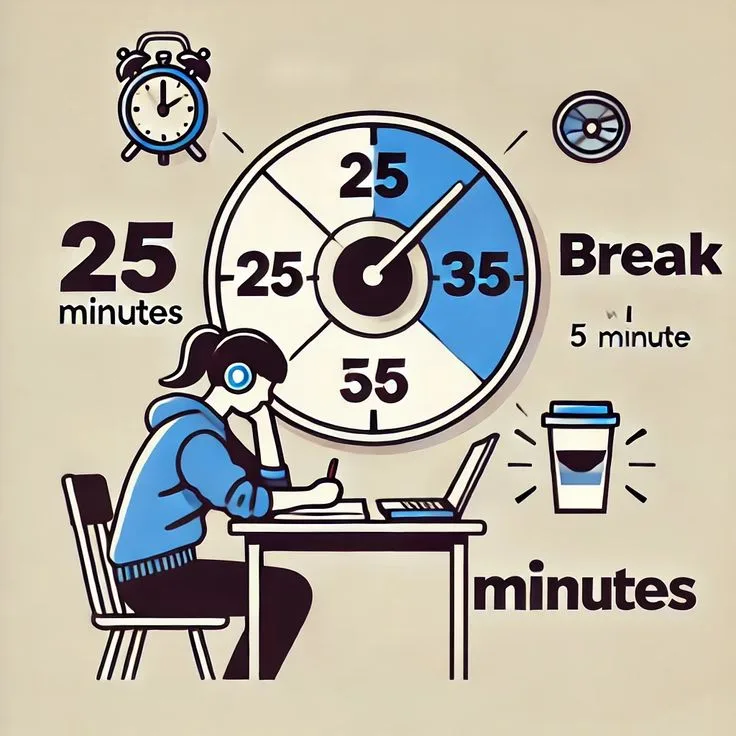
Pomodoro and time blocking are the two most common scheduling systems for protecting focused work. They solve overlapping problems through opposite mechanisms. Pomodoro chops the day into fixed 25-minute work intervals with 5-minute breaks.
Time blocking assigns variable-length blocks to specific tasks across the calendar. Most productivity writers recommend one or the other. The research-backed answer is that each dominates in a specific condition, and the wrong choice creates drag rather than traction.
Francesco Cirillo invented Pomodoro in the late 1980s while studying at Guido Carli International University in Rome. The original 1987 protocol used a tomato-shaped kitchen timer, which gave the technique its name.
Time blocking traces back further, to productivity writers in the early 20th century, and was popularized for knowledge workers by Cal Newport in Deep Work (2016) and by Benjamin Franklin's published daily schedule reproduced in his autobiography.
"If you do not give your mind something to do, it defaults to reacting to what is most immediately in front of it."
- Cal Newport, Deep Work, 2016
What Each Method Actually Is
The Pomodoro Protocol
The canonical Pomodoro cycle is: 25 minutes of work, 5 minutes of rest, repeated four times, followed by a longer 15 to 30 minute break. Cirillo's 2006 book The Pomodoro Technique codified five rules.[1]
- A pomodoro is indivisible. Interruptions must either be deflected or require the timer to restart.
- The next pomodoro makes up for the last one. Missed intervals are logged, not lamented.
- One pomodoro equals one task unit. Tasks larger than 7 pomodoros should be split; tasks smaller than 1 should be batched.
- The break is mandatory. Skipping breaks compounds fatigue across the day.
- Track every pomodoro. The log is the unit of self-calibration.
Modifications exist. Many programmers use 50 to 10 variants for tasks that require 30 to 45 minutes of warm-up before productive work begins. The core principle is the fixed interval with a timer, not the specific 25 to 5 ratio.[8]
Time Blocking Protocol
Time blocking is the practice of assigning specific tasks to specific calendar slots before the day or week begins. The block length is determined by the task, not by a universal interval. A deep writing session might be a 3-hour block. Email triage might be a 20-minute block.
Newport's version, called time-block planning, has four rules.[4]
- Every minute of the workday is pre-assigned to a block.
- Blocks can be overridden only by revising the schedule, not by reacting.
- Deep work blocks are non-negotiable.
- The end-of-day shutdown ritual confirms the day's blocks were respected or revised deliberately.
Benjamin Franklin's version, documented in his autobiography, assigned question-based blocks: "the morning question: what good shall I do this day?" The structure has been stable across three centuries.
Side-by-Side Comparison
| Dimension | Pomodoro Technique | Time Blocking |
|---|---|---|
| Unit of time | Fixed 25 minutes | Variable by task |
| Cognitive load | Low (timer does the thinking) | High (requires planning) |
| Best for | Repetitive or anxiety-heavy tasks | Complex creative or strategic work |
| Warm-up cost | Low tolerance for warm-up | Supports long warm-up |
| Interruption resilience | High (interruption resets pomodoro) | Low (interruption disrupts block) |
| Learning curve | Minutes | Days to weeks |
| Calendar integration | External to calendar | Native to calendar |
| Role fit | Students, support roles, writers | Executives, researchers, engineers |
| Main failure mode | Task fragmentation | Over-scheduling breaks momentum |
| Research support | Moderate | Strong in deliberate practice literature |
The table highlights the central tradeoff. Pomodoro optimizes for starting. Time blocking optimizes for sustaining. Most people who cannot start will not be saved by time blocking. Most people who can already start will not be deepened by Pomodoro.
What the Research Says
Pomodoro Research
Despite its popularity, the Pomodoro Technique has limited peer-reviewed research directly testing its protocol.
The most cited study is Almeida, Jo, and Bryer (2020) in the International Journal of Industrial Ergonomics, which found that fixed-interval work-rest cycles reduced self-reported fatigue and improved task completion rates compared to self-directed work in a sample of 30 knowledge workers.
The effect was moderate, and the study was small.
More indirect support comes from the broader microbreak literature. A 2022 meta-analysis by Albulescu, Macsinga, and Rusu in PLOS ONE covered 22 studies and concluded that short breaks (5 to 15 minutes) between focused work periods improved performance on subsequent cognitive tasks by a small but consistent margin.[3]
The finding aligns with Pomodoro's 25 to 5 structure but does not validate the specific ratio.
K. Anders Ericsson's deliberate practice research found that elite performers typically practiced in blocks of 45 to 90 minutes, longer than a Pomodoro.[5] This suggests that Pomodoro's 25-minute interval is a starting ratio for untrained attention, not an optimum for experienced practitioners.
Time Blocking Research
Time blocking is well-supported by research on implementation intentions. Peter Gollwitzer's 1999 paper in American Psychologist and subsequent meta-analyses (Gollwitzer and Sheeran 2006, covering 94 studies) found that specifying when, where, and how a behavior will occur raises execution rates by 20 to 40 percentage points compared to general intention.[2]
Time blocking is implementation intention applied to the whole workday.
Newport's deep work framing draws on Anders Ericsson's deliberate practice research showing that elite cognitive performance is produced in long focused sessions rather than distributed short attempts. Time blocking is the scheduling consequence of that finding.
Gloria Mark's attention-fragmentation research at UC Irvine provides indirect support. Interrupted knowledge workers take an average of 23 minutes to fully return to a task.[6] A calendar-defended time block is the primary defense against that cost.
"Plan the work, then work the plan."
- David Allen, Getting Things Done, 2001
The Decision Framework
Use these six questions to choose. Three or more in favor of one method strongly indicates starting there.
Question 1: How much do you dread starting?
High dread, procrastination-heavy: Pomodoro. The 25-minute commitment is low enough that the starting resistance collapses. Once the timer starts, the work happens.
Low dread, problem is other demands rather than starting: Time blocking. The issue is protection, not activation.
Question 2: What is the shape of your day?
Reactive role, interruption-heavy (support, operations, management): Pomodoro. Time blocks you cannot defend are not time blocks.
Protected role, calendar-controlled (research, writing, deep engineering): Time blocking. The calendar is the defense.
Question 3: What is the cognitive complexity of your core work?
Clear, bounded tasks (study, code review, email triage, writing sessions with known topic): Pomodoro works well. Task structure maps to intervals.
Complex, ambiguous, creative work (research, strategy, original writing, design): Time blocking. The warm-up required for deep cognitive work exceeds 25 minutes.
Question 4: How many different task types fill your day?
One or two dominant categories: Pomodoro fits. The interval becomes a universal unit.
Five or more distinct categories with different durations: Time blocking fits. The variable block length matches task reality.
Question 5: How do you relate to breaks?
You forget to take breaks, work until burnout: Pomodoro. The forced break is the feature.
You take breaks reliably, rarely burn out: Time blocking. The forced break is redundant.
Question 6: What is your current tooling?
Lightweight (paper planner, Notion, Todoist, physical timer): Pomodoro is easier to adopt.
Calendar-native (Google Calendar, Outlook, Fantastical): Time blocking integrates directly.
A Hybrid Protocol
Most serious practitioners use neither pure Pomodoro nor pure time blocking. They combine the two. The common hybrid is called block-within-block or Pomodoro inside a block.
The Hybrid Structure
- Time block the day at the calendar level. Assign 60 to 180 minute blocks to specific tasks.
- Inside each block, use a Pomodoro-style timer when the task is repetitive or when attention starts to drift.
- Skip the timer when the work is deeply absorbing and the break would interrupt flow.
The hybrid respects the underlying finding from Csikszentmihalyi's flow research: forced breaks during flow states reduce output, but unforced breaks during shallow work increase output.[7] The timer is a tool, not a master.
Example Daily Schedule
- 7:30 to 9:00 AM: Deep work block on the main creative project. No timer. Flow is the protection.
- 9:00 to 9:30 AM: Email triage. Two Pomodoros, 12 minutes each with short breaks. The timer resists the email rabbit hole.
- 9:30 to 11:00 AM: Second deep work block on the main project or a secondary long task. No timer.
- 11:00 to noon: Meetings. Calendar-native blocks, no Pomodoro needed.
- Noon to 1:00 PM: Lunch and recovery.
- 1:00 to 2:30 PM: Administrative work. Three Pomodoros. The structure prevents drift.
- 2:30 to 4:00 PM: Meetings, collaboration, reactive work.
- 4:00 to 4:30 PM: Shutdown ritual. Review the day's blocks, plan tomorrow.
The hybrid uses Pomodoro where attention is likely to drift and time blocking where flow is possible. The combination usually outperforms either pure method.
Common Failure Modes
Pomodoro Failures
Task fragmentation. The 25-minute interval fragments tasks that need 45 to 90 minutes of continuous thought. Writers, designers, and researchers often find that the break arrives just as the work starts flowing.
The solution is to extend the interval (50 to 10 or 90 to 20) for cognitively deep tasks, or to skip the timer entirely for those blocks.
Break inflation. The 5-minute break expands to 15 or 20 minutes when the reward activity (phone, social media, snack) is more stimulating than the work. The solution is to design the break: walk, stretch, drink water, no phone.
Pomodoro as procrastination. Some users spend more time setting up the timer, tracking pomodoros, and refining the system than doing work. The technique is a means, not an end.
Time Blocking Failures
Over-scheduling. Filling every 15-minute slot leaves no room for the unexpected, which is guaranteed in any real workday. The solution is Newport's recommendation: leave 30 to 50 percent of the day unassigned or assigned to flexible blocks.
Rigid protection. Treating every block as immovable creates stress when reality intrudes. The point of time blocking is to make scheduling decisions deliberate, not to eliminate revision.
Calendar theater. Some users block their calendars to look busy without actually protecting the blocks. When the blocks are violated by meetings, slack requests, and drop-in chats, the system collapses. The solution is cultural: the blocks have to be real defenses, not symbolic ones.
Role-Specific Recommendations
For Programmers and Engineers
Engineers often need 30 to 60 minutes of warm-up before productive coding begins. Strict 25-minute Pomodoros fragment the warm-up. The recommended adaptation is 90 to 15 intervals or pure time blocking with 2 to 4 hour blocks. Documentation, code review, and bug triage fit 25 to 5 Pomodoros well.
For Writers
Writers face the same warm-up problem as engineers. A 25-minute Pomodoro often ends at the moment the writing becomes non-terrible. The recommended adaptation is 60 to 90 minute blocks with no timer during flow, with Pomodoros reserved for revision and editing sessions.
For Students and Certification Candidates
Students benefit from strict Pomodoros because study sessions are anxiety-heavy and starting is the primary bottleneck.
For Executives
Executives rarely have 2 to 4 hour blocks available. Their days are meetings plus reactive work. Time blocking helps at the calendar level to protect thinking time, but most of the workday is better served by pure meeting scheduling. Pomodoro fits the scattered 15 to 30 minute windows between meetings for email and quick-task work.
For Remote Workers
Remote workers have more calendar control and more distraction. The hybrid protocol is usually the right answer: time blocking at the calendar level, Pomodoro within blocks that require structured attention. Environment design from the habit literature complements both systems.
For Customer Support and Operations Roles
These roles are interruption-dominated. Pure time blocking fails because blocks cannot be defended. Pomodoro offers partial relief: the 25-minute interval is short enough to protect during routine work, and the broken-pomodoro rule provides a way to recover from interruptions without guilt.
Deep thinking work (process improvement, training) should be scheduled outside core coverage hours.
Assessment Before You Choose
Before committing to a method, measure your current baseline. Spend one week without either system. Track in a simple spreadsheet or notebook: when you started each task, when you finished, how often you switched, how you felt at the end of each day.
The baseline reveals which method your situation actually needs. People who never start need Pomodoro. People who start but cannot sustain need time blocking. People who do both but cannot produce valuable output need Newport's deep work rules inside their time blocks.
Cognitive baseline matters too. The comparison turns a vague "I feel more focused" into a measurable delta.
"Measure what matters. Measure what you can change. Then change it."
- Peter Drucker, paraphrased from The Effective Executive, 1967
Frequently Asked Questions
Can I do Pomodoro with a 50-minute interval instead of 25?
Yes. The 25-minute interval is a starting ratio, not a universal optimum. Many practitioners extend to 50 to 10 or 90 to 20 once their attention capacity grows. The important feature is the structure, not the specific duration.
Does time blocking work in jobs with heavy meeting loads?
Partially. The non-meeting time should still be blocked rather than left to reactive drift. Even 15 to 30 minute gaps between meetings produce more output when pre-assigned than when left to email triage by default.
Which method is better for avoiding burnout?
Pomodoro has a slight edge because the forced breaks prevent the push-through-fatigue pattern that produces burnout. Time blocking handles burnout prevention through shutdown rituals and deliberate rest blocks, but requires more self-awareness.
How do I handle interruptions during a Pomodoro?
Cirillo's original protocol offers three options: inform the interrupter you are in a focused block and will return in X minutes, deflect the interruption entirely, or restart the Pomodoro after handling the urgent matter. The key rule is that interruptions are logged, not ignored.
What tools are best for time blocking?
Google Calendar, Outlook, and Fantastical are the most common. The tool matters less than the discipline of actually pre-assigning blocks and treating them as commitments. Paper planners work equally well for single-person workflows.
Can children learn the Pomodoro Technique?
Yes. Many schools and tutors use modified Pomodoro with younger students: 10 to 5 intervals for ages 6 to 10, 15 to 5 for ages 11 to 14, 20 to 5 for teenagers. The structure teaches self-regulation and attention training.
Is there a productivity method that is clearly better than both?
No single method dominates across contexts. The research supports matching method to task type, attention profile, and role constraints. The hybrid approach described above outperforms both pure methods for most knowledge workers.
Sources & Further Reading
Cirillo, F. (2006). The Pomodoro Technique.
Gollwitzer, P. M., & Sheeran, P. (2006). Implementation intentions and goal achievement: A meta-analysis of effects and processes. Advances in Experimental Social Psychology, 38, 69-119. DOI: 10.1016/S0065-2601(06)38002-1
Albulescu, P., Macsinga, I., Rusu, A., Sulea, C., Bodnaru, A., & Tulbure, B. T. (2022). Give me a break! A systematic review and meta-analysis on the efficacy of micro-breaks for increasing well-being and performance. PLOS ONE, 17(8). DOI: 10.1371/journal.pone.0272460
Newport, C. (2016). Deep Work: Rules for Focused Success in a Distracted World. Grand Central Publishing. View source
Ericsson, K. A., Krampe, R. T., & Tesch-Romer, C. (1993). The role of deliberate practice in the acquisition of expert performance. Psychological Review, 100(3), 363-406. DOI: 10.1037/0033-295X.100.3.363
Mark, G., Gudith, D., & Klocke, U. (2008). The cost of interrupted work: More speed and stress. Proceedings of the 2008 SIGCHI Conference on Human Factors in Computing Systems. DOI: 10.1145/1357054.1357072
Csikszentmihalyi, M. (1990). Flow: The Psychology of Optimal Experience. Harper and Row.
Farnam Street. (2022). The Pomodoro Technique: Why Short Focus Periods Produce Long Results.