
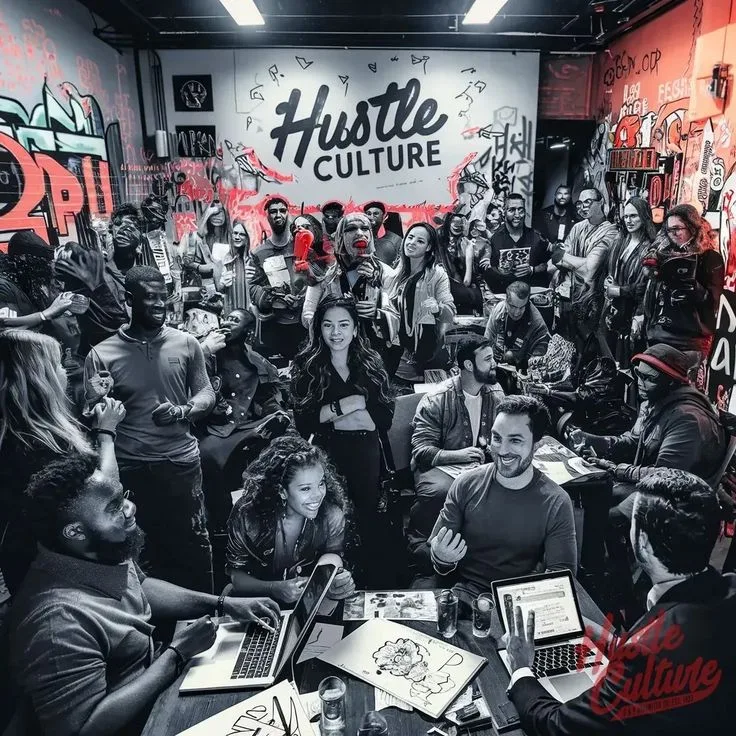
Hustle culture is the belief system that frames extreme, continuous work as both the primary determinant of professional success and a moral virtue - characterized by the glorification of overwork, the stigmatization of rest, and the fusion of personal identity with professional output.
Originating in Silicon Valley startup mythology and amplified through social media in the 2010s, hustle culture promised that anyone willing to outwork their competition could achieve extraordinary results.
The evidence from productivity research, occupational health studies, and workplace psychology now shows that this promise was not only false but actively harmful - with long working hours producing diminishing returns after 50 hours per week, increasing cardiovascular mortality risk by 35%, and driving a global burnout epidemic that the World Health Organization formally recognized in 2019.
For approximately two decades, a particular idea about work dominated the ambitions of people building careers in technology, entrepreneurship, and beyond. The idea was simple: the people who succeeded were the people who worked hardest, longest, and most relentlessly.
Sleep was a weakness. Weekends were for the unambitious. If you were not working when your competitors were, you were falling behind.
This idea had a name - hustle culture - and it spread from the startup campuses of San Francisco to corporate offices, high school career advice, motivational podcasts, and the aspirational social media accounts of people who styled themselves as proof that grinding works.
The evidence that hustle culture is failing is now overwhelming, and it comes from multiple directions simultaneously. The medical research on long working hours documents serious cardiovascular and cognitive costs.
The productivity research finds that output per hour drops sharply above fifty hours per week, making extreme hours counterproductive by their own logic. The mental health data shows burnout rates rising across most professional sectors.
And cultural rejection, most visible in the "quiet quitting" discourse of 2022 and the explicit work-life balance priorities of Gen Z workers, suggests that the ideology's hold on the workforce is weakening.
Understanding why hustle culture became so pervasive - and why it is now collapsing - requires looking at both its origins and its promises. Hustle culture did not emerge from nowhere. It was a response to real economic conditions, spread through real cultural mechanisms, and promised real rewards.
Many of the people who promoted it believed what they were saying. The problem was not that hard work is without value. The problem was that hustle culture misrepresented what determined success, instrumentalized human beings in ways that damaged them, and rested on empirical claims about productivity that the research does not support.
"The five-day, forty-hour work week is not a gift from employers. It is the hard-won result of a century of labour organising. Hustle culture is a campaign to give it back." - Jenny Odell, How to Do Nothing: Resisting the Attention Economy (2019)
| Hustle Culture Claim | Counter-Evidence | Source |
|---|---|---|
| More hours = more productivity | Productivity drops sharply beyond 50 hours/week; zero additional output above 55 hours | Pencavel, Stanford (2014) |
| Sleep is optional / overrated | Sleep deprivation degrades performance equivalent to 0.10% BAC alcohol impairment | Williamson & Feyer, Occupational and Environmental Medicine (2000) |
| Rest is laziness | Most historically productive scientists and writers worked 4-5 focused hours daily | Pang, Rest (2016) |
| Passion justifies suffering | Burnout rates highest in "passion-driven" professions (healthcare, education, nonprofits) | Maslach & Leiter (1997) |
| Success requires sacrifice of health | Working 55+ hrs/week: 35% increased stroke risk, 17% increased heart disease risk | WHO/ILO (2021) |
| Hustle rewards the hardest workers | Success correlates more strongly with structural factors (network, capital, timing) than hours worked | Denrell, Management Science (2005) |
Key Definitions
Hustle culture: The belief system that frames extreme, continuous work as both the primary determinant of success and a moral virtue. Hustle culture is characterized by the glorification of overwork, the stigmatization of rest, and the fusion of personal identity with professional output.
It operates as a form of meritocratic ideology that attributes success primarily to effort rather than structural factors like access to capital, social networks, educational opportunity, and timing.
Burnout: Defined by the World Health Organization in its 2019 revision of the International Classification of Diseases (ICD-11) as an occupational phenomenon resulting from chronic workplace stress that has not been successfully managed.
Burnout has three dimensions: emotional exhaustion, depersonalization (cynicism or detachment from work), and reduced personal accomplishment.
The WHO's classification was significant because it medicalized a condition that hustle culture framed as simply insufficient toughness.
Quiet quitting: A 2022 viral term describing the practice of performing one's job duties as defined and compensated, without taking on additional unpaid labor, emotional investment, or availability that exceeds the formal scope of employment.
Despite its name, quiet quitting does not involve resignation but rather a redrawing of work-life boundaries that hustle culture had erased.
Deep work: A concept developed by computer science professor Cal Newport in his 2016 book of the same name, describing cognitively demanding, distraction-free work on tasks that create real value.
Newport's research suggested that quality and depth of focused work, not volume of hours, produced the most meaningful professional output - a direct challenge to hustle culture's hours-based value system.
Understanding deep work connects to broader principles of how to learn anything faster and deliberate practice.
Productivity ceiling: The empirically documented phenomenon where additional work hours produce diminishing marginal returns, eventually reaching a threshold above which additional hours produce near-zero additional output.
Stanford economist John Pencavel's research demonstrated this ceiling at approximately 55 hours per week for most knowledge workers.
Presenteeism: The practice of being physically present at work while functionally impaired - through exhaustion, illness, or cognitive depletion.
Research by the American Productivity Audit (2003) estimated that presenteeism costs US employers over $150 billion annually in lost productivity - significantly more than absenteeism. Hustle culture actively promotes presenteeism by equating physical presence with commitment.
The Origins of Hustle Culture
Silicon Valley Mythology
The modern hustle culture has its most direct origin in the mythology of Silicon Valley entrepreneurship in the early 2000s. The stories of companies founded in garages, of founders who slept under their desks, of teams who worked through weekends to ship product became the defining narrative of how transformative companies were built.
Steve Jobs's legendary 90-hour weeks at Apple. Elon Musk sleeping on the Tesla factory floor. Mark Zuckerberg's "Move fast and break things" ethos at Facebook.
These stories were not entirely false - founding-stage startup work is genuinely intense - but they were systematically misleading about what determined which companies succeeded.
As researcher Jason Fried and David Heinemeier Hansson argued in their 2018 book It Doesn't Have to Be Crazy at Work, survivorship bias makes hustle narratives deeply unreliable. We hear the stories of founders who worked 100-hour weeks and built billion-dollar companies.
We do not hear the stories of the thousands who worked equally hard and failed - because failed startups do not generate bestselling memoirs.
Research by Jerker Denrell at Stanford (2005) demonstrated mathematically that success in competitive environments is more strongly determined by luck and structural positioning than by effort alone, but the narrative infrastructure of business media systematically overweights effort in causal explanations.
The venture capital ecosystem that funded Silicon Valley companies had structural reasons to promote hustle culture. VCs invest in a portfolio of bets, expecting most to fail.
In that context, encouraging founders to work themselves to the limit maximizes the probability that any individual bet will succeed, even though it damages founder wellbeing across the portfolio.
A 2019 study by Michael Freeman at the University of California San Francisco found that 72% of entrepreneurs in his sample reported mental health concerns, compared to 48% of the general population. The survivors' story is the VC's marketing. The burnout of the failures is invisible.
Motivational Entrepreneurialism
The early 2010s saw hustle culture exported from Silicon Valley to mainstream aspiration through social media, particularly through the personal brands of motivational entrepreneurs.
Gary Vaynerchuk - "Gary Vee" - built a following of millions around content that explicitly celebrated extreme work hours and scorned work-life balance.
In a 2017 interview, Vaynerchuk stated: "Look, I put in 18-hour days and I'm happy. The problem is, I think that people aren't willing to put in the work." Grant Cardone'sThe 10X Rule (2011) proposed that all goals should be pursued at ten times the effort most people would consider reasonable.
Tim Ferriss'sThe 4-Hour Workweek (2007) paradoxically both contributed to and complicated hustle culture: it promised escaping traditional employment but through extreme optimization that was itself a form of intense work.
These figures were not promoting anything simply false. Hard work matters. Persistence matters.
But hustle culture's intellectual contribution was to take the true observation that effort is necessary and transform it into the false claim that effort alone is sufficient - and the morally dubious claim that people who are not succeeding simply are not working hard enough.
This is a textbook example of what philosophers call the just-world fallacy: the belief that outcomes are always deserved.
Economic Context
Hustle culture gained traction during a period of significant economic dislocation. The 2008 financial crisis destroyed the pretense that employment and conventional career paths offered reliable security.
Wages for most workers had been stagnant in real terms since the 1970s even as productivity increased - a divergence documented by the Economic Policy Institute, which found that productivity grew 59.7% between 1979 and 2019 while hourly compensation for typical workers grew only 15.8%.
The gig economy, which expanded rapidly after 2010 with the growth of Uber, TaskRabbit, and DoorDash, created millions of workers without employment protections, benefits, or predictable income - a labor market in which working more was the only available response to economic precarity.
For many people, hustle was not an ideology but a necessity. Sociologist Juliet Schor, in her prescient 1991 book The Overworked American, documented how American working hours had been increasing since the 1970s while European countries moved in the opposite direction.
Hustle culture took their necessity and repackaged it as virtue. This repackaging served a clear ideological function: it located the cause of economic precarity in individual effort rather than systemic structures, making structural critique harder by moralizing the discussion.
The Research on Long Working Hours
Productivity: The Pencavel Study
John Pencavel's 2014 study for the IZA (Institute of Labor Economics), analyzing archival data on munitions workers in World War One, found that output was proportional to hours worked up to approximately 49 hours per week, after which it declined sharply.
Above 55 hours per week, additional hours produced essentially zero additional output. Workers who put in 70 hours produced no more than those who worked 55 hours - the additional 15 hours were economically worthless in terms of output while extracting a biological cost.
Subsequent research has extended these findings to knowledge work. Alex Soojung-Kim Pang's 2016 book Rest: Why You Get More Done When You Work Less surveyed the working habits of highly productive scientists, writers, and inventors across history and found that most of the most productive worked approximately four to five hours of deep, focused effort per day:
- Charles Darwin worked four to five hours daily on his scientific writing, spending the rest walking, corresponding, and resting.
- Henri Poincare, one of the most prolific mathematicians in history, worked four hours daily - two in the morning and two in the afternoon.
- Charles Dickens wrote for five hours each morning and spent afternoons on long walks.
- Composer Benjamin Britten worked five hours daily.
The rest of their time was spent walking, reading, socializing, and resting - activities that most hustle culture proponents would classify as unproductive. Yet these individuals were among the most prolific in their fields.
The pattern suggests that sustained creative output depends not on maximizing hours but on protecting the quality of focused work periods and allowing adequate recovery between them.
A 2022 study by Maastricht University researchers, published in IZA World of Labor, found similar patterns in modern knowledge workers: cognitive performance degraded significantly after approximately six hours of concentrated intellectual work, and that no amount of caffeine, motivation, or deadline pressure could override the biological ceiling.
Health: WHO and ILO Data
A 2021 joint study by the World Health Organization and the International Labour Organization, published in Environment International, analyzed data from 194 countries and found that 745,000 deaths per year from stroke and heart disease were attributable to long working hours.
Working 55 or more hours per week was associated with a 35 percent increased risk of stroke and a 17 percent increased risk of coronary heart disease compared to a 35-40 hour week.
The research was the most comprehensive global study of occupational health risks from overwork ever conducted, synthesizing data from 37 studies covering over 768,000 participants.
The biological mechanism is well-established: chronic overwork elevates cortisol and other stress hormones, promotes systemic inflammation, disrupts sleep architecture, increases blood pressure, and reduces the body's capacity for cardiovascular repair.
Research by Marianna Virtanen and colleagues at the Finnish Institute of Occupational Health (2012) also found that long working hours were associated with increased risk of Type 2 diabetes, depression, and cognitive decline in later life.
Sleep researcher Matthew Walker, in his 2017 book Why We Sleep, documented that sleeping fewer than six hours per night - a common consequence of extreme work schedules - reduces immune function, impairs memory consolidation, increases cancer risk, and degrades emotional regulation.
Walker summarized the evidence bluntly: "The shorter your sleep, the shorter your life."
Mental Health: The Burnout Evidence
Christina Maslach at the University of California, Berkeley, whose Maslach Burnout Inventory (MBI) has been the primary research tool for studying burnout since the 1970s, has spent decades documenting the conditions that produce it.
The MBI has been used in over 6,000 published studies, making burnout one of the most thoroughly researched occupational health phenomena.
Maslach's research consistently identifies that burnout is not primarily a personal failing but an organizational problem - produced by six key factors: excessive workload, lack of control, insufficient reward, absent community, unfairness, and values mismatches.
Hustle culture creates most of these conditions by design: it normalizes excessive workload, frames lack of control as strength, defines reward as future wealth while denying present recognition, and elevates competitive isolation over community.
A 2023 survey by the American Psychological Association found that 77% of workers had experienced work-related stress in the previous month, and 57% reported negative impacts including emotional exhaustion, lack of motivation, and desire to quit.
The cost of burnout to US employers has been estimated at $125-190 billion in healthcare spending annually (Garton, Harvard Business Review, 2017).
The Quiet Quitting Moment
The 2022 Discourse
In August 2022, a TikTok video by user @zkchillin - a young worker explaining that he had decided to do his job rather than his life - went viral and sparked an international discourse about work.
The phrase "quiet quitting" spread rapidly, generating think-pieces from every major publication, debates in HR communities, and responses from both managers (largely hostile) and workers (largely sympathetic).
The speed of the spread was revealing: the term obviously resonated with an enormous number of people who had already been doing what it described.
Gallup's State of the Global Workplace 2022 report published research suggesting that approximately 50 percent of the US workforce could be classified as quiet quitters - people performing their job duties without going above and beyond.
Only 32% of workers were classified as "engaged." The report framed this as an engagement crisis. An alternative reading is that it was a rational response to a decade of employers normalizing unpaid extra labor under the ideology of hustle culture.
As management researcher Jim Detert of the University of Virginia noted in Harvard Business Review (2022), the real question was not why workers were setting boundaries but why "doing your job as described and compensated" had become newsworthy.
The answer, Detert argued, was that hustle culture had so thoroughly normalized unpaid discretionary effort that its absence felt like rebellion.
The Limits of the Narrative
Quiet quitting as a discourse had significant limits. It was predominantly a conversation among knowledge workers in white-collar employment, and its spread via social media made it largely invisible to the working-class and gig workers whose working conditions were shaped by very different pressures.
Warehouse workers, delivery drivers, and food service employees do not have the luxury of "quiet quitting" - their work is monitored, their output is measured in real-time, and their employment is contingent on meeting quotas.
The idea that refusing to do unpaid overtime was a form of radical workplace behavior revealed something about how thoroughly hustle culture had redefined normal: a refusal to give away labor had become newsworthy.
Gen Z and the Rejection of Hustle
Different Starting Premises
Research consistently documents that Gen Z workers (born approximately 1997-2012) enter the workforce with different priorities than their predecessors.
Deloitte's Global Millennial and Gen Z Survey, which has tracked workplace attitudes since 2017, has found that Gen Z workers consistently rank work-life balance as more important than salary when evaluating employers, and are significantly more likely to report that they would leave a job that compromised their mental health or personal life.
A 2023 LinkedIn survey found that 87% of Gen Z job seekers listed work-life balance in their top three criteria for evaluating employers, compared to 71% of Millennials.
What Changed
Several factors distinguish Gen Z's relationship to work from Millennial experience at equivalent career stages:
Observed failure: Gen Z grew up watching Millennials follow hustle culture's prescriptions - incurring enormous student debt, working exhausting hours in competitive industries - and achieve neither the promised financial rewards nor stable employment.
The 2008 recession's impact on Millennial career trajectories was a cautionary tale in real time.
Pandemic reordering: They entered the workforce during or shortly after a pandemic that made visible the fragility of employer loyalty and the importance of non-work life. Essential workers who risked their lives received minimal compensation or recognition, undermining the narrative that loyalty and sacrifice would be rewarded.
Mental health literacy: They are the first generation to have grown up with mental health discourse as a normal part of their social environment, and they are significantly more likely than previous generations to name mental health as a legitimate factor in life decisions.
A 2022 study by the American Psychological Association found that Gen Z reported the highest rates of therapy utilization of any generation.
Economic realism: Housing costs, student debt levels, and wage stagnation have made the traditional markers of financial success - homeownership, retirement savings, family formation - less attainable through conventional career paths, reducing the perceived return on investment for extreme work effort.
Is It Different This Time
The cyclical quality of generational work-value research should prompt caution. Each generation has been described as less committed to work than its predecessors, and subsequent research has often found that these differences narrowed as people aged and took on financial obligations.
Sociologist Jean Twenge at San Diego State University has noted that some generational "differences" in work values may reflect life stage rather than genuine cohort effects.
What may be different about Gen Z's position is structural: the labor market of 2025 is genuinely different from the one that shaped Boomer and Gen X work values, with weaker employer-employee loyalty, weaker union protections (union membership fell from 20.1% in 1983 to 10.0% in 2023, according to the Bureau of Labor Statistics), and an economic context in which the promised correlation between hard work and upward mobility is less reliable than it was for previous generations.
What Replaces Hustle Culture
Sustainable Performance Models
The research points toward what might be called a sustainable performance model: concentrated, high-quality work during working hours, followed by genuine recovery. This is not a compromise between productivity and wellbeing but a more accurate account of how productivity works.
The evidence from Cal Newport, Alex Soojung-Kim Pang, and the sports science literature on periodization all points in the same direction: performance requires recovery, and sustainable output over a career requires managing energy rather than simply maximizing hours.
The four-day work week experiments provide additional evidence. The 2022 pilot program organized by 4 Day Week Global, involving 61 UK companies and approximately 2,900 workers, found that revenue remained broadly stable during the trial period while employee wellbeing, stress levels, and retention all improved significantly.
56 of 61 participating companies chose to continue the four-day week after the trial ended. Similar results emerged from trials in Iceland (2015-2019), where researchers from the Association for Sustainability and Democracy analyzed productivity data and found that output was maintained or improved despite reduced hours.
Organizational Responsibility
Christina Maslach's decades of burnout research make a point that individual productivity frameworks often miss: burnout is primarily an organizational problem requiring organizational solutions.
Flexible working, adequate staffing, meaningful work, fair compensation, and cultures that do not punish boundary-setting are structural interventions that individual willpower cannot substitute for.
The organizations that have moved beyond hustle culture - reducing hours, implementing flexible working, measuring output rather than input - tend to find that productivity is maintained or improved while employee retention, health, and morale benefit significantly.
Research by Erin Kelly and Phyllis Moen at MIT and the University of Minnesota (2014), published in the American Sociological Review, found that workplace flexibility interventions - giving workers more control over when and where they worked - reduced turnover intentions by 45% and improved health outcomes, without reducing productivity.
The study demonstrated that organizational design, not individual grit, was the primary determinant of sustainable performance.
Practical Takeaways
The failure of hustle culture does not mean that effort, ambition, or hard work are unimportant. They are important. The evidence suggests a fundamentally different model of how productive work actually functions:
For individuals, the most evidence-backed approach to sustainable high performance involves protecting time for deep, focused work (Newport's research suggests 3-4 hours of genuinely concentrated effort produces more value than 8 hours of fragmented work); treating recovery as productive rather than idle; and evaluating career opportunities partly on whether the working culture allows for sustainable engagement over decades rather than sprints.
Understanding decision fatigue and cognitive limits is essential to designing a workday that produces genuine output.
For employers and organizations, the evidence strongly supports abandoning the hours-as-commitment heuristic, investing in the structural conditions that prevent burnout, and recognizing that retention of experienced workers is an economic argument for sustainable working practices, not a concession to softness.
The cost of replacing a knowledge worker - estimated at 50-200% of annual salary by the Society for Human Resource Management (2022) - makes burnout-driven turnover one of the most expensive organizational failures.
For society, the collapse of hustle culture raises deeper questions about the relationship between work, identity, and human flourishing - questions explored in philosophy since Aristotle distinguished between labor undertaken for survival and activity pursued for its own sake.
The emerging consensus, supported by research from multiple disciplines, is that human beings are not productivity machines that occasionally need maintenance.
They are complex organisms whose capacity for sustained creative output depends on rest, meaning, social connection, and the kind of intrinsic motivation that hustle culture, paradoxically, destroys.
Sources & Further Reading
- Pencavel, J. (2014). "The Productivity of Working Hours." IZA Discussion Paper No. 8129. View source
- Pang, A. S.-K. (2016). Rest: Why You Get More Done When You Work Less. Basic Books.
- Newport, C. (2016). Deep Work: Rules for Focused Success in a Distracted World. Grand Central Publishing.
- Maslach, C., & Leiter, M. P. (1997). The Truth About Burnout: How Organizations Cause Personal Stress and What to Do About It. Jossey-Bass.
- WHO & ILO. (2021). "Long working hours increasing deaths from heart disease and stroke." Environment International, 154. DOI: 10.1016/j.envint.2021.106595
- Odell, J. (2019). How to Do Nothing: Resisting the Attention Economy. Melville House.
- Ferriss, T. (2007). The 4-Hour Workweek. Crown Publishers.
- Gallup. (2022). State of the Global Workplace 2022 Report. gallup.com
- Deloitte. (2023). 2023 Gen Z and Millennial Survey. deloitte.com/global/en/issues/work/genzmillennialsurvey.html
- Schor, J. B. (1991). The Overworked American: The Unexpected Decline of Leisure. Basic Books.
- Weil, D. (2014). The Fissured Workplace: Why Work Became So Bad for So Many and What Can Be Done About It. Harvard University Press.
- Malesic, J. (2022). The End of Burnout: Why Work Drains Us and How to Build Better Lives. University of California Press.
- Walker, M. (2017). Why We Sleep: Unlocking the Power of Sleep and Dreams. Scribner.
- Fried, J., & Heinemeier Hansson, D. (2018). It Doesn't Have to Be Crazy at Work. Harper Business.
- Kelly, E. L., & Moen, P. (2014). "Changing Work and Work-Family Conflict: Evidence from the Work, Family, and Health Network." American Sociological Review, 79(3), 485-516.
- Williamson, A. M., & Feyer, A.-M. (2000). "Moderate sleep deprivation produces impairments in cognitive and motor performance equivalent to legally prescribed levels of alcohol intoxication." Occupational and Environmental Medicine, 57(10), 649-655.
- 4 Day Week Global. (2023). The Results Are In: The UK's Four-Day Week Pilot. 4dayweek.com