
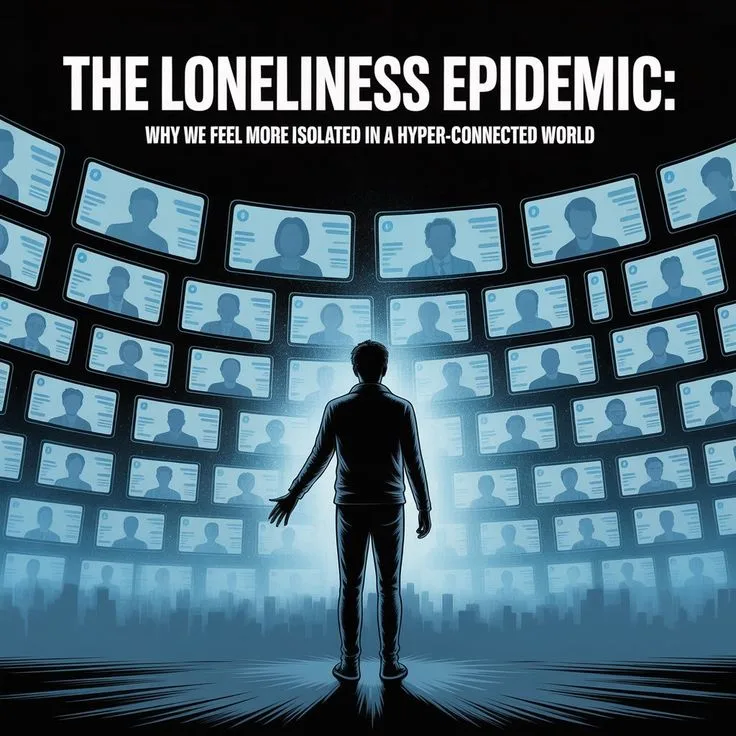
Exploring: Modern societies are wealthier, more connected, and more technologically sophisticated than at any point in human history. We carry devices that allow us to communicate with anyone on earth in seconds.
We live in cities dense with other people, work in offices shoulder to shoulder, and maintain digital contact with hundreds of acquaintances simultaneously. And yet, across the developed world, an extraordinary number of people report feeling profoundly, chronically alone.
The loneliness epidemic is not a metaphor. It is a measurable public health crisis with consequences as serious as obesity, smoking, or untreated depression.
The science of loneliness has advanced dramatically over the past two decades, largely because of the work of John Cacioppo at the University of Chicago, who spent much of his career dismantling the idea that loneliness was a simple emotional preference.
Cacioppo and his colleagues demonstrated that loneliness functions as a biological alarm system - a signal as ancient and urgent as pain or hunger - that evolved to push humans back toward the social groups that kept their ancestors alive.[1]
When that alarm fires chronically, without the possibility of relief, it sets off a cascade of physiological changes that damage the body from the inside out.
The Surgeon General of the United States made this explicit in a landmark 2023 advisory that formally declared loneliness a public health crisis. The document cited evidence that social isolation increases the risk of premature death by approximately 26 percent, a figure equivalent to smoking 15 cigarettes a day.
That comparison is deliberately arresting. Governments spend billions regulating tobacco. Loneliness, which is at least as deadly, has until very recently received almost no policy attention at all.
Understanding why loneliness has become epidemic - and what might actually address it - requires looking at biology, sociology, technology, and the design of daily life simultaneously.
"Loneliness is not the physical absence of other people. It is the sense that you are not sharing anything that matters with anyone." - John T. Cacioppo, 'Loneliness: Human Nature and the Need for Social Connection' (2008)
| Factor | How It Drives Loneliness | Evidence |
|---|---|---|
| Declining social participation | Fewer people joining civic and religious organizations | Putnam's Bowling Alone; General Social Survey data |
| Delayed marriage and family formation | Fewer household relationships in young adulthood | Rising median age of first marriage in OECD |
| Urban design | Car-dependent sprawl reduces casual encounters | Suburban isolation vs. walkable neighborhood research |
| Digital substitution | Online interaction replaces in-person connection | Twenge's iGen; screen time and loneliness studies |
| Rising single-person households | More people living alone | 1-person households now ~28% in US |
| Long work hours | Less time for relationships | Loneliness higher among overworked populations |
Key Definitions
Loneliness: The subjective, distressing experience of perceived social isolation. It is distinct from objective aloneness - a person can be physically surrounded by others and feel deeply lonely, or live alone and feel richly connected.
Cacioppo's research established that it is the perception of inadequate connection, not the fact of it, that drives the biological stress response.
Social isolation: The objective condition of having few or no social relationships. Unlike loneliness, isolation can be measured externally by counting interactions, household members, or network size. Social isolation and loneliness frequently co-occur but are not the same phenomenon and do not always respond to the same interventions.
Chronic loneliness: Loneliness that persists over months or years, as distinct from transient loneliness triggered by a specific event such as bereavement or relocation. Chronic loneliness is the form associated with severe health consequences, because it involves sustained activation of biological stress systems.
Social prescribing: A healthcare approach in which clinicians refer patients to community-based activities - gardening clubs, walking groups, volunteering - rather than or in addition to pharmaceutical treatment. The model has become central to UK loneliness policy and is spreading internationally.
Hypervigilance to threat: A cognitive pattern identified by Cacioppo in chronically lonely individuals, in which the brain becomes more alert to negative social cues and more likely to interpret ambiguous interactions as hostile. This pattern makes it harder to form new connections and can entrench loneliness as a self-reinforcing cycle.
The Biology of Being Alone
John Cacioppo's central insight, developed through decades of research with collaborators including Louise Hawkley, was that loneliness is not merely uncomfortable - it is biologically costly.[7]
In a series of studies published between 2000 and 2015, Cacioppo's team showed that lonely individuals consistently exhibit elevated levels of cortisol, the primary stress hormone, particularly in the morning. They show disrupted slow-wave sleep, the deepest and most restorative phase.
Their immune cells display altered gene expression patterns that increase inflammatory signalling while reducing antiviral defences.
The Evolutionary Logic
The explanation is evolutionary. For most of human prehistory, being separated from your social group was genuinely life-threatening.
Individuals who responded to isolation with heightened alertness - who slept more lightly, who scanned for threats, who felt motivating distress - were more likely to survive long enough to reconnect with their group.
Loneliness, in this reading, is an adaptive signal. The problem is that a system calibrated for the Pleistocene is poorly suited to modern life, where millions of people live in structural conditions that make sustained loneliness likely but where no sabre-toothed cat is about to appear. The alarm fires, but relief does not come.
Hypervigilance and the Loneliness Trap
Cacioppo's research identified a particularly cruel dimension of chronic loneliness: it changes cognition in ways that make escape harder.
Lonely individuals develop what his team called hypervigilance to social threat - a heightened sensitivity to rejection cues, a tendency to interpret neutral interactions negatively, and a defensive withdrawal from social risk-taking.
This is adaptive in the short term (if you are genuinely isolated, caution around strangers makes sense) but catastrophic over time.
The lonely person who needs connection most becomes, through no fault of their own, progressively less able to pursue it. This helps explain why loneliness tends to persist and why simply telling lonely people to 'put themselves out there' is largely unhelpful advice.
The Scale of the Crisis
American Evidence
A 2018 survey by health insurer Cigna, using the UCLA Loneliness Scale, found that 46 percent of American adults reported feeling alone sometimes or always, and 47 percent reported feeling left out.
Generation Z - those born between 1997 and 2012 - scored as the loneliest generation in the survey, which inverted the common assumption that loneliness primarily afflicts the elderly.
A follow-up Cigna survey in 2020 found the figures had worsened, and that the pandemic had dramatically accelerated trends already under way.
The Surgeon General's 2023 Advisory
In May 2023, US Surgeon General Vivek Murthy published 'Our Epidemic of Loneliness and Isolation,' a 81-page advisory that assembled the full weight of epidemiological evidence.[3] The advisory noted that Americans were spending approximately 24 fewer hours per month in person with friends compared to 2003.
It cited studies showing that social connection is as important to health as diet and exercise, and that its absence elevates risk across cardiovascular disease, dementia, stroke, depression, anxiety, and all-cause mortality.
The advisory called for a national strategy to rebuild social infrastructure, framing loneliness as a structural problem requiring structural solutions.
The UK and Global Picture
The UK Office for National Statistics reported in 2021 that approximately 3.7 million adults in England experienced chronic loneliness. The Jo Cox Commission on Loneliness, published in 2017, had estimated that nine million Britons experienced loneliness often or always.[11]
In Japan, a 2021 government survey found that more than one-third of respondents rarely or never had social interaction.
The World Health Organization established a Commission on Social Connection in 2023, chaired by Surgeon General Murthy and Africa CDC Director-General Jean Kaseya, signalling that loneliness was now considered a global health priority.
The Social Media Paradox
Jean Twenge's Research
Among the most contested and significant findings in the loneliness literature is the work of psychologist Jean Twenge, whose 2017 book 'iGen' and subsequent peer-reviewed papers documented sharp inflections in adolescent mental health indicators beginning around 2012 - precisely when smartphone ownership became near-universal among American teenagers.
Using data from the Monitoring the Future survey and the Youth Risk Behavior Survey, Twenge and colleagues found that rates of teen depression, anxiety, loneliness, and suicidality rose steeply after 2012, particularly among girls.[6]
The Displacement Hypothesis
Twenge's proposed mechanism is displacement: time spent on social media comes at the cost of the face-to-face interaction, sleep, and physical activity that support wellbeing.
This is not merely about the content encountered online, though social comparison with curated images clearly matters, but about the structural replacement of nourishing activities with ones that are engaging but not fulfilling.
Psychologist Jonathan Haidt, who co-authored research with Twenge, has argued that the smartphone-social media combination represents a 'great rewiring of childhood' that has fundamentally altered the social development environment for an entire generation.[5]
Competing Evidence
Not all researchers accept Twenge's conclusions. Andrew Przybylski at the Oxford Internet Institute has published studies suggesting the association between social media use and poor wellbeing is small and inconsistent across datasets.
Amy Orben and Przybylski's 2019 analysis using preregistered methods found that the association between screen time and wellbeing was comparable in magnitude to wearing glasses or eating potatoes.[10]
The debate remains live, but the weight of large-scale longitudinal evidence has increasingly shifted toward concern, and several major tech companies have implemented modifications to their platforms in response to regulatory pressure.
The UK Minister for Loneliness
In January 2018, Prime Minister Theresa May appointed Tracey Crouch as the UK's first Minister for Loneliness, acting on the recommendations of the Jo Cox Commission.
The commission's founding rationale - that loneliness was not a personal problem but a social and economic one costing the UK an estimated 32 billion pounds per year - represented a significant shift in how governments thought about wellbeing policy.
Social Prescribing at Scale
The minister's office funded the development of social prescribing link workers - NHS-embedded professionals whose job is to connect patients with community resources rather than clinical treatment.
A 2020 evaluation by the University of Westminster found that social prescribing significantly reduced GP appointments and emergency department visits among participants, suggesting meaningful health benefits beyond subjective wellbeing.
England's National Academy for Social Prescribing was established in 2019 to coordinate and expand the approach nationally.
The Cross-Party Loneliness Strategy
The government published a cross-departmental loneliness strategy in 2018, 'A Connected Society,' which committed to embedding loneliness considerations across housing, transport, workplace, and education policy.[12]
The strategy included requirements for new housing developments to incorporate shared spaces, and commitments to expand community volunteering opportunities.
Though implementation has been uneven, the strategy represented the most comprehensive governmental response to loneliness attempted anywhere in the world.
Health Consequences: The Evidence Base
Cardiovascular and Immune Effects
A 2010 meta-analysis by Julianne Holt-Lunstad at Brigham Young University, examining data from 148 studies covering more than 300,000 participants, found that adequate social relationships were associated with a 50 percent greater likelihood of survival compared to poor social relationships.[2]
Holt-Lunstad's work, which the Surgeon General's advisory drew on heavily, demonstrated that the mortality risk associated with social isolation exceeded that associated with obesity and was comparable to the risk from smoking.[4]
Mechanistically, social isolation activates the hypothalamic-pituitary-adrenal axis, driving cortisol elevation and systemic inflammation that damage blood vessels, impair immune surveillance, and accelerate cellular ageing.
Cognitive Decline and Dementia
A 2020 study by Andrew Sommerlad and colleagues, published in PLOS Medicine, found that poor social contact in midlife was associated with a 26 percent increased risk of developing dementia in later life.[9]
The authors proposed several pathways: loneliness may directly reduce cognitive stimulation; chronic stress may accelerate hippocampal deterioration; and social isolation may reduce access to the practical support that helps people manage early cognitive symptoms.
The Alzheimer's Society now lists social isolation as a modifiable dementia risk factor alongside hypertension, hearing loss, and physical inactivity.
What Works: Evidence-Based Interventions
Cognitive Behavioural Approaches
The most rigorously evaluated individual-level intervention for loneliness is cognitive behavioural therapy adapted to target the hypervigilant thought patterns Cacioppo identified.
A 2011 Cochrane review by Masi and colleagues analysed 50 loneliness intervention studies and found that CBT-based approaches showed the strongest effects, because they address the cognitive distortions that perpetuate loneliness rather than simply increasing social contact.[8]
Contact alone, without addressing negative social expectations, often fails to reduce loneliness.
Group-Based Community Activities
Group activities that centre on shared purpose - singing choirs, walking clubs, community gardens, creative workshops - consistently outperform purely social gatherings in reducing loneliness.
The shared task provides a reason to be together that reduces the social anxiety of unstructured interaction, creates a natural conversation focus, and generates feelings of competence and contribution that reinforce wellbeing.
Research by Stephen Clift at Canterbury Christ Church University demonstrated that community choir participation reduced loneliness and improved mental health markers across diverse adult populations.
Urban Design and Infrastructure
At the structural level, research consistently finds that built environments matter. Jane Jacobs observed in 'The Death and Life of Great American Cities' (1961) that streets designed for cars rather than pedestrians destroy the incidental encounters that build community.
Contemporary urban design research by Charles Montgomery, documented in 'Happy City' (2013), has demonstrated that cities with walkable streets, shared public spaces, and mixed-use neighbourhoods generate significantly more social interaction and report lower loneliness.[13]
These are policy levers that operate at scale, affecting millions of people without requiring individual intervention.
Practical Takeaways
The loneliness epidemic is not solved by individual effort alone, though individual choices matter. For those experiencing loneliness, the evidence suggests that seeking structured group activities with shared purpose is more effective than purely social gatherings.
Reducing passive social media consumption and replacing it with active, reciprocal digital communication shows modest but consistent benefits. Therapy that addresses negative social expectations is more effective than social exposure alone.
For policymakers and employers, the evidence supports investment in community infrastructure, social prescribing programmes, and workplace policies that prevent structural isolation - particularly among remote workers, new parents, and older adults.
For urban planners, walkability, shared spaces, and mixed-use development are proven loneliness reducers.
The Surgeon General's framing matters. Loneliness is not a personal failure. It is a public health challenge produced by structural conditions - architectural, economic, technological, and political - that have systematically eroded the conditions under which human connection flourishes.
Addressing it requires the same seriousness of purpose we bring to any other epidemic.
Sources & Further Reading
- Cacioppo, J. T., & Patrick, W. (2008). Loneliness: Human Nature and the Need for Social Connection. W. W. Norton.
- Holt-Lunstad, J., Smith, T. B., & Layton, J. B. (2010). Social relationships and mortality risk: A meta-analytic review. PLoS Medicine, 7(7), e1000316.
- Murthy, V. H. (2023). Our Epidemic of Loneliness and Isolation: The U.S. Surgeon General's Advisory on the Healing Effects of Social Connection and Community. US Department of Health and Human Services.
- Holt-Lunstad, J., Smith, T. B., Baker, M., Harris, T., & Stephenson, D. (2015). Loneliness and social isolation as risk factors for mortality: A meta-analytic review. Perspectives on Psychological Science, 10(2), 227-237.
- Twenge, J. M. (2017). "iGen: Why Today's Super-Connected Kids Are Growing Up Less Rebellious, More Tolerant, Less Happy." Atria Books.
- Twenge, J. M., Haidt, J., Joiner, T. E., & Campbell, W. K. (2020). Underestimating digital media harm. Nature Human Behaviour, 4(4), 346-348.
- Cacioppo, J. T., Hawkley, L. C., et al. (2006). Loneliness as a specific risk factor for depressive symptoms. Psychology and Aging, 21(1), 140-151.
- Masi, C. M., Chen, H.-Y., Hawkley, L. C., & Cacioppo, J. T. (2011). A meta-analysis of interventions to reduce loneliness. Personality and Social Psychology Review, 15(3), 219-266.
- Sommerlad, A., Sabia, S., Singh-Manoux, A., Lewis, G., & Livingston, G. (2019). Association of social contact with dementia and cognition. PLOS Medicine, 16(8).
- Orben, A., & Przybylski, A. K. (2019). The association between adolescent well-being and digital technology use. Nature Human Behaviour, 3(2), 173-182.
- Jo Cox Commission on Loneliness. (2017). Alone in the Crowd: Loneliness in Schools, Old People's Homes and Communities. Jo Cox Foundation.
- HM Government. (2018). A Connected Society: A Strategy for Tackling Loneliness. Department for Digital, Culture, Media and Sport.
- Montgomery, C. (2013). Happy City: Transforming Our Lives Through Urban Design. Farrar, Straus and Giroux.