
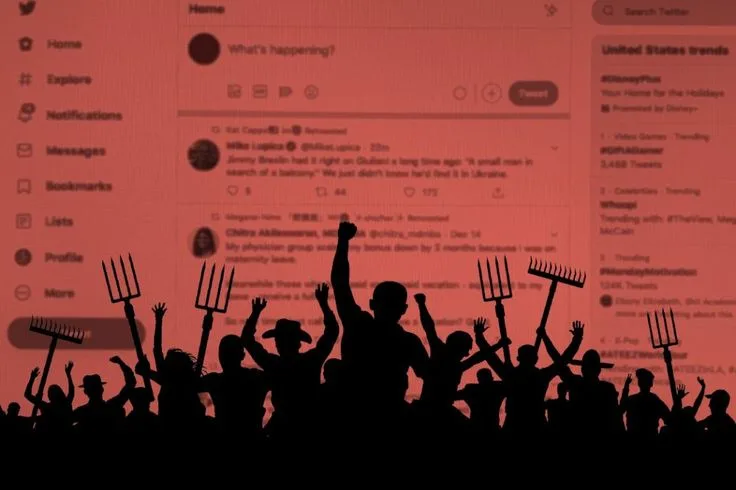
Evidence: On a Tuesday morning in 2013, a woman named Justine Sacco boarded a flight from London to Cape Town. She had 170 Twitter followers. Before boarding, she posted a joke - awkward, arguably offensive, certainly misjudged - about AIDS in Africa.
It was the kind of tweet that might have passed unnoticed in most circumstances. While she was in the air, completely unreachable, the tweet was screenshotted, amplified, and spread across the internet. A hashtag tracked her landing.
When she turned on her phone, she discovered that her career was over, that she had been the number one trending topic on Twitter for hours, and that strangers around the world had spent their Tuesday following her flight with what can only be described as anticipatory relish. The modern cancel culture had found its template.
Jon Ronson, who wrote about Sacco's case in So You Have Been Publicly Shamed (2015), observed that what happened to her was not straightforwardly about the tweet.[1]
It was about what public shaming, newly scaled to global reach by social media, does to human psychology - both in the person being shamed and in the thousands of people who participated in her humiliation.
The participants were, individually, mostly reasonable people. Collectively, they were something else: a self-reinforcing cascade of moral performance in which the signalling of outrage was as important as the outrage itself.
Cancel culture is one of the most contested terms in contemporary discourse, partly because it describes a genuinely heterogeneous set of phenomena.
The same label is applied to the downfall of Harvey Weinstein - whose systematic predation was documented over years and whose removal from positions of power represents a clear case of accountability - and to the brief social media firestorm that damages a private individual's livelihood for a comment that attracted attention it would not otherwise have received.
Understanding how cancel culture works requires disaggregating these cases.
"The rush to condemn reflects not just outrage at the offence but pleasure in the condemning - the warm sensation of being on the right side, publicly, at low personal cost." - Jon Ronson, So You Have Been Publicly Shamed (2015)
Key Definitions
Cancel culture - The broad set of practices by which individuals or groups use social media and related digital platforms to withdraw support from, stigmatize, and campaign against individuals perceived to have committed social offences.[5]
The term is contested: critics apply it broadly; defenders argue it describes legitimate accountability and that the term is used to suppress justified criticism.
Social contagion - The spread of behaviours, emotions, or ideas through a social network, analogous to the spread of a pathogen.
Online moral outrage displays contagion dynamics: once a critical mass of expression is visible, conformity pressures and amplification mechanisms drive further participation, sometimes independently of participants' individual judgements about severity.
Moral outrage - A strong negative emotional response to perceived violations of ethical norms, associated with motivations to punish the violator and restore the moral order.
When expressed publicly, moral outrage often has performative functions - signalling the expresser's own virtue to an audience - which can make it self-sustaining independently of the actual severity of the offending behaviour.
Digital permanence - The quality of digital records whereby content, once indexed and cached by search engines and archival services, is effectively permanent and indefinitely retrievable. Digital permanence means that offences for which individuals might otherwise be forgiven remain searchable and re-surfaceable indefinitely.
Proportionality - The principle that punishment should be commensurate with the severity of an offence.
Cancel culture's critics most frequently cite a proportionality failure: the mechanisms of online shaming have no built-in proportionality calibration, so consequences can vastly exceed what any deliberate accountability system would impose.
Reintegrative shaming - John Braithwaite's distinction between shaming that labels the individual as fundamentally bad and excludes them (stigmatizing shaming) versus shaming that condemns the act while maintaining community membership and offering a restoration path.[4] Cancel culture typically resembles the former.
Accountability or Punishment: Case Typology
Not all "cancellations" are equivalent. The following typology helps distinguish cases that differ substantially in their moral character.
| Type | Example | Evidence Standard | Proportionality | Accountability Value |
|---|---|---|---|---|
| Documented serious misconduct | Harvey Weinstein; Bill Cosby | Extensive, corroborated | High - career/legal consequences appropriate | High - removes predators from positions of power |
| Credible but contested allegations | Many #MeToo cases | Partial, contested | Variable - risk of injustice | Moderate - depends on process quality |
| Past statements by public figures | Old offensive tweets | Low evidentiary bar | Often disproportionate - context lost | Low-moderate - selective exposure risk |
| Jokes/satire misread | Justine Sacco type | Minimal - intent ignored | Very disproportionate | Very low - punishes ambiguity |
| False or coordinated allegations | Manufactured pile-ons | None | Completely disproportionate | Negative - produces injustice |
| Legitimate criticism / accountability | Boycotts for genuine policy | Transparent | Proportionate | Positive - legitimate speech act |
The History and Evolution of Public Shaming
Before Social Media
Public shaming is not a social media invention. Stocks and pillories in medieval Europe, public floggings, scarlet letters sewn onto clothing - these were formalized, state-sanctioned mechanisms for deploying communal shame as a deterrent and punishment.
The difference between these historical practices and their contemporary digital counterparts is one of scale, speed, and the removal of institutional oversight.
In pre-digital societies, shaming events were constrained by geography and time. A community might know about someone's transgression, but news travelled slowly and community memory faded.
The absence of a permanent record meant that rehabilitation was structurally possible - the community's knowledge was impermanent, and a person could move elsewhere and start over.
The nineteenth and early twentieth centuries produced new forms of public shaming through mass media: newspapers running sensational stories about individuals, names published in courts listings, social ostracism coordinated through community networks.
These could be devastating, but they operated within communities that shared context about the individuals involved. A neighbour who knew you, your family, and your circumstances was making a different kind of judgement than a stranger reading a screenshot on the other side of the world.
The Digital Transition
The transition to digital public shaming created several structural changes that made it qualitatively different from its predecessors. A 2014 Pew Research Center study found that 40 percent of American internet users had personally experienced online harassment, and 73 percent had witnessed someone else being harassed online.[12]
By 2021, that figure had risen: a follow-up Pew study found that 41 percent of Americans had personally experienced online harassment, with young women disproportionately affected.
What makes digital shaming distinctive is the combination of global reach, permanent record, and zero marginal cost of participation. A tweet costs nothing to retweet.
A pile-on that would have required coordinated effort across a community can assemble itself spontaneously in hours through platform amplification mechanisms, requiring no relationship between the participants and no shared context about the target.
The Psychology of Online Pile-Ons
Group Polarisation
Cass Sunstein's research on group polarisation identifies a robust social phenomenon: when people deliberate primarily with others who share their views, their positions become more extreme rather than more moderate.[2] This applies to online moral outrage in predictable ways.
A condemnation that begins in one ideologically coherent community attracts amplification from similar communities, each iteration receiving more extreme endorsement than the last. Moderating voices self-censor under what Sunstein calls the "chilling effect" of visible group consensus.
Research published in 2017 in the Proceedings of the National Academy of Sciences by William Brady and colleagues at Yale University found that moral outrage expressions on Twitter spread significantly faster than non-outrage content, and that the emotional language in those expressions became more extreme as they were retweeted further from the original source.[10]
The amplification process strips context and adds emotional intensity - a combination that makes proportionate judgment nearly impossible.
Performative Outrage
Matthew Feinberg and colleagues at the Rotman School of Management published research in 2020 documenting what they called "virtuous outrage" - the finding that public expressions of moral outrage are often more strongly motivated by the desire to appear virtuous to an audience than by the intensity of the underlying moral conviction.
The implication for cancel culture is significant: pile-ons may sustain themselves partly as social signalling exercises in which individuals express condemnation to assert their own moral standing, irrespective of whether additional condemnation serves any useful accountability function.
The signal is asymmetric: expressing condemnation is low-cost and socially rewarded; expressing measured disagreement or concern about proportionality risks appearing to defend the target. This asymmetry ensures that pile-ons contain more condemnation than the underlying distribution of views would predict.
The Bystander Dynamic
Social psychological research on conformity, building on Solomon Asch's classic line experiments, demonstrates that individuals routinely suppress private judgements to align with apparent group consensus.
In cancel culture contexts, this produces a documented dynamic: many participants in pile-ons privately believe the response is disproportionate but do not say so, because doing so risks becoming a secondary target.
This silence is read by others as further evidence of consensus, amplifying the apparent unanimity of condemnation.
The result is a social performance that misrepresents the actual distribution of views in the participating community - what Elisabeth Noelle-Neumann called the "spiral of silence": the public expression of a view that is more extreme than what most participants privately hold.[9]
Identity Threats and Moral Licensing
Psychological research on moral licensing adds a further layer to the pile-on dynamic. When people believe they have established their credentials as good, moral people, they often feel licensed to behave less ethically in subsequent interactions.
Participating in the public condemnation of someone perceived as morally bad can serve as a form of moral credentialing - after which the participant may feel genuinely entitled to greater condemnation, harsher language, and less concern about accuracy.
A 2019 study in the Journal of Experimental Social Psychology found that people who had recently performed a prosocial act were subsequently more likely to engage in antisocial behaviour toward a target they perceived as morally deficient.
The moral licensing effect suggests that pile-ons can accelerate in intensity as participants build their sense of righteous credentials.
The Architecture of Amplification
Platform Incentive Structures
Social media platforms are architecturally designed to maximise engagement, and outrage is one of the most reliably engaging emotions. Twitter (now X), Facebook, Instagram, and TikTok all use engagement signals - shares, comments, reactions - as primary inputs to recommendation algorithms.[7]
Content expressing moral outrage generates high engagement, so platforms organically amplify it.
Molly Crockett at Oxford and later Yale published research in 2017 in Nature Human Behaviour arguing that digital media had fundamentally changed the ecology of moral outrage by removing the social friction that historically constrained its expression.[3]
Expressing outrage in person requires effort and social risk. Expressing it online costs nothing and carries social rewards. This imbalance means outrage is expressed more frequently, more casually, and with less deliberation than it would be in face-to-face social environments.
A key finding from Crockett's research is that digital expressions of moral outrage are also less responsive to feedback about their social consequences.
In face-to-face contexts, visible distress from a target typically modulates the intensity of shaming; in online contexts, the target's distress is invisible or filtered, removing the natural brake that inhibits escalation.
Coordinated vs Organic Cascades
Not all cancel culture events are purely organic. Research documented that coordinated inauthentic behaviour - organized groups deliberately amplifying content to trigger cancellation events - is a real phenomenon that distorts the apparent scale of public condemnation.
Some cancellations that appear to represent widespread public outrage have been substantially driven by small numbers of highly coordinated actors who understood how to exploit platform amplification mechanisms.
This makes distinguishing genuine social accountability from manufactured outrage difficult for both targets and observers.
A 2022 analysis by researchers at Stanford Internet Observatory found that coordinated inauthentic behaviour was involved in a significant percentage of major online harassment campaigns they examined, though determining exact proportions remains methodologically challenging.
The implication is that what looks like broad social consensus against an individual may in many cases be a manufactured appearance of consensus.
The Attention Economy Context
Cancel culture did not emerge in a vacuum. It emerged within what critics have called the attention economy - a commercial ecosystem in which platforms profit from human attention, which makes the most attention-capturing content the most economically valuable.
Outrage, conflict, and moral condemnation are among the most reliable attention-capturing formats.
Tim Wu's 2016 book The Attention Merchants traces the history of industries built on selling attention and documents how the logic of attention capture shapes media content.[11]
In this framework, cancel culture events are not simply spontaneous social phenomena but are partially produced by an economic environment that systematically rewards content generating maximum engagement, which includes the most intense condemnation available.
The Proportionality Problem
The debate about proportionality is best illustrated by examining specific cases. The cancellations that most forcefully raised the proportionality question have not typically been cases of serious documented misconduct - in those cases, few critics argue that consequences were unfair.
The difficult cases involve ambiguity: jokes taken out of context from years or decades in the past; statements that were controversial rather than clearly harmful; conduct ordinary by the standards of its time but considered unacceptable by contemporary norms; or allegations that were unverified but spread as fact.
The Temporal Problem
One of the most vexed proportionality issues in cancel culture involves historical statements - tweets, posts, or public comments made years or decades before they became controversial.
The cultural context of discourse changes over time, and statements that were unremarkable by the standards of 2005 may be read as deeply offensive by the standards of 2025.
This creates a retroactive accountability that applies contemporary norms to past behaviour without the individual having had any opportunity to know they were in violation.
The philosopher J.S. Mill's harm principle provides limited guidance here: a statement that caused no harm when made, and that the speaker would not make today, raises different accountability questions than a statement that was harmful at the time and reflected a genuine, persistent attitude.
Cancel culture typically cannot distinguish between these cases because it lacks the deliberative process necessary to investigate context and intent.
The Absence of Process
The deepest problem with cancel culture as an accountability mechanism is not that it punishes people - all accountability systems involve costs - but that it has no process. There is no standard of evidence. There is no mechanism for hearing the subject's account.
There is no deliberation about appropriate consequences proportionate to the offence. There is no appeal.
This absence of process means that cancel culture cannot reliably distinguish between genuine misconduct and false accusations, between serious harm and minor offence, or between appropriate condemnation and mob behavior.
These are not exotic failures; they are inevitable consequences of substituting unstructured social media dynamics for deliberate accountability processes.
A 2020 Harvard Kennedy School working paper by Pippa Norris analysed cases of high-profile cancellations and found that the severity of social media condemnation bore no consistent relationship to the severity of the underlying offense.[6]
Minor transgressions occasionally generated massive pile-ons while genuinely harmful behavior sometimes went unaddressed - a pattern consistent with viral dynamics driven by engagement mechanics rather than proportionate moral judgment.
What Research Says About Accountability Versus Punishment
Does Shaming Change Behaviour?
John Braithwaite's influential 1989 book Crime, Shame and Reintegration distinguished between "stigmatising shaming" - which labels the individual as fundamentally bad and excludes them - and "reintegrative shaming" - which condemns the act while maintaining community membership and offering restoration.
Braithwaite found that stigmatising shaming tends to increase social exclusion and recidivism, while reintegrative approaches better achieve stated goals of changing behavior and repairing harm.
Cancel culture, as typically practised, closely resembles stigmatising shaming. It focuses on the individual's character rather than the act, offers no clear path to restoration, and often involves permanent exclusion from social and professional communities.
By Braithwaite's framework, this is the least effective form of accountability available.
The Effect on Public Discourse
A particularly well-documented concern about cancel culture's operation is its effect on public discourse beyond the specific cancellation events.
Research by political scientists found that fear of social media pile-ons produces significant self-censorship among academics, journalists, and public commentators - particularly on topics where the risk of misinterpretation is high.
A 2020 Cato Institute survey found that 62 percent of American adults said the political climate prevented them from sharing their views, including 52 percent of Democrats and 77 percent of Republicans.[13]
Among academics specifically, a 2021 survey by the Foundation for Individual Rights in Education found that 74 percent of faculty members censored themselves in the classroom at least some of the time due to fear of controversy.
This chilling effect means that cancel culture's costs extend well beyond its direct targets.
Targets' Psychological Outcomes
Research on the psychological impacts of being targeted by online pile-ons documents severe and sometimes permanent harms.
A 2019 study in Cyberpsychology, Behavior, and Social Networking found that targets of coordinated online harassment experienced rates of post-traumatic stress symptoms comparable to those seen in survivors of physical assault.
Sleep disruption, anxiety, depression, and social withdrawal were consistently documented across studies.
Monica Lewinsky, in her role as an anti-bullying advocate since 2015, has been a particularly articulate voice on these harms.[8]
Her own experience - subjected to global public humiliation from 1998 before the concept of online pile-ons existed in its modern form - was, as she described, managed without the support networks or cultural vocabulary that exist now for understanding online harassment trauma.
The psychological harm of being the target of mass public condemnation is not hypothetical; it is documented in multiple populations across multiple studies.
Digital Permanence and Second Chances
Human social life has always involved mechanisms for forgiveness and restoration after acknowledged wrongdoing. These mechanisms depend partly on the fading of memory: as time passes and individuals change, communities have been able to reassess their judgements.
Digital permanence disrupts this by making past conduct permanently accessible. A statement made at 22 that would otherwise be forgotten by 42 is instead searchable, indexable, and re-surfaceable to any context at any time.
This creates a moral philosophy problem that society has not yet seriously grappled with.
If a person is not simply the sum of their worst moments, and if genuine change is possible, then a record system that makes every worst moment permanently accessible raises profound questions about whether genuine rehabilitation is compatible with digital permanence.
Recovery Trajectories
The evidence on recovery from cancellation is highly variable and correlates strongly with the severity of the underlying misconduct and the person's prior resources.
High-profile individuals with significant cultural capital - established entertainers, writers, prominent intellectuals - have in some cases successfully reintegrated into public life after periods of exile.
The capacity to reframe the narrative, access sympathetic media platforms, and wait out the news cycle all depend on resources that most private individuals subject to pile-ons do not have.
Monica Lewinsky, who became the subject of perhaps the most intense public shaming of the early internet era following her relationship with President Clinton in 1998, has become an important voice on the harm of online shaming and the possibilities of recovery.
Her 2015 TED Talk The Price of Shame demonstrated that it is possible to reframe a narrative from victim to advocate - but only with extraordinary personal resources and over a very long time.
For private individuals with no public platform, recovery is far more difficult. The Justine Sacco case illustrates this: years after the incident, Sacco was still dealing with the consequences - new employers Googling her name, social relationships affected by what strangers had read.
The asymmetry between how quickly someone can be destroyed by a pile-on and how slowly they can rebuild is one of the most morally troubling aspects of cancel culture as a social practice.
The International Dimension
Cancel culture is not solely an American phenomenon, but it has taken different forms in different cultural and political contexts. Understanding this variation illuminates what is structural and what is culturally specific about the phenomenon.
Authoritarian Uses of Cancellation Logic
In China, social credit systems and state-orchestrated public shaming campaigns represent a state-directed version of cancellation logic - the withdrawal of social and economic participation from individuals who violate norms, at a scale and with a permanence that makes Western social media pile-ons look temporary by comparison.
The Chinese government's use of public humiliation campaigns against political dissidents and ethnic minorities demonstrates that the tools of cancellation can be deployed systematically by state actors with far more devastating consequences than private social media dynamics.
This comparison is not made to equate Western cancel culture with authoritarian practice - the differences in state power and coercive capacity are enormous.
It is made to illuminate the underlying logic: public withdrawal of social participation as punishment for perceived norm violation is a power mechanism that operates across very different political contexts.
European Responses
Several European countries have moved to regulate aspects of digital public harassment through legal frameworks that do not exist in the United States.
Germany's Network Enforcement Act (NetzDG), enacted in 2017, requires social media platforms with more than two million users to remove clearly illegal content within 24 hours of notification.
France has enacted legislation specifically addressing online mob harassment. These regulatory responses acknowledge that the free speech framework applied to online harassment in the US creates different trade-offs than the European approach, which gives somewhat more weight to protection from harassment.
Practical Takeaways
Cancel culture, as a concept, bundles genuinely different phenomena: legitimate accountability for serious misconduct, disproportionate pile-ons for ambiguous offences, and everything in between. The appropriate response is not to defend misconduct in the name of anti-cancellation nor to endorse every pile-on as accountability.
It is to apply the standards of evidence, proportionality, and procedural fairness that we would expect of any other accountability system.
For individuals navigating digital public life, the evidence suggests taking pauses before expressing moral outrage, considering whether condemnation serves accountability or performance, and recognising that silence in the face of pile-ons is not neutral but participates in the distorted consensus.
For institutions, the evidence supports building genuine accountability processes - with evidence standards, proportionality considerations, and appeals mechanisms - rather than deferring to social media dynamics as a substitute for deliberate judgment.
For platforms, the research points clearly toward architectural changes: reducing the amplification of content expressing moral outrage, introducing friction into the process of sharing condemnation, and creating better mechanisms for distinguishing coordinated inauthentic campaigns from genuine public sentiment.
Several platform researchers have proposed specific interventions - delayed sharing of content flagged as potentially harassing, prompts asking users to confirm they have read content before sharing it - that could reduce the worst pile-on dynamics without compromising legitimate public discourse.
The deeper question that cancel culture raises is one of social epistemology: what do we think accountability is for? If the purpose of accountability is to change harmful behaviour, deter future offences, and repair harm where possible, then stigmatising pile-ons without process are among the least effective tools available.
If the purpose is to signal community values, perform moral identity, and demonstrate membership in the right tribe, then pile-ons are extremely well-suited to those goals - which is precisely why they persist.
Sources & Further Reading
- Ronson, J. (2015). So You Have Been Publicly Shamed. Riverhead Books.
- Sunstein, C. R. (2009). Going to Extremes: How Like Minds Unite and Divide. Oxford University Press.
- Crockett, M. J. (2017). Moral outrage in the digital age. Nature Human Behaviour, 1(11), 769-771.
- Braithwaite, J. (1989). Crime, Shame and Reintegration. Cambridge University Press.
- Clark, M. D. (2020). DRAG THEM: A brief etymology of so-called 'cancel culture.' Communication and the Public, 5(3-4), 88-92.
- Norris, P. (2021). Cancel Culture: Myth or Reality? Working Paper, Harvard Kennedy School.
- Vaidhyanathan, S. (2018). Antisocial Media: How Facebook Disconnects Us and Undermines Democracy. Oxford University Press.
- Lewinsky, M. (2015). The price of shame. TED2015 Conference. TED.com.
- Noelle-Neumann, E. (1984). The Spiral of Silence: Public Opinion - Our Social Skin. University of Chicago Press.
- Brady, W. J., Wills, J. A., Jost, J. T., Tucker, J. A., & Van Bavel, J. J. (2017). Emotion shapes the diffusion of moralized content in social networks. Proceedings of the National Academy of Sciences, 114(28), 7313-7318.
- Wu, T. (2016). The Attention Merchants: The Epic Scramble to Get Inside Our Heads. Knopf.
- Pew Research Center. (2021). Online Harassment 2021. Pew Research Center.
- Cato Institute. (2020). The State of Free Speech and Tolerance in America. Cato Institute National Survey.
Further Reading
- Feinberg, M., Willer, R., & Kovacheff, C. (2020). The activist's dilemma: Extreme protest actions reduce popular support for social movements. Journal of Personality and Social Psychology, 119(5), 1086-1111.