
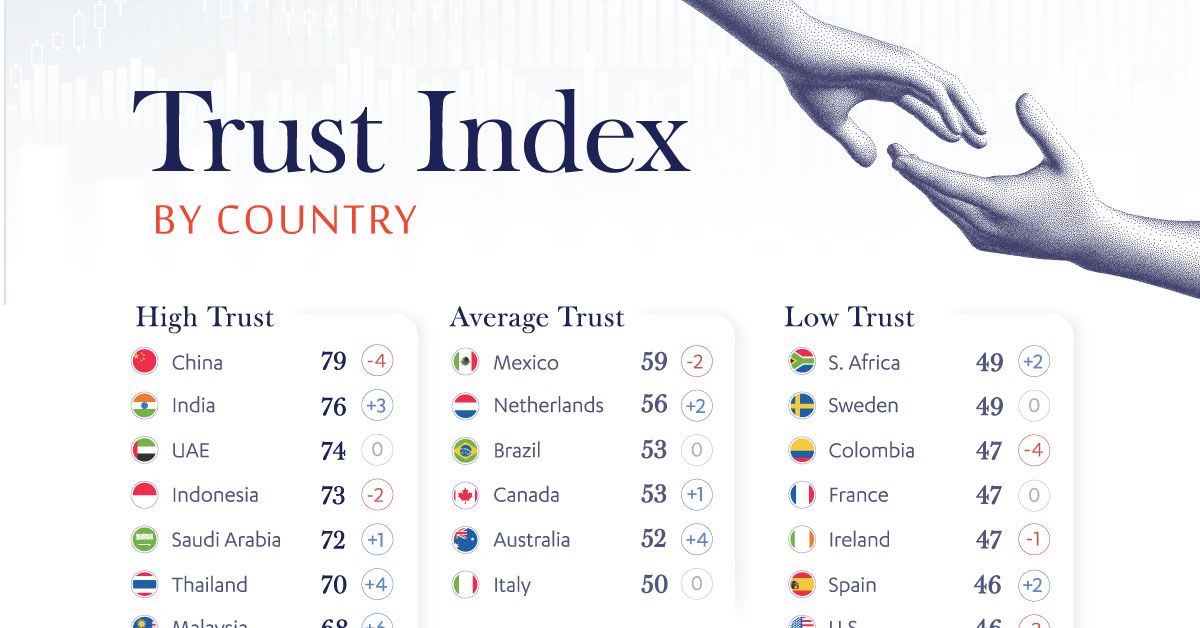
Institutional trust is the generalized belief that an institution - government, media, judiciary, scientific body, or religious organization - acts with competence, benevolence, and integrity toward the public it serves.
Across nearly every major democracy, this trust has been declining for decades, accelerating sharply after the 2008 financial crisis, the COVID-19 pandemic, and the rise of algorithmically driven social media.
Understanding why trust is collapsing, what the data actually shows, and what evidence-based strategies can reverse the decline is among the most urgent questions facing democratic societies today.
There is a scene that has played out in various forms across every major democracy over the past two decades. A government announces a policy. Journalists investigate and find contradictions. Officials revise their position. Social media amplifies every contradiction and revision into evidence of deliberate deception.
A significant portion of the population concludes that the institution cannot be trusted. The cycle repeats. The trust deficit widens.
And gradually, the social infrastructure that makes collective action possible - the shared belief that institutions, however imperfect, are basically trying to serve the public good - erodes into something more brittle and dangerous.
The decline of institutional trust is one of the most consequential developments in contemporary democratic societies, and also one of the least well understood.
It is tempting to explain it as a product of deliberate disinformation campaigns, or of social media algorithms, or of individual politicians who have cynically weaponized distrust for electoral advantage.
All of these factors are real. But the deeper story is more structural: institutions have, in many cases, genuinely failed the people they were supposed to serve, and people have noticed.
The question of how to rebuild trust cannot be separated from the question of how to rebuild institutional performance.
The Edelman Trust Barometer, the most comprehensive long-running measurement of institutional trust globally, has been documenting this erosion since 2000. The 2024 report found that only a minority of respondents in most developed democracies trusted their governments.
More strikingly, the report found that 57 percent of people globally described their countries as more divided than united - a figure that would have seemed extraordinary to social scientists twenty years ago.
Understanding where this distrust comes from, what sustains it, and what the evidence suggests about reversing it is urgent work for anyone who cares about the future of democratic governance.
"The arc of distrust bends not toward cynicism as a destination but toward disengagement - and disengagement is what authoritarians have always depended on." - Francis Fukuyama, 'Trust: The Social Virtues and the Creation of Prosperity' (1995)
The Data at a Glance
| Institution | Trust Level (US, c.2023) | Trust Level (1970s) | Change | Source |
|---|---|---|---|---|
| Military | ~60% | ~70% | Moderate decline | Gallup Historical Trends |
| Small business | ~65% | ~68% | Stable | Gallup Historical Trends |
| Supreme Court | ~27% | ~49% | Sharp decline (-22 pts) | Gallup 2022 |
| Congress | ~8% | ~42% | Severe decline (-34 pts) | Gallup 2023 |
| Television news | ~14% | ~46% | Severe decline (-32 pts) | Gallup 2023 |
| Newspapers | ~18% | ~39% | Sharp decline (-21 pts) | Gallup 2023 |
| Big business | ~14% | ~26% | Moderate decline | Gallup 2023 |
| Medical system | ~34% | ~80% | Severe decline (-46 pts) | Gallup 2023 |
| Public schools | ~26% | ~58% | Sharp decline (-32 pts) | Gallup 2023 |
The scale of these declines is difficult to overstate. Congress has gone from being trusted by nearly half the population to being trusted by fewer than one in ten. The medical system, once trusted by 80% of Americans, is now trusted by roughly a third.
These are not minor fluctuations. They represent a fundamental restructuring of the relationship between citizens and the institutions that organize democratic society.
Key Concepts for Understanding Institutional Trust
The Edelman Trust Barometer: An annual survey of approximately 32,000 respondents across 28 countries, conducted by the public relations firm Edelman since 2000. The barometer measures trust in four pillars - government, business, media, and NGOs - and has become the most widely cited longitudinal dataset on institutional trust globally.
Trust gap: The divergence in institutional trust between high-income, high-education populations and lower-income, lower-education populations.
Edelman data consistently shows a widening gap, with the informed elite trusting institutions significantly more than the mass population - a pattern associated with political volatility and populist movements.
In the 2024 Edelman report, the trust gap between the top and bottom income quartiles was 16 percentage points in the US and 19 points in the UK.
Epistemic crisis: The broader phenomenon in which societies lose shared frameworks for establishing what is true. Declining trust in media and scientific institutions contributes to epistemic crisis by leaving people without reliable arbiters of factual disputes.
Jonathan Rauch's 2021 book The Constitution of Knowledge frames this as a fundamental threat to democratic self-governance, arguing that the institutions that produce reliable knowledge - science, journalism, the courts - depend on public trust to function.
Social capital: The networks of relationships, norms of reciprocity, and associated trust that enable people to cooperate effectively.
Political scientist Robert Putnam's landmark research in Bowling Alone (2000) documented declining social capital in the United States from the 1960s onward, arguing that reduced civic participation and community engagement both reflected and reinforced declining institutional trust.
Putnam found that every measure of civic engagement he tracked - from voter turnout to club membership to dinner party attendance - had declined by 25 to 50 percent between 1965 and 2000. This matters because social norms and interpersonal trust form the foundation on which institutional trust is built.
The Edelman Data: What the Numbers Show
A Long Decline With Sharp Punctuations
The Edelman Trust Barometer's longitudinal data shows that the decline in trust is neither linear nor uniform. Certain events - the 2008 financial crisis, the exposure of government surveillance programs by Edward Snowden in 2013, the COVID-19 pandemic - produced sharp downward inflections.
Other periods showed partial recovery. But the overall trend across most Western democracies has been persistently downward, and recovery episodes have not restored previous baselines.
The 2022 report, published during the Omicron phase of the pandemic, found what Edelman called "a collapse of trust" in government in many countries. The US government's trust score fell to 39 percent. France fell to 35 percent.
The UK to 36 percent. These are not figures consistent with a functioning democratic relationship between citizens and their governments.
Pew Research Center's longitudinal data tells a similar story with an even longer baseline. In 1958, 73% of Americans said they trusted the federal government to do what is right "most of the time" or "just about always." By 2023, that figure was 16%.
The decline was not steady - it dropped during Vietnam and Watergate, recovered partially under Reagan, dropped again after the Iraq War, recovered slightly after 9/11, and then entered a sustained decline from which it has not recovered.
Business vs Government: An Inversion
One of the most striking patterns in the Edelman data is that trust in business has held up considerably better than trust in government and media. In the 2024 report, business was the most trusted institution globally at 62%, compared to 50% for NGOs, 47% for government, and 43% for media.
In many countries, more people trust "my employer" to tell the truth than trust the government or press.
This inversion has significant implications. It suggests that people have not become uniformly cynical - they are capable of extending trust when they perceive competence and relative honesty.
It also raises concerning questions about what it means for democratic societies when commercial institutions are more trusted than governmental ones.
Historian Jill Lepore at Harvard has argued that this reflects a dangerous privatization of public trust - a shift that weakens the shared civic infrastructure that democracies require.
The Generational Dimension
Roberto Stefan Foa and Yascha Mounk published a landmark analysis in the Journal of Democracy in 2016 titled "The Danger of Deconsolidation," which found that support for democratic institutions was significantly lower among younger cohorts in established democracies than among older ones.
Only 30 percent of Americans born in the 1980s said it was "essential" to live in a democracy, compared to 75 percent of those born in the 1930s.
Subsequent research has debated the precise interpretation of these findings - political scientist Erik Voeten at Georgetown argued in 2017 that the survey question may measure satisfaction with current democracy rather than commitment to democratic principles - but the generational gradient in institutional trust is real and documented across multiple datasets, including the World Values Survey and the European Social Survey.
Why Institutions Lost Public Confidence
The 2008 Financial Crisis
No single event did more to undermine trust in Western institutions than the 2008 global financial crisis.
The crisis demonstrated, in the most visceral possible way, that the institutions responsible for managing the economy - central banks, regulatory agencies, major financial corporations, and the governments that oversaw them - had either catastrophically failed or had been captured by the interests they were supposed to regulate.
What made it worse was what came after. The banks were bailed out to the tune of $700 billion in the US alone (the Troubled Asset Relief Program). Their executives were largely not prosecuted - the Department of Justice charged no senior Wall Street executives with fraud related to the crisis.
Many continued to receive large bonuses while millions of ordinary people lost homes and jobs. The Federal Reserve reported that US household net worth fell by $13 trillion between 2007 and 2009, with the losses disproportionately borne by middle-class and lower-income families whose wealth was concentrated in home equity.
The asymmetry between institutional failure and institutional accountability was glaring and indelible.
A 2012 study by Stevenson and Wolfers in the American Economic Review found that trust in financial institutions dropped by 23 percentage points between 2006 and 2010, with the sharpest declines among people who experienced foreclosure or job loss.
This is closely related to how ethical failures happen in organizations - the institutional structures that were supposed to prevent catastrophic risk-taking had been systematically weakened by the institutions themselves.
Intelligence Failures and the Iraq War
The intelligence failures that preceded the invasion of Iraq in 2003 - and the subsequent revelation that officials in multiple governments had presented intelligence they knew to be unreliable as definitive - created lasting damage to trust in government truth-telling.
The Chilcot Report in the UK, published in 2016 after a seven-year inquiry, concluded that the decision to invade Iraq was "not a last resort" and that the intelligence had been presented with "unwarranted certainty." In the US, the Senate Select Committee on Intelligence concluded in 2008 that senior Bush administration officials had made public statements that were "not supported by the intelligence."
For people who had marched in protest against the war - an estimated 6 to 10 million people worldwide on February 15, 2003, in the largest coordinated protest in human history - the inquiries confirmed what they had suspected.
For those who had trusted their governments, it was a significant blow.
Political scientist John Mueller at Ohio State documented that the Iraq War produced a lasting "credibility deficit" for government claims about national security, comparable to the post-Vietnam credibility gap of the 1970s.
This deficit manifested during COVID-19, when public health directives were met with skepticism partly rooted in a generalized distrust of government claims.
COVID-19 and the Science Communication Collapse
The COVID-19 pandemic placed enormous strain on institutional trust in ways that varied significantly by country. In some nations, particularly those with high baseline trust and competent public health systems - New Zealand, Denmark, South Korea - institutions responded effectively and maintained public confidence.
In others, particularly the United States and the United Kingdom, confusing and sometimes contradictory guidance from health authorities - on mask wearing, school closures, the origins of the virus - was amplified by social media into something that looked, to many observers, like institutional dishonesty rather than genuine scientific uncertainty.
Nicholas Christakis at Yale documented extensively how the pandemic interacted with pre-existing trust deficits to produce divergent outcomes across societies.
His 2020 book Apollo's Arrow argued that trust in public health institutions was among the most important variables determining compliance with epidemic control measures - and that once eroded, it was extraordinarily difficult to restore during an active emergency.
The communication failure was partly structural. Science operates through a process of hypothesis, evidence gathering, revision, and gradual convergence on reliable conclusions. This process is inherently uncertain in early stages.
The public, accustomed to institutions speaking with authority, interpreted uncertainty and revision as incompetence or deception.
Researcher Kathleen Hall Jamieson at the University of Pennsylvania's Annenberg Public Policy Center documented how the shifting guidance on masks - from "not recommended" in early 2020 to "strongly recommended" by mid-2020 - became a primary talking point for those arguing that public health institutions could not be trusted.
The guidance changed because the evidence changed, but the communication infrastructure was not designed to convey that nuance at scale.
Social Media Fragmentation and the Amplification of Distrust
How Algorithms Shape Perception
Platforms designed to maximize engagement have an inherent tendency to amplify institutional failures. A government policy working smoothly generates no shares. A government policy failing spectacularly generates enormous engagement.
Over time, the information environment that social media creates is systematically skewed toward institutional dysfunction, giving users a distorted picture of how often institutions succeed or fail.
Eli Pariser introduced the concept of the "filter bubble" in his 2011 book of that name, arguing that algorithmic personalization was creating information cocoons that reinforced existing beliefs rather than exposing users to challenging evidence.
More recent research has nuanced this picture - a 2023 study by Nyhan et al. published in Science found that Facebook's algorithm changes had a measurable but modest effect on political attitudes during the 2020 US election, suggesting that filter bubbles are less hermetically sealed than Pariser proposed.
However, the basic dynamic of algorithmic amplification of outrage and distrust is well-documented.
Research by William Brady and colleagues at Yale, published in the Proceedings of the National Academy of Sciences (2017), found that each moral-emotional word in a social media post increased its sharing rate by approximately 20%.
Since institutional failures naturally generate moral outrage and institutional successes do not, the algorithmic environment creates a systematic selection bias toward content that erodes trust.
This is a pattern that affects how internet culture forms and how information spreads in digital environments.
The Speed Asymmetry
Institutions operate slowly. They gather evidence, consult stakeholders, revise positions based on new information, and communicate through official channels. Social media operates at the speed of a retweet.
This creates a fundamental asymmetry: by the time an institution has a considered response to a crisis, the social media narrative has already hardened.
The responsible behavior of revising guidance as evidence changes - which science demands - looks, in a social media environment, like inconsistency or dishonesty.
Renee DiResta, research manager at the Stanford Internet Observatory, has documented how this speed asymmetry allows misinformation to establish narrative dominance before institutional corrections can reach the same audience.
Her research shows that corrective information typically reaches only 10 to 20 percent of the audience that saw the original false claim - a structural problem that no amount of institutional communication improvement can fully address.
Political Polarization and Partisan Trust
Trust as Political Alignment
One of the most troubling developments in institutional trust research is the extent to which trust has become polarized along partisan lines.
Research by political scientists Matthew Levendusky and Neil Malhotra, published in Political Communication (2016), found that trust in institutions now tracks partisan identity to a remarkable degree: Republicans trust institutions under Republican governments; Democrats trust them under Democratic ones.
Pew Research Center quantified this pattern precisely in 2023: trust in the federal government was 24 percentage points higher among members of the party controlling the White House than among the opposition party. This gap has roughly tripled since the 1970s.
The implication is that what appears to be a generalized decline in institutional trust is partly a phenomenon of motivated reasoning - people distrust institutions controlled by political opponents and trust those aligned with their own side.
This pattern is dangerous for different reasons than generalized distrust. Generalized distrust, while corrosive, at least holds all institutions to some standard.
Partisan trust means that institutional behavior is evaluated not by performance but by political affiliation, which destroys the incentive for actual institutional improvement.
It also means that any institution attempting to be nonpartisan - the judiciary, scientific agencies, election administration - faces distrust from whichever side perceives it as aligned with the other.
Populism as Trust Symptom
The rise of populist movements across Europe and North America in the 2010s - from Brexit to the Trump presidency to the gilets jaunes in France to the Five Star Movement in Italy to Syriza in Greece - can be read partly as a symptom of institutional trust collapse.
Populism, as theorized by Jan-Werner Muller in What Is Populism? (2016), is specifically a politics that claims to represent "the real people" against a corrupt elite that has captured institutions. It flourishes precisely where the gap between institutional claims and institutional performance is widest.
Political scientist Pippa Norris at Harvard, in her 2019 book Cultural Backlash: Trump, Brexit, and Authoritarian Populism, documented that populist support correlates strongly with perceived institutional failure - particularly economic insecurity and cultural displacement.
The people most likely to support populist movements are not those with the lowest absolute incomes but those who feel their economic position has deteriorated relative to what institutions promised.
This perception gap - between what institutions claim to deliver and what people experience - is the fertile ground in which distrust grows.
Generational Differences in Trust
Trust levels vary significantly by age cohort, but not always in the direction commonly assumed.
Older citizens generally exhibit higher institutional trust, but research suggests this is partly a cohort effect - they grew up when institutional performance was stronger and the social contract was more visibly honored - and partly a life-cycle effect, as people tend to develop trust in institutions as they interact with them more (healthcare, courts, social security).
Younger people, who have experienced institutions primarily during periods of significant failure - the financial crisis during their formative years, stagnant wages despite economic growth, rising housing costs, the pandemic - show lower baseline trust but are not necessarily more cynical in a generalized sense.
Gallup's 2023 data shows that adults under 35 express higher trust in science and technology institutions than adults over 55, but dramatically lower trust in government, organized religion, and traditional media. Their distrust is selective, not universal.
Bobby Duffy, director of the Policy Institute at King's College London, summarized research in The Generation Myth (2021) suggesting that generational differences in values and attitudes are smaller than popular discourse suggests, and that younger people's lower institutional trust reflects their different life experiences rather than a fundamentally different political psychology.
The question is whether trust will increase as this generation ages and accumulates positive institutional interactions, or whether the accumulation of institutional failures during their formative years has created a permanently lower trust baseline - a question that how values shape decisions research is beginning to address.
What Actually Rebuilds Trust: The Evidence
Transparency and Accountability
The most robust evidence on trust recovery comes from organizational psychology and political science, and it consistently identifies transparency about failure as the most powerful trust-rebuilding behavior.
The counterintuitive finding is that admitting mistakes - rather than defending institutional credibility - is more effective at rebuilding trust.
Tom Tyler's research on procedural justice, spanning three decades and synthesized in Why People Obey the Law (2006), found that people care less about outcomes than about whether processes are fair and whether they are treated with honesty and respect.
When institutions acknowledge errors transparently, explain what went wrong, and describe corrective actions, trust recovers faster than when institutions deny or minimize failures. This finding has been replicated across criminal justice, healthcare, corporate governance, and government administration.
A 2019 study by Kim, Dirks, and Cooper in the Academy of Management Review formalized this into what they called the "trust repair" framework, identifying four critical elements: acknowledgment of the violation, explanation of causes, acceptance of responsibility, and demonstration of corrective action.
Institutions that performed all four steps recovered trust significantly faster than those that skipped any element.
Competence and Follow-Through
Trust requires evidence of competence over time. Institutions that consistently deliver on commitments, that perform the basic functions they were established for, rebuild trust through accumulated evidence of reliability.
The Scandinavian countries that maintain high institutional trust - Denmark, Norway, Sweden, and Finland consistently rank in the top tier of the Edelman data - are not free of corruption or error.
They are characterized by institutions that, on average, perform their core functions competently and where accountability mechanisms work.
Denmark's trust in government, measured at 73% in the 2024 Edelman Trust Barometer, compared to 39% in the US, reflects not better communication but better institutional performance: functioning healthcare, education, and social services; low corruption (Denmark has ranked in the top 3 of Transparency International's Corruption Perceptions Index in every year since 2010); and accountability systems that visibly function.
Structural Conditions: Inequality and Trust
Perhaps most importantly, institutional trust appears to be a byproduct of institutional performance in a broadly shared social context.
Research by Robert Putnam, Jonas Pontusson, Bo Rothstein, and others documents that trust is higher in societies with lower economic inequality, stronger safety nets, and more equitable distribution of institutional benefits.
Bo Rothstein at the University of Gothenburg has argued in The Quality of Government (2011) that the causal mechanism runs in both directions: high-quality institutions build trust, and high trust enables better institutions. This creates a virtuous or vicious cycle depending on the starting conditions.
The implication is sobering: rebuilding trust may require not just better communication or leadership but structural changes to who benefits from institutional action - changes that are inherently political and contested.
The economist Thomas Piketty documented in Capital in the Twenty-First Century (2013) that economic inequality in the US and UK has returned to levels not seen since the 1920s.
Research by Uslaner (2002) and Wilkinson and Pickett (2009, The Spirit Level) shows a strong negative correlation between inequality and generalized trust across countries.
As inequality has risen, trust has fallen - and the countries with the lowest inequality consistently maintain the highest trust.
Practical Takeaways
For citizens trying to navigate an environment of low institutional trust, the evidence suggests that blanket distrust is as epistemically irresponsible as blanket deference.
Evaluating institutions by their track record, their transparency about uncertainty and error, and the quality of their accountability mechanisms is more reliable than trusting or distrusting based on political alignment.
This kind of calibrated evaluation is a core skill in media literacy in the digital age.
For institutional leaders, the research is unambiguous: transparency, acknowledgment of failure, consistent follow-through, and genuine accountability are the only proven paths to trust recovery. Defensive communication that minimizes institutional failures accelerates trust erosion rather than halting it.
The natural institutional instinct to protect reputation by minimizing problems is precisely the behavior that destroys trust fastest.
For policymakers, the evidence points toward structural reform: reducing corruption, strengthening accountability mechanisms, and ensuring that institutional benefits are broadly and equitably distributed. Trust follows performance. It cannot be manufactured through communication strategies alone.
The countries that have maintained high trust are not those with the best public relations - they are those with the most competent and equitable institutions.
Sources & Further Reading
- Edelman. (2024). Edelman Trust Barometer 2024. View source
- Fukuyama, F. (1995). Trust: The Social Virtues and the Creation of Prosperity. Free Press.
- Foa, R. S., & Mounk, Y. (2016). The danger of deconsolidation: The democratic disconnect. Journal of Democracy, 27(3), 5-17.
- Putnam, R. D. (2000). Bowling Alone: The Collapse and Revival of American Community. Simon & Schuster.
- Rauch, J. (2021). The Constitution of Knowledge: A Defense of Truth. Brookings Institution Press.
- Pariser, E. (2011). The Filter Bubble: What the Internet Is Hiding from You. Penguin Press.
- Muller, J.-W. (2016). What Is Populism? University of Pennsylvania Press.
- Duffy, B. (2021). The Generation Myth: Why When You Are Born Matters Less Than You Think. Basic Books.
- Christakis, N. A. (2020). Apollo's Arrow: The Profound and Enduring Impact of Coronavirus on the Way We Live. Little, Brown Spark.
- Tyler, T. R. (2006). Why People Obey the Law. Princeton University Press.
- Levendusky, M., & Malhotra, N. (2016). Does media coverage of partisan polarization affect political attitudes? Political Communication, 33(2), 283-301.
- Chilcot, J. (2016). The Iraq Inquiry: Report of a Committee of Privy Counsellors. The Stationery Office.
- Brady, W. J., et al. (2017). Emotion shapes the diffusion of moralized content in social networks. Proceedings of the National Academy of Sciences, 114(28), 7313-7318.
- Norris, P. (2019). Cultural Backlash: Trump, Brexit, and Authoritarian Populism. Cambridge University Press.
- Rothstein, B. (2011). The Quality of Government: Corruption, Social Trust, and Inequality in International Perspective. University of Chicago Press.
- Piketty, T. (2013). Capital in the Twenty-First Century. Harvard University Press.
- Nyhan, B., et al. (2023). Like-minded sources on Facebook are prevalent but not polarizing. Science, 381(6656), 392-398.
- Kim, P. H., Dirks, K. T., & Cooper, C. D. (2009). The repair of trust: A dynamic bilateral perspective and multilevel conceptualization. Academy of Management Review, 34(3), 401-422.
- Gallup. (2023). Confidence in Institutions. View source
- Pew Research Center. (2023). Public Trust in Government: 1958-2023. View source