
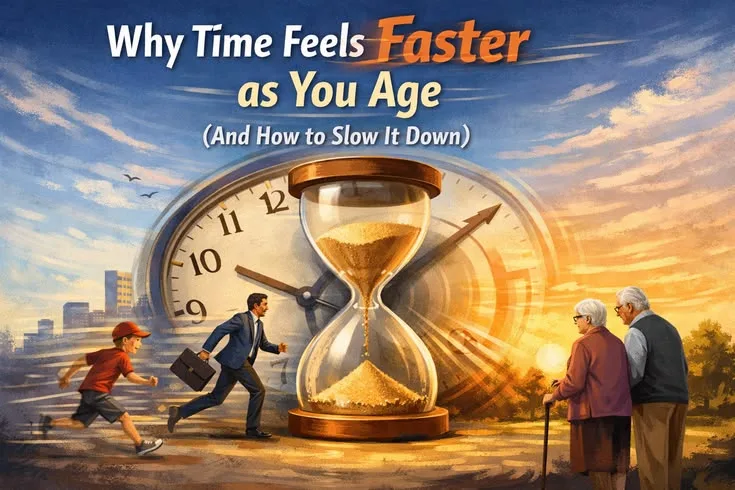
Feels: Think back to the summer you were eight years old. July stretched in every direction. The walk to the swimming pool felt like an expedition. August was a continent you hadn't yet crossed. Now think about last year. When did it start? Where did March go?
The year you are fifty passes in a flash compared to the year you were ten, and this is not merely sentiment - it is one of the most consistently reported psychological phenomena across cultures, ages, and historical periods.
The experience is so common that it has become a kind of cultural cliche: time speeds up as you age, the years go faster, you blink and the decade is gone.
But cliches sometimes describe real things, and this one describes a real psychological phenomenon with a traceable research history, multiple competing explanations, and practical implications for how you might choose to spend the years you have remaining.
Understanding why time accelerates is not only intellectually interesting; it may be among the most consequential things you learn about the structure of a human life.
What makes this phenomenon particularly worth examining carefully is that its causes are not as simple as they first appear.
Several mechanisms are probably operating simultaneously - mathematical, cognitive, memorial, neurological - and they interact in ways that create paradoxes anyone who has thought carefully about time will recognize.
A vacation feels short while you're on it but long in memory. A boring afternoon drags on forever yet seems to have vanished when you look back a week later. The years of childhood feel like long slow chapters while entire decades of adult life compress into a sentence.
"In youth we may have an absolutely new experience, every hour. Towards middle life they become rare." - William James, The Principles of Psychology (1890)
Key Definitions
Prospective time perception: The felt sense of duration while an experience is occurring - how long does this moment seem to be lasting right now.
Retrospective time perception: The estimated duration of a past period when recalled from memory - how long does that stretch of time seem in hindsight.
The proportionality (ratio) hypothesis: The proposal that subjective time is perceived as a fraction of total life lived rather than as an absolute quantity, producing logarithmic compression of experienced years.
The holiday paradox: The counterintuitive finding that novel experiences seem to pass quickly in the moment but feel long in retrospect, while routine periods feel neither particularly fast nor slow in the moment but seem brief in memory.
Storage size hypothesis: Robert Ornstein's proposal that retrospective duration estimates correlate with the amount of information encoded during a period; informationally dense periods feel longer in memory.[2]
Attentional gate model: Dan Zakay and Richard Block's framework proposing that prospective time perception depends on how much attention is directed toward time-monitoring; more attention to time equals slower felt passage.
Scalar Expectancy Theory (SET): The dominant neuroscientific framework for interval timing, developed by Gibbon, Church, and Meck (1984), which models time perception as a pacemaker-accumulator system modulated by dopamine.[3]
The First Systematic Treatment: William James in 1890
William James did not have brain imaging equipment or randomized controlled trials. What he had was extraordinary introspective precision and a scholar's familiarity with everything that had been written before him.
In Volume I of The Principles of Psychology, published in 1890, he devoted a long chapter to the perception of time - the first systematic psychological treatment of the subject in English.
James observed what any reflective adult knows: that "the same space of time seems shorter as we grow older." He offered the intuition that would eventually become the proportionality hypothesis: each year is experienced relative to the accumulation of years already lived.[1]
He also identified, with characteristic insight, the role of novelty. Young people, he noted, encounter genuinely new experiences constantly. Each new experience must be processed, encoded, integrated - it takes up psychological space.
By middle age, the calendar of genuinely novel experience has contracted sharply. The grooves of habit have formed. Days begin to resemble one another, weeks merge, months bleed together.
James was not doing quantitative psychology. He was making an argument based on careful observation of his own and others' experience.
But he identified the two central explanatory threads - proportionality and novelty - that researchers would spend the next hundred-plus years trying to disentangle and empirically test. His framing still anchors how psychologists think about the problem.
The Proportionality Hypothesis
The cleanest mathematical formulation of James's intuition came from Robert Lemlich in 1975.
Writing in Perceptual and Motor Skills, Lemlich proposed that subjective time is inversely proportional to age - or more precisely, that the rate at which subjective time passes is proportional to the ratio of a time interval to the total life lived so far.[4]
The implication is that subjective time follows a logarithmic function of chronological age.
The numbers are striking. At age 5, one year represents 20 percent of a lifetime. At age 10, it is 10 percent. At age 20, it is 5 percent. At age 50, a single year is only 2 percent of total life experience. At 70, it is 1.4 percent.
Each subsequent year is a smaller slice of an expanding whole, and the subjective experience of duration shrinks accordingly.
This is not an arbitrary mathematical curiosity - it mirrors the Weber-Fechner law from sensory psychophysics, which holds that the perceived intensity of a stimulus scales logarithmically with its physical magnitude.
Just as the difference between one candle and two feels enormous in a dark room but negligible in daylight, the difference between year 5 and year 6 feels far more significant than the difference between year 45 and year 46.
William Friedman and others have continued developing and testing this framework. The proportionality hypothesis makes testable predictions about how people at different ages should estimate the relative length of past periods, and survey data tend to support its general shape, though not its precise parameters.[6]
One limitation is that the hypothesis is purely mathematical - it does not require any change in the brain or in behavior.
It is simply an arithmetic consequence of living longer, which means it would operate even in a hypothetical person whose neural architecture, curiosity, and rate of novel experience remained perfectly constant across a lifetime.
In practice, of course, those things do not remain constant, which is where the novelty and memory hypotheses enter.
The Novelty and Memory Hypothesis
Robert Ornstein's 1969 book On the Experience of Time introduced what he called the storage size hypothesis: our retrospective sense of how long a period lasted is determined by how much information was encoded during that period.
Experiences that require extensive processing - because they are unfamiliar, complex, or emotionally vivid - generate dense, discriminable memory traces.
When we later estimate how long that period was, we implicitly survey the memory record: many distinct entries suggest a long time; few entries suggest a short one.
Novelty is the primary driver of storage density. A child encountering the mechanics of a bicycle, the social dynamics of a first classroom, the geography of a new neighborhood - every hour is informationally rich. The brain is constructing new schemas at a rapid pace, and those schemas are recorded as distinct memories.
An adult who has commuted the same route for fifteen years, attended the same kind of meetings, eaten variations on the same meals, and navigated a stable social world is encoding very little that is genuinely new.
The cognitive processing runs automatically and efficiently, largely below conscious awareness, leaving almost no distinct memory trace.
The compounding effect across a lifetime is substantial. The first ten years of a human life are disproportionately rich in firsts: first words, first steps, first day of school, first friendship, first encounter with death, first experience of music, sport, love, failure.
These firsts generate the dense early memory record that makes childhood seem, in retrospect, to have lasted a very long time. The subsequent decades - barring major disruptions - are increasingly composed of familiar variations on established themes.
The memory record of a routine decade in middle age may contain no more genuinely distinct episodes than a single eventful month of childhood.
The Holiday Paradox
Claudia Hammond, drawing on work including that of Steve Wallman, gave a precise name to one of the most interesting predictions of the novelty-memory framework: the holiday paradox.[7] It works like this.
You take a two-week vacation to somewhere unfamiliar. While you are there, the days seem to pass remarkably quickly: you are absorbed, engaged, constantly encountering new things, not watching the clock. At the end of the two weeks you are almost surprised that it is already over.
But when you return home and the following weeks settle back into routine, something unexpected happens. You look back on that vacation and it seems to have lasted a long time - possibly longer than several months of ordinary life at home. The vacation expanded in memory even as it seemed to compress in experience.
This is not a paradox of measurement error - it reflects a genuine difference between two distinct time perception systems. Prospective time perception (how long does this feel right now) is governed primarily by attentional allocation: when attention is directed away from time-monitoring and toward engaging content, time flies.
Retrospective time perception (how long does that seem in memory) is governed primarily by memory density: more encoded episodes produce a longer felt retrospective duration.
A novel vacation engages both mechanisms in opposite directions. The engagement and absorption make prospective time move quickly. The novelty and richness generate dense encoding, making retrospective time expand.
A routine week at home does the opposite: nothing particularly novel happens (fast prospective, because nothing is demanding attention), and almost nothing is memorably encoded (fast retrospective, because the memory record is sparse).
The holiday paradox reveals that the question "how do I make time feel slower?" cannot be answered with a single strategy - it depends on whether you care about prospective or retrospective duration, and which you prioritize may differ depending on your circumstances.
The Attentional Gate
The dominant model for prospective time perception is the attentional gate model, developed by Dan Zakay and Richard Block (1995).[5] The model proposes that the subjective passage of time depends on a kind of internal pacemaker that generates time-units continuously, and an accumulator that collects them.
The key variable is how much attention is directed toward the accumulator: when attention is focused on time-monitoring - as during boredom or waiting - time units accumulate rapidly in awareness and time drags.
When attention is absorbed by external content, the gate between pacemaker and accumulator is effectively narrowed, fewer time-units enter conscious awareness, and time seems to fly.
This model explains why interesting work and play feel fast while tedious tasks feel slow.
It also explains why emotional arousal - fear, excitement, threat - can cause time to seem to stretch: heightened arousal may increase the pacemaker rate while simultaneously drawing attention to the environment, producing expanded prospective duration.
The distorted time perception of accidents and emergencies ("everything seemed to slow down") is consistent with this mechanism, though the precise explanation remains debated.
For the aging question, the attentional gate model offers a partial account. Adults in stable, familiar environments have fewer occasions for the kind of absorbed, time-forgetting engagement that characterized childhood. The routine is predictable; there are few surprises to absorb attention.
This could increase the average amount of attention available for time-monitoring, paradoxically making individual moments feel neither particularly fast nor slow, while contributing to the overall pattern of minimal encoding and compressed retrospective duration.
| Time perception type | Governed by | Novel vacation | Routine work week |
|---|---|---|---|
| Prospective (feels long while happening) | Attention to time | Fast (absorbed, not monitoring) | Variable (often slow if tedious) |
| Retrospective (feels long in memory) | Memory density | Long (many distinct memories) | Short (minimal encoding) |
| Net subjective result | Both combined | "That flew by but felt like a long time" | "That dragged but I can't remember it" |
Neurological Mechanisms: Dopamine and the Internal Clock
The cognitive and memorial accounts of time acceleration are compelling, but they leave open the question of whether there are also direct neurological changes in the brain's timekeeping systems that contribute to the experience.
The most developed neurological theory implicates the dopamine system. Warren Meck's decades of research, culminating in the foundational Scalar Expectancy Theory published with John Gibbon and Russell Church in 1984, established that interval timing - the ability to estimate durations from a few seconds to many minutes - depends critically on dopaminergic circuits in the basal ganglia.
In the SET model, dopamine functions as a pacemaker signal: higher dopamine activity corresponds to a faster rate of subjective time accumulation, and dopamine depletion slows it.
This is dramatically illustrated in Parkinson's disease, where dopamine loss frequently produces severe distortions in time perception: patients underestimate durations, experience time as passing more slowly or inconsistently, and have difficulty with time-dependent tasks.
Since dopamine function declines with normal aging - both in terms of receptor density and dopamine synthesis - some researchers have proposed that the aging brain's internal clock runs at a slower absolute rate.
Counterintuitively, this would produce the experience that external time is passing faster: if your internal pacemaker generates fewer "ticks" per minute of clock time than it did at twenty, then more real time will have elapsed before your brain registers a subjective unit of duration.
Time would seem to rush.
A second neurological thread involves the circadian system and body temperature. Core body temperature and internal clock speed are correlated - lower body temperature produces a slower internal clock.
Older adults tend to have lower average body temperatures and less robust circadian rhythms than younger adults, which could contribute to time acceleration by the same mechanism.
These neurological accounts are not fully established. Human studies of dopamine and time perception cannot achieve the precision of rodent studies, and the relationship between dopamine decline, internal clock speed, and subjective time acceleration has not been cleanly demonstrated in a longitudinal human sample.
But the convergent evidence is suggestive enough that neurological mechanisms are now routinely included in comprehensive models of age-related time acceleration.
Flow States and the Examined Life
Mihaly Csikszentmihalyi's research on flow - the state of complete absorption in a challenging, meaningful activity - identified one of the most reliable inducers of subjective time distortion. In flow, the attentional gate is completely occupied with the task.
Time perception effectively halts: hours pass without being registered, and the afterward surprise at how much time has elapsed is characteristic of flow experiences. By the standards of prospective time perception, flow makes time vanish.
But flow experiences are often also deeply encoding. They tend to involve genuine engagement with something difficult and meaningful, and the resulting memories - of struggle, mastery, peak performance, creative insight - are among the most durable and distinctive a person can have.
People frequently report that their most memorable and seemingly extended periods of life coincide with periods of intense engagement: demanding projects, new relationships, years in unfamiliar places.
The retrospective duration of a flow-saturated life may be considerably longer than that of a comfortable but unstimulating one.
This observation carries a philosophical weight that several researchers have noted. The novelist and philosopher Milan Kundera wrote about the relationship between speed and forgetting, slowness and memory.
The philosopher William James, in a different register, suggested that the path to a long life was not longevity itself but the density of experience - and that this was partly within human control.
If the examined life is worth living on moral grounds, it may also be, quite literally, a longer life in the only sense that ultimately matters: the subjective one.
A life filled with deliberate novelty, demanding engagement, and continuous learning will, in retrospect, seem to have taken up more time than a life of comfortable routine - even if both last the same number of years on the calendar.
Practical Implications
The research on time perception does not yield simple prescriptions, but several implications are reasonably well supported.
Seek genuine novelty. Not novelty for its own sake - novelty that requires real cognitive engagement, new skill acquisition, and genuine processing. A new route to work that you navigate on autopilot generates little new encoding.
A new language, craft, instrument, or professional challenge that demands sustained attention and produces genuine uncertainty generates a great deal.
Travel to genuinely unfamiliar places. The holiday paradox is real: the retrospective expansion of a novel trip is well-documented. The mechanisms are clear. This does not require expensive international travel - the relevant variable is genuine unfamiliarity, not distance or cost.
Maintain deliberate attention. Mindfulness practices that increase present-moment attentiveness to sensory experience may deepen encoding by preventing the automatic, unattended processing that leaves no memorial trace. Even writing brief daily notes about what you observed or did can function as an encoding intervention.
Recognize the cost of pure comfort. A life optimized for frictionless routine may be pleasant in the moment but produces a retrospective duration that feels very short. The friction of new experience - confusion, effort, uncertainty, occasional failure - is precisely what generates the memory density that makes time feel long.
The phenomenon of time acceleration is one of the places where psychology and the philosophy of life most directly intersect. How you allocate your time affects not just how much you accomplish but how long your life feels - from the inside, which is the only inside there is.
Related Articles
Sources & Further Reading
- James, W. (1890). The Principles of Psychology. Henry Holt.
- Ornstein, R. E. (1969). On the Experience of Time. Penguin.
- Gibbon, J., Church, R. M., & Meck, W. H. (1984). Scalar timing in memory. Annals of the New York Academy of Sciences, 423, 52-77. DOI: 10.1111/j.1749-6632.1984.tb23417.x
- Lemlich, R. (1975). Subjective acceleration of time with aging. Perceptual and Motor Skills, 41(1), 235-238. DOI: 10.2466/pms.1975.41.1.235
- Zakay, D., & Block, R. A. (1995). An attentional-gate model of prospective time estimation. In M. Richelle, V. De Keyser, G. d'Ydewalle, & A. Vandierendonck (Eds.), Time, Action and Cognition (pp. 167-178). Kluwer.
- Wittmann, M., & Lehnhoff, S. (2005). Age effects in perception of time. Psychological Reports, 97(3), 921-935. DOI: 10.2466/pr0.97.3.921-935
- Hammond, C. (2012). Time Warped: Unlocking the Mysteries of Time Perception. Canongate.