
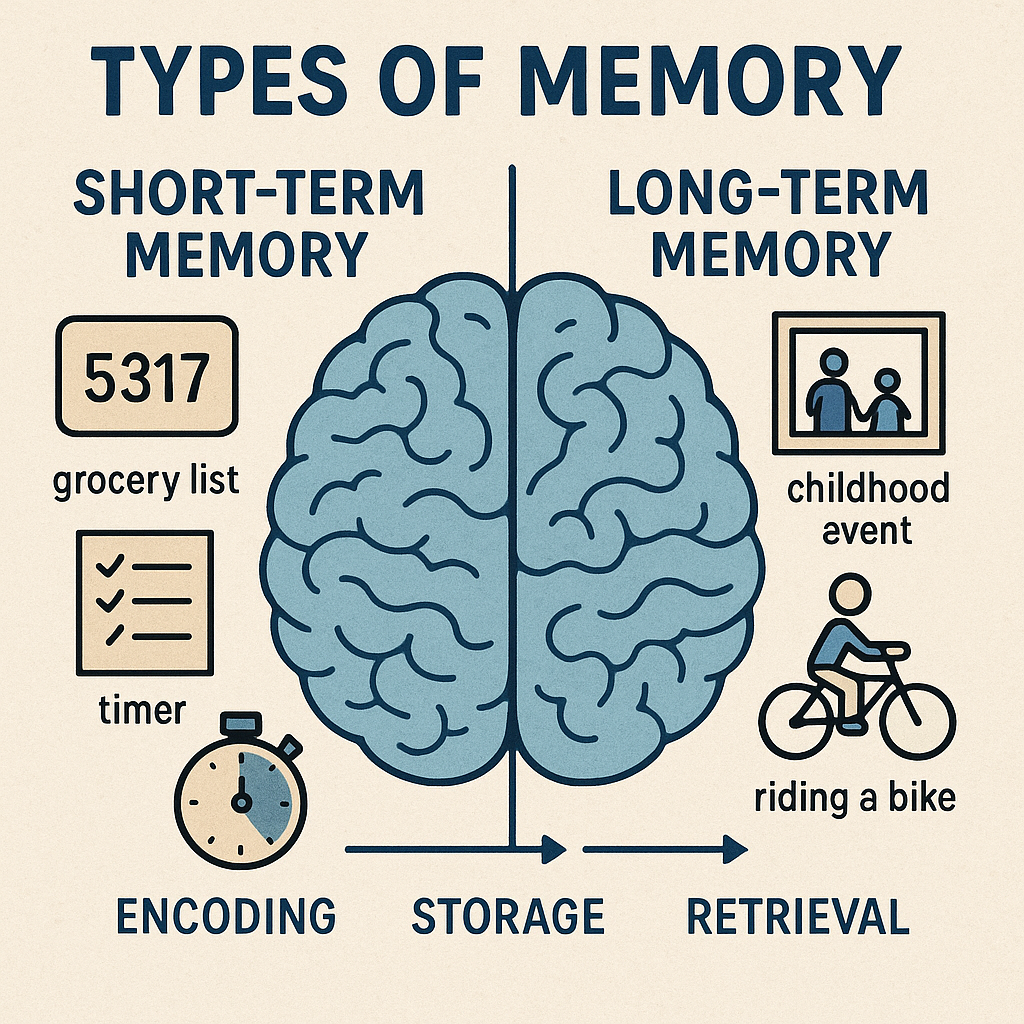
Memory is a group of systems that encode, store, and retrieve information through different brain structures and mechanisms. The answer to what is memory includes fleeting sensory traces, limited working memory, explicit memories for events and facts, and implicit skills or conditioning. Retrieval reconstructs rather than replays stored experience, while the hippocampus is especially important for forming new explicit memories.
In 1953, a 27-year-old man with severe epilepsy named Henry Molaison agreed to an experimental surgery. Neurosurgeon William Beecher Scoville removed large portions of his medial temporal lobes - including most of his hippocampus - hoping to cure seizures that had consumed his life.
The surgery worked. But what happened next transformed our understanding of human memory.
Henry could no longer form new long-term memories. His mind was trapped. Each morning when he woke, the previous day had vanished. He read the same magazines again and again, finding them fresh each time. Doctors who had worked with him for years were strangers each time they entered the room. He lived in a permanent, bewildered present.
Yet his intelligence was intact. His personality was recognizable. He remembered his childhood, his name, how to speak and reason. He could learn new motor skills - if you gave Henry a mirror-tracing task each day, he improved, even though he had no memory of ever having done it before. The hands remembered what the mind could not.
The man known in the scientific literature for decades as "H.M." became the most important research subject in the history of neuroscience. His case proved what no experiment before had established: memory is not one thing.
It is a collection of distinct systems, stored in different brain structures, operating by different mechanisms.[1]
Understanding these systems is the foundation of everything we know about learning, forgetting, and the fallibility of human experience.
"Memory is not a recording device. It is a creative act. Every time you remember, you rebuild." - Daniel Schacter, The Seven Sins of Memory (2001)
Key Definitions
Memory - The capacity to encode, store, and retrieve information over time. Memory is not a single faculty but a family of related systems with distinct mechanisms, anatomical substrates, and behavioral properties.
Encoding - The process of transforming experience into a memory trace. Encoding can be shallow (superficial features, quickly forgotten) or deep (meaningful connections to existing knowledge, durably stored). The level of processing theory (Craik & Lockhart, 1972) proposes that deeper encoding produces stronger memory traces.
| Memory Type | Duration | Capacity | Example |
|---|---|---|---|
| Sensory memory | ~0.5-3 seconds | Very large | Brief afterimage of visual scene |
| Working memory | Seconds to minutes | ~4 chunks | Holding a phone number while dialing |
| Long-term declarative | Years to lifetime | Effectively unlimited | Facts, autobiographical events |
| Long-term procedural | Years to lifetime | Large | Riding a bicycle, typing |
| Implicit memory | Long-lasting | Large | Conditioned responses, priming effects |
Storage - The maintenance of information over time. Unlike digital storage, biological memory is not stored in specific neurons but in patterns of synaptic connections - the strengthening of connections between neurons that fired together during encoding. Memory traces are distributed across networks rather than localized.
Retrieval - The process of accessing stored information. Retrieval is not passive playback - it is active reconstruction. Each retrieval rebuilds the memory from stored fragments; this process is fallible and susceptible to distortion.
Working memory - A limited-capacity system that holds and manipulates information in conscious awareness for seconds to minutes.
George Miller's famous "magical number seven plus or minus two" (1956) estimated working memory capacity at 7 chunks of information; later research by Nelson Cowan (2001) suggests 4 is more accurate for pure, unrelated chunks.[13]
Working memory is what you use to hold a phone number in mind while dialing, or to track conversation threads.
Long-term memory - Memory that persists beyond the immediate moment, potentially for a lifetime. Long-term memory is subdivided into explicit (declarative) and implicit memory.
Explicit (declarative) memory - Memory that can be consciously recalled and verbally reported. Subdivides into episodic memory (personal experiences - "what happened to me") and semantic memory (facts and general knowledge - "what is true about the world").[2]
Episodic memory - Memory for personally experienced events, embedded in spatial and temporal context. "I was standing in the kitchen when I heard the news." Episodic memory involves mental time travel - the re-experiencing of past events.
Endel Tulving (1972), who coined the term, described episodic memory as uniquely human and uniquely dependent on autonoetic consciousness - the awareness of oneself as a being that persists through time.[3]
Semantic memory - Memory for facts, concepts, and general knowledge, without autobiographical context. The capital of France is Paris; dolphins are mammals; 7 8 = 56. Semantic memories often derive from episodic memories that have lost their contextual details through repeated retrieval.
Implicit memory - Memory that influences behavior without conscious awareness. Includes procedural memory (motor skills, habits), priming (prior exposure to a stimulus influences subsequent processing), and conditioning.
Implicit memory systems are largely independent of the hippocampus - H.M.'s implicit memory was preserved despite his explicit memory loss.
Hippocampus - A seahorse-shaped structure in the medial temporal lobe, critical for the formation and consolidation of explicit memories. The hippocampus binds together information from multiple sensory cortices into coherent memory representations and mediates memory consolidation during sleep.
Long-term potentiation (LTP) - The cellular mechanism of memory: repeated stimulation of a synapse strengthens the connection between the pre-synaptic and post-synaptic neurons - "neurons that fire together, wire together" (Hebb's rule, 1949).
LTP involves changes in AMPA receptor density and, over longer periods, protein synthesis and structural changes in synaptic morphology.
Memory consolidation - The process by which newly encoded memories are stabilized and integrated with long-term knowledge. Synaptic consolidation occurs in the hours after learning (protein synthesis-dependent).
Systems consolidation occurs over days to years as hippocampus-dependent memories are gradually transferred to neocortical networks through sleep replay.
The forgetting curve - Hermann Ebbinghaus's 1885 discovery that memory declines exponentially after learning, with approximately 70% of new information forgotten within 24 hours without review. The rate of forgetting slows over time; information remembered after a month tends to be retained for much longer.
Reconsolidation - The discovery (Nader, Schafe, & LeDoux, 2000) that retrieved memories become temporarily unstable and must be re-stabilized (reconsolidated).[8]
Reconsolidation means memories are not static after storage - they can be modified by new information introduced during the reconsolidation window. This has implications for therapy (modifying traumatic memories) and for the fallibility of eyewitness testimony.
The Architecture of Memory
Working Memory: The Conscious Workspace
Working memory is the scratchpad of cognition - the information you can hold in mind right now. Alan Baddeley's influential model, refined across four decades of research, describes working memory as having multiple components:
Phonological loop: Holds verbal and auditory information through subvocal rehearsal - the inner voice that repeats a phone number to keep it active. Capacity: roughly 2 seconds of spoken material.
Visuospatial sketchpad: Holds visual and spatial information - mental images, navigation representations. Independent from the phonological loop; you can hold an image in mind while reciting something verbally.
Episodic buffer: Integrates information from different sources (including long-term memory) into coherent episodes. Added to Baddeley's model in 2000, this component connects working memory to long-term memory and explains how the two interact in real-time cognition.[11]
Central executive: The attentional control system that manages and allocates working memory resources, coordinates the other components, and manages dual-task performance.
Working memory capacity is strongly correlated with fluid intelligence - the ability to reason with novel problems. Unsworth and colleagues (2014) found that working memory capacity accounted for approximately 50% of the variance in fluid intelligence across a large sample.
The Flynn effect (rising IQ scores over the 20th century) may partly reflect improved working memory capacity from education and environmental changes, though this remains debated.
Working memory limitations have direct practical consequences. When a student studies while half-watching television, both tasks draw on the central executive. The resulting cognitive load (Sweller, 1988) means neither task receives adequate processing resources.
Material that enters working memory while it is already at capacity tends to receive shallow encoding and is quickly forgotten.
From Working Memory to Long-Term Memory
Not everything in working memory enters long-term memory. Factors promoting encoding:
Attention: You cannot encode what you do not attend to. Divided attention during encoding dramatically reduces memory formation. This is why studying while distracted by a phone produces shallow encoding.
Fernandes and Moscovitch (2000) showed that even a secondary auditory task presented during reading impaired later recall, even though participants did not report noticing the distraction.
Elaborative rehearsal: Connecting new information to existing knowledge, generating inferences, and thinking about meaning produces far stronger encoding than simple repetition. Testing yourself (retrieval practice) is more effective than re-reading for the same reason.
Craik and Tulving (1975) demonstrated this systematically: words processed for meaning (Does this word fit the sentence?) were recalled two to three times as often as words processed for surface features (Does this word contain the letter E?).
Emotional significance: The amygdala modulates hippocampal memory consolidation: emotionally arousing events are preferentially consolidated. You remember where you were during major life events; you don't remember most of what you had for lunch last Tuesday.
Cahill and McGaugh (1998) showed that injecting beta-blockers (which block the stress hormone norepinephrine) before watching an emotional film impaired memory for the emotional portions specifically, confirming that the amygdala-hippocampus interaction is chemically mediated.[16]
Sleep: Memory consolidation requires sleep. During slow-wave sleep, the hippocampus replays recently encoded experiences to the neocortex - "offline reprocessing" that strengthens and integrates memories.
Stickgold (2005) reviewed extensive evidence showing that people who sleep after learning perform significantly better on subsequent tests than those who remain awake for an equivalent period.[9] The hippocampal-neocortical dialogue during sleep is the mechanism of systems consolidation.
Spaced repetition: Distributing study over time - studying material on Day 1, reviewing on Day 3, reviewing again on Day 10 - produces dramatically better long-term retention than equivalent time spent in massed study (cramming).
Cepeda and colleagues (2006) conducted a meta-analysis of 317 studies on distributed practice and found that spacing study sessions produced consistently superior retention, with the optimal gap between sessions depending on the intended retention interval.[19]
The Hippocampus as Memory Binder
The hippocampus does not store memories long-term; it creates them. During encoding, the hippocampus binds together the elements of an experience - what you saw, heard, smelled, thought, and felt - into a unified memory representation.
These elements are stored in their original sensory cortices (visual memories in visual cortex, auditory in auditory cortex), but the hippocampus holds the index that links them.
This complementary learning systems theory (McClelland, McNaughton, & O'Reilly, 1995) proposes that the hippocampus and neocortex learn in fundamentally different ways: the hippocampus encodes rapidly and precisely (a specific episode), while the neocortex learns slowly and abstractly (general patterns).[18]
The two systems are complementary precisely because rapid hippocampal learning would cause catastrophic interference in the neocortex if general knowledge were updated with every single experience.
Over time, with repeated reactivation (especially during sleep), cortical connections strengthen and the memory becomes more independent of the hippocampus - explaining why H.M. retained older memories even as he could not form new ones. Recent memories require the hippocampus for retrieval; old memories do not.
This model also explains the temporal gradient of amnesia: hippocampal damage produces disproportionate loss of recent memories compared to older memories, because older memories have been more fully transferred to neocortex.
The period during which this transfer is incomplete can extend for years to decades, which is why even patients with significant hippocampal damage often retain vivid memories from childhood.
Why We Forget
Forgetting is not a failure of the memory system; it is a feature. Remembering everything would be cognitively catastrophic - you would be unable to extract patterns, generalize, or function in the present while drowning in the past.
Jorge Luis Borges described this in the short story "Funes the Memorious" (1942): a man who remembers every detail of every experience with perfect clarity finds that memory without forgetting is paralyzing.
Real cases of hyperthymesia (highly superior autobiographical memory, HSAM) - the ability to recall detailed personal memories from decades ago - are often described as a burden by those who have it.
Parker, Cahill, and McGaugh (2006) published the first formal case study of HSAM, describing a woman who could report what she was doing on virtually any date going back to age 14.
Despite total recall of personal events, she showed no enhancement of other kinds of memory, and described her condition as exhausting and disruptive.
The mechanisms of forgetting:
Decay
Without rehearsal, memory traces fade. The Ebbinghaus forgetting curve shows exponential decay: most forgetting happens rapidly, then slows.[12] The mechanism may involve homeostatic synaptic scaling - the nervous system keeps total synaptic weight in bounds by globally weakening connections, particularly during sleep.
Tononi and Cirelli (2006) proposed the synaptic homeostasis hypothesis: sleep serves partly to downscale synaptic connections built up during waking learning, preserving the most important patterns while allowing weaker traces to fade.
Interference
Old memories can interfere with new ones (proactive interference): if you have memorized one set of locker combinations, learning a new combination is harder and the old one may intrude.
New memories can disrupt old ones (retroactive interference): learning new information about a topic can overwrite or distort older memories on the same topic.
Interference is why similar information learned close together is poorly retained. Studying French vocabulary immediately after Spanish vocabulary produces worse retention than studying with an unrelated activity in between.
Anderson and Neely (1996) reviewed extensive evidence showing that interference is one of the most robust and reproducible phenomena in memory research, and argued that it is a more important cause of everyday forgetting than decay.
Retrieval Failure
Many "forgotten" memories are not absent from storage - they simply cannot be accessed without the right cue.
The "tip of the tongue" phenomenon is retrieval failure in partial form: you know the information exists and can access its features (it starts with a certain letter, it has a certain sound), but cannot fully retrieve it.
Exposure to the cue (a hint, a related word) often unlocks the memory.
Context-dependent memory (Tulving's encoding specificity principle, 1983): memories are most accessible when retrieval conditions match encoding conditions. Memory cues include physical environment, emotional state, physiological state (state-dependent memory), and preceding thoughts.
Godden and Baddeley (1975) demonstrated this experimentally with scuba divers who learned word lists either underwater or on land: recall was significantly better when learning and testing occurred in the same environment.
Motivated Forgetting
Sigmund Freud proposed repression: motivated forgetting of emotionally threatening material. The empirical status of repression is contested, but there is evidence for directed forgetting (Anderson & Green, 2001): instructing people to forget material reduces their memory for it.[14]
Using fMRI, Anderson and colleagues showed that actively suppressing a memory engages the lateral prefrontal cortex and inhibits hippocampal activity - suggesting a genuine neural mechanism for motivated forgetting.
The clinical reality of traumatic memory - memories that intrude involuntarily in PTSD, or conversely, memories that are difficult to access - suggests complex interactions between emotional systems and memory.
Memory Is Reconstructive: The Problem of False Memories
The most practically important insight from memory research is also the most counterintuitive: memory does not record experience like a video camera.[20] It reconstructs experience from stored fragments - and reconstruction is error-prone.[4]
Elizabeth Loftus and the Misinformation Effect
Elizabeth Loftus at the University of Washington conducted a landmark series of experiments beginning in the 1970s on how post-event information alters memory.
In a 1974 study published in the Journal of Verbal Learning and Verbal Behavior, participants watched a video of a car accident and were later asked: "How fast was the car going when it smashed into the other car?" vs.
"How fast was the car going when it contacted the other car?" The "smashed" group estimated higher speeds and was more likely to report (falsely) having seen broken glass.[5]
Loftus demonstrated that memories are susceptible to:
- Leading questions
- Information provided by others after the event
- Repeated suggestions
- Imagination inflation (repeatedly imagining an event makes it feel more familiar, mimicking memory)
Her research fundamentally reshaped how psychologists think about memory reliability and had enormous implications for the legal system.
As Loftus and colleagues showed in subsequent work, the post-event misinformation effect is not merely a laboratory curiosity - it operates in real eyewitness situations, in therapy settings, and in any context where information about a past event is encountered after that event occurred.
"People's memories are not only the sum of all that they have done, but also everything they have thought, been told, and read. Memory is flexible, alive - and entirely capable of lying to us." - Elizabeth Loftus, The Myth of Repressed Memory (1994)
Implanting False Memories
In the "lost in the mall" paradigm, Loftus showed that approximately 25% of participants could be induced to "remember" a detailed false childhood memory (getting lost in a shopping mall) through suggestion and imagery exercises.
Subsequent research has implanted false memories of more dramatic events, including witnessing demonic possession and nearly drowning in childhood.
Shaw and Porter (2015) published a particularly striking study in Psychological Science: they interviewed participants about false crimes they had supposedly committed as teenagers (events that had never occurred, confirmed with parents).[15]
Within three interviews, 70% of participants came to describe the false crime as a genuine memory, providing detailed accounts complete with emotional content and peripheral detail.
This has profound legal implications. The American legal system has historically treated eyewitness testimony as highly reliable; research shows it is among the least reliable forms of evidence.
The Innocence Project, which uses DNA evidence to exonerate wrongfully convicted individuals, reports that eyewitness misidentification is the leading contributing factor in wrongful convictions, present in approximately 69% of cases later overturned.
Emotion, Stress, and Memory
The relationship between emotional arousal and memory is not simple enhancement. Moderate arousal improves encoding of information central to the arousing experience - the details that make the event emotionally significant. But it impairs encoding of peripheral information.
This weapon focus effect (Loftus, Loftus, & Messo, 1987) shows that witnesses to a violent crime involving a weapon tend to focus attention on the weapon itself and encode fewer details about the perpetrator's face or clothing.
The arousal that makes the central detail vivid also narrows attention, leaving peripheral information weakly encoded.
Glucocorticoids (stress hormones including cortisol) have complex effects on memory. At moderate levels during learning, they enhance hippocampal consolidation. At high levels - the kind produced by severe, uncontrollable stress - they impair hippocampal function and can produce the dissociative memory disruptions associated with trauma.
This is part of why traumatic memories have an unusual character: they may be fragmented, sensory-rich, and difficult to recall narratively - not because they are repressed, but because the encoding conditions under extreme stress differ from those of ordinary memory formation.
Christianson (1992), reviewing cross-cultural studies of emotional memory, found that central details of emotional events are remembered with higher accuracy and longer persistence than neutral events, while peripheral details suffer.
This is the memory equivalent of depth of field: emotional salience acts as a focusing mechanism that sharpens some aspects of the record while blurring others.
The Testing Effect: How to Remember Better
One of the most robust findings in cognitive psychology is the testing effect (also called retrieval practice): actively retrieving information from memory produces stronger, more durable learning than passively re-reading or re-studying.
In a 2006 paper in Psychological Science, Roediger and Karpicke compared students who studied material repeatedly versus students who studied it once but tested themselves repeatedly.[6] A week later, the test group remembered 61% of the material; the repeated-study group remembered 40%.
The act of retrieval - even when effortful - strengthens the memory trace more than passive exposure.
The mechanism: retrieval forces the memory system to locate, activate, and reconstruct the memory - the reconsolidation process strengthens the pathways used. Re-reading activates recognition (familiar?) without requiring recall (can I reproduce it?); tests require recall.
Karpicke and Blunt (2011) extended this finding in a paper in Science, showing that retrieval practice produced better learning than even elaborate concept-mapping strategies - a finding that surprised many educators who had championed visual learning techniques.[7]
The superiority of retrieval practice held across different types of material, different educational levels, and different testing delays.
This has direct implications for learning. The dominant study strategy - re-reading notes and highlighted text - is one of the least effective methods of learning.
Dunlosky and colleagues (2013), in a comprehensive review in Psychological Science in the Public Interest, rated ten common study techniques on the strength of evidence for their effectiveness.[17]
Distributed practice (spaced repetition) and retrieval practice received the highest ratings; highlighting and re-reading received the lowest.
Hermann Ebbinghaus, who had memorized lists of nonsense syllables and tracked his own forgetting curves in 1885, discovered both the spacing effect and the testing effect from self-experimentation. His findings have been replicated thousands of times.
The science of memory is one of the few fields where practical recommendations are exceptionally clear - and widely ignored.
Sleep, Dreams, and Memory Consolidation
The relationship between sleep and memory is among the most practically important findings in memory research, and among the most consistently underappreciated in educational settings.
Walker and Stickgold (2006) reviewed extensive evidence that different stages of sleep serve different memory consolidation functions.[10]
Slow-wave sleep (deep non-REM sleep) appears critical for declarative memory consolidation: the hippocampus replays recent experiences during slow-wave sleep, transferring representations to neocortical storage.
REM sleep appears important for procedural and emotional memories, as well as for integrating new information with existing knowledge networks - a process sometimes described as "insight consolidation."
The practical implication is significant: studying immediately before sleep is substantially more effective than the same study session earlier in the day, because the encoding is followed immediately by the consolidation window that sleep provides.
Conversely, all-night study sessions that sacrifice sleep for additional study time produce poor long-term retention precisely because they eliminate the consolidation period.
Wamsley and Stickgold (2011) reported that subjects who napped after a learning session showed better memory performance than those who stayed awake, and that dream content during the nap (subjects who reported dreaming about the material) showed the greatest memory benefit - suggesting that the offline reprocessing during sleep is not entirely passive.
Practical Applications: Building Better Memory
The research on memory has generated a set of unusually well-supported practical recommendations:
Use spaced repetition: Reviewing material at expanding intervals (1 day, 3 days, 1 week, 2 weeks) exploits the spacing effect and the forgetting curve. Digital flashcard systems like Anki implement this automatically.
Test yourself instead of re-reading: Even self-testing with low stakes - trying to recall what you just read before looking back at the text - dramatically improves retention compared to passive review.
Sleep before forgetting: Study in the evening when possible. The consolidation window begins during the first full sleep cycle.
Elaborate as you learn: Ask why, make analogies, connect to existing knowledge. The deeper the processing, the more durable the encoding.
Use retrieval cues at encoding: If you associate material with a vivid image, location, or narrative, you create more retrieval pathways - each of which can serve as an access route to the memory.
Create context for recall: Recognizing that memory is context-dependent, learning in varied contexts (or deliberately imagining varied contexts at encoding) increases the number of cues that can trigger later retrieval.
For related concepts, see how sleep works, how habits form and change, and how artificial intelligence learns.
Sources & Further Reading
- Squire, L. R. (2004). Memory Systems of the Brain: A Brief History and Current Perspective. Neurobiology of Learning and Memory, 82(3), 171-177. DOI: 10.1016/j.nlm.2004.06.005
- Tulving, E. (1972). Episodic and Semantic Memory. In Tulving, E., & Donaldson, W. (Eds.), Organization of Memory (pp. 381-402). Academic Press.
- Tulving, E. (1985). Memory and consciousness. Canadian Psychology, 26(1), 1-12. DOI: 10.1037/h0080017
- Schacter, D. L. (2001). The Seven Sins of Memory: How the Mind Forgets and Remembers. Houghton Mifflin.
- Loftus, E. F., & Palmer, J. C. (1974). Reconstruction of Automobile Destruction: An Example of the Interaction Between Language and Memory. Journal of Verbal Learning and Verbal Behavior, 13(5), 585-589. DOI: 10.1016/S0022-5371(74)80011-3
- Roediger, H. L., & Karpicke, J. D. (2006). Test-Enhanced Learning: Taking Memory Tests Improves Long-Term Retention. Psychological Science, 17(3), 249-255. DOI: 10.1111/j.1467-9280.2006.01693.x
- Karpicke, J. D., & Blunt, J. R. (2011). Retrieval Practice Produces More Learning than Elaborative Studying with Concept Mapping. Science, 331(6018), 772-775. DOI: 10.1126/science.1199327
- Nader, K., Schafe, G. E., & LeDoux, J. E. (2000). Fear Memories Require Protein Synthesis in the Amygdala for Reconsolidation After Retrieval. Nature, 406(6797), 722-726. DOI: 10.1038/35021052
- Stickgold, R. (2005). Sleep-Dependent Memory Consolidation. Nature, 437(7063), 1272-1278. DOI: 10.1038/nature04286
- Walker, M. P., & Stickgold, R. (2006). Sleep, Memory, and Plasticity. Annual Review of Psychology, 57, 139-166. DOI: 10.1146/annurev.psych.56.091103.070307
- Baddeley, A. (2000). The Episodic Buffer: A New Component of Working Memory? Trends in Cognitive Sciences, 4(11), 417-423. DOI: 10.1016/S1364-6613(00)01538-2
- Ebbinghaus, H. (1885/1913). Memory: A Contribution to Experimental Psychology. Teachers College, Columbia University.
- Cowan, N. (2001). The magical number 4 in short-term memory: A reconsideration of mental storage capacity. Behavioral and Brain Sciences, 24(1), 87-114. DOI: 10.1017/S0140525X01003922
- Anderson, M. C., & Green, C. (2001). Suppressing unwanted memories by executive control. Nature, 410(6826), 366-369. DOI: 10.1038/35066572
- Shaw, J., & Porter, S. (2015). Constructing Rich False Memories of Committing Crime. Psychological Science, 26(3), 291-301. DOI: 10.1177/0956797614562862
- Cahill, L., & McGaugh, J. L. (1998). Mechanisms of emotional arousal and lasting declarative memory. Trends in Neurosciences, 21(7), 294-299. DOI: 10.1016/S0166-2236(97)01214-9
- Dunlosky, J., Rawson, K. A., Marsh, E. J., Nathan, M. J., & Willingham, D. T. (2013). Improving Students' Learning With Effective Learning Techniques. Psychological Science in the Public Interest, 14(1), 4-58. DOI: 10.1177/1529100612453266
- McClelland, J. L., McNaughton, B. L., & O'Reilly, R. C. (1995). Why there are complementary learning systems in the hippocampus and neocortex. Psychological Review, 102(3), 419-457. DOI: 10.1037/0033-295X.102.3.419
- Cepeda, N. J., Pashler, H., Vul, E., Wixted, J. T., & Rohrer, D. (2006). Distributed practice in verbal recall tasks: A review and quantitative synthesis. Psychological Bulletin, 132(3), 354-380. DOI: 10.1037/0033-2909.132.3.354
- Cofer, C. N. (1973). Constructive Processes in Memory. American Scientist, 61(5), 537-543.