
In 1980, the American Psychiatric Association added Post-Traumatic Stress Disorder to the Diagnostic and Statistical Manual for the first time. The inclusion was politically charged.
Vietnam veterans, rape survivors, and mental health advocates had lobbied for official recognition that certain kinds of experience produce lasting psychological injury.
Before 1980, the pattern of symptoms - intrusive memories, hypervigilance, emotional numbing, nightmares - had been dismissed as weakness, malingering, or pre-existing character pathology.
The formal recognition of PTSD was a scientific and social turning point. It acknowledged something that clinicians had observed across centuries of documentation - from the "soldier's heart" of the American Civil War to the "shell shock" of World War One to the "war neurosis" of World War Two - that extreme experience can fundamentally alter the way a nervous system functions.
The wound was real. The mechanism was not understood.
Four decades of subsequent research have produced a detailed account of what trauma is, what it does to the brain and body, who is most vulnerable, why the same event traumatizes some people and not others, and what treatments are most effective.
The science has also forced a reckoning with the original DSM definition, which was drawn too narrowly to capture the full range of traumatic experience.
Key Definitions
Trauma: Any experience that overwhelms the nervous system's capacity to process and integrate it, producing lasting changes in physiological and psychological functioning. The clinical definition is narrower; the psychological concept is broader.
PTSD (Post-Traumatic Stress Disorder): A psychiatric condition defined by DSM-5 as arising from Criterion A exposure (see below), with four symptom clusters: intrusion, avoidance, negative alterations in cognition and mood, and alterations in arousal and reactivity.
Criterion A: The DSM-5 definition of qualifying traumatic exposure: (1) direct exposure to death, threatened death, actual or threatened serious injury, or actual or threatened sexual violence; (2) witnessing such events; (3) learning of a close family member or friend experiencing such events (in cases of death or threatened death, the event must be violent or accidental); or (4) repeated first-hand indirect exposure to aversive details (as in first responders).
Complex PTSD (CPTSD): Recognized in the ICD-11 (International Classification of Diseases, 11th revision) as a distinct diagnosis from PTSD.
Includes the core PTSD criteria plus three additional disturbances: affect dysregulation, negative self-concept (shame-based persistent beliefs about the self as defective), and relational difficulties (difficulty maintaining relationships or feeling close to others).
Big-T trauma: Clinical shorthand for events meeting DSM-5 Criterion A - life-threatening events, sexual assault, combat exposure, witnessing violent death.
Little-t trauma: Events that are psychologically devastating but do not meet DSM-5 Criterion A - emotional neglect, chronic relational rupture, humiliation, loss, attachment failures in childhood. Associated with complex presentations including complex PTSD.
Peritraumatic dissociation: Dissociation occurring at the time of the traumatic event, including depersonalization (feeling detached from one's body), derealization (feeling the world is unreal), and altered time perception. A strong predictor of subsequent PTSD.
Post-traumatic growth: Positive psychological change experienced as a result of the struggle with highly challenging life circumstances. Described by Tedeschi and Calhoun as distinct from both the absence of distress and from resilience.
The Definitional Problem
The DSM-5's Criterion A is specific by design. Its specificity serves important diagnostic functions: it creates a bright line distinguishing PTSD from other anxiety and stress disorders, it provides a legal and clinical threshold for determining who qualifies for disability compensation and treatment coverage, and it prevents the concept of trauma from expanding to include ordinary adversity.
But the specificity has costs. Criterion A excludes many experiences that produce PTSD-equivalent neurobiological and psychological damage.
Childhood emotional abuse and neglect - not involving physical violence or sexual assault - can produce all four DSM symptom clusters and the same neurobiological profile as combat exposure.
Chronic relational trauma, involving repeated experiences of abandonment, betrayal, and humiliation, frequently produces the disturbances in affect regulation, self-concept, and relational functioning that Judith Herman first described as "complex PTSD" in her 1992 book Trauma and Recovery.[1]
Medical trauma, involving the experience of serious illness or painful procedures in a context of helplessness, meets Criterion A only for some presentations.
ICD-11, the World Health Organization's diagnostic system, took a different approach. It retained PTSD for discrete event exposure but added Complex PTSD as a separate diagnosis for cases of prolonged or repeated trauma, particularly in childhood.[12]
The ICD-11 CPTSD diagnosis captures what many clinicians and researchers had observed for decades: that prolonged early interpersonal trauma produces a fundamentally different clinical picture from the single-event PTSD paradigm, involving pervasive disturbances in self-organization rather than discrete trauma-triggered symptoms.
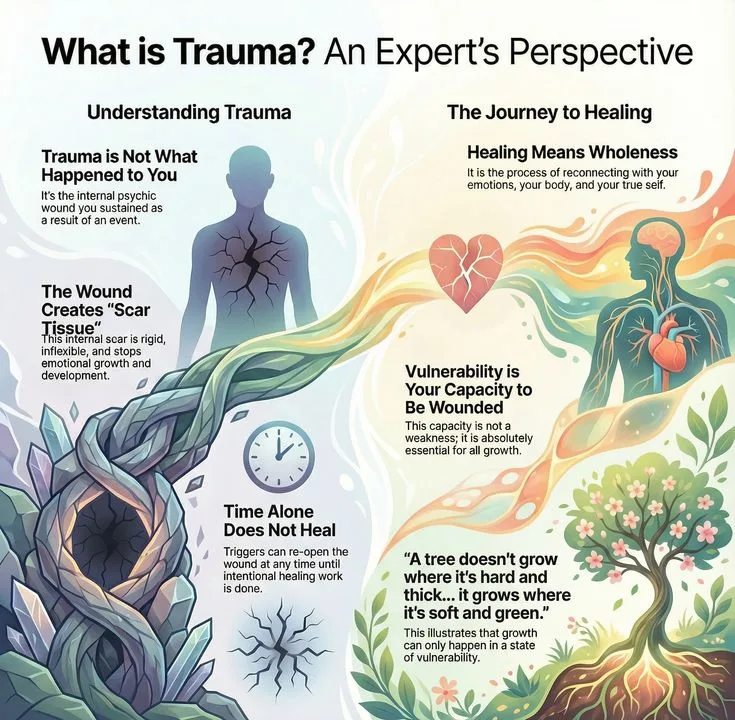
"Trauma is not what happens to you. Trauma is what happens inside you as a result of what happens to you." - Gabor Mate, The Myth of Normal, 2022
The Neurobiology of Trauma: A Brain Changed by Fear
The most significant scientific development in trauma research over the past three decades has been the documentation of specific, measurable neurobiological changes in trauma survivors. Trauma is not a metaphor. It is a physiological state.
The Amygdala: Threat Detection Gone Hyperactive
The amygdala, a paired almond-shaped structure in the medial temporal lobe, is the brain's primary threat detection and emotional tagging system.
When sensory input contains features associated with previous danger, the amygdala activates rapidly, triggering the stress response cascade - cortisol and adrenaline release, autonomic nervous system activation, preparation for fight or flight - before conscious awareness of the threat has occurred.
In PTSD, the amygdala is hyperreactive. Stimuli that merely resemble the traumatic context - a smell, a sound, a visual similarity - trigger full fear responses that are physiologically indistinguishable from the original trauma response.
This is the mechanism of intrusive memories and flashbacks: the brain is not "remembering" the trauma in the way it remembers a phone number.
It is re-experiencing it, because the amygdala cannot distinguish past danger from present danger on the basis of the features that triggered the original response.
The Hippocampus: Memory Without Context
The hippocampus, immediately adjacent to the amygdala, is critical for episodic memory - the encoding of experiences into conscious, contextually situated autobiographical narrative.
Hippocampal function is what allows a person to recall a frightening experience and simultaneously know that it happened in the past, in a specific context, and is not happening now.
In PTSD, hippocampal function is impaired. J. Douglas Bremner's 1995 study, using MRI volumetrics in male Vietnam veterans with PTSD, found that their hippocampi were on average 8% smaller than those of veterans without PTSD who had equivalent combat exposure.[3]
Similar findings have been replicated across PTSD populations including childhood abuse survivors and disaster victims.[4]
The consequence of hippocampal atrophy is the loss of context-embedding capacity. Traumatic memories are stored in ways that are not fully integrated into autobiographical narrative - they lack the "this happened back then" quality that normal memories possess.
When triggered, they are experienced as present-tense events. The trauma is felt as happening now because the neural architecture that would situate it in the past is damaged.
The Prefrontal Cortex: Regulation Offline
The prefrontal cortex, particularly the medial prefrontal cortex and anterior cingulate cortex, normally regulates amygdala reactivity.
When the prefrontal cortex is active, it can evaluate whether an amygdala-triggered fear response is appropriate to the actual current context and modulate the response accordingly. This is the neural basis of what psychologists call "emotion regulation."
In PTSD, prefrontal activity is reduced in response to trauma cues. The regulatory mechanism that would ordinarily assess "is this actually dangerous right now?" is offline precisely when it is most needed.
The result is that amygdala fear responses run without prefrontal override, producing the characteristic hyperreactivity of PTSD.
Bessel van der Kolk's synthesis of this literature, in The Body Keeps the Score (2014), describes the resulting state as "fear without context." The person experiencing a PTSD response feels the physiological urgency of immediate danger without the cognitive context that would identify the source or allow rational evaluation of actual current risk.
Why the Same Event Traumatizes Some People and Not Others
One of the most important findings in trauma research is that exposure to potentially traumatic events does not reliably produce PTSD. Population studies estimate lifetime prevalence of Criterion A events in the United States at 50-70%. PTSD lifetime prevalence is approximately 7-8%.
Resilience - the absence of lasting trauma symptoms after exposure - is the statistical norm.
Peritraumatic Dissociation
Charles Marmar and colleagues, studying emergency personnel and disaster victims, identified peritraumatic dissociation as one of the strongest individual predictors of subsequent PTSD.[7]
Peritraumatic dissociation - the experience of feeling detached from one's body, experiencing the event as unreal, or having altered time perception - during the traumatic event predicts PTSD development more strongly than the severity of the objective event.
The mechanism appears to involve disruption of normal memory consolidation. Dissociation during trauma interrupts the hippocampal contextual encoding that would ordinarily integrate the experience into autobiographical memory. The result is fragmented, non-integrated traumatic memory that is more vulnerable to intrusive re-experiencing.
Social Support
Chris Brewin's meta-analytic review of PTSD risk factors, published in 2000 in Journal of Consulting and Clinical Psychology, identified perceived social support as among the most robust protective factors against PTSD development following trauma exposure.[5]
The protective effect of social support is not simply that it provides practical assistance. It appears to facilitate the narrative processing of traumatic experience - the integration of what happened into a coherent story that can be shared, reflected on, and placed in context.
The inverse - social isolation after trauma - is among the most reliable risk factors for severe and chronic PTSD. This finding has implications for how trauma responses should be managed: the isolation that shame and stigma produce is itself pathogenic.
Prior Trauma History
A robust finding across PTSD research is that prior trauma exposure sensitizes the nervous system to subsequent trauma. A person who has experienced childhood abuse is at substantially elevated risk of developing PTSD following an adult trauma compared to someone with no prior trauma history.
This sensitization effect is likely mediated by both neurobiological changes (including hippocampal volume reduction, which impairs recovery from subsequent events) and psychological factors (including pre-existing beliefs about the world as dangerous and the self as unable to cope).
Intergenerational Transmission: Epigenetic Evidence
Rachel Yehuda's research at the Icahn School of Medicine at Mount Sinai has produced some of the most provocative findings in trauma science.
Her studies of Holocaust survivors and their offspring found that children of survivors showed elevated rates of anxiety, PTSD vulnerability, and altered stress hormone profiles - even though the children themselves had not been exposed to the Holocaust.
A 2015 study published in Biological Psychiatry examined epigenetic markers in Holocaust survivors and their offspring.
Yehuda and colleagues found that methylation of the FKBP5 gene - a gene involved in glucocorticoid receptor sensitivity and stress response regulation - differed between Holocaust survivors with PTSD and their children, compared to control families.[6]
The pattern of methylation suggested that parental trauma had produced heritable changes in stress system regulation.
The mechanism is epigenetic rather than genetic: not a change in the DNA sequence itself but in the chemical tags that regulate gene expression. The implication is that severe early-life adversity can alter the biological inheritance of the next generation, transmitting altered stress reactivity without direct trauma exposure.
The finding remains active in research, with ongoing work attempting to clarify the magnitude of the effect and the specific mechanisms of transmission.
But the evidence that trauma has biological intergenerational consequences is now sufficiently established to have influenced clinical practice, with therapists increasingly considering multi-generational trauma history as relevant to current presentations.
Evidence-Based Treatments
Three trauma-focused psychotherapies have the most robust empirical support, all endorsed as first-line treatments by the American Psychological Association, the Department of Veterans Affairs, and the Department of Defense:[11]
Cognitive Processing Therapy (CPT)
Developed by Patricia Resick, CPT is a structured 12-session protocol focusing on the thoughts that maintain PTSD - "stuck points" that prevent processing of the trauma. Patients examine and challenge distorted beliefs about safety, trust, power, esteem, and intimacy that developed in response to the trauma.
Randomized controlled trials consistently show large effect sizes (Cohen's d approximately 1.0-1.5 for self-reported PTSD symptoms).
Prolonged Exposure (PE)
Developed by Edna Foa, PE uses systematic, graduated exposure to trauma-related stimuli to extinguish conditioned fear responses. Patients create a trauma narrative that they repeatedly recount (imaginal exposure) and progressively approach previously avoided situations (in vivo exposure).
The theoretical mechanism is fear habituation: repeated activation of the fear memory without the expected catastrophic outcome allows new, non-fear associations to override the conditioned fear.
Eye Movement Desensitization and Reprocessing (EMDR)
Developed by Francine Shapiro, EMDR involves activating trauma memories while simultaneously attending to bilateral sensory stimulation (typically lateral eye movements, but also taps or tones).
The mechanism is disputed - research has consistently found that the bilateral stimulation is not the active ingredient, and that the exposure component drives outcomes - but EMDR consistently produces results equivalent to CPT and PE in head-to-head RCTs.
| Treatment | APA Guideline Status | Typical Effect Size | Sessions |
|---|---|---|---|
| CPT | Strongly Recommended | d ~ 1.2 | 12 |
| PE | Strongly Recommended | d ~ 1.1 | 8-15 |
| EMDR | Strongly Recommended | d ~ 1.0 | 8-12 |
| MDMA-assisted therapy | Investigational (Phase 3) | d ~ 0.9 | 3 (with prep/integration) |
MDMA-Assisted Therapy
Mitchell and colleagues published Phase 3 trial results in Nature Medicine in 2021. The study randomized 90 participants with severe, chronic PTSD to either MDMA-assisted therapy (three 8-hour sessions with MDMA, plus integration therapy) or placebo-assisted therapy.[9]
At follow-up, 67% of MDMA group participants no longer met PTSD diagnostic criteria, compared to 32% of the placebo group.[8] The treatment is pending FDA approval as of 2024.
Post-Traumatic Growth
Richard Tedeschi and Lawrence Calhoun at the University of North Carolina developed the concept of post-traumatic growth in the 1990s, building on observations that a significant minority of trauma survivors reported not just recovery but genuine positive transformation.[10]
Their Post-Traumatic Growth Inventory (PTGI), published in 1996, identifies five domains of growth: relating to others (stronger relationships, greater compassion), new possibilities (discovering new paths, new interests), personal strength (discovery of resilience, greater self-reliance), spiritual change (deepened spiritual or existential understanding), and appreciation for life (changed priorities, greater present-moment awareness).
Several important caveats apply. Post-traumatic growth is not the same as resilience. Resilience is the absence of significant distress; growth is the development of something new from the engagement with distress. Growth does not negate suffering - the same person can report both significant PTSD symptoms and genuine growth.
The two are not inversely related. Studies find that growth is most likely in those who were most distressed, not least - because growth requires encountering a genuine disruption to one's prior worldview.
Post-traumatic growth also has a measurement problem. Tedeschi and Calhoun acknowledge that self-reports of growth may reflect motivated positive reappraisal - the desire to find meaning - rather than objective functional change.
Independent corroboration of reported growth by informants and behavioral measures tends to show smaller effects than self-report.
"Post-traumatic growth is not a return to baseline. It is a development of psychological capacities that were not there before." - Richard Tedeschi, Posttraumatic Growth: Conceptual Foundations and Empirical Evidence, 2004
Conclusion
Trauma is a change in how the nervous system processes threat, memory, and safety. It is not a sign of weakness, a diagnostic category applied loosely, or a metaphor for distress. At its core, it is a fear system that has been calibrated to a past danger and cannot fully distinguish that past danger from the present.
The neurobiology is specific: amygdala hyperreactivity, hippocampal atrophy, prefrontal hypoactivity. The result is a brain producing fear responses that are disconnected from accurate current assessment of threat - fear without context, as van der Kolk describes it.[2]
Not everyone exposed to traumatic events develops PTSD. Peritraumatic dissociation, prior trauma history, social isolation, and biological stress response characteristics all modulate vulnerability. This is important: resilience is normal, not exceptional.
PTSD is the minority outcome among trauma survivors, though a serious and often chronic one.
The definitional debate matters clinically. The DSM-5 Criterion A boundary excludes many people with equivalent neurobiological damage and clinical presentations. ICD-11's recognition of complex PTSD as a distinct diagnosis represents an important step toward acknowledging the range of traumatic experience that produces enduring harm.
Effective treatments exist. CPT, PE, and EMDR produce clinically significant improvement in the majority of patients who complete treatment. MDMA-assisted therapy shows substantial promise for treatment-resistant cases. The obstacle to treatment is rarely the unavailability of effective methods.
It is the combination of stigma, access barriers, and the avoidance that is itself a symptom of the disorder.
And a significant proportion of trauma survivors report genuine growth alongside their suffering. The capacity of human beings to transform devastating experience into expanded capability and deepened understanding is among the most consistent findings in clinical observation.
It does not mean that trauma is good, or that it should be minimized. It means that the aftermath of trauma is not uniformly one of damage.
Both things are true: trauma changes the brain in measurable ways, and those same brains retain the capacity to heal.
Sources & Further Reading
- Herman, J. L. (1992). Trauma and recovery: The aftermath of violence - from domestic abuse to political terror. Basic Books.
- van der Kolk, B. A. (2014). The body keeps the score: Brain, mind, and body in the healing of trauma. Viking.
- Bremner, J. D., Randall, P., Scott, T. M., Bronen, R. A., Seibyl, J. P., Southwick, S. M., Delaney, R. C., McCarthy, G., Charney, D. S., & Innis, R. B. (1995). MRI-based measurement of hippocampal volume in patients with combat-related posttraumatic stress disorder.
- American Journal of Psychiatry, 152(7), 973-981. DOI: 10.1176/ajp.152.7.973
- Brewin, C. R., Andrews, B., & Valentine, J. D. (2000). Meta-analysis of risk factors for posttraumatic stress disorder in trauma-exposed adults. Journal of Consulting and Clinical Psychology, 68(5), 748-766. DOI: 10.1037/0022-006X.68.5.748
- Yehuda, R., Daskalakis, N. P., Bierer, L. M., Bader, H. N., Klengel, T., Holsboer, F., & Binder, E. B. (2016). Holocaust exposure induced intergenerational effects on FKBP5 methylation. Biological Psychiatry, 80(5), 372-380. DOI: 10.1016/j.biopsych.2015.08.005
- Marmar, C. R., Weiss, D. S., Schlenger, W. E., Fairbank, J. A., Jordan, B. K., Kulka, R. A., & Hough, R. L. (1994). Peritraumatic dissociation and posttraumatic stress in male Vietnam theater veterans. American Journal of Psychiatry, 151(6), 902-907. DOI: 10.1176/ajp.151.6.902
- Mitchell, J. M., Bogenschutz, M., Lilienstein, A., Harrison, C., Kleiman, S., Parker-Guilbert, K., Ot'alora G, M., Garas, W., Paleos, C., Gorman, I., Nicholas, C., Mithoefer, M., Carlin, S., Poulter, B., Mithoefer, A., Quevedo, S., Wells, G., Klaire, S.
- S., van der Kolk, B., ... Doblin, R. (2021). MDMA-assisted therapy for severe PTSD: A randomized, double-blind, placebo-controlled phase 3 study. Nature Medicine, 27, 1025-1033. DOI: 10.1038/s41591-021-01336-3
- Tedeschi, R. G., & Calhoun, L. G. (1996). The Posttraumatic Growth Inventory: Measuring the positive legacy of trauma. Journal of Traumatic Stress, 9(3), 455-471. DOI: 10.1007/BF02103658
- American Psychological Association (2017). Clinical practice guideline for the treatment of PTSD. View source
- World Health Organization (2019). ICD-11 for mortality and morbidity statistics. View source
Health note: This article is general educational information about how a topic works, not medical, psychological, or mental-health advice, diagnosis, or treatment. Everyone's situation is different, and research findings describe groups, not individuals.
If you are struggling or have concerns about your health, please talk to a qualified professional such as a doctor or licensed therapist.
If you are in crisis or thinking about harming yourself, contact your local emergency services or a crisis line right away: in the US you can call or text 988 (Suicide & Crisis Lifeline); elsewhere, find local lines at findahelpline.com.