
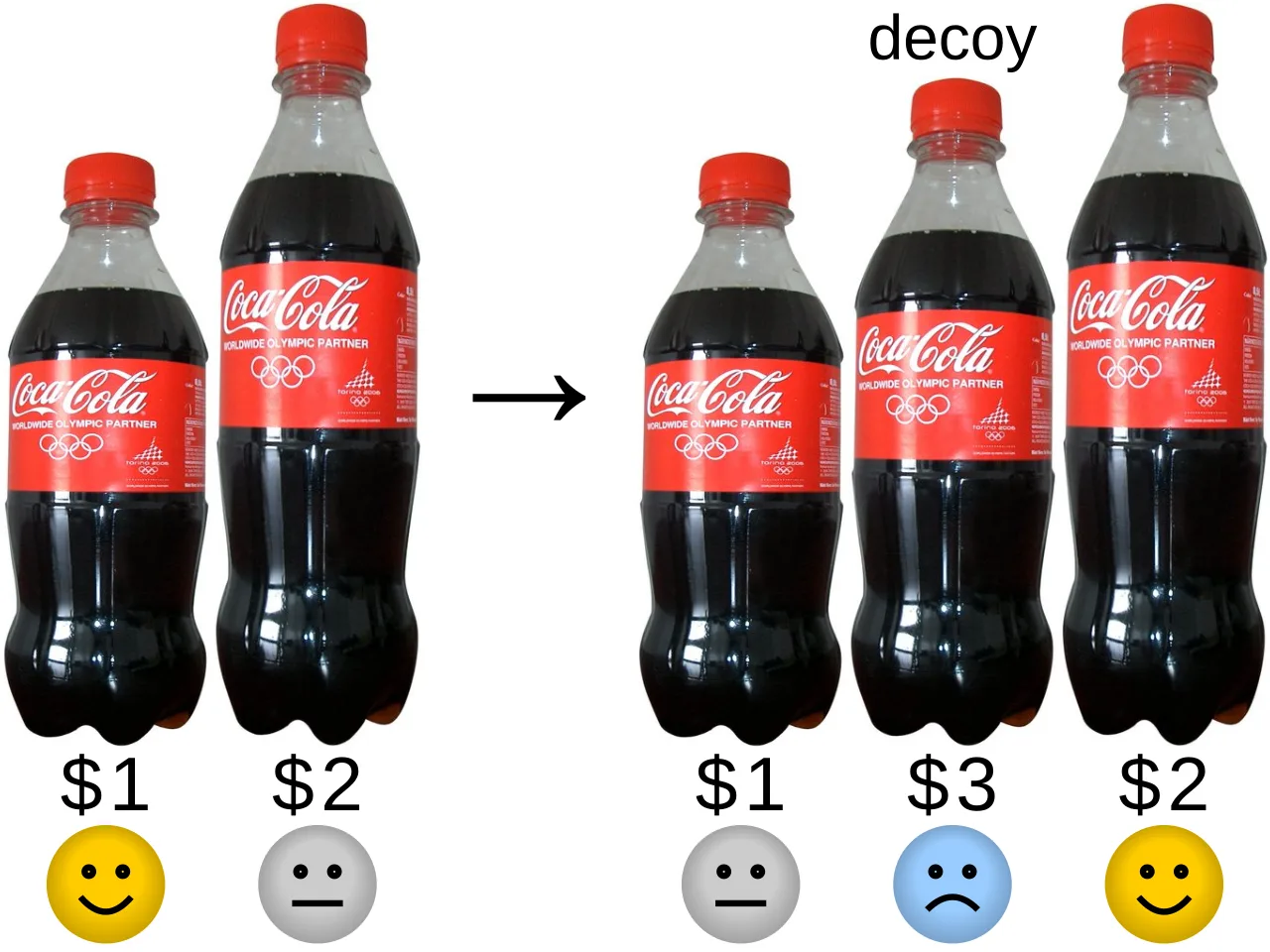
Adding an option can change preferences between options already available, contradicting the assumption that choice probabilities stay fixed. The decoy effect occurs when an inferior alternative makes one existing option look more attractive by comparison, reshaping an apparently rational decision.
In the spring of 1982, Joel Huber, John Payne, and Christopher Puto published a paper in the Journal of Consumer Research that quietly upended one of the foundational axioms of rational choice theory.
The axiom they disturbed was called the regularity condition - the assumption that adding a new option to a choice set can never increase the probability that any of the original options is chosen.
It sounds almost definitionally true. If you are choosing between a Honda and a Toyota, and a Hyundai is added to the mix, simple probability arithmetic says neither the Honda's nor the Toyota's share can go up.
The total probability must sum to one; adding a third option can only divide the pie, never enlarge any existing slice.
Huber, Payne, and Puto demonstrated that this axiom is wrong.[1] In a series of controlled experiments, they showed that adding a new option to a choice set could dramatically increase the market share of one of the original options - provided the new option had the right structural relationship to it.
The key was asymmetric dominance. If the new option was dominated by option A (worse than A on every relevant dimension, or worse on one dimension and not better on any) but not dominated by option B, then preferences shifted toward A.
The dominated option attracted little business for itself; its function was entirely referential. It existed to make A look better by comparison, and it succeeded.
Their classic demonstration used beer. Participants chose between two beers varying on quality and price. When a third beer was added - priced slightly higher than the premium option but rated as lower quality - preference for the premium beer rose significantly.
The decoy had done its work. Participants had not acquired new information about the premium beer. They had simply been given a comparison point that made the premium beer look like the obviously superior choice. The decoy loses, and by losing, it confers victory on its neighbor.
This finding was striking enough on its own. But Huber, Payne, and Puto also documented what they called the asymmetric dominance effect with a systematic experimental design across multiple product categories - cars, restaurants, lottery tickets, films - and consistently found the same result.
The regularity condition was not merely occasionally violated. It was violated reliably, in both directions: whichever option received the decoy won more market share.
The mechanism they proposed was comparative. When a choice is difficult - when two options trade off against each other on different dimensions - people feel uncertain and uncomfortable. They want a reason to choose.
A decoy provides that reason by creating a local comparison that is easy and one-sided: the decoy is clearly worse than one of the two original options, and that clarity extends, by cognitive contamination, to the overall evaluation of that option.
The target option does not merely beat the decoy; it gains a halo of superiority that spills over into its comparison with the competitor.
The most famous real-world illustration came not from a laboratory but from a magazine subscription page. In his 2008 book Predictably Irrational, behavioral economist Dan Ariely described a pricing structure that appeared in an old issue of The Economist.[3]
The subscription page offered three options: digital-only for $59, print-only for $125, and print-plus-digital for $125. The third option, print-plus-digital, cost the same as print-only but included the digital edition at no additional cost.
By any rational calculation, print-only was dominated - it offered less for the same price. No one should choose it.
Ariely ran a study with 100 MIT students. When presented with all three options, 84 chose print-plus-digital, 16 chose digital-only, and zero chose print-only. The print-only option was, in effect, a decoy: not a product anyone wanted, but a comparison point that made print-plus-digital look like a spectacular deal.
To test this, Ariely removed the dominated option and re-ran the study. Now only two options remained: digital-only at $59 and print-plus-digital at $125.
The result flipped: 68 chose digital-only and only 32 chose print-plus-digital. Removing a worthless option - one nobody had chosen - had cost the premium subscription two-thirds of its market share. The decoy had been doing enormous invisible work.
"Adding an asymmetrically dominated option to a choice set increases the preference share of the dominating option." - Joel Huber, John Payne & Christopher Puto, 1982
What the Decoy Effect Is
The decoy effect - also called the asymmetric dominance effect - describes the phenomenon whereby a consumer's preference between two options shifts in favor of one of them when a third option is added that is asymmetrically dominated: inferior to one of the original options but not to the other.
Decoy Effect vs. Compromise Effect
The decoy effect is frequently conflated with a neighboring phenomenon called the compromise effect, first formalized by Itamar Simonson in 1989.[2] Both involve context-dependent preference shifts triggered by the addition of a third option, but the underlying mechanisms and the structural position of the critical option are distinct.
| Dimension | Decoy Effect (Asymmetric Dominance) | Compromise Effect |
|---|---|---|
| Position of critical option | Third option is dominated by one target option but not the other | Third option makes one of the original options appear to be the "middle" choice |
| What gets boosted | The option that dominates the decoy (the "target") | The option positioned as a compromise between extremes |
| Mechanism | Asymmetric dominance creates an easy local comparison that raises target's perceived value | Extremeness aversion makes the middle option feel safe and socially defensible |
| Original paper | Huber, Payne & Puto, Journal of Consumer Research, 1982 | Simonson, Journal of Marketing Research, 1989 |
| Key cognitive driver | Ease of comparison; decoy provides a "reason to choose" the target | Loss aversion applied to attribute extremes; people avoid appearing excessive |
| Example | Adding a worse-quality beer at a higher price to shift buyers toward the premium beer | Pricing three TV sets at $299, $499, $799 - adding the $799 model boosts the $499 model |
| Susceptibility to removal | Removing the decoy collapses the target's advantage | Removing an extreme option collapses the middle option's advantage |
The two effects are related - both involve choice-set composition shaping preference - but they are mechanistically separate and should not be conflated. The decoy effect requires that the third option be dominated; the compromise effect requires that the third option define an extreme.
An option can function as both simultaneously, but the roles are analytically distinct.
The Cognitive Science Behind the Effect
Reason-Based Choice
The most theoretically influential framework for explaining the decoy effect was proposed by Eldar Shafir, Itamar Simonson, and Amos Tversky in a 1993 paper titled "Reason-Based Choice," published in Cognition (Vol.[4] 49, Issues 1-2).
Their argument was that people do not simply maximize utility - they search for reasons that justify a choice, reasons they can articulate to themselves and potentially to others.
A dominated decoy provides exactly such a reason: "I chose the premium option because it was clearly better than the alternative, and the value relative to the print-only option was obvious." This justification narrative makes the choice feel coherent and defensible, reducing the psychological discomfort of deciding under uncertainty.
Shafir, Simonson, and Tversky demonstrated reason-based choice across multiple domains, showing that when an option provides a compelling reason to choose - even when the reason is structurally created rather than informationally new - it captures more of the preference.
The decoy functions as a reason-generator: it does not provide new facts about the target option, but it restructures the evaluative landscape so that choosing the target becomes narratively easy.
Attribute-Based Comparison
A complementary mechanism was identified through the work of Simonson and his colleagues on attribute-based evaluation. When choices are difficult because options trade off on multiple dimensions, people default to attribute-by-attribute comparison rather than holistic utility estimation.
The presence of a dominated decoy makes this kind of comparison especially potent: on the dimension where the target beats the decoy, the target's advantage is clear and quantifiable.
On the dimension where the decoy is not worse than the competitor, the comparison provides less information. The result is an asymmetric advantage for the target in the comparison process - not because the target's absolute quality has changed, but because the decoy makes its relative quality easier to calculate.
Neural Correlates and Attention
Neuroscientific work on the decoy effect has clarified some of the attentional mechanisms involved.
A 2010 study by Hedgcock and Rao, published in the Journal of Marketing Research, used eye-tracking to show that participants spent more time looking at the target option and the decoy than at the competitor, suggesting that the decoy captures attention and directs it toward the comparison that flatters the target.[9]
This attentional asymmetry may itself drive a portion of the preference shift, independent of explicit comparison: the target is simply seen more, thought about more, and therefore feels more salient and cognitively fluent.
Fluency and Ease
Related to attentionl is cognitive fluency - the ease with which a comparison can be made and understood. Research on fluency effects, pioneered by Norbert Schwarz and colleagues in the 1990s, shows that when cognitive processing is easy, the object of that processing is evaluated more positively.
The decoy makes the target option easy to evaluate favorably: the comparison between target and decoy is transparent and effortless. This fluency bleeds over into the target's general evaluation, lending it a felt quality of superiority that the absolute attributes alone would not generate.
Preference Construction
Perhaps the deepest theoretical account comes from the view, associated with Paul Slovic, that preferences are not discovered but constructed during the act of choosing.
If preferences exist fully formed prior to decision, context-manipulation like the decoy effect should have little power - people would simply read off their pre-existing rankings.
But if preferences are assembled on the fly from available cues, comparative relationships, attention patterns, and justification needs, then the decoy effect is exactly what should happen.
The decoy provides raw material for constructing a preference: a comparison that is easy, one-sided, and flattering to the target. The mind uses that material, not because it is irrational, but because it is building a preference rather than expressing one.
Four Case Studies
Marketing: Amazon's Product Tiering
Online retail provides a particularly rich environment for decoy effects because the digital shelf is infinitely malleable - prices and configurations can be altered at will, and A/B testing allows companies to measure preference shifts with high precision.
Amazon has been documented using decoy-adjacent pricing structures across multiple product categories.
In a pattern analyzed by pricing researcher Rafi Mohammed and described in the Harvard Business Review in 2012, consumer electronics pages frequently feature three versions of a product: a basic model, a mid-tier model, and a premium model, where the premium model's price increment over the mid-tier is smaller than the mid-tier's increment over the basic.
The premium model functions as a partial decoy for the mid-tier - it is not strictly dominated (it offers more features), but its poor value per dollar makes the mid-tier look like the sensible choice.
More directly, Amazon's Subscribe-and-Save program often presents monthly versus subscription pricing in a way that makes the one-time purchase price function as a decoy.
When a 12-pack of paper towels is priced at $18.99 single-purchase and $16.14 with Subscribe-and-Save, the single-purchase price anchors the evaluation and makes the subscription appear discounted - but the framing also means that any intermediate option (say, a smaller pack at $9.99) that is priced to make the 12-pack look like bad value will reduce 12-pack purchases.
The structural logic is identical to Huber et al.'s original beer experiment; the scale and the sophistication of the measurement have simply increased.
Politics: Candidate Positioning and Ballot Effects
The decoy effect is not confined to commercial markets. A 2004 paper by Simon and Colleagues, drawing on the reason-based choice framework, demonstrated experimentally that the presence of a "dominated" political candidate - one who shares a core position with a target candidate but is perceived as less competent or less electable - can shift voter preferences toward the target.
The mechanism is the same: the dominated candidate makes the target look like the obviously superior representative of a shared political position.
In multi-party electoral systems, spoiler candidates sometimes function as inadvertent decoys.
When a far-right candidate runs alongside a moderate right candidate and a left candidate, the far-right candidate may not attract votes from the center-right but can define a dimension - immigration policy, say - on which the moderate right candidate looks balanced and reasonable.
Political strategists in modern campaigns have shown increasing sophistication about this dynamic.
Framing a target candidate favorably requires not just promoting the target but managing the comparison set - ensuring that any third-party or primary challenger occupies a position that, by asymmetric dominance, makes the target look better.
The structural logic of the decoy, first mapped in beer-preference experiments in 1982, operates in voting booths.
Medicine: Treatment Option Framing
Healthcare decisions are among the highest-stakes choices humans make, and the decoy effect has been documented in medical contexts by multiple research teams. A study by Patel, Cialdini, and colleagues examined how the framing of treatment alternatives affected patient preferences for surgical versus non-surgical interventions.
When a third treatment option was introduced that was dominated by the surgical option (higher risk of complications, slower recovery, and lower probability of success than surgery, but not dominated by the non-surgical option), patient preferences shifted significantly toward surgery - even when the underlying medical characteristics of the primary options were held constant.
A broader review by Schwartz and Chapman, published in Medical Decision Making, documented multiple instances of decoy-consistent effects in clinical judgment, including preferences among chemotherapy regimens and organ transplant waiting-list prioritizations.
The implications are serious: if the configuration of a treatment menu - which options are presented and in what form - can shift patient preferences independent of the medical merits of those options, then clinical framing is not neutral.
Presenting three treatment options is an act with ethical consequences, not merely an informational one. The physician who adds a dominated alternative to a conversation, perhaps hoping to make one option look good, is exercising influence over patient choice in ways that may not be transparent or consented to.
Environmental Policy: Valuation Surveys and the Decoy in Conservation
The decoy effect has been documented in a domain far from consumer goods or clinical medicine: economic valuation of environmental goods.
Bateman et al., in a 2008 paper published in Environmental and Resource Economics, demonstrated that willingness-to-pay estimates for conservation programs were systematically influenced by the presence of dominated alternatives in stated-preference surveys.[6]
When respondents were asked how much they would pay to protect a nature reserve, and a dominated program (protecting a smaller area at a higher cost) was included alongside the target program and a competitor, willingness-to-pay for the target increased substantially.
The finding has significant methodological implications. Environmental economists use stated-preference methods - contingent valuation, choice experiments - to estimate the monetary value of non-market goods such as clean air, biodiversity, or scenic landscapes.
These estimates feed directly into cost-benefit analyses that shape regulatory policy. If the composition of the choice set in a survey systematically distorts stated willingness-to-pay, the resulting policy valuations are artifacts of survey design as much as reflections of genuine preferences.
Bateman et al. called for systematic examination of choice-set composition effects in environmental valuation, arguing that the presence of dominated alternatives in survey designs - often included inadvertently, as "reality checks" - may be generating biased estimates at scale.
Intellectual Lineage
The decoy effect sits within a lineage of challenges to the rational actor model that accumulated across the latter half of the twentieth century.
Its intellectual ancestors include Allais's 1953 demonstration that expected utility theory generates systematically wrong predictions (the Allais Paradox), and Tversky's 1969 paper on the intransitivity of preferences, which showed that people's choices can violate transitivity - the axiom that if A is preferred to B and B is preferred to C, then A must be preferred to C.
The decoy effect extends this tradition by attacking the regularity condition specifically, which is a weaker requirement than full transitivity. Regularity does not demand that preferences be consistent across all options; it merely demands that adding a new option to a set cannot increase the probability of selecting an existing option.
Huber, Payne, and Puto showed that even this weak condition fails. This places the decoy effect at the center of a broader project: mapping the conditions under which the standard axioms of rational choice theory break down, and understanding why.
The work of Amos Tversky and Daniel Kahneman provides the theoretical backdrop.[10] Their 1979 prospect theory paper, published in Econometrica, established that people evaluate outcomes relative to reference points, not in absolute terms, and that losses loom larger than equivalent gains.
The decoy effect extends this reference-point logic: the decoy functions as a reference point that makes the target look like a gain relative to a clearly inferior alternative.
The mechanism is choice-set relative rather than outcome relative, but the underlying cognitive architecture - comparison to a salient reference - is the same.
Richard Thaler's concept of mental accounting, developed across several papers in the 1980s, is also relevant. Mental accounting describes how people categorize and evaluate financial transactions using subjective rules that diverge from objective value calculations.
The decoy effect exploits mental accounting by creating a local comparison in which the target appears to offer disproportionate value - making it feel like a "deal" relative to the decoy, even though no objective fact about the target has changed.
The subjective sense of getting a good deal is a mental accounting outcome, not a utility calculation.
The effect also connects to the work of Herbert Simon on bounded rationality. Simon argued in the 1950s that economic agents do not maximize utility but rather "satisfice" - search for options that meet some threshold of acceptability, using simple heuristics rather than full optimization.
The decoy effect can be understood as a satisficing outcome: the target option, when accompanied by a dominated decoy, satisfices more easily because the comparison with the decoy quickly establishes the target as "good enough" and terminates the search. The decoy lowers the cognitive cost of choosing the target.
Empirical Research: Robustness and Boundaries
The decoy effect's empirical record is substantial. The original Huber, Payne, and Puto 1982 demonstration was followed by a large number of replications and extensions across the 1980s and 1990s.
Simonson's 1989 paper in the Journal of Marketing Research confirmed the effect across additional product categories and introduced the comparison with the compromise effect, enabling researchers to distinguish between the two phenomena experimentally.[12]
Doyle, O'Connor, Reynolds, and Bottomley published a comprehensive replication study in 1999 in Psychology and Marketing - one of the most rigorous examinations of the effect's robustness - and confirmed that asymmetric dominance reliably shifts preferences in the predicted direction across multiple cultures and product types.[5]
Wedell's 1991 paper, "Distinguishing Among Models of Contextually Induced Preference Reversals," published in the Journal of Experimental Psychology: Learning, Memory, and Cognition, provided a formal modeling framework that allowed researchers to decompose the decoy effect from other context effects and test competing mechanistic accounts.[7]
Wedell's analysis was particularly important for distinguishing "range" effects - where the decoy shifts the effective range of the attribute space and thereby changes relative positioning - from "frequency" effects, where the decoy changes the frequency with which different attribute values appear in the choice set, shifting attention and weighting.
More recent work has examined the decoy effect in non-hypothetical settings with real incentives.
Frederick, Lee, and Baskin's 2014 paper in the Journal of Marketing Research, titled "The Limits of Attraction," conducted a systematic meta-analysis of decoy effect studies and found that the effect was substantially weaker in real-choice conditions with financial stakes than in hypothetical scenarios.[8]
While the effect remained statistically significant in incentivized conditions, its magnitude was reduced, suggesting that motivational factors and deliberative attention can partially mitigate it. This is a meaningful qualification: the decoy effect is real, but it is not equally powerful under all conditions.
Cultural moderators have also been documented. Kim and Meyers-Levy, in a 2008 study, found that the decoy effect was stronger among individuals with a prevention regulatory focus (motivated by avoiding losses and maintaining safety) than among those with a promotion focus (motivated by achieving gains and advancement).
This connects to the broader finding that loss aversion - stronger in prevention-focused individuals - amplifies the decoy effect because the dominated option makes the target look like a loss avoided.
Limits and Nuances
The decoy effect is a genuine and replicable phenomenon, but several important qualifications bound its scope.
Dominance must be perceptible. The decoy's effectiveness depends on the target clearly dominating the decoy on at least one attribute. When the dominated relationship is ambiguous or requires careful calculation to perceive, the effect weakens.
Consumers who take time to understand the full attribute structure may correctly identify the decoy and discount it. In low-involvement purchase contexts - quick decisions, small amounts - the decoy works largely because consumers do not scrutinize the choice set carefully.
In high-stakes, high-involvement contexts, deliberate analysis can partially undo the effect.
Product familiarity matters. Muthukrishnan, Warlop, and Alba (1991) showed that the decoy effect is weaker when consumers have strong prior preferences based on product experience. If you have bought and loved a particular brand of coffee for years, the addition of a dominated decoy is unlikely to shift your preference substantially.
The effect is most powerful in unfamiliar choice domains where preferences are weakly formed and the consumer is genuinely uncertain - precisely the conditions under which external comparison points are most influential.
Attribute structure constrains the effect. The decoy effect requires that the choice be evaluable on at least two dimensions on which the options differ.
For single-attribute choices (choose the cheapest option, or choose the one with the most storage), there is no role for the decoy mechanism because comparison across attributes is not required.
The effect is most powerful when trade-offs between two salient attributes - quality and price, speed and accuracy, risk and return - make the choice genuinely difficult.
The meta-analytic reality. Frederick, Lee, and Baskin's 2014 meta-analysis, analyzing 50 studies, found that the mean size of the asymmetric dominance effect was substantial but varied considerably across studies.
Effect sizes (measured as the percentage-point advantage conferred on the target by the decoy) ranged from near zero to over 40 percentage points.
This variance reflects the importance of moderating factors - product category, involvement level, dominance clarity, presentation format - and means that predicting the decoy effect's magnitude in any specific application requires knowing those moderators. The effect is robust on average; it is not guaranteed in any particular case.
Ethical dimensions. The decoy effect's use in commercial and political settings raises genuine ethical questions.
When a company deliberately engineers a pricing menu to exploit asymmetric dominance - as The Economist subscription page appeared to do - it is exploiting a known cognitive vulnerability to steer consumers toward choices they might not make under neutral conditions.
This is qualitatively different from merely presenting accurate information about products.
The decoy structure conveys no new factual information; it changes preference through cognitive manipulation. Behavioral economists differ on whether this constitutes illegitimate manipulation or legitimate persuasion.
Thaler and Sunstein, in their 2008 book Nudge, argued for a standard of "libertarian paternalism" in which nudges - including choice-architecture effects like the decoy - are acceptable when they steer people toward better outcomes, but their ethical status becomes more complex when they are used to maximize corporate revenue rather than consumer welfare.[11]
Sources & Further Reading
Huber, J., Payne, J. W., & Puto, C. (1982). Adding asymmetrically dominated alternatives: Violations of regularity and the similarity hypothesis. Journal of Consumer Research, 9(1), 90-98.
Simonson, I. (1989). Choice based on reasons: The case of attraction and compromise effects. Journal of Marketing Research, 26(2), 158-174.
Ariely, D. (2008). "Predictably Irrational: The Hidden Forces That Shape Our Decisions". HarperCollins.
Shafir, E., Simonson, I., & Tversky, A. (1993). Reason-based choice. Cognition, 49(1-2), 11-36.
Doyle, J. R., O'Connor, D. J., Reynolds, G. M., & Bottomley, P. A. (1999). The robustness of the asymmetrically dominated effect: Buying frames, phantom alternatives, and in-store purchases. Psychology and Marketing, 16(3), 225-243.
Bateman, I., Day, B., Loomes, G., & Sugden, R. (2008). Can ranking techniques elicit robust values? Environmental and Resource Economics, 39(4), 413-445.
Wedell, D. H. (1991). Distinguishing among models of contextually induced preference reversals. Journal of Experimental Psychology: Learning, Memory, and Cognition, 17(4), 767-778.
Frederick, S., Lee, L., & Baskin, E. (2014). The limits of attraction. Journal of Marketing Research, 51(4), 487-507.
Hedgcock, W., & Rao, A. R. (2009). Trade-off aversion as an explanation for the attraction effect: A functional magnetic resonance imaging study. Journal of Marketing Research, 46(1), 1-13.
Tversky, A., & Kahneman, D. (1979). "Prospect theory: An analysis of decision under risk. Econometrica, 47(2), 263-292."
Thaler, R. H., & Sunstein, C. R. (2008). Nudge: Improving Decisions About Health, Wealth, and Happiness. Yale University Press.
Simonson, I., & Tversky, A. (1992). Choice in context: Trade-off contrast and extremeness aversion. Journal of Marketing Research, 29(3), 281-295.