
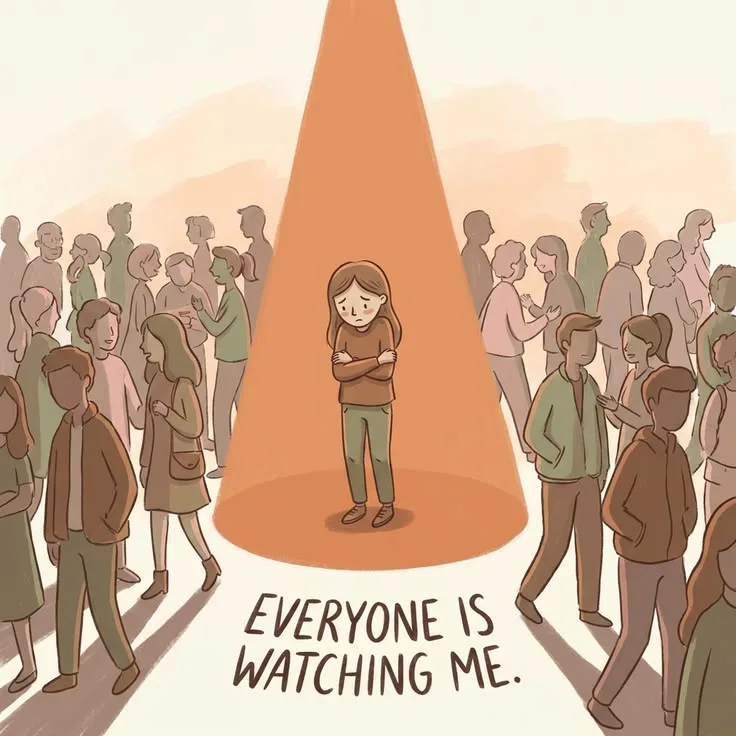
Spotlight: You spill a drink at a party. You trip getting off a bus. You give a presentation and lose your train of thought for three seconds. For the next hour - or the next week - you feel as though everyone who witnessed it is still thinking about it. Replaying it. Judging you for it.
They almost certainly are not. This is the spotlight effect: the systematic overestimation of how much other people notice, remember, and evaluate what we do. It is a normal cognitive bias, well documented in experimental psychology.
But for people with social anxiety, it operates with a force and persistence that can be genuinely disabling - and understanding it is one of the first steps toward addressing it.
The Research Foundation: Gilovich and the Embarrassing T-Shirt
The original Cornell study
The spotlight effect was named and characterized by psychologist Thomas Gilovich and colleagues at Cornell University in a widely cited 2000 paper in the Journal of Personality and Social Psychology, "The Spotlight Effect in Social Judgment: An Egocentric Bias in Estimates of the Salience of One's Own Actions and Appearance."
Gilovich's experimental setup was elegantly simple. Participants were asked to wear a T-shirt with an embarrassing image on it (a large picture of Barry Manilow was chosen for its recognizability and mild social awkwardness) and then enter a room full of other students.
The participant was then escorted out and asked to estimate how many of the other students had noticed and could remember the image on the shirt.
Participants consistently estimated that approximately 50 percent of students in the room had noticed the shirt. When the other students were actually surveyed, the correct figure was approximately 25 percent - roughly half what participants predicted.
This result has been replicated across many variations: predictions about who noticed you stumble, who remembers a poor performance, who observed an embarrassing moment. In each case, people overestimate their salience to others by a factor of roughly two.
Why the effect exists
Gilovich and colleagues attribute the spotlight effect to anchoring on one's own perspective. You know what you are wearing, what mistake you made, what awkward thing you said, because it is salient to you.
You then adjust your estimate of how salient it is to others - but the adjustment is insufficient. You remain anchored on your own experience of yourself as conspicuous.
A related mechanism is the social attention bias: we are evolutionarily primed to be alert to social evaluation, because being judged negatively by the group had survival costs for social species like humans. This priming means the question "did people notice?" feels more pressing than it actually is.
Social Anxiety and the Amplified Spotlight
What social anxiety disorder is
Social anxiety disorder (SAD), also called social phobia, is characterized by intense fear of social or performance situations in which the person might be scrutinized by others. This fear is disproportionate to any actual threat, persistent (lasting six months or more), and causes significant interference with normal functioning.
According to the National Institute of Mental Health, social anxiety disorder affects approximately 12.1 percent of Americans at some point in their lives, making it one of the most common anxiety disorders. It typically begins in early adolescence and, without treatment, tends to persist.
The spotlight effect is a component of normal cognition. Social anxiety involves the spotlight effect operating in overdrive - chronically, intensely, and across situations where ordinary people feel no particular self-consciousness.
Self-focused attention: the core mechanism
The cognitive model of social anxiety, developed primarily by David Clark and Adrian Wells at the University of Oxford, identifies self-focused attention as the central maintaining mechanism.
In social situations, people with social anxiety devote a large share of their attention to monitoring their own internal state: how anxious they feel, what they look like, whether their voice is shaking, whether their hands are visible and trembling.
This internal monitoring serves as the primary source of information about how they appear to others.
The problem is that internal information is a poor proxy for external appearance. A person whose heart is racing and whose hands feel unsteady is far less conspicuously anxious than they feel.
Studies using video recordings of socially anxious participants show a substantial gap between how anxious they believe they appear and how anxious independent raters judge them to be.
Because their attention is directed inward rather than outward, people with social anxiety also miss the actual social cues that might correct their assumptions - the listener who is nodding attentively, the audience that is engaged rather than critical.
Their model of how others perceive them is constructed primarily from their own internal experience of anxiety, which means it is systematically distorted toward overestimating negative evaluation.
"In social anxiety, the spotlight is not an external fact about the social world. It is a projection outward of intense internal self-scrutiny." - Paraphrase of the Clark-Wells cognitive model
The post-event processing loop
Social anxiety includes a characteristic pattern called post-event processing: after a social situation, the person mentally reviews the event in detail, focusing on perceived failures and embarrassments.
This review is typically skewed by negative appraisal - the processing is not objective but selectively attends to moments of discomfort and potential judgment.
Post-event processing reinforces the spotlight effect in several ways. It maintains the salience of embarrassing moments in memory, making them more available as reference points. It builds an increasingly negative autobiographical account of one's social performance.
And it generates anticipatory anxiety about future similar situations, which leads to increased self-focused attention when they occur.
Behavioral Consequences of the Spotlight Effect in Social Anxiety
Safety behaviors and their costs
When people believe they are being intensely scrutinized, they adopt safety behaviors: actions intended to reduce the risk of negative evaluation.
A person who fears looking anxious in a meeting may grip their notes tightly (to prevent visible hand trembling), avoid eye contact (to prevent others from reading their face), speak quickly (to spend less time being watched), or rehearse sentences mentally before speaking (to avoid stumbling).
Safety behaviors are counterproductive in two ways. First, they consume cognitive resources that could otherwise be directed at actual task performance - the mental rehearsal that is meant to prevent stumbling often causes it.
Second, they maintain the underlying belief that conspicuousness is dangerous, because they prevent disconfirmatory experiences.
If you avoided speaking and "got away with it," you attribute the success to the avoidance rather than updating toward the belief that speaking would have been fine.
Avoidance and its long-term effects
The most significant behavioral consequence of the intensified spotlight effect is avoidance: declining social opportunities, withdrawing from conversations, avoiding situations where performance will be evaluated.
Avoidance reduces immediate anxiety but reinforces the disorder over time by preventing the learning that social situations are safe.
Social avoidance also has direct costs to life quality: reduced social support, career limitations, restricted relationship opportunities, and the secondary demoralization of knowing that anxiety is limiting your life.
CBT Treatment: Testing the Spotlight
Cognitive behavioral therapy (CBT) for social anxiety is among the most thoroughly evidence-supported treatments in clinical psychology. A meta-analysis by Otte (2011) found effect sizes of 0.86 to 1.0 for CBT versus control conditions, placing it among the most effective psychological treatments for any condition.
Cognitive restructuring
The cognitive component of CBT addresses the distorted appraisals underlying the spotlight effect. Therapists help clients identify automatic thoughts ("everyone will notice I'm nervous," "they'll think I'm incompetent") and evaluate the evidence for and against them.
Key questions in cognitive restructuring:
- What is the actual evidence that people are paying this level of attention?
- Is there an alternative interpretation of others' behavior?
- Even if people did notice, what would actually happen?
- How would you feel about someone else in the same situation?
This process does not simply substitute positive thoughts for negative ones - it builds more accurate, evidence-based appraisals of social situations.
Behavioral experiments
Behavioral experiments are the active ingredient of CBT for the spotlight effect. These are structured tests of specific predictions.
| Belief | Predicted Outcome | Experiment | Typical Finding |
|---|---|---|---|
| "Everyone notices when I blush" | 80% of people will notice | Count how many comment or react | Usually 0-5% |
| "My anxiety is obvious" | "I look visibly nervous" | Compare self-rating to video or peer rating | Self-rating consistently higher |
| "If I stumble speaking, people will think less of me" | Audience will judge me negatively | Ask for audience feedback | Feedback generally neutral or positive |
| "I must avoid eye contact or people will see my fear" | Eye contact will make anxiety worse | Make sustained eye contact and observe | Anxiety often decreases with habituation |
The power of behavioral experiments is that they provide direct disconfirmatory evidence in the person's own experience, rather than asking them to accept the therapist's reassurance. The spotlight effect weakens not through argument but through repeated experience that the predicted scrutiny does not materialize.
Attention retraining
Because self-focused attention is a central maintaining factor, attention retraining is a specific CBT technique that teaches clients to direct attention outward during social situations.
Rather than monitoring internal sensations, the client practices noticing specific features of the environment and other people - what they are saying, their expressions, the content of conversation.
Attention retraining has two direct benefits. It generates better-quality information about the actual social environment, replacing the distorted self-generated model with more accurate feedback. And it reduces the subjective intensity of anxiety, because awareness of internal sensations is itself anxiety-amplifying.
A controlled trial by Wells and Papageorgiou (1998) found that attention retraining produced significant reductions in social anxiety relative to a control condition, consistent with the theoretical model.
The FOMO Connection
Fear of Missing Out (FOMO) is the anxiety arising from the perception that others are having rewarding experiences from which you are absent. The connection to the spotlight effect is structural: both involve excessive self-referential social cognition.
In the spotlight effect, you place yourself at the center of others' attention and judgment. In FOMO, you place yourself at the periphery of others' rewarding experiences.
Both involve an inflated estimate of how much social attention is organized around you - either as an object of scrutiny (spotlight effect) or as a notable absence (FOMO).
Social media platforms amplify both dynamics. They provide a constant feed of others' social activity, fueling FOMO through social comparison. They also create a documented record of one's own social performance - posts, comments, photos - that becomes a concrete object of potential evaluation, heightening spotlight concerns.
Research on social media use and social anxiety by Vannucci and colleagues (2017) found that greater social media use was significantly associated with higher self-reported social anxiety. The mechanisms are likely multiple, but the reinforcement of both spotlight and FOMO dynamics is plausible as a contributing factor.
Practical Steps Beyond Therapy
For people who do not have access to formal CBT, a number of evidence-informed practices can address the spotlight effect directly:
Conduct informal behavioral experiments. The next time you do something mildly embarrassing in public, notice how many people actually respond to it rather than assuming maximum scrutiny. Keep a brief record. The data will typically be less alarming than the prediction.
Practice perspective-shifting. When you notice spotlight thinking, ask: "What am I thinking about right now, and is it what they were wearing last week?" Most people are preoccupied with their own concerns to a degree that makes sustained attention to your actions extremely unlikely.
Redirect attention outward. In social situations where you feel conspicuous, practice deliberately noticing specific external details - what someone is saying, what the room looks like, what expressions others have. The physical sensation of self-focused attention is very different from the sensation of external focus.
Reduce safety behaviors gradually. Identify one safety behavior - speaking quickly, avoiding eye contact, overexplaining - and experiment with dropping it in low-stakes situations. Notice what actually happens.
Talk to a professional if functioning is impaired. The spotlight effect as experienced in social anxiety disorder is not a mild inconvenience - it can severely restrict career options, relationships, and quality of life.
CBT delivered by a trained therapist, with exposure and behavioral experiments systematically implemented, has a strong evidence base for producing lasting change.
The spotlight effect is not a flaw in your character or evidence that you are particularly conspicuous. It is a cognitive tendency, amplified in some people more than others, that can be understood and corrected.
The evidence consistently shows that the audience you are imagining is far less attentive, far less critical, and far more preoccupied with itself than you think.
The Transparency Illusion and Spotlight Effect
Closely related to the spotlight effect is the illusion of transparency: the tendency to overestimate how much of our internal state - nervousness, embarrassment, excitement, dishonesty - "leaks out" and is detectable by others.
Gilovich and colleagues demonstrated the illusion of transparency in a 1998 study. Participants who were told to lie in an interview predicted that approximately 49 percent of observers would detect their deception. The actual detection rate was approximately 25 percent.
Similarly, participants experiencing strong emotional states consistently overestimated how visible those states were to observers.
In social anxiety, the illusion of transparency is particularly significant because the anxiety itself becomes an object of fear. A person is not only anxious about the social situation; they are anxious about being seen as anxious, which is itself anxiety-provoking.
This meta-anxiety - fear of appearing fearful - creates a compounding cycle.
CBT for social anxiety directly addresses this by encouraging video-recorded exposure exercises. When anxious clients watch recordings of their own performances, they are typically surprised by how composed they appear compared to how anxious they felt internally.
This direct disconfirmation of the illusion of transparency is among the most powerful tools for breaking the meta-anxiety cycle.
How the Spotlight Effect Develops
Developmental origins in adolescence
Social self-consciousness intensifies dramatically in early adolescence. Research by David Elkind in the 1960s described the "imaginary audience" as a characteristic feature of adolescent cognition - the intense conviction that others are watching and evaluating you constantly.
Elkind attributed this to the development of formal operational thinking, which enables adolescents to think about their own thinking and others' thinking simultaneously, but not yet accurately.
Most people develop a more calibrated social perspective through late adolescence and young adulthood as social experience provides repeated disconfirmation of the imagined audience.
For individuals who develop social anxiety, this calibration process is disrupted: the feedback loop that should reduce the imaginary audience instead maintains or intensifies it, because safety behaviors prevent the accumulation of disconfirmatory social experience.
The role of early social experiences
Negative social experiences - bullying, public humiliation, harsh criticism from caregivers or peers - can install a heightened spotlight sensitivity that persists. When early experiences teach a child or adolescent that public visibility leads to harm, the attentional system appropriately heightens monitoring for social scrutiny.
The problem is that this adaptive response to a specific threatening environment generalizes to all social contexts, including safe ones.
Cognitive models of social anxiety treat this developmental pathway as a contributing but not determining factor: the same negative experiences produce social anxiety in some individuals and not others, with individual differences in temperament, cognitive appraisal style, and subsequent social experience all playing roles.
The Spotlight Effect Across Cultures
The spotlight effect is documented across cultures, but its intensity varies with cultural emphasis on collective observation and social shame.
Research in East Asian contexts, where group-based social evaluation is more salient in everyday life, finds higher levels of fear of negative evaluation and greater spotlight sensitivity compared to Northern European and North American samples.
This does not mean social anxiety is more prevalent in collectivist cultures - the relationship between cultural context and social anxiety prevalence is complex.
It does suggest that the reference point for what constitutes "normal" scrutiny from others is itself culturally calibrated, and that the spotlight effect operates against a culturally specific baseline expectation of how much social observation is normal and acceptable.
Understanding these cultural variations matters clinically: a CBT model developed primarily in individualist Western contexts may need adaptation when applied to clients whose cultural context involves genuinely higher levels of social monitoring and where fear of social evaluation has different functional meanings.
Health note: This article is general educational information about how a topic works, not medical, psychological, or mental-health advice, diagnosis, or treatment. Everyone's situation is different, and research findings describe groups, not individuals.
If you are struggling or have concerns about your health, please talk to a qualified professional such as a doctor or licensed therapist.
If you are in crisis or thinking about harming yourself, contact your local emergency services or a crisis line right away, in the US you can call or text 988 (Suicide & Crisis Lifeline); elsewhere, find local lines at findahelpline.com.