
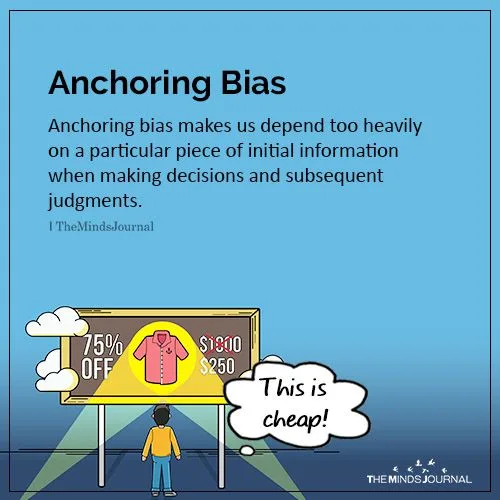
An arbitrary starting number can bend an estimate even when people know it is meaningless, making early prices, forecasts, and framing unusually consequential. Anchoring bias arises because people adjust from an initial value rather than reasoning from scratch, and those adjustments are typically insufficient.
In September 1974, in a psychology laboratory at Hebrew University of Jerusalem, two researchers wheeled in a device that looked like something from a game show: a large circular wheel of fortune, rigged by hidden mechanism to land on one of two numbers - 10 or 65.
Subjects were told, truthfully, that the wheel was random. It was not. Daniel Kahneman and Amos Tversky spun the wheel in front of each participant, let the number settle, then asked a single seemingly unrelated question: what percentage of African countries are members of the United Nations?
The results, published that year in Science, were quietly staggering. Subjects who saw the wheel land on 10 estimated, on average, that 25 percent of African nations were in the UN. Those who saw it land on 65 guessed 45 percent.
A gap of 20 percentage points - an enormous difference - driven entirely by an arbitrary spinning wheel that everyone in the room knew to be rigged. The correct answer at the time was around 35 percent, but that almost doesn't matter.
What matters is that a meaningless number, a number participants explicitly knew to be meaningless, bent their estimates toward itself like gravity bends light. Kahneman and Tversky had demonstrated one of the most robust and disturbing findings in the history of behavioral science: the anchoring effect.
"People make estimates by starting from an initial value that is adjusted to yield the final answer. Adjustments are typically insufficient." - Tversky & Kahneman, 1974
What Anchoring Actually Is
The anchoring effect - also called the anchoring-and-adjustment heuristic, or simply anchoring bias - describes the cognitive tendency to rely too heavily on the first piece of numerical information encountered when making an estimate or decision.
The mind treats that initial figure as a reference point, or "anchor," and then adjusts away from it. The problem is that the adjustment is almost always insufficient: people end up too close to the anchor, pulled toward it even when they consciously try to correct for it.
This needs to be distinguished carefully from several neighboring concepts, because anchoring is often conflated with related but distinct phenomena.
| Concept | Definition | Key Difference from Anchoring |
|---|---|---|
| Anchoring Bias | Over-reliance on first numerical value encountered; insufficient adjustment away from it | The anchor is a specific number that distorts estimates |
| Framing Effect | Judgments shift based on how information is presented (gain vs. loss framing) | Framing involves presentation format, not necessarily a numerical anchor |
| Availability Heuristic | Judging probability by how easily examples come to mind | Based on memory retrieval ease, not initial numerical exposure |
| Confirmation Bias | Seeking information that confirms existing beliefs | About selective evidence-gathering, not numerical distortion |
| Priming | Prior exposure to a stimulus influences response to subsequent stimuli | Broader concept; anchoring is a specific numeric priming effect |
| Status Quo Bias | Preference for the current state of affairs | About inertia and loss aversion, not initial number exposure |
The distinction matters because anchoring is uniquely powerful: it operates even when the anchor is known to be arbitrary, irrelevant, or randomly generated. That is what makes the spinning wheel experiment so alarming.
The subjects were not uninformed - they watched Kahneman and Tversky rig the wheel in front of them - and still they could not escape its gravitational pull.
The Cognitive Machinery Behind the Bias
Why does anchoring happen? The research has converged on two distinct but complementary mechanisms, and understanding both reveals just how deep the vulnerability runs.
The original account, proposed by Kahneman and Tversky in their landmark 1974 paper "Judgment Under Uncertainty: Heuristics and Biases," published in Science (Vol.[1] 185, Issue 4157), was the insufficient adjustment model.
People start from the anchor and mentally "slide" toward what seems like a plausible answer, stopping when they reach a value that no longer seems implausible.
The trouble is that this stopping criterion is itself biased: people stop too early, at the first value that feels "good enough," rather than continuing to push toward the true value.
The anchor sets the starting position, and since adjustment is cognitively costly, the mind conserves energy by stopping sooner than accuracy would require.
Fritz Strack and Thomas Mussweiler proposed a second and more troubling mechanism in 1997, published in the Journal of Personality and Social Psychology.[2] Their account is known as the confirmatory hypothesis testing model.
When you encounter an anchor, the mind does not merely use it as a starting point - it actively searches for evidence that would be consistent with the anchor being correct.
If you are told that Gandhi died at age 140 and asked how old he actually was when he died, your brain does not simply adjust downward from 140; it first searches memory for facts consistent with Gandhi being 140.
This selective retrieval process temporarily populates your working memory with anchor-consistent information, skewing your final estimate toward the anchor even before the explicit adjustment begins.
Strack and Mussweiler demonstrated this by showing that the anchoring effect was dramatically stronger when the anchor and the target question were on the same dimension - because confirmatory search is more productive when domains align.
A third layer of explanation comes from neuroscience. Studies using neuroimaging have shown that numerical anchors activate the same cortical regions involved in numerical processing and magnitude estimation.
The brain does not cleanly segregate "irrelevant anchor" from "relevant estimate" - both pass through the same cognitive hardware, and the anchor contaminates the machinery.
Additionally, working memory constraints play a role: when cognitive load is high, people adjust even less from anchors, because the deliberate effort required to push away from the anchor competes with other mental tasks.
Together, these mechanisms explain why anchoring is so hard to defeat by mere awareness. Knowing you are susceptible to anchoring reduces but does not eliminate the effect. The bias runs below the level at which conscious correction can fully neutralize it.
Four Case Studies
The Real Estate Appraisal, Tucson, 1987
In 1987, Gregory Northcraft and Margaret Neale of the University of Arizona conducted what remains one of the most elegant demonstrations of anchoring in a real-world professional context.[3]
They took actual residential properties in Tucson, Arizona, and provided participants with detailed information packets including all the data a buyer or appraiser would normally consult - square footage, room counts, condition reports, recent sales of comparable properties.
Participants were then asked to appraise the property's value. The critical manipulation was the listing price included in the packet, which was varied across four conditions: approximately $119,900, $129,900, $139,900, or $149,900 for the same property.
Two groups of participants were used: real estate agents with professional experience, and undergraduate students. The agents' appraised values differed by roughly $14,000 between the lowest and highest listing price conditions - a substantial sum that tracked the anchor.
Crucially, when interviewed afterward, the agents overwhelmingly denied that the listing price had influenced them. They cited square footage, comparable sales, neighborhood data.
But the numbers told a different story. The undergraduates showed an even larger anchoring effect, but the agents were far from immune. Expert knowledge buffered the bias slightly - it did not eliminate it.
The Social Security Number Auction, MIT, 2003
Dan Ariely, George Loewenstein, and Drazen Prelec published a study in the Quarterly Journal of Economics in 2003, under the title "Coherent Arbitrariness: Stable Demand Curves Without Stable Preferences." The experiment asked MIT Sloan School students to write down the last two digits of their Social Security Numbers, then bid in a real-money auction on consumer goods including computer accessories, wine, and chocolates.
The anchor - the SSN digits - was written down explicitly before bidding began, making the anchor's presence transparent.
The correlation between SSN ending digits and bid amounts was approximately 0.5. Students in the top quintile of SSN endings (digits 80-99) bid between two and three times more for the same items than students in the bottom quintile (digits 1-20).
A wireless keyboard that commanded bids averaging around $16 from low-SSN participants drew bids averaging around $56 from high-SSN participants. An arbitrary, personally meaningless number - a government tax identifier - had restructured participants' willingness to pay for unrelated consumer goods.
Dice and the Courtroom, Germany, 2006
Birte Englich of the University of Wurzburg, along with collaborators Thomas Mussweiler and Fritz Strack, published a series of studies examining anchoring in legal sentencing.
In a paradigmatic experiment published in 2006 in Personality and Social Psychology Bulletin, experienced German judges were given a case file describing a shoplifting offense and asked to recommend a sentence.
Before doing so, judges were asked to roll a pair of dice - which were, unknown to them, loaded to land on either 3 or 9.
Judges who rolled 3 recommended an average sentence of approximately 5 months; judges who rolled 9 recommended an average of approximately 8 months. A randomly generated dice roll, produced by a game of chance in which the judges themselves participated, shifted sentencing recommendations by roughly 50 percent.
In a related experiment, the anchor was introduced through a prosecutor's sentencing request - itself an arbitrary figure. The result was the same: higher prosecutorial requests produced longer sentences, even when judges were explicitly warned about anchoring before deliberating.
Salary Negotiation: First Offer, Last Word
The negotiation literature has consistently found that the party who makes the first offer gains a systematic advantage - not because first offers represent better information, but because they function as anchors.
A 2001 study by Adam Galinsky and Thomas Mussweiler, published in the Journal of Personality and Social Psychology, found that first offers were among the strongest predictors of final settlement prices, outweighing variables like BATNA strength and objective market value.[6]
Negotiators who received high first offers adjusted insufficiently downward; those who received low first offers adjusted insufficiently upward. Critically, this anchoring effect persisted even when participants had access to information making the first offer clearly unreasonable.
The debiasing strategy that showed most promise: focusing intensively on the counterpart's reservation price rather than the anchor itself - forcing attention to the opposing information most likely to break the anchor's hold.
Applications Across Domains
The anchoring effect does not respect disciplinary boundaries. In retail, merchants have known for decades that a crossed-out "original price" displayed next to a sale price functions as an anchor - the sale price feels like a bargain relative to the anchor, regardless of whether the original price was ever real.
Williams-Sonoma famously noticed that the introduction of a $429 bread maker boosted sales of their $279 model substantially - the $429 price served as an anchor that made $279 feel like shrewd economy.
In public policy, anchoring shapes outcomes in ways that are less transparent but no less consequential.
Environmental economics research has shown that "willingness to pay" surveys for public goods - clean air, wildlife preservation, park access - are heavily anchored by any numerical figure mentioned in the survey instrument itself.
Respondents who are asked "Would you pay $5 per year?" before giving an open-ended willingness-to-pay estimate give systematically lower figures than those asked "Would you pay $500 per year?" Policy makers who design these surveys without accounting for anchoring can generate data that systematically misrepresents public values.
In investment and finance, anchoring is pervasive. Investors anchor to the price at which they originally purchased a stock, treating it as a reference point for gains and losses even though it has no bearing on future returns.
This leads to well-documented patterns of holding losing positions too long - waiting for the price to "return to the anchor" - and selling winning positions too soon.
Analysts anchor to prior earnings figures when making forecasts; their revisions are consistently insufficient relative to new information.
The Intellectual Lineage
The formal study of anchoring begins with Kahneman and Tversky's 1974 Science paper, though the intuition had predecessors.
Early researchers in judgment and decision-making had noted that people used reference points in their estimates, but it was Kahneman and Tversky who systematized the phenomenon within their broader framework of heuristics - mental shortcuts that are often useful but systematically biased in predictable ways.
The 1974 paper identified three heuristics - representativeness, availability, and anchoring-and-adjustment - that they argued accounted for a wide range of human judgment errors.
The anchoring section was arguably the most startling, because it demonstrated bias arising from a source that was not merely irrelevant but demonstrably, obviously irrelevant to the participant.
The program of research launched by that paper eventually earned Kahneman the Nobel Memorial Prize in Economic Sciences in 2002 - Tversky having died in 1996, and the Nobel not being awarded posthumously.
Strack and Mussweiler's 1997 work introduced the confirmatory hypothesis testing account, which explained why anchoring occurred even with implausible anchors - a finding that the insufficient adjustment model struggled to accommodate.
If people were merely adjusting from the anchor, they should adjust further when the anchor is clearly absurd.
Instead, Strack and Mussweiler showed that absurd anchors sometimes produced effects nearly as large as plausible ones, because the selective memory search triggered by any anchor contaminates estimation regardless of the anchor's credibility.
The "coherent arbitrariness" framing introduced by Ariely, Loewenstein, and Prelec in 2003 extended the argument into consumer behavior and economics, demonstrating that arbitrary anchors could create stable, internally coherent preference structures.[4]
Their finding implied something unsettling for economic theory: consumers do not have stable, pre-existing preferences that markets discover - preferences are partly constructed in the moment of decision, and that construction is vulnerable to whatever number happens to be nearby.
What the Empirical Record Shows
The empirical literature on anchoring is among the most replicated in behavioral science.
A meta-analysis by Furnham and Boo, published in the Journal of Socio-Economics in 2011, examined dozens of anchoring studies across domains and found effect sizes that were consistently large by psychological standards - Cohen's d values frequently exceeding 0.5, meaning anchors shifted estimates by more than half a standard deviation.[8]
Northcraft and Neale's 1987 study remains among the most methodologically careful demonstrations of anchoring in a professional context, because it used real practitioners making real professional judgments about real properties - not abstract laboratory tasks with student populations.
Englich, Mussweiler, and Strack's 2006 study, "Playing Dice With Criminal Sentences," is particularly significant because it demonstrated anchoring effects in experienced judges who had both domain expertise and professional obligation to resist such influences.
Research on debiasing has been sobering. Epley and Gilovich (2006), published in Psychological Science, found that forewarning participants about anchoring and explicitly asking them to consider the possibility that their estimates were anchored produced only modest reductions in the effect.[7]
The most effective debiasing strategy identified in the literature involves actively generating arguments against the anchor - not merely being told that anchoring exists - but even this approach reduces rather than eliminates the bias.
Where Anchoring Breaks Down
The anchoring effect is robust, but it is not omnipotent. Several conditions attenuate or limit it.
Domain expertise provides partial protection. The gap between Northcraft and Neale's student participants and their professional realtor participants was real: experts were anchored, but less severely.
Research by Wilson, Houston, Etling, and Brekke (1996), published in the Journal of Personality and Social Psychology, found that expertise in a domain reduces anchoring because experts have richer prior knowledge that competes with the anchor and supports more confident adjustment.[9]
The key word is reduces - the Englich studies with experienced judges demonstrate that expertise does not eliminate the effect.[5]
Implausibility matters at extremes. An anchor so absurd that it triggers counter-argumentation rather than confirmatory search can reverse the usual pattern - a phenomenon sometimes called the "contrast effect." But the range within which anchors operate implausibly is narrower than intuition suggests: Kahneman and Tversky showed effects with numbers that were quite obviously wrong, and Englich showed effects with numbers that participants explicitly knew to be randomly generated.
Janiszewski and Uy (2008), published in Psychological Science, found a counterintuitive moderating factor: the precision of the anchor.[10]
Precise anchors ($19.85) produced weaker effects than round anchors ($20.00), because precise numbers imply that the offeror has done careful calculation - which induces smaller adjustments - whereas round numbers signal approximation and invite larger adjustment.
The implication for negotiators is that precise first offers anchor more strongly than rounded ones.
Strong accountability and systematic decision procedures also attenuate anchoring. Structured diagnostic checklists - which force consideration of alternative possibilities before committing to a first impression - reduce anchoring in medical diagnosis.
The mechanism is that checklists impose the counter-argumentative process that most people do not spontaneously engage in.
The Key Insight
The Kahneman-Tversky spinning wheel experiment retains its power more than fifty years after it was conducted because it strips the anchoring effect down to its most disturbing core: a number does not need to be credible, relevant, or even purportedly accurate to bend your mind toward it.
The first number you hear - about a salary, a house price, a sentence length, a product's value - does not merely inform your estimate. It partly constitutes it.
This is not a quirk of uninformed judgment. It is a feature of how human estimation works - built into the cognitive machinery of expert and novice alike, appearing in courtrooms and auction houses and real estate offices, persisting even when the anchor's irrelevance is loudly announced.
The practical implication is not to distrust all numerical starting points - some anchors carry genuine information. The implication is to recognize that the first number you encounter creates an asymmetric field: it is much harder to push your estimate away from an anchor than to push it toward one.
The rational response is to generate your own estimate before exposing yourself to external numbers, and then to treat any subsequent anchor with deliberate suspicion - knowing that your brain will try to do the opposite.
Sources & Further Reading
Kahneman, D., & Tversky, A. (1974). Judgment under uncertainty: Heuristics and biases. Science, 185(4157), 1124-1131.
Strack, F., & Mussweiler, T. (1997). Explaining the enigmatic anchoring effect: Mechanisms of selective accessibility. Journal of Personality and Social Psychology, 73(3), 437-446.
Northcraft, G. B., & Neale, M. A. (1987). Experts, amateurs, and real estate: An anchoring-and-adjustment perspective on property pricing decisions. Organizational Behavior and Human Decision Processes, 39(1), 84-97.
Ariely, D., Loewenstein, G., & Prelec, D. (2003). Coherent arbitrariness: Stable demand curves without stable preferences. Quarterly Journal of Economics, 118(1), 73-105.
Englich, B., Mussweiler, T., & Strack, F. (2006). Playing dice with criminal sentences: The influence of irrelevant anchors on experts' judicial decision making. Personality and Social Psychology Bulletin, 32(2), 188-200.
Galinsky, A. D., & Mussweiler, T. (2001). First offers as anchors: The role of perspective-taking and negotiator focus. Journal of Personality and Social Psychology, 81(4), 657-669.
Epley, N., & Gilovich, T. (2006). The anchoring-and-adjustment heuristic: Why the adjustments are insufficient. Psychological Science, 17(4), 311-318.
Furnham, A., & Boo, H. C. (2011). A literature review of the anchoring effect. Journal of Socio-Economics, 40(1), 35-42.
Wilson, T. D., Houston, C. E., Etling, K. M., & Brekke, N. (1996). A new look at anchoring effects: Basic anchoring and its antecedents. Journal of Experimental Psychology: General, 125(4), 387-402.
Janiszewski, C., & Uy, D. (2008). Precision of the anchor influences the amount of adjustment. Psychological Science, 19(2), 121-127.