
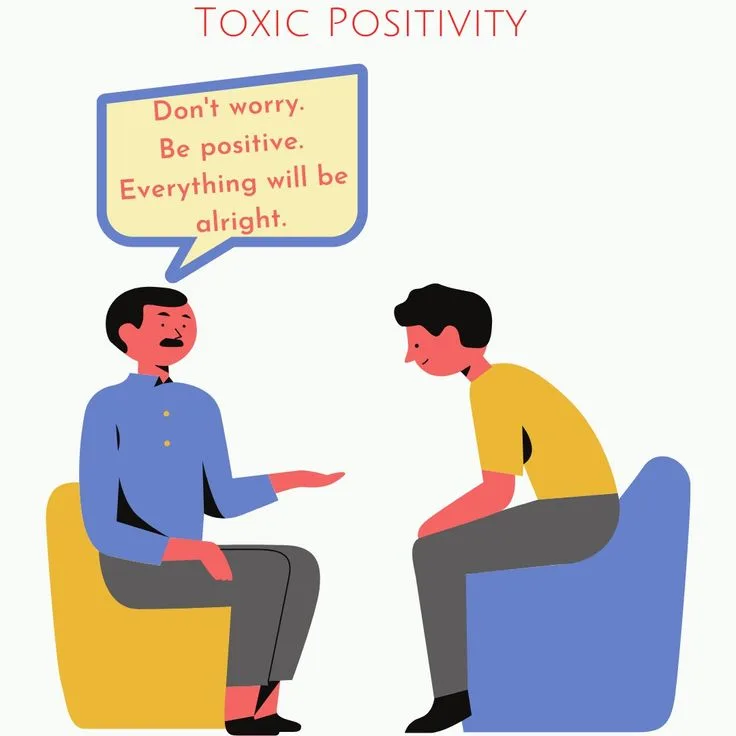
Understanding: Someone tells you they are struggling. Maybe they lost a job, went through a breakup, received a difficult diagnosis, or are simply having a hard time for reasons they cannot fully articulate. You want to help. You want to make them feel better. So you say something encouraging:
"At least you have your health." "Everything happens for a reason." "Just focus on the positives." "You have so much to be grateful for." "Other people have it much worse."
You meant well. But there is a reasonable chance the person you said this to felt worse after hearing it, not because they are ungrateful or fragile, but because something in that exchange went wrong.
What went wrong has a name: toxic positivity. It is not a new problem, but it has received more attention in recent years as understanding of emotional psychology has become more sophisticated and more widely shared.
Understanding what it is, why it backfires, and what actually works instead can make a real difference in how we support others, and how we treat ourselves.
What Toxic Positivity Is
A Working Definition
Toxic positivity is the practice of responding to difficult emotions or circumstances with forced, dismissive optimism: insisting that people focus on the bright side, suppress or quickly replace negative feelings, or adopt a consistently upbeat attitude regardless of what they are actually experiencing.
The word "toxic" does not mean that positivity itself is harmful. Optimism, gratitude, and positive thinking have documented benefits. What makes positivity toxic is its function in a specific interaction: when it is used, consciously or not, to shut down the acknowledgment and expression of genuine difficulty.
The defining feature of toxic positivity is the sequence: it skips validation and moves directly to reassurance. "I'm sorry that's hard, tell me more" is not toxic.
"At least you have your health" is, because it bypasses the person's experience and implicitly instructs them to stop feeling what they are feeling.
The Historical and Cultural Context
The concept of toxic positivity is not a product of contemporary therapy culture. Its roots lie in long-standing tensions between optimism as a cultural ideal and the psychological necessity of processing genuine hardship.
American culture in particular has a deep tradition of positive thinking as a moral virtue, from Norman Vincent Peale's 1952 bestseller The Power of Positive Thinking through the self-help explosion of the 1980s and 1990s to the wellness industry of the 2000s.
Sociologist Barbara Ehrenreich documented this cultural history in her 2009 book Bright-Sided: How the Relentless Promotion of Positive Thinking Has Undermined America, arguing that mandatory positivity in contexts ranging from breast cancer support groups to corporate culture functioned less as genuine support and more as social enforcement: a mechanism to silence difficulty and maintain an acceptable emotional performance.
The rise of social media has intensified the phenomenon. Platforms optimized for engagement reward inspirational content: motivational quotes, before-and-after transformation stories, gratitude posts, good news. They systematically deprioritize the messy, unresolved, ongoing quality of real difficulty.
The result is a curated environment in which struggle is largely invisible and toxic positivity is encoded into the social architecture.
The Spectrum
Toxic positivity exists on a spectrum from mildly unhelpful to actively harmful.
At the mild end: well-intentioned but slightly dismissive comments from people who are genuinely trying to help and simply lack better emotional vocabulary.
At the more harmful end: systematic patterns in relationships or organizations where negative emotions are consistently unwelcome, difficulty is never acknowledged, and people learn that expressing struggle is socially unacceptable. In these environments, toxic positivity is not a slip in conversation, it is a cultural norm.
Clinical psychologists Jamie Zuckerman and Whitney Goodman, who popularized the term in wider clinical practice, have described a particularly harmful version: positivity as a relational contract, where one or both people in a relationship have an explicit or implicit agreement that only positive emotional content will be shared.
This arrangement produces functional but emotionally shallow relationships that cannot withstand genuine crisis.
Common Toxic Positivity Phrases
Most toxic positivity is not delivered maliciously. It comes from people who want to help and who genuinely believe their positive framing will make the other person feel better. The phrases are familiar:
| Toxic Positive Phrase | What It Communicates (Unintentionally) |
|---|---|
| "Just stay positive!" | Your negative feelings are wrong and should stop |
| "Everything happens for a reason" | Your pain has a justification, so stop dwelling on it |
| "Others have it worse" | Your suffering is not valid enough to merit acknowledgment |
| "Good vibes only" | Negative emotions are not welcome here |
| "You'll get through it, you're so strong" | You shouldn't need support; handle it yourself |
| "At least..." (reframe to positive) | The negative aspect isn't worth your attention |
| "Don't be so negative" | Your realistic assessment is the problem |
| "Think happy thoughts!" | Feelings can be changed by willing them away |
| "It could be worse" | You have no right to feel as bad as you do |
| "This is part of God's plan" | Your objection to what happened is presumptuous |
| "You just need a positive mindset" | Your suffering is a choice you are making |
None of these phrases are necessarily harmful in every context. "You'll get through it" said to a friend who has already processed a difficulty and is looking for encouragement is different from the same phrase said the moment they share the difficulty, before any acknowledgment.
Context, timing, and whether validation has already occurred fundamentally change the meaning of any reassurance.
The critical factor is whether the person offering reassurance has first communicated that they understand and accept what the other person is feeling. Without that foundation, reassurance does not land as support. It lands as dismissal.
The Research: Why Emotional Suppression Backfires
James Gross and the Suppression Studies
The most relevant body of research on why toxic positivity backfires comes from work on emotional suppression (the deliberate inhibition of outward emotional expression).
Psychologist James Gross at Stanford has been the central figure in this research since the 1990s, publishing a foundational taxonomy of emotional regulation strategies in Psychological Review in 1998.
His findings are consistent and striking: emotional suppression does not reduce the emotional experience. It reduces the external expression while leaving the internal activation essentially unchanged or intensified. The emotion persists; only its outward sign is hidden.
More specifically, suppression research finds that:
- Physiological arousal (heart rate, skin conductance, blood pressure response) increases when people suppress emotional expression
- Cognitive resources are consumed by the suppression effort, impairing memory and information processing
- Suppressed emotions are associated with more intrusive thoughts about the suppressed content, not fewer
- Long-term suppression is associated with higher rates of anxiety, depression, and interpersonal difficulties
In a widely cited 2003 study, Gross and Olivier John assessed habitual use of suppression versus cognitive reappraisal in a large sample and tracked wellbeing outcomes.
Habitual suppressors reported lower positive emotion, higher negative emotion, poorer interpersonal relationships, and lower overall life satisfaction than habitual reappraisers.
Critically, the interpersonal costs of suppression were social: people who habitually suppressed emotions during interactions were perceived as less warm, less authentic, and were less liked by conversation partners, even in brief laboratory interactions.
The Ironic Process Theory
The famous thought suppression experiment by Daniel Wegner (1987), in which participants were asked not to think of a white bear (and immediately thought of little else), illustrates the general principle: trying not to have an experience tends to make the experience more prominent, not less.
Wegner formalized this in ironic process theory: when we try to suppress a thought or feeling, a monitoring process actively looks for the forbidden content to ensure it has been successfully suppressed, which has the paradoxical effect of making the thought or feeling more accessible.
Applied to toxic positivity: when someone tells you to "just be positive" and you try to comply, part of your cognitive system is now actively monitoring for negative thoughts to suppress them. This monitoring keeps those thoughts active, not dormant.
Research by Wegner, Zanakos, and colleagues in the 1990s demonstrated this consistently across different thought content, emotional states, and populations.
A 2011 study by Borton, Markowitz, and Dieterich found that people instructed to suppress emotional responses to distressing imagery showed greater intrusive thought activity in the hours following the suppression task, compared to people allowed to process freely.
The suppression produced a rebound effect precisely where it was intended to reduce distress.
The Role of Invalidation
Beyond the direct effects of suppression, there is a second mechanism through which toxic positivity backfires: invalidation, the explicit or implicit communication that the person's emotional response is wrong, disproportionate, or socially unacceptable.
Marsha Linehan, the developer of Dialectical Behavior Therapy, placed emotional invalidation at the center of her theory of borderline personality disorder and emotional dysregulation.
Linehan (1993) proposed that chronic emotional invalidation, consistent messages that one's emotional responses are incorrect or unacceptable, disrupts the normal development of emotional regulation capacity.
When people cannot trust their own emotional responses to be valid signals, they lose the foundation for self-understanding and self-regulation.
Even without clinical-level impact, momentary invalidation affects the quality of emotional processing.
A 2015 study by Molina, Solomon, and Schwartz found that participants whose emotional responses were invalidated by a conversation partner showed increased physiological arousal and greater emotional intensity in the minutes following the interaction, compared to those whose emotions were validated.
The invalidation did not reduce the emotion, it amplified it.
Emotional Disclosure and Its Benefits
The counterpart to the suppression literature is research on emotional disclosure, the benefits of expressing and processing difficult emotions. This line of research was pioneered by psychologist James Pennebaker, who in the 1980s began studying the effects of writing about traumatic or stressful events.
His findings, replicated extensively across more than thirty studies, are that structured emotional disclosure through writing is associated with:
- Improved physical health outcomes (fewer doctor visits, stronger immune response)
- Improved psychological adjustment and reduced depression
- Better academic performance in students processing difficult transitions
- Faster adaptation to bereavement and other major losses
- Reduced cortisol levels and improved immune markers (measured objectively in Pennebaker and Beall's 1986 study and multiple replications)
"Inhibiting thoughts, feelings, and behaviors is associated with increased physiological work. Over time, the stress of inhibition can contribute to physical problems and the exacerbation of psychosomatic diseases." (James Pennebaker, Opening Up: The Healing Power of Expressing Emotions (1990))
The mechanism appears to involve both cognitive (processing and organizing an experience into a coherent narrative) and physiological (reducing the sustained activation of the stress response) pathways.
A 2001 study by Klein and Boals found that individuals who wrote expressively about a stressful experience showed significantly better working memory performance in the subsequent weeks, suggesting that emotional processing frees cognitive resources previously consumed by ongoing suppression.
The breadth of emotional disclosure benefits, spanning immune function, physical health, academic performance, and psychological wellbeing, suggests that suppression is not just emotionally costly. It carries a physiological load that, when lifted, produces improvements across multiple systems.
Toxic Positivity in Relationships
How It Damages Closeness
Genuine intimacy requires the ability to show up honestly, including with difficulty, sadness, fear, and pain. When toxic positivity is a consistent feature of a relationship, the implicit message is: your negative emotions are not welcome here. People learn to present only their positive, upbeat selves.
The result is functional but shallow connection. The person who always offers silver linings and changes the subject when things get heavy may be enjoyable company in good times, but they become unavailable precisely when support matters most.
Research on what distinguishes supportive from unsupportive relationship responses is consistent: validation, communicating that the other person's feelings are understandable and acceptable, is the most important component of helpful emotional support.
Advice-giving, minimization, and reframing before validation is offered are consistently rated as unhelpful.
Research on supportive communication suggests that whether someone feels supported by a conversation often depends less on whether the listener offers solutions or information, and more on whether the listener demonstrates that they understand and accept the emotional content of what is being shared.
This sense of feeling understood often matters more to people than the actual content of any advice or reframe offered.
In long-term relationships, the cumulative effect of chronic toxic positivity creates what psychologists call emotional unavailability: the state in which one partner consistently cannot engage with the other's difficult emotional experiences.
Studies on relationship satisfaction and longevity (Gottman and colleagues, 1990s and 2000s) consistently show that emotional unavailability, including dismissive responses to expressed difficulty, predicts relationship deterioration over time.
The Compound Effect of "Being Strong"
A particularly harmful variation of toxic positivity is the praise of strength as a reason not to show difficulty.
"You're so strong, you'll handle this." "I know you can deal with it." This makes expressing struggle feel like a failure of character, a betrayal of the strong identity the person has been assigned.
The people who hear this most often, those who are competent and composed in most situations, are exactly the people who sometimes most need to hear "it is okay not to be okay." The expectation of strength without room for difficulty is isolating.
Research on emotional masking in high-achieving individuals (Lerner, Li, and Weber, 2013) found that people perceived as strong or resilient by their social networks were significantly less likely to receive unprompted emotional support during difficulty, and significantly more likely to have their expressed distress met with dismissal or encouragement to stay strong.
The expectation of strength, paradoxically, creates a social context that reduces available support for those who most appear to not need it.
Toxic Positivity Toward Grief
Grief is the domain where toxic positivity is most acute and most damaging. Cultural discomfort with grief is well-documented.
The sociologist Tony Walter has written extensively about how Western societies have developed increasingly formulaic scripts for bereavement (brief, bounded periods of visible mourning followed by expected return to normal function) that leave little room for the genuine, non-linear, often years-long process of grief.
Phrases like "at least they are no longer suffering," "they would want you to be happy," and "you'll find someone else" are all forms of toxic positivity applied to grief.
They may contain elements of truth, but their function in a conversation is to close down rather than open up: to signal that the level of grief being displayed is socially excessive, that the grieving person should be further along the recovery timeline, or that their continued suffering is a choice.
Research by Colin Murray Parkes (2001) and others on complicated grief found that social support quality, specifically whether the bereaved person's grief was consistently validated or consistently minimized, was a significant predictor of grief trajectory.
People whose grief was minimized showed higher rates of complicated, prolonged grief, not the faster recovery that toxic positive responses appear designed to produce.
Toxic Positivity in the Workplace
The Culture of Mandatory Enthusiasm
Some organizational cultures are systematically toxic positive: relentlessly upbeat, enthusiastic, and allergic to negative framing.
Concerns are "challenges" or "opportunities." Failures are "learning experiences." People who raise realistic risks or express genuine worry are labeled negative or not aligned with the culture.
This is not just uncomfortable, it is functionally dangerous. Organizations that cannot surface negative information do not have access to the information they need to make good decisions.
Research on psychological safety, the degree to which people feel safe expressing concerns and raising problems, consistently finds that teams with low psychological safety make more errors, learn less from failures, and perform worse than those where people feel free to say what is actually true.
Amy Edmondson at Harvard Business School, whose research on psychological safety spans more than two decades, documented this in healthcare settings where the consequences are starkest.
Her research found that nursing teams in hospitals with higher psychological safety reported significantly more medication errors, not because they made more errors, but because they were more willing to surface them.
Teams with lower psychological safety underreported errors, making quality improvement impossible. The "good vibes only" culture was literally costing patients.
A 2019 survey by the Society for Human Resource Management found that 58% of employees reported that their workplace had a toxic culture, and among contributing factors, "not being able to speak up about concerns" and "pressure to appear positive regardless of circumstances" ranked among the most commonly cited.
The organizational costs, in turnover, productivity, and innovation suppression, are substantial.
The "Failure" of Resilience Framing
A subtler workplace version appears in wellness programs and mental health initiatives that emphasize resilience and positive thinking while not addressing the conditions that make work stressful.
"Have you tried gratitude journaling?" offered as a response to unsustainable workload or dysfunctional management is a form of institutional toxic positivity: locating the problem in the employee's mindset rather than in the organizational conditions.
Organizational psychologist Liz Slade has described this as individualizing systemic problems: reframing structural issues as personal resilience failures. The employee is not overwhelmed because the workload is impossible; they simply need better coping strategies.
This framing benefits organizations by shifting responsibility, but it systematically fails employees by misidentifying the cause of distress.
This is not to say resilience building and mental health resources are valueless. They are valuable. But when they substitute for rather than supplement addressing structural causes of distress, they represent a form of positivity that serves the organization's comfort rather than the employee's wellbeing.
What Actually Helps: Validation and Support
The Validation-First Model
Research on effective emotional support converges on a simple sequence: validate first, then offer perspective. This sequence matters because people cannot effectively hear perspective, reassurance, or advice when they do not yet feel heard.
Skipping to the positive, however well-intentioned, communicates that their emotional experience is not the right thing to be having.
Validation does not require:
- Agreement that the situation is hopeless
- Having solutions
- Abandoning your own perspective
- Extended emotional processing
It requires only communicating: "I hear you. What you are feeling makes sense." This typically takes 30 seconds. What changes after it is remarkable: people become more open to perspective, more able to engage with practical considerations, and more connected to the person offering support.
Psychologist Carl Rogers, who developed the person-centered therapeutic approach, articulated this principle in his concept of unconditional positive regard: the therapeutic stance of accepting the client's experience as it is, without evaluation, judgment, or attempt to change it.
Rogers argued that this acceptance was not merely a therapeutic technique but a fundamental psychological need: to have one's experience acknowledged as real and acceptable.
Decades of therapy research have borne this out. Meta-analyses of what makes therapy effective consistently find that the quality of the therapeutic alliance, the degree to which the client feels heard, understood, and accepted, predicts outcomes more reliably than any specific therapeutic technique.
The same principle holds outside therapy: feeling genuinely heard and understood is the foundation on which all further support rests.
The Difference Between Validation and Agreement
A common misconception is that validating someone's emotion means agreeing with their interpretation or accepting that the situation is as bad as they feel it is. It does not.
You can say "I understand why that feels overwhelming" without agreeing that the situation is objectively overwhelming. You can acknowledge "that sounds really painful" without concluding that the person is handling the situation poorly. Validation is about the feeling, not the interpretation.
This distinction is important for people who fear that validation will deepen or entrench difficulty. The research does not support this fear. Validated emotions do not intensify permanently, they tend to de-escalate once acknowledged.
The emotion that is fought or dismissed is more likely to persist than the emotion that is recognized and accepted.
Acceptance and Commitment Therapy (ACT), developed by Steven Hayes and colleagues, has produced substantial evidence that acceptance of difficult emotional experiences (neither fighting them nor suppressing them) produces better long-term outcomes than attempts to eliminate or minimize them.
Acceptance does not mean approving of or wanting the difficult emotion; it means allowing it to be present without treating its presence as an emergency requiring immediate resolution.
What to Say Instead
Replacing toxic positivity does not require extraordinary emotional skill. Some simple alternatives:
- "That sounds really hard."
- "I'm sorry you're going through this."
- "That makes a lot of sense, of course you feel that way."
- "I hear you."
- "What do you need right now?"
- "I'm here."
- "That would be hard for anyone."
- "Tell me more about what that's been like."
The last question, "What do you need right now?", is particularly useful because it treats the person as the authority on their own needs rather than assuming they want advice, reassurance, or a reframe.
Research on social support preferences consistently finds that people vary widely in what kind of support they find helpful, and that matching support type to need is more important than any specific support behavior.
Self-Directed Toxic Positivity
The same dynamic applies internally. Many people maintain an inner voice that does not allow negative emotions, that insists on gratitude, dismisses legitimate distress, or berates itself for not being more positive.
This internal toxic positivity has the same effects as the interpersonal version: it does not make difficult feelings go away; it prevents them from being processed.
Research on self-compassion (particularly the foundational work of Kristin Neff at the University of Texas) finds that people who respond to their own difficulty with warmth and acknowledgment, rather than forced positivity or harsh self-criticism, show better emotional resilience, not worse.
Neff's research demonstrates three components of self-compassion: self-kindness (treating yourself as you would treat a struggling friend), common humanity (recognizing that difficulty is universal), and mindfulness (holding difficult emotions in awareness without over-identification or suppression).
All three are incompatible with internal toxic positivity.
A 2012 meta-analysis by MacBeth and Gumley, reviewing twenty studies on self-compassion and psychological wellbeing, found robust associations between higher self-compassion and lower anxiety, lower depression, and better overall psychological adjustment.
Crucially, these findings held even when controlling for self-esteem, suggesting that self-compassion has effects beyond simply feeling good about oneself.
The person who can say to themselves "this is genuinely hard, and it makes sense that I am struggling with it" is doing something functionally different from toxic positive self-talk. They are processing, not bypassing.
Acknowledging "this is hard" to yourself, without requiring yourself to immediately reframe it as a blessing in disguise, is not pessimism. It is the first step in actually processing the experience and moving through it.
The Role of Emotional Intelligence
The concept of emotional intelligence (EQ), developed by psychologists Peter Salovey and John Mayer in 1990 and popularized by Daniel Goleman, offers a useful framework for understanding what the alternative to toxic positivity actually requires.
Emotional intelligence involves four capacities: perceiving emotions accurately, using emotions to facilitate thought, understanding how emotions change over time, and managing emotions effectively. The first capacity, accurate perception, is directly undermined by toxic positivity.
If a culture or relationship consistently communicates that certain emotional states are unacceptable, people lose access to accurate information about their own and others' emotional states.
Research on emotional intelligence and leadership by Goleman and colleagues found that leaders who scored higher on emotional intelligence, particularly on the empathy and social awareness dimensions, produced consistently better outcomes: higher team engagement, lower turnover, better performance in complex environments.
The leaders who scored lower, who were more likely to use minimizing, dismissive, or toxic positive responses, generated anxiety and disengagement in their teams.
The practical implication is that developing the capacity to respond to difficulty with genuine acknowledgment rather than reflexive positivity is not just emotionally virtuous, it is a functional competency with measurable effects on the people around you.
A Note on Positivity Itself
None of this is an argument against hope, optimism, gratitude, or positive thinking. These have documented benefits. Optimistic people tend to be healthier, more persistent, and more effective at managing adversity. Gratitude practices reliably improve wellbeing.
Barbara Fredrickson's broaden-and-build theory of positive emotions (2001) demonstrated that positive emotional states genuinely broaden cognitive flexibility and build long-term psychological resources: the benefits of positivity are real.
The problem is not positivity. It is positivity deployed prematurely, before acknowledgment, as a replacement for rather than a follow-up to genuine emotional recognition. Positivity that comes after someone feels heard and understood is not toxic. Positivity that arrives before that, as a way of bypassing the difficult experience, is.
The signal question is: is this positive statement coming from a place of genuine support, or is it coming from my own discomfort with sitting with this person's difficulty? If the motivation is to make the other person feel better, ask what they actually need.
If the motivation is to make yourself feel less uncomfortable with their pain, that is worth noticing.
Psychologist Brene Brown, whose research on vulnerability and shame has reached a wide audience, articulates this distinction in her work on empathy versus sympathy.
Empathy, Brown argues, requires the willingness to go into the difficult place with someone, to acknowledge "I know what it's like to feel that way", while sympathy looks at the difficult place from above and tries to silver-line it.
The difference is the direction of movement: toward the person in their difficulty, or away from it.
Key Takeaways
- Toxic positivity is the use of forced optimism to dismiss or bypass genuine difficult emotions rather than acknowledge them
- It is defined by sequence: the problem is skipping validation and moving directly to the positive, not positivity itself
- Research on emotional suppression (Gross, 1998, 2003; Wegner, 1987) shows that trying to push away negative feelings makes them persist or intensify, not diminish
- Ironic process theory explains why trying not to think about something keeps it active in working memory
- James Pennebaker's disclosure research shows that acknowledging and processing difficult emotions has measurable physical and psychological benefits including improved immune function and fewer physician visits
- Emotional invalidation (Linehan, 1993) disrupts normal emotional regulation development and amplifies rather than reduces emotional intensity
- Validation, communicating that someone's feelings are understandable and acceptable, is the most effective component of emotional support, predicting satisfaction more reliably than advice or reframing
- Workplace cultures that suppress negative information sacrifice the psychological safety needed for honest communication and effective decision-making, with documented consequences in patient safety and innovation
- Kristin Neff's self-compassion research shows that treating yourself warmly in difficulty produces better resilience than forced positivity or self-criticism
- The antidote is not pessimism but acknowledgment first: "that sounds really hard" before "here is the silver lining"