
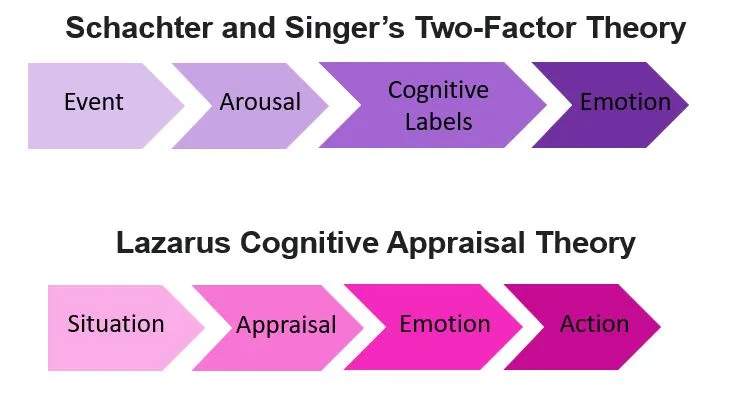
The same event can produce different emotions because people interpret its relevance, threat, and their ability to cope differently. Cognitive appraisal theory treats emotion as a response to those meanings in relation to goals and well-being, rather than an automatic reaction to the event itself.
What Is Cognitive Appraisal Theory?
Cognitive appraisal theory is the psychological framework, developed principally by Richard Lazarus from the mid-1950s onward, proposing that emotions are not automatic responses to events but are produced by the meanings people assign to those events in relation to their own goals and well-being.
According to the theory, the same situation - a public criticism, an unexpected change, a looming deadline - will produce different emotions in different people depending on how each person appraises it: whether it is relevant to their goals, whether it threatens or serves those goals, and what resources they believe they have to cope with it.
This two-stage appraisal process (primary appraisal of stakes and valence, secondary appraisal of coping capacity) accounts for both the specific emotion experienced and its intensity, making cognition the central determinant of emotional life rather than a mere aftermath of it.
"Emotion is not simply a reaction to an event but depends on how the person appraises that event in relation to their own well-being." - Richard Lazarus, 1991
The Experiment That Changed Emotion Science
In 1962, Stanley Schachter and Jerome Singer at Columbia University staged one of the most provocative experiments in the history of psychology.
They injected participants with epinephrine - adrenaline - under the guise of a vision study, then placed each participant in a waiting room with a confederate who behaved either euphorically (shooting paper basketballs, playing with a hula hoop) or with escalating anger (complaining about an insulting questionnaire, eventually tearing it up and storming out).
The critical variable was whether participants had been told the truth about the injection: some were informed it would cause physiological arousal, others were told nothing, and a third group was deliberately misinformed.
Participants who were uninformed or misinformed - those who had no ready physiological explanation for their racing hearts and flushed skin - rated their emotional experience in accordance with whatever the confederate was modeling.
When the confederate was euphoric, they felt elated. When he was enraged, they felt angry. Participants who had been correctly informed about the drug's effects showed no such susceptibility.
Schachter and Singer's two-factor theory, published in Psychological Review that year, proposed that emotion is the product of two independent ingredients: undifferentiated physiological arousal plus a cognitive label applied to that arousal.[3]
The specific emotion you feel depends not on the arousal itself, which is largely the same regardless of cause, but on how you interpret it. Context, information, and inference do the disambiguating work.
This was a radical departure from James-Lange theory, which held that emotions simply were the perception of bodily states, and from Cannon-Bard theory, which argued that emotion and physiological response were produced simultaneously and independently by the thalamus.
The Schachter-Singer experiment was contested almost immediately - subsequent replication attempts produced mixed results, and critics noted methodological problems with the original design.
But it planted an enduring question at the center of emotion science: if cognition shapes emotion, exactly what kind of cognition is involved, and how?
The answer that would prove most durable came not from Columbia but from the University of California, Berkeley, where Richard Lazarus had been quietly building a more comprehensive framework since the mid-1950s.
Lazarus would call it cognitive appraisal theory, and by the time he published his landmark 1966 book, it had already begun to reshape how psychologists conceptualized the relationship between mind and feeling.
Primary Appraisal vs. Secondary Appraisal: A Comparison
Lazarus and Folkman's framework distinguishes two sequential but interacting stages of cognitive appraisal.[2] They are not entirely separable in practice, but the distinction captures meaningfully different evaluative questions the mind asks when encountering a potentially significant event.
| Dimension | Primary Appraisal | Secondary Appraisal |
|---|---|---|
| Core question | Is this event relevant to my well-being, and if so, how? | What can I do about this? What resources do I have? |
| Content evaluated | Stakes, relevance to goals, perceived valence (threatening, challenging, or irrelevant) | Coping options, personal resources, social support, accountability |
| Timing | Occurs first, or simultaneously with encounter | Follows or runs in parallel with primary appraisal |
| Key dimensions | Goal relevance, goal congruence, ego-involvement | Blame/credit attribution, coping potential, future expectancy |
| Typical outcomes | Initial emotional valence (positive, negative, or neutral) and intensity | Differentiation of specific emotions (guilt vs. anger vs. anxiety vs. pride) |
| Research examples | Lazarus (1966) stress threshold studies; Folkman and Lazarus (1985) college exam studies | Smith and Ellsworth (1985) appraisal dimensions; Roseman (1991) causal attribution research |
Primary appraisal is the gate. An event that is appraised as irrelevant to the person's goals generates no emotion. An event that is appraised as goal-congruent - aligned with what the person wants - tends to produce positive emotion.
An event appraised as goal-incongruent, as threatening or damaging to what the person cares about, generates negative emotion.
But primary appraisal alone cannot account for the specificity of emotional experience. Why does one person feel afraid and another feel angry when facing the same threat? That is the question secondary appraisal answers.
Secondary appraisal concerns agency and capacity. Who or what is responsible for this situation? What resources - behavioral, social, cognitive - does the person have to address it? Is the outcome still changeable?
Lazarus and Folkman (1984) argued that the answers to these questions differentiate the specific emotion that emerges from the same basic valence. Anger typically involves appraising an agent (usually another person) as blameworthy for a harm.
Guilt involves appraising oneself as responsible for a harm. Anxiety involves uncertainty about whether one can cope with a threatening future outcome. Pride involves appraising oneself as responsible for a valued achievement.
The same negative valence, parsed differently at secondary appraisal, produces categorically distinct emotional states.
The Cognitive Science of Appraisal
Richard Lazarus and the Founding Framework (1966, 1984)
Richard Lazarus's intellectual project was unified by a single conviction: that psychological stress and emotion are not stimulus-response reflexes but meaning-making processes.[1]
His 1966 book, Psychological Stress and the Coping Process (McGraw-Hill), synthesized a decade of laboratory research using film-induced stress - showing participants disturbing industrial accident footage or anthropological films depicting genital mutilation in aboriginal rites - and systematically manipulating the cognitive framing participants were given before viewing.
When participants were told to view the footage with clinical detachment, or when they were given a benign interpretive frame ("the boys are proud to undergo this ritual"), their physiological stress responses - measured by skin conductance and heart rate - were significantly attenuated compared to participants given no reinterpretive frame.
The appraisal, not the stimulus itself, drove the stress response.
The mature framework emerged in Lazarus's collaboration with Susan Folkman in the 1984 volume Stress, Appraisal, and Coping (Springer).
This book formalized the distinction between primary and secondary appraisal, and introduced the concept of reappraisal, the process by which an initial appraisal is revised as new information arrives or as deliberate cognitive effort changes the meaning of an event.
It also positioned coping not as a fixed trait but as a dynamic process that interacts with appraisal in a continuous feedback loop.
An individual's coping behavior changes the situation, which changes the appraisal, which changes the emotion, which shapes further coping - a transactional model in which person and environment are in constant mutual determination.
Smith and Ellsworth: Mapping the Appraisal Dimensions (1985)
Phoebe Ellsworth and Craig Smith, working at the University of Michigan, published a study in 1985 in the Journal of Personality and Social Psychology that became one of the most influential pieces of evidence for cognitive appraisal theory.[4]
Rather than beginning with theory and moving to experiment, they took an inductive approach: they asked participants to recall specific emotional experiences - instances of anger, sadness, fear, happiness, disgust, boredom, contempt, and several others - and then rate those experiences on fifteen appraisal dimensions.
Six dimensions emerged as particularly powerful in distinguishing one emotion from another: pleasantness (was the situation evaluated as good or bad?), attentional activity (how much attention did the person want to pay to the situation?), and certainty (how predictable or clear was the outcome?).
The remaining three dimensions were coping potential (how capable did the person feel of dealing with the situation?), human agency (was a human being responsible for the situation?), and situational control (how much did circumstances rather than persons determine the outcome?).
Each of the fifteen emotions they studied occupied a distinct position in this six-dimensional appraisal space. Anger, for example, was characterized by high unpleasantness, high certainty, high human agency, and moderate coping potential.
Fear, by contrast, was characterized by unpleasantness, low certainty, low coping potential, and low human agency.
The data suggested that what distinguishes one negative emotion from another is not the valence but the precise appraisal profile that accompanies it.
Ira Roseman and Causal Attribution (1991)
Ira Roseman, publishing in Cognition and Emotion in 1991, extended appraisal theory into a formal structural model that placed causal attribution at its center.[5]
Roseman proposed that emotions are differentiated by five primary appraisal dimensions: motivational state (whether the event is consistent with an appetitive or aversive motive), probability (how certain the outcome is), and agency (whether the person, another person, or circumstances caused the event).
The remaining two dimensions were unexpectedness, and power (whether the person feels strong or weak relative to the situation).
What made Roseman's model distinctive was its emphasis on the interactional logic of these dimensions.
Agency, for instance, does not produce anger or guilt in isolation; it produces anger when combined with an aversive motivational state and other-attributed causation, and guilt when the same aversive state is combined with self-attributed causation.
The model generated specific testable predictions about which combinations of appraisal dimensions would reliably produce which emotions, and Roseman provided supporting data using both experimental vignette methods and recall studies.
The paper demonstrated that emotions are not merely loosely correlated with appraisals but are systematically organized by them.
Klaus Scherer's Component Process Model
Klaus Scherer, at the University of Geneva, developed the most architecturally detailed version of appraisal theory, which he called the Component Process Model (CPM).
Scherer proposed that emotional episodes involve multiple synchronously unfolding components - subjective feeling, physiological response, motor expression, action tendencies, and cognitive appraisal - all of which emerge from and are organized by a sequence of four stimulus evaluation checks (SECs).
The four checks evaluate, in order: novelty (is this event new or unexpected?), intrinsic pleasantness (is the event sensory pleasant or unpleasant?), goal significance (does this event bear on the organism's current goals and needs?), and coping potential (what resources does the organism have to deal with this event?).
Scherer's model made specific claims about the temporal ordering of these checks and about which components each check most directly influences.
Scherer and Ceschi (1997) tested predictions of the CPM in a study of airport travelers experiencing the loss of their luggage, finding that appraisal patterns predicted emotional expression and coping behavior in ecologically valid conditions.
Van Reekum and Scherer (1997) further examined how appraisal changes were reflected in vocal expression, finding that specific appraisal dimensions - particularly urgency and unpredictability - were associated with predictable changes in vocal parameters such as pitch and speech rate.[10]
Four Case Studies in Appraisal Research
Case Study 1: Lazarus and the Exam (Folkman and Lazarus, 1985)
In a landmark longitudinal study published in the Journal of Personality and Social Psychology, Susan Folkman and Richard Lazarus followed college students through midterm examinations, measuring appraisals, emotions, and coping at three time points: before the exam, after the exam but before results, and after receiving grades.[7]
Before the exam, students who appraised the exam as a challenge reported relatively more hope and confidence, while those who appraised it as a threat reported more anxiety.
After the exam but before results, primary appraisals shifted toward uncertainty, and students who felt they had done well reported primarily positive anticipatory emotions.
After receiving grades, those who did poorly and attributed the failure to their own inadequate effort reported shame and guilt, while those who attributed it to unfair examination conditions reported anger.
The study was among the first to track appraisal and emotion longitudinally within a real-world stressor, providing ecological validity for the laboratory-based framework.
Case Study 2: The Cultural Generalizability Study (Mauro, Sato, and Tucker, 1992)
Richard Mauro, Kosuke Sato, and John Tucker published a study in 1992 in the Journal of Personality and Social Psychology that tested whether appraisal-emotion relationships held across cultures.[8]
They recruited participants from the United States, Japan, Hong Kong, and the People's Republic of China, asking them to recall emotional experiences and rate them on appraisal dimensions drawn from Smith and Ellsworth's work.
Across all four cultures, the same basic appraisal patterns differentiated the same emotion categories.
Anger was consistently associated with high human agency and other-attributed blame. Sadness was associated with low coping potential and low agency. Fear was associated with uncertainty and low control.
The cross-cultural consistency of these patterns was evidence that appraisal-emotion linkages are not culturally arbitrary - they reflect something about the functional logic of emotion that is stable across very different social and linguistic contexts.
Differences in emotion intensity, and in the specific coping responses that followed, showed more cultural variation than the appraisal-emotion links themselves.
Case Study 3: Appraisal and Grief (Bonanno and Keltner, 1997)
George Bonanno and Dacher Keltner, studying bereaved individuals over a two-year period following the death of a spouse, found that appraisal-like processes - specifically, how surviving partners made meaning of the loss and evaluated their own coping resources - predicted long-term adjustment more strongly than the raw intensity of initial grief.
Published in the Journal of Personality and Social Psychology, the study found that individuals who could reappraise the loss in terms of personal growth, spiritual meaning, or the quality of the relationship they had shared showed better psychological outcomes over two years than those who appraised the loss primarily as threatening and overwhelming.
The reappraisal process was not denial or suppression - it was a genuine cognitive restructuring of what the event meant, which altered the emotion experienced and the coping behavior that followed.
Case Study 4: Appraisal in Competitive Sport (Hanton, Neil, and Mellalieu, 2008)
Sheldon Hanton, Rich Neil, and Stephen Mellalieu, publishing in the Journal of Sport and Exercise Psychology, studied competitive athletes' pre-competition anxiety using an appraisal framework.
Athletes who appraised their pre-competition arousal as facilitative - as a sign that they were ready to compete, that the competition mattered, and that they had the resources to perform - showed better performance outcomes than athletes who appraised the same level of physiological arousal as debilitative.
Critically, the appraisal was the mediating variable: physiological arousal intensity was similar across groups, but the interpretation of that arousal differed sharply.
The study replicated the Schachter-Singer logic in an ecologically valid competitive setting and demonstrated the practical relevance of secondary appraisal - specifically, coping potential - in determining whether anxiety becomes facilitating or inhibiting.
The Intellectual Lineage
Cognitive appraisal theory occupies a specific position in a lineage that runs from nineteenth-century introspective psychology through mid-century behaviorism's collapse and into the cognitive revolution of the 1960s and 1970s.
The proximate intellectual ancestor is Arnold (1960), whose Emotion and Personality (Columbia University Press) was the first systematic theoretical treatment of appraisal.[11]
Magda Arnold argued that emotions begin with an intuitive evaluation - she called it "appraisal" - of whether a perceived object is good or bad for the organism.
Lazarus acknowledged Arnold's priority while arguing that his own framework was more thoroughly empirical and that it extended appraisal into coping and reappraisal in ways Arnold had not developed.
Behind Arnold lies the phenomenological tradition - particularly the work of Wilhelm Wundt, who catalogued emotional experience through introspection, and William James, whose 1884 question "What is an emotion?" set the terms for all subsequent debate.
James argued that emotions are perceptions of bodily changes, which placed body before cognition in the causal sequence. Schachter and Singer accepted the body's role but insisted cognition was necessary to differentiate and interpret bodily states.
Lazarus went further, arguing that appraisal was not merely interpretive but generative - it caused the physiological response in the first place.
The theoretical bridge between Lazarus and contemporary affective neuroscience runs through several important nodes.
Nils Frijda's 1986 book The Emotions (Cambridge University Press) introduced the concept of action readiness as the defining outcome of appraisal - emotions are not experiences that happen to you but states that prepare you for specific kinds of action.[6]
Anger prepares approach and confrontation; fear prepares withdrawal or freezing; sadness involves a collapse of action readiness associated with irreversible loss.
Frijda's contribution was to explain why appraisal matters from a functional standpoint: it is the mechanism by which organisms calibrate their behavioral repertoire to the demands of the situation.
Empirical Research and Findings
The empirical literature on appraisal theory has accumulated across several methodological traditions. Laboratory studies using film-induced stress (Lazarus and Alfert, 1964; Speisman et al., 1964) established that cognitive reframing systematically modulates physiological stress responses.
Vignette studies - in which participants read scenarios and report which emotions they would feel - consistently find that appraisal dimensions account for substantial variance in predicted emotional responses (Roseman, 1991; Smith and Ellsworth, 1985).
Daily diary and ecological momentary assessment studies track appraisals and emotions in real-time as people move through their days, finding strong within-person appraisal-emotion correlations that replicate laboratory patterns (Folkman and Lazarus, 1985).
Cross-cultural research (Mauro, Sato, and Tucker, 1992; Scherer, Wallbott, and Summerfield, 1986) has found that the core appraisal dimensions predict emotion categories consistently across a wide range of cultures, while noting cultural differences in the threshold for specific appraisals and in the social display rules that govern emotional expression.
Neuroscientific research using neuroimaging has begun to map appraisal processes onto specific brain regions: the medial prefrontal cortex and anterior cingulate cortex appear to be involved in the kind of evaluative cognition that appraisal theory describes, while the amygdala mediates rapid threat detection that may precede or bypass cortical appraisal processes.
Limits, Critiques, and Nuances
Cognitive appraisal theory faces several serious challenges, and they are important to understand because they reveal the boundaries of the framework.
The most fundamental critique is the temporal priority problem. Appraisal theory asserts that appraisal causes emotion - that evaluative cognition precedes and generates emotional response.
But this causal claim is difficult to establish empirically, because appraisal and emotional response occur nearly simultaneously and because, in practice, what we measure as "appraisal" may often be a post-hoc rationalization of an emotion already in process rather than its antecedent cause.
Joseph LeDoux's influential work on fear conditioning, summarized in his 1996 book The Emotional Brain (Simon and Schuster), demonstrated that sensory information about threats reaches the amygdala via a subcortical "low road" pathway that bypasses the cortex entirely.[12]
Fear responses - heart rate acceleration, freezing, stress hormone release - are initiated before the cortex has had time to perform anything recognizable as cognitive appraisal. The organism is already afraid before it has "decided" the stimulus is threatening.
LeDoux's two-route model does not necessarily refute appraisal theory, but it places an important constraint on it.
Appraisal may be necessary for the full elaboration and differentiation of emotion - for distinguishing fear from anger, for modulating intensity, for generating the specific phenomenological character of emotional experience - while not being necessary for the initial, automatic triggering of basic defensive responses.
This is consistent with what Lazarus himself eventually acknowledged as "primary process" appraisal - fast, automatic, and not necessarily conscious - alongside the more deliberate secondary appraisal he had originally emphasized.
A related challenge came from Robert Zajonc, whose 1980 paper "Feeling and Thinking: Preferences Need No Inferences," published in American Psychologist, marshaled evidence that affective reactions could be elicited by stimuli so brief as to be consciously unrecognized, the mere exposure effect at sub-threshold durations.
These affective responses were sometimes independent of, and sometimes inconsistent with, subsequent cognitive appraisal.
Zajonc argued that affect and cognition are partially independent systems with separate anatomical substrates, and that the assumption of cognitive primacy built into appraisal theory was empirically unsustainable.[9]
The ensuing Lazarus-Zajonc debate, conducted largely in the pages of American Psychologist in the early 1980s, was one of the most productive theoretical disputes in late-twentieth-century psychology and resulted in a more nuanced position from both parties: Lazarus acknowledged fast automatic appraisals, and Zajonc acknowledged that cognition could subsequently shape affect.
A third problem is the measurement problem. Most research on appraisal theory relies on self-report - participants describing how they evaluated a situation - which creates obvious circularity concerns.
The appraisal dimensions are typically derived from participants' verbal reports about their emotional experiences, and then those appraisal dimensions are used to explain those same emotional experiences.
Real-time physiological and behavioral measures, and studies that manipulate appraisals experimentally rather than merely measuring them, are methodologically stronger but less common.
The field has made progress on this front with neuroimaging and ambulatory physiological monitoring, but the gap between appraisal theory's theoretical claims and the strength of the causal evidence remains.
Finally, cultural psychologists have questioned whether the appraisal dimensions that dominate the literature reflect a particular Western individualist conception of the self-environment relationship.
Appraisal theory, in most versions, presupposes a self that evaluates external events in terms of its own goals, values, and coping resources.
In cultures where the boundaries between self and social group are less sharply drawn, the relevant appraisal questions may be configured differently, not "what can I do about this?" but "what should we do about this?" or "what does this mean for our group's standing?"
The cross-cultural evidence suggests substantial universality, but the framework's individualist architecture may constrain its applicability in ways that are not yet fully understood.
Sources & Further Reading
Lazarus, R. S. (1966). Psychological Stress and the Coping Process. McGraw-Hill.
Lazarus, R. S., & Folkman, S. (1984). Stress, Appraisal, and Coping. Springer.
Schachter, S., & Singer, J. E. (1962). Cognitive, social, and physiological determinants of emotional state. Psychological Review, 69(5), 379-399.
Smith, C. A., & Ellsworth, P. C. (1985). Patterns of cognitive appraisal in emotion. Journal of Personality and Social Psychology, 48(4), 813-838.
Roseman, I. J. (1991). Appraisal determinants of discrete emotions. Cognition and Emotion, 5(3), 161-200.
Frijda, N. H. (1986). The Emotions. Cambridge University Press.
Folkman, S., & Lazarus, R. S. (1985). If it changes it must be a process: Study of emotion and coping during three stages of a college examination. Journal of Personality and Social Psychology, 48(1), 150-170.
Mauro, R., Sato, K., & Tucker, J. (1992). The role of appraisal in human emotions: A cross-cultural study. Journal of Personality and Social Psychology, 62(2), 301-317.
Zajonc, R. B. (1980). Feeling and thinking: Preferences need no inferences. American Psychologist, 35(2), 151-175.
Van Reekum, C. M., & Scherer, K. R. (1997). Levels of processing for emotion-antecedent appraisal. In G. Matthews (Ed.), Cognitive Science Perspectives on Personality and Emotion (pp. 259-300). Elsevier.
Arnold, M. B. (1960). Emotion and Personality (Vol. 1). Columbia University Press.
LeDoux, J. E. (1996). The Emotional Brain: The Mysterious Underpinnings of Emotional Life. Simon and Schuster.