
Language is so pervasive that most people never stop to think about it. You wake each morning already immersed in words, in grammar rules you have never consciously studied, in the ability to produce and understand sentences you have never encountered before.
Linguists, however, do stop to think about it. They ask why every human community has language, what structure it has beneath the surface, how children acquire it so rapidly, and what it reveals about the human mind.
The answers are not obvious. Language turns out to be extraordinarily complex, deeply shaped by biology and culture simultaneously, and central to questions in psychology, anthropology, cognitive science, and philosophy.
Linguistics as a formal discipline took shape through the work of multiple scholars across the nineteenth and early twentieth centuries, but it received its clearest conceptual foundation from Ferdinand de Saussure, whose posthumous 'Course in General Linguistics' (1916) recast the entire enterprise.
Rather than cataloguing the quirks and histories of individual languages, Saussure argued that the proper object of study was the underlying system, the abstract rules and relationships that make linguistic communication possible.
That insight opened a research tradition that would eventually recruit Noam Chomsky, who argued the system is partly innate, and sociolinguists like William Labov, who showed that the system varies systematically with social life.
This article traces the major intellectual developments in linguistics: Saussure's structural foundations, Chomsky's generative revolution, the empirical study of language acquisition, debates about whether language shapes thought, the reconstruction of prehistoric languages, the sociolinguistic study of variation and language death, and the pragmatic analysis of how speakers mean more than they literally say.
"A science that studies the life of signs within society is conceivable... I shall call it semiology. It would show what constitutes signs, what laws govern them." - Ferdinand de Saussure, 'Course in General Linguistics' (1916)
Key Definitions
Langue vs. parole: Saussure's distinction between the abstract linguistic system shared by a community (langue) and the actual, individual acts of speaking (parole). Linguistics studies langue.
Signifier and signified: The two components of the linguistic sign. The signifier is the sound image; the signified is the concept. Their relationship is arbitrary: convention, not nature, links the word to its meaning.
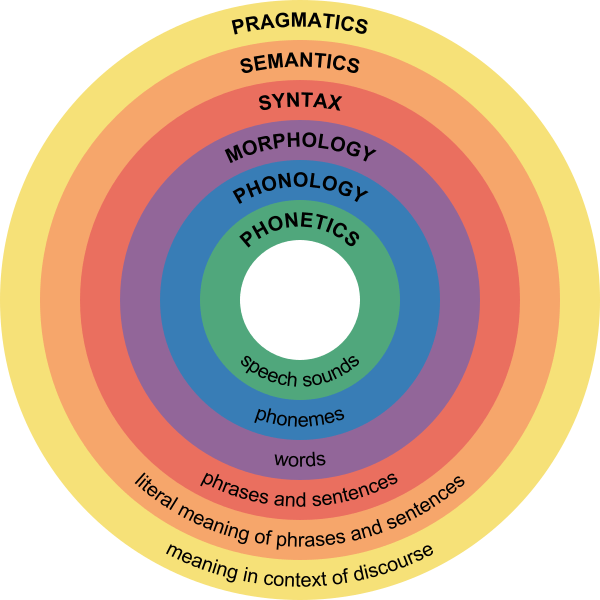
| Linguistics Subfield | Focus | Example Questions |
|---|---|---|
| Phonology | Sound systems of language | How do languages organize sounds? What sounds are universal? |
| Morphology | Structure of words | How do prefixes and suffixes alter meaning? |
| Syntax | Rules governing sentence structure | What makes a sentence grammatically acceptable? |
| Semantics | Meaning in language | How do words and sentences refer to the world? |
| Pragmatics | Language in context and use | How does context determine intended meaning beyond literal words? |
| Sociolinguistics | Language and social factors | How does dialect vary by class, region, or ethnicity? |
Universal Grammar: Chomsky's hypothesis that all human languages share an innate abstract structure, encoded in the biology of the language faculty, that constrains what grammars can look like.
Critical period: A biologically defined developmental window during which first-language acquisition proceeds normally. First articulated systematically by Eric Lenneberg (1967).
Conversational implicature: The meaning that a listener infers from an utterance beyond its literal content, derived by reasoning about the speaker's adherence to or deviation from Grice's conversational maxims.
Saussure and the Structural Foundations of Linguistics
The Sign, the System, and Arbitrariness
Ferdinand de Saussure's lectures at the University of Geneva, delivered between 1906 and 1911 and reconstructed by students as 'Course in General Linguistics' after his death in 1913, proposed a set of distinctions that structured the discipline for a century.[1]
Saussure began by insisting that language is a sign system. The linguistic sign is composed of two inseparable faces: the signifier (the acoustic image, the psychological impression of a sound pattern) and the signified (the concept).
The relationship between them is arbitrary in a precise sense: there is nothing in the concept of a dog that demands the sound sequence /dg/ in English, /j/ in French, or /hund/ in German. Convention, maintained by social habit within a speech community, fixes the association.
This arbitrariness has a profound consequence: linguistic signs derive their value not from any intrinsic properties but from their differences from other signs.
'Sheep' and 'mutton' exist as separate English words because English carves the semantic space of ovine meat in a way that French, with only 'mouton,' does not. There are no positive terms in the system; there are only differences.
Langue, Parole, and Synchronic Analysis
Saussure distinguished langue (the shared, abstract system) from parole (individual acts of speech). Linguistics, he argued, should study langue: the system of rules and values that makes communication possible, not the messy, error-prone reality of actual utterances.
He also distinguished synchronic analysis (the study of a language at one moment in time) from diachronic analysis (the study of how it changes).
His insistence on the primacy of synchronic study was a corrective to the predominantly historical focus of nineteenth-century philology, and it opened space for structural accounts of how languages work at a given moment.
The structuralist program Saussure initiated radiated well beyond linguistics. Claude Levi-Strauss applied structural analysis to mythology and kinship; Roland Barthes applied it to literature and popular culture; semiotics as a broader discipline takes the Saussurean sign as its point of departure.
Chomsky's Revolution: Innateness and Generative Grammar
The Poverty of the Stimulus
Noam Chomsky's slim 1957 monograph 'Syntactic Structures' transformed linguistics by introducing a fundamental question: what kind of formal system could generate all and only the grammatical sentences of a natural language?
Chomsky showed that finite-state grammars were inadequate; human languages required phrase-structure rules and, he later argued, transformational rules that moved constituents between positions.[2]
But the deeper revolution came with Chomsky's argument for innateness.[3] Children acquire their native language with striking speed and uniformity, despite enormous variation in the quality and quantity of linguistic input they receive.
They converge on the correct grammar despite never being told explicitly which structures are ungrammatical.
This is the poverty of the stimulus argument: the input underdetermines the output. The knowledge children end up with is richer than any reasonable inductive generalization from the data could support.
Chomsky concluded that children come to the language-learning task equipped with a Language Acquisition Device - an innate, species-specific faculty that restricts the class of possible human grammars to a manageable set.
Destroying the Behaviorist Account
Chomsky's 1959 review of B.F. Skinner's 'Verbal Behavior' (1957) is one of the most consequential papers in the history of psychology. Skinner had attempted to explain language as a system of verbal operants, shaped by reinforcement and stimulus control.
Chomsky systematically demolished this account. The productivity of language - the fact that speakers regularly produce and understand sentences they have never heard before - cannot be explained by reinforcement of specific responses.
The systematicity of grammatical knowledge, which extends to sentences no speaker has ever experienced, cannot be accounted for by associative learning. Children are not, in practice, corrected for grammatical errors in the way Skinner's model required.
The review did not merely criticize Skinner; it established that an adequate account of language required positing internal mental representations and rule-governed processes, a foundational move for cognitive science.
Deep Structure, Surface Structure, and Transformations
Chomsky's framework distinguished deep structure - an abstract level of grammatical representation that captures logical and thematic relationships - from surface structure - the linear sequence of words that is actually pronounced. Transformations mapped deep onto surface structures.
Active and passive sentences ('The cat chased the mouse' vs. 'The mouse was chased by the cat') share a deep structure but differ in surface form; questions and their declarative counterparts are related by movement transformations.
This architecture explained many distributional facts that had resisted earlier analysis.
Later theoretical developments, including Government and Binding theory (1981) and the Minimalist Program (1995), continued to elaborate and constrain the system, but the basic insight that syntax is an abstract, rule-governed computational system operating over hierarchical structures remained central.
Language Acquisition: Biology, Statistics, and Critical Periods
Eric Lenneberg and the Biological Foundations of Language
Chomsky's nativist hypothesis was given a biological grounding by Eric Lenneberg's 1967 'Biological Foundations of Language.' Lenneberg argued that language acquisition is tied to a critical period, a biologically specified developmental window during which the brain is maximally plastic for language learning.
The critical period extends roughly from infancy to puberty; after it closes, acquiring a first language becomes qualitatively harder.
Lenneberg pointed to evidence from children who suffered brain damage at different ages (recovery being more complete with earlier damage), from the patterns of language emergence in deaf children who received signing input at different ages, and from the observation that language milestones follow a maturational schedule largely independent of parental input style.[4]
The critical period hypothesis received its most tragic naturalistic test in the case of Genie, a child discovered in 1970 who had been kept in conditions of extreme social isolation and linguistic deprivation until age thirteen.
Despite intensive rehabilitation efforts, Genie never acquired the normal syntax of English, particularly the ability to produce complex embedded clauses.
While her case was confounded by psychological trauma and deprivation in other domains, it remains consistent with the claim that the critical period for syntactic development had expired.
Patricia Kuhl and Native Language Neural Commitment
Patricia Kuhl's experimental research documented one dimension of the critical period in fine-grained detail. Infants are born as universal phoneticians, capable of discriminating the phonetic contrasts of any human language.
By approximately twelve months, however, they have become specialized for the contrasts of their native language.
Japanese infants who have not received English input largely lose the ability to discriminate the English /r/-/l/ contrast, which is not phonemically distinct in Japanese.
Kuhl describes this as native language neural commitment: the brain reorganizes in response to the statistical properties of the input, optimizing for the native language while losing sensitivity to foreign contrasts.
The implication is that language experience in the first year is shaping neural architecture in ways that constrain later learning.
Statistical Learning: Saffran, Aslin, and Newport (1996)
A landmark 1996 paper in 'Science' by Jenny Saffran, Richard Aslin, and Elissa Newport introduced a complementary mechanism for acquisition.[5]
Eight-month-old infants were exposed to a continuous, monotone stream of nonsense syllables - with no pauses, stress differences, or other cues to word boundaries - for just two minutes.
The stream was generated by combining made-up words (such as 'tupiro' and 'golabu') in random order.
After this brief exposure, infants preferred to listen to the non-words over the words, indicating they had tracked the transitional probabilities between syllables and extracted word-like units.
Syllables within words were followed by the next syllable more reliably than syllables at word boundaries; infants used this statistical regularity to find boundaries.
This finding demonstrated that infants are powerful statistical learners, sensitive to distributional patterns in the input, a capacity that might contribute to lexical and grammatical learning without requiring all structure to be innately specified.
The Sapir-Whorf Hypothesis: Does Language Shape Thought?
The evidence supports a weak version of the hypothesis, not the strong one. Benjamin Lee Whorf's original claim that language determines thought, illustrated by his analysis of Hopi, has been largely rejected by contemporary linguists. Research by Lera Boroditsky and others instead shows that language shapes habitual attention and certain cognitive tasks, such as color discrimination and spatial reasoning, without determining the limits of thought.
Whorf and the Strong Version
Benjamin Lee Whorf, who worked as a fire insurance inspector while pursuing linguistics as a passionate avocation, proposed in a series of essays (collected posthumously in 'Language, Thought, and Reality,' 1956) that the structure of a language shapes its speakers' habitual thought and perception of the world.
His most influential claim concerned the Hopi people of the American Southwest. Whorf argued that the Hopi language encoded time without reference to the past-present-future framework central to European languages, and that Hopi speakers therefore experienced temporality in a fundamentally different way.
This strong version - that language determines thought - implies a radical cognitive relativism that most contemporary linguists reject. Ekkehart Malotki's detailed analysis of Hopi (1983) found extensive evidence of temporal reference, undermining Whorf's specific claims.
Berlin and Kay: Cross-Linguistic Universals in Color
Brent Berlin and Paul Kay's 1969 study 'Basic Color Terms' tested the relativist position against a large cross-linguistic sample.[8] They found that color vocabularies across languages were far from arbitrary.
Every language had terms for a focal set of colors; languages with few color terms always included terms for black and white; languages that added a third term always chose red; and subsequent elaborations followed a predictable hierarchy.
Berlin and Kay concluded that color perception was largely universal, shaped by human photoreceptor biology, with language marking rather than creating perceptual categories. This appeared to refute Whorf.
The Weak Version: Boroditsky and Linguistic Relativity
However, Paul Kay and Willett Kempton (1984) demonstrated that the placement of linguistic color category boundaries could influence similarity judgments under certain conditions, suggesting a weaker influence of language on cognition.
Lera Boroditsky's extensive program of experimental research in the 2000s and 2010s provided evidence for modest but genuine linguistic effects across multiple domains.[12]
Russian speakers, who must lexically distinguish light blue (goluboy) from dark blue (siniy), were faster at discriminating color pairs that crossed that boundary than pairs within a category, and this advantage disappeared when a verbal interference task was imposed, suggesting the effect was mediated by verbal labeling.
Studies of spatial reasoning, time metaphors (whether time flows left to right or front to back depending on the language), and grammatical gender effects on object associations pointed to consistent, replicable influences of language on thought.
The consensus today endorses a nuanced weak relativity: language shapes habitual attention and certain cognitive tasks, without determining the limits of thought.
Everett and the Piraha Controversy
Daniel Everett's fieldwork with the Piraha people of the Brazilian Amazon, summarized in 'Language: The Cultural Tool' (2012), generated heated controversy.
Everett claimed that Piraha lacks recursion - the embedding of clauses within clauses that Chomsky had proposed was the defining feature of human language - and that Piraha speakers show no evidence of precise number words, color terms, or creation myths.[11]
If correct, this would challenge Universal Grammar directly.
Chomsky, Hauser, and Fitch (in a 2002 'Science' paper) had proposed that recursion was the core of the language faculty. Critics of Everett disputed his linguistic analyses and argued that features he claimed were absent could be found with closer analysis.
The controversy remains unresolved but has usefully forced clarity about what Universal Grammar claims are empirical and what is unfalsifiable.
Historical Linguistics: Reconstructing the Past
The Comparative Method and Proto-Indo-European
Historical linguistics reconstructs the past of languages and their relationships using systematic comparison of attested forms.
The comparative method, developed by nineteenth-century scholars including Franz Bopp, Rasmus Rask, and Jacob Grimm, identifies cognates - words in different languages derived from a common ancestor - and uses regular sound correspondences to reconstruct the ancestor.
English 'father,' German 'Vater,' Latin 'pater,' Greek 'pater,' and Sanskrit 'pitar' share a pattern that cannot be coincidence; they descend from a Proto-Indo-European word reconstructed as something like *ph2ter.
Jacob Grimm (1822) identified a systematic pattern of consonant shifts in the Germanic languages - known as Grimm's Law - that distinguished them from other Indo-European branches. Proto-Indo-European voiceless stops (p, t, k) became Germanic fricatives (f, th, h); voiced stops (b, d, g) became voiceless stops (p, t, k); and so on.
The Neogrammarian hypothesis, formulated by scholars at Leipzig in the 1870s, proposed that sound change is exceptionless: apparent exceptions always have a regular explanation, whether another sound change, analogy, or borrowing. This principle gave historical linguistics a predictive rigor comparable to other natural sciences.
Linguistic Paleontology and Language Families
The comparative method can reach into prehistory. By identifying shared vocabulary relating to specific cultural items (words for 'wheel,' 'yoke,' 'horse'), linguists can draw inferences about the culture and environment of proto-language speakers - a practice called linguistic paleontology.
The debate about the Proto-Indo-European homeland, placing it somewhere in the Eurasian steppes approximately five thousand years ago (the Kurgan hypothesis associated with Marija Gimbutas), exemplifies this interaction between linguistics and archaeology.
Beyond Indo-European, linguists have identified dozens of language families worldwide: Sino-Tibetan, Afro-Asiatic, Niger-Congo, Austronesian, among many others.
Some proposed large-scale groupings, such as Greenberg's Amerind hypothesis or Nostratic, remain highly contested because the methods become unreliable over the very long timescales involved.
Glottochronology - an attempt to date language divergence from the rate at which basic vocabulary changes - was once widely used but is now largely discredited due to variable rates of change.
Sociolinguistics: Language in Social Life
Labov and the Social Stratification of Language
William Labov's foundational studies established that linguistic variation is not random but patterned by social structure.[6] His 1963 Martha's Vineyard study revealed that vowel centralization correlated with speakers' identification with island versus mainland values.
His 1966 'The Social Stratification of English in New York City' documented that phonological variables - particularly the presence or absence of postvocalic /r/ - varied systematically with social class, age, and speech style (ranging from casual conversation to reading word lists).
Working-class speakers used fewer prestigious features in casual speech but showed hypercorrection - using more prestigious forms than higher-class speakers - in formal styles, indicating social awareness of prestige norms despite different default usage.
AAVE as a Full Linguistic System
Labov's analysis of African American Vernacular English in 'Language in the Inner City' (1972) challenged educational theories that attributed the academic difficulties of Black urban children to linguistic deficiency.
Labov demonstrated that AAVE is a fully systematic dialect with its own consistent phonological rules (consonant cluster simplification, vocalization of postvocalic /r/), morphological patterns (invariant aspectual 'be' for habitual or distributed situations), and syntactic structures (copula deletion governed by precise phonological and syntactic conditions).[7]
AAVE is not English with mistakes; it is a variety of English with a different but internally consistent grammar.
Language Death and Endangerment
Of the approximately seven thousand languages spoken today, roughly half are judged to be at risk of extinction by 2100. Language death typically results from the displacement or assimilation of minority communities by dominant language groups, often in contexts of colonialism, urbanization, or economic pressure.
When a language dies, it takes with it a unique way of organizing the lexicon, a store of oral literature and ecological knowledge, and a window into the range of possible human grammars.
Language documentation efforts, community-driven revitalization programs (as in Welsh, Hawaiian, and Maori), and linguistic fieldwork all attempt to address this crisis, though the structural forces driving language shift are formidable.
Pragmatics: What Language Does
Grice's Cooperative Principle
H. Paul Grice's 1975 paper 'Logic and Conversation' proposed that conversations are guided by a general Cooperative Principle - contribute as required by the purpose of the exchange - elaborated through four maxims: quantity (say enough, but not too much), quality (say what you believe is true and have evidence for), relation (be relevant), and manner (be clear, orderly, and brief).
These maxims are not rules that speakers always follow but norms whose apparent violation generates inferences, which Grice called conversational implicatures.[9]
If a friend asks whether you enjoyed a novel and you say 'Well, the cover was beautifully designed,' you have apparently violated the maxim of relation; your friend infers that you did not enjoy the novel but are choosing an indirect way to say so.
Implicatures are cancellable (you could add 'and yes, I loved every page'), which distinguishes them from entailments that follow necessarily from the semantic content of an utterance.
Speech Act Theory
J.L. Austin's 'How to Do Things with Words' (published posthumously in 1962) distinguished performative utterances - in which saying something constitutes doing it ('I hereby declare this meeting open') - from constative utterances, and then dissolved this distinction by proposing that all utterances have an illocutionary force, a kind of action being performed.[10]
John Searle systematized this in 'Speech Acts' (1969), distinguishing the locutionary act (saying something with literal meaning), the illocutionary act (the social action accomplished: promising, warning, requesting, apologizing), and the perlocutionary act (the effect produced on the listener).
Understanding ordinary communication requires recognizing illocutionary force, which is often conveyed indirectly and depends on shared knowledge, context, and the elaborate system of social conventions governing what kinds of acts are felicitous in what kinds of circumstances.
Deixis and Context Dependence
Pragmatics also addresses deixis: the way certain expressions get their reference only relative to the context of utterance. 'I,' 'you,' 'here,' 'now,' 'yesterday' cannot be interpreted without knowing who speaks, to whom, where, and when.
This context-dependence is pervasive in natural language and creates intrinsic links between linguistic form and the social and physical situation of use.
Discourse analysis extends this concern from individual sentences to extended texts, asking how coherence is maintained across utterances, how narrative is structured, and how genres differ across cultures and contexts.
Conclusion
Linguistics demonstrates that the most familiar human activity - talking - is the product of an extraordinarily sophisticated system.
From Saussure's structural insight that signs derive value from differences, to Chomsky's argument that grammar is partly a biological given, to Labov's documentation of how social identity shapes phonology, to Grice's analysis of how speakers convey more than they say, linguistics illuminates the mechanisms that underlie every conversation.
As roughly half the world's languages face extinction, as computational systems achieve unprecedented performance on language tasks, and as debates about linguistic relativity and universals continue, the science of language remains central to our understanding of what it means to be human.
Sources & Further Reading
- Saussure, Ferdinand de. 'Course in General Linguistics.' Translated by Wade Baskin. McGraw-Hill, 1966 [1916].
- Chomsky, Noam. 'Syntactic Structures.' Mouton, 1957.
- Chomsky, Noam. 'Review of B.F. Skinner's Verbal Behavior.' Language 35(1), 26-58, 1959.
- Lenneberg, Eric. 'Biological Foundations of Language.' Wiley, 1967.
- Saffran, Jenny R., Richard N. Aslin, and Elissa L. Newport. 'Statistical Learning by 8-Month-Old Infants.' Science 274(5294), 1926-1928, 1996.
- Labov, William. 'The Social Stratification of English in New York City.' Center for Applied Linguistics, 1966.
- Labov, William. 'Language in the Inner City: Studies in the Black English Vernacular.' University of Pennsylvania Press, 1972.
- Berlin, Brent, and Paul Kay. 'Basic Color Terms: Their Universality and Evolution.' University of California Press, 1969.
- Grice, H. Paul. 'Logic and Conversation.' In P. Cole and J. Morgan (eds.), 'Syntax and Semantics, Vol. 3: Speech Acts,' 41-58. Academic Press, 1975.
- Austin, J.L. 'How to Do Things with Words.' Oxford University Press, 1962.
- Everett, Daniel. 'Language: The Cultural Tool.' Pantheon, 2012.
- Boroditsky, Lera, Lauren A. Schmidt, and Webb Phillips. 'Sex, Syntax, and Semantics.' In D. Gentner and S. Goldin-Meadow (eds.), 'Language in Mind.' MIT Press, 2003.