
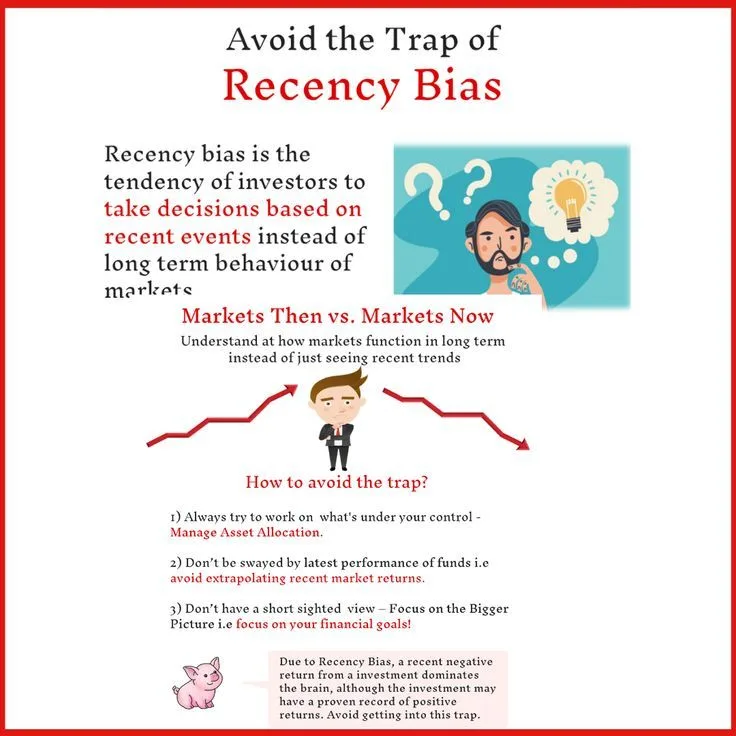
Recency bias is the systematic tendency to give disproportionate weight to recent events in memory, judgment, and decision-making. It causes people to overweight what happened last week or last quarter while underweighting a longer, more representative track record, distorting everything from list recall to investment decisions to performance reviews.
Ask someone to name a few words from a list they heard two minutes ago and they will reliably recall the last few items far better than items from the middle of the list. Ask an investor to estimate the likely return on stocks over the next decade and they will anchor heavily on what markets have done in the last year or two.
Ask a manager to evaluate an employee's annual performance and they will overweight what happened in the last month.
This is recency bias: the systematic tendency to give disproportionate weight to recent events in memory, judgment, and decision-making.
It is one of the most pervasive cognitive biases in human reasoning, and its effects range from mildly inconvenient in everyday decisions to catastrophically costly in financial markets and long-range planning.
The Serial Position Effect: Where Recency Bias Comes From
The scientific foundation of recency bias lies in memory research conducted by Hermann Ebbinghaus in the 1880s. Ebbinghaus, experimenting on himself with lists of nonsense syllables, discovered that recall accuracy was not uniform across a list.
Items at the beginning and end were remembered far better than items in the middle. This is the serial position effect, and its two components are the primacy effect and the recency effect.
The Primacy Effect
Items encountered at the beginning of a list are remembered well because they receive more processing time and are more likely to have been rehearsed and moved into long-term memory. When you encounter an item early, there is nothing else competing for attention, and you have time to consolidate it before the next item arrives.
The Recency Effect
Items encountered at the end of a list are remembered well because they are still active in working memory, the limited-capacity short-term buffer that holds information being currently processed.
When asked to recall the list immediately, these items are easily retrieved from working memory without requiring reconstruction from long-term storage.
The recency effect is strong in the short term but fades quickly. If there is a delay between encountering the list and recalling it, the recency advantage disappears: working memory has been overwritten by subsequent information, and the end-of-list items now compete on equal terms with middle items.
The primacy effect, by contrast, persists over delays because it reflects genuine long-term memory consolidation.
This short-term vs. long-term distinction matters: recency bias in everyday judgment does not simply reflect that recent information is better remembered. It reflects something more active: a tendency to weight recent information as more diagnostic, more representative, and more predictive than it actually is.
The Neuroscience of Recency
The neural basis of the recency effect has been illuminated through neuroimaging research. Murdock (1962) established the canonical free-recall curve that showed the precise shape of the serial position effect across hundreds of experiments.
Subsequent neuroimaging work by Talmi et al. (2005) using fMRI found that hippocampal activation during encoding predicted later recall of items from the primacy portion of lists, while prefrontal and parietal activity during retrieval correlated with recency-driven recall.
This neurological double dissociation supports the view that primacy and recency effects reflect genuinely different memory systems operating simultaneously.
The key implication is that recency bias is not simply a bad habit; it is anchored in the architecture of human memory. Addressing it requires deliberate structural interventions, not just awareness.
Recency Bias as a Heuristic
Kahneman and Tversky's availability heuristic is the mechanism most closely related to recency bias. The availability heuristic is the tendency to judge the likelihood of events by how easily examples come to mind.
Recent events are highly available (they are easy to bring to mind, vivid, and emotionally salient) and so they feel representative of underlying frequencies and probabilities.
When a dramatic plane crash dominates the news, air travel feels more dangerous than it was last month, even though the objective risk has not changed. When a severe winter follows several mild ones, climate change seems less real. When a stock has risen sharply for six months, a continued rise feels probable.
In each case, recency inflates the perceived representativeness of recent data relative to longer-term base rates.
The mental shortcut of using vivid, available recent examples as proxies for underlying probability distributions is fast and often reasonable, but it introduces a systematic bias toward the recent at the expense of the historically grounded.
Kahneman's System 1 and System 2 Framing
In Daniel Kahneman's dual-process model, described in Thinking, Fast and Slow (2011), recency bias is primarily a product of System 1 thinking: the fast, automatic, associative mode of cognition that operates below conscious awareness.
System 1 naturally retrieves what is most available, most vivid, and most recent without stopping to ask whether this sample is representative.
System 2, the slow, deliberate, effortful mode, is capable of correcting for recency bias, but it requires activation. It must be triggered deliberately, and it is metabolically costly.
Under time pressure, cognitive load, or emotional arousal, precisely the conditions in which important decisions are often made, System 2 is less likely to engage, leaving System 1's recency-driven assessments to stand unchallenged.
This framing explains why experienced professionals who intellectually understand recency bias continue to exhibit it under pressure. Understanding a bias and correcting for it in the moment are separate cognitive tasks.
Recency Bias in Financial Markets
The most economically consequential domain where recency bias operates is investing. The pattern is consistent and well-documented: investors pour money into assets after extended periods of strong performance and withdraw money after extended periods of poor performance.
This is the opposite of rational strategy. Buying high and selling low guarantees underperformance relative to simply holding.
The DALBAR Data
The financial research firm DALBAR has published annual analyses of investor behavior for decades. Their Quantitative Analysis of Investor Behavior consistently finds that the average equity fund investor substantially underperforms the funds they invest in, often by three to four percentage points annually.
The mechanism is straightforward: investors buy funds after periods of strong performance (when prices are elevated) and sell after periods of poor performance (when prices are depressed).
In their 2022 report, DALBAR found that while the S&P 500 returned an average of 18.18% for the year 2021, the average equity fund investor earned only 14.04%, a gap of more than four percentage points attributable primarily to mistimed market entry and exit decisions driven by recent performance extrapolation.
The 2008 financial crisis illustrated this pattern with clarity. Equity fund outflows reached their maximum in the first quarter of 2009, precisely the bottom of the market, and the moment of maximum future return.
Investors who sold at the bottom locked in their losses and missed the subsequent recovery, driven by extrapolating recent losses into the future.
Institutional Investors Are Not Immune
Research by Amit Goyal and Sunil Wahal, published in the Journal of Finance in 2008, examined the investment decisions of over 3,400 pension funds over a decade.
They found that pension plans consistently hired investment managers after periods of strong recent performance and fired managers after periods of poor recent performance, with no improvement in subsequent returns from the hiring decisions.
The study is particularly striking because it involves sophisticated institutional actors with professional investment teams, fiduciary obligations, and access to high-quality research.
The fact that they exhibited the same recency-driven pattern as retail investors suggests that the bias is not primarily a product of ignorance or lack of resources.
Institutional investors with sophisticated research teams and fiduciary obligations made the same recency-driven errors as retail investors, just with larger sums of money.
"The investor's chief problem, and even his worst enemy, is likely to be himself. In the end, how your investments behave is much less important than how you behave." Benjamin Graham, The Intelligent Investor
Bull Markets and Confidence
Recency bias also inflates confidence during extended bull markets. After years of rising asset prices, investors revise upward their estimates of likely future returns, reducing their perception of risk.
This underestimation of risk at market peaks, driven by extrapolating recent low-volatility experience, contributes to the excessive leverage and risk-taking that amplifies eventual corrections.
The housing market of the early-to-mid 2000s showed this clearly: years of rising prices led lenders, borrowers, and rating agencies to model future losses using recent default rates that had been suppressed by the rising-price environment. The models were accurate descriptions of the recent past and poor predictions of the near future.
Robert Shiller's Nobel Prize-winning research on irrational exuberance documented the mechanism in detail. In surveys conducted throughout the bull market of the late 1990s, Shiller and his colleagues found that investor expectations of future returns rose in direct proportion to recent past returns, a textbook recency extrapolation.
Investors expected the next 10 years to look like the last 3, systematically ignoring the mean-reverting properties of long-run equity returns.
The Disposition Effect
Recency bias interacts with a related phenomenon documented by Hersh Shefrin and Meir Statman (1985): the disposition effect, the tendency of investors to sell winning assets too quickly and hold losing assets too long.
Investors who have experienced recent gains become more loss-averse (the recent gain is the reference point), while investors nursing recent losses hold on, hoping for a recovery to their original reference price.
Terrance Odean's landmark 1998 study of 10,000 brokerage accounts found that stocks sold by investors outperformed stocks that were held by an average of 3.4 percentage points over the following year.
Investors were systematically selling their best-performing stocks (reacting to recent gains) and holding their worst ones (refusing to update their assessment in light of recent losses), a dual manifestation of recency-driven judgment.
Recency Bias in Performance Evaluation
In organizational settings, recency bias systematically distorts performance reviews. The evaluation period is typically a full year, but managers' memories of an employee's performance are dominated by the most recent weeks.
This has been documented extensively in performance appraisal research. Studies by psychologist Kevin Murphy in the 1980s and 1990s found that rating accuracy dropped significantly as the interval between observed performance and evaluation increased, precisely because memory for earlier-in-period performance degraded while recent performance remained vivid.
A 2019 study by Bi et al. published in the Journal of Applied Psychology found that performance ratings were significantly more influenced by performance in the final quarter of an evaluation period than in earlier quarters, even when raters were explicitly instructed to consider the full period.
The recency effect persisted even under conditions designed to mitigate it.
The End-of-Period Gaming Problem
One practical consequence of recency bias in evaluations is that employees who understand the recency effect learn to peak at evaluation time, pushing out visible results, increasing communication with managers, and taking on high-visibility work close to review dates.
This produces a misalignment between actual sustained performance and evaluated performance.
A striking real-world demonstration of this effect was observed by Ely and Geanakoplos (2010) in a study of Major League Baseball players approaching contract years.
Players' statistics improved measurably in the final year of their contracts, not necessarily because they were working harder, but because the incentive structure rewarded making recency work for them.
The same dynamic operates in organizations where promotion cycles and review periods are known in advance.
Consequences
Missed development opportunities. If a manager's view of an employee is dominated by recent events, poor performance earlier in the year that has since improved may be underweighted, while a strong first half followed by a difficult patch will be remembered primarily as a difficult patch.
Pay and promotion distortions. To the extent that evaluations drive compensation and advancement decisions, recency bias systematically misevaluates performance that was strong early in the year and treats recent reversals as more permanent than they may be.
Calibration failures. In multi-rater calibration sessions, the employee who happened to complete a visible project the week before ratings are due will be evaluated more favorably than the employee who did superior work in March. This creates an organizational signal that visibility and timing matter more than sustained output.
Recency Bias in Forecasting and Planning
Recency bias is pervasive in organizational forecasting. When building financial models, demand projections, and scenario plans, analysts typically anchor on recent trend data and project it forward.
This produces systematic errors during turning points. After years of strong growth, demand forecasts extrapolate growth. After a recession, demand forecasts extrapolate decline.
At precisely the moments when long-term base rates and mean reversion are most relevant, near the top and bottom of cycles, recency bias leads analysts away from base rates and toward recent trends.
Philip Tetlock's research on expert political forecasting, published in Superforecasting (2015), found that one of the most consistent differentiators between accurate and inaccurate forecasters was base rate use.
Expert-level "superforecasters" consistently sought out long historical base rates before incorporating recent events, and weighted recent deviations from base rates as likely to revert rather than likely to continue.
The Planning Fallacy
A related manifestation of recency bias in planning is the planning fallacy, named by Kahneman and Tversky (1979). The planning fallacy is the tendency to underestimate the time, costs, and risks of future actions while overestimating the benefits.
A key driver is the "inside view", basing projections on the specific features of the current project (often including recent smooth progress) rather than on the historical base rate of similar projects.
Bent Flyvbjerg, who has studied mega-project cost overruns extensively, found in a 2002 study of 258 infrastructure projects across 20 countries that 90% ran over budget, by an average of 28%. In transport infrastructure specifically, the average cost overrun was 44.7%.
The root cause, Flyvbjerg argued, was systematic optimism driven by the inside view: projecting from recent planning-phase smoothness rather than from the historical base rate of similar project completions.
The antidote, which Flyvbjerg called reference class forecasting, is to begin all project estimates with the base rate of similar past projects before adjusting for project-specific features.
This is structurally equivalent to the general prescription for recency bias: establish the long-run base rate first, then incorporate recent data as an update rather than a replacement.
Recency Bias in Medical Diagnosis
Recency bias has life-or-death consequences in clinical medicine. Availability bias, the immediate ancestor of recency bias in clinical contexts, causes physicians to overestimate the likelihood of diagnoses they have seen recently and underestimate the likelihood of diagnoses they have not seen for a long time.
A physician who has just treated three cases of a rare condition will be more likely to diagnose a fourth borderline case as that condition than a physician who has not seen it recently, even when the objective symptoms are identical.
This "availability cascade" in clinical reasoning was documented by Tversky and Kahneman (1974) and has been extensively studied in medical decision-making literature since.
Croskerry (2002), in an influential paper on cognitive error in medicine published in Academic Emergency Medicine, identified recency bias as one of the most common sources of diagnostic error in emergency settings, particularly when unusual presentations follow a run of similar cases.
Primacy vs. Recency in Different Contexts
| Context | Which Effect Dominates | Implication |
|---|---|---|
| Immediate recall (seconds) | Recency | Last items remembered best |
| Delayed recall (hours/days) | Primacy | First items remembered best |
| First impressions of people | Primacy | Early information anchors judgment |
| Investment decisions | Recency | Recent returns drive allocation |
| Performance reviews | Recency | Recent events dominate evaluation |
| Narrative persuasion | Primacy + Recency | First and last arguments remembered best |
| Job interviews | Both | First impression + final impression matter most |
| Sales negotiations | Recency | Last offer discussed anchors final agreement |
| Medical diagnosis | Recency | Recent cases inflate estimated base rates |
| Project planning | Recency | Recent project progress dominates projections |
The interaction between primacy and recency effects helps explain several common communication recommendations. Presenting your strongest arguments first and last in a presentation, the "bookend" structure, exploits both effects.
Most evaluation situations show recency dominance, while social judgment situations often show primacy dominance: first impressions are sticky precisely because subsequent information is interpreted in light of them.
Case Study: The 2008 Financial Crisis and Recency-Driven Rating Models
Few examples illustrate the institutional consequences of recency bias more vividly than the risk models used by major financial institutions and credit rating agencies in the years leading up to the 2008 financial crisis.
The models used to estimate default probabilities on mortgage-backed securities were calibrated primarily on data from the 2000-2006 period, years of rising house prices and unusually low default rates.
The models treated this recent data as representative of future conditions, assigning very low probabilities to scenarios involving national house price declines.
David Li's Gaussian copula model, which became the industry standard for pricing collateralized debt obligations, was notorious for its reliance on recent credit correlation data. As Felix Salmon described in Wired magazine, the model "worked beautifully as long as you used it to extrapolate from recent history.
But when house prices started falling nationally for the first time since the Great Depression, the model's assumptions, built on recent data, proved catastrophically wrong."
The rating agencies' AAA ratings for tranches of subprime mortgage securities were similarly anchored on recent default experience.
A broader historical sample that included the 1930s, regional downturns of the 1980s, and international housing market collapses would have produced radically different risk estimates. The recency bias was not individual: it was embedded in the mathematical models themselves.
How to Counteract Recency Bias
Recency bias is countered by deliberately weighting long-term evidence over recent impressions: anchor on historical base rates before adjusting for new data, keep written records so memory cannot quietly rewrite the past, seek out disconfirming long-horizon evidence, build in structural delays before acting on recent events, and run pre-mortems that surface the historical counter-evidence a recent trend suppresses. None of these eliminate the bias, since it is built into memory itself, but together they force decisions onto a fuller record.
Use Base Rates as Anchors
Before incorporating recent data, establish the long-term base rate for the relevant outcome. What is the historical average annual equity return, not just the last three years? What is the median employee performance across the full review period, not just November? What is the typical sales cycle length, not just the last quarter?
Anchoring on base rates does not mean ignoring recent data: it means treating recent data as an update to a well-calibrated prior rather than as a replacement for one. Bayesian reasoning formalism, updating a prior belief in proportion to the strength of new evidence, is the normative model that recency bias violates.
Maintain Written Records
Memory is unreliable for events beyond a few weeks, and recency bias means that what is remembered most readily is the most recent. Keeping written records of performance, decisions, market conditions, and outcomes creates an objective basis for evaluation that is not distorted by memory's recency preference.
In performance management, this means keeping notes throughout the review period, not just in the month before reviews. In investing, it means tracking portfolio decisions and their rationales so they can be evaluated against outcomes rather than reconstructed from memory.
Many experienced fund managers maintain explicit investment journals partly for this reason, to prevent the current market environment from rewriting their memory of past reasoning.
Seek Disconfirming Long-Horizon Evidence
Actively look for data that covers periods before the recent trend began. If markets have risen for three years, look at the full historical distribution of three-year market returns and the range of outcomes that followed.
If an employee has had a strong recent quarter, review their performance across the full prior year before updating your assessment.
In forecasting contexts, this means explicitly including scenarios based on mean reversion and historical averages, not just the central scenario that projects the recent trend. Scenario planning that includes only optimistic, base, and pessimistic variations of the current trend is still anchored in recency.
Build in Structural Delays
For consequential decisions, building in a structured delay between observing recent events and acting on them reduces the weight of recency. A rule of "I will not change my investment allocation within 30 days of a market movement of more than 10 percent" forces a review at a moment when the recency effect has partially faded.
Investment policy statements, documents that specify target allocations and the conditions under which they will be changed, serve a similar function. By committing to a policy in advance, investors remove the in-the-moment discretion that recency bias exploits.
Use the Pre-Mortem Technique
Before acting on a recency-driven assessment, conduct a pre-mortem: imagine that the action taken based on recent trends turns out to be a mistake and ask what the most likely reason would be. This exercise reliably surfaces the historical counter-evidence and mean-reversion arguments that recency bias suppresses.
Gary Klein, who developed the pre-mortem technique, found in his research with decision teams that pre-mortems increased identification of reasons for failure by approximately 30 percent compared to traditional risk assessment approaches, primarily because they gave people explicit permission to voice concerns that recency-optimism had made feel contrarian.
Calibrate Through Feedback Tracking
One of the most effective long-term corrections for recency bias is systematic feedback tracking: maintaining explicit records of predictions alongside outcomes, and reviewing them regularly.
Tetlock's superforecasters maintained this discipline rigorously: they kept detailed records of forecasts, updated them as new information arrived, and scored themselves against outcomes over time.
This process makes recency bias visible in a way that simple awareness does not. When you can look back and see that your forecasts became systematically more optimistic after market rallies and more pessimistic after corrections, the pattern becomes undeniable, and correctible.
Recency Bias and Generational Memory
Recency bias operates at the collective level as well as the individual level. Generational memory, the shared baseline of experience that a cohort uses to calibrate its expectations, is subject to the same recency distortion as individual memory.
Investors who began their careers during the long bull market of the 1990s developed calibrations of expected return and acceptable risk based on that experience. Those who began during the Great Depression developed radically different calibrations.
Ulrike Malmendier and Stefan Nagel (2011), in a study published in the Quarterly Journal of Economics, found that individuals who experienced low stock market returns during their formative years invested significantly less in stocks throughout their lives, a generational recency effect that persisted for decades.
This finding has important practical implications. Investment advisors, organizational leaders, and policy makers should be aware that their own baseline expectations are calibrated against the recent historical experience they personally witnessed, which may not be representative of the longer-run base rate.
Summary
Recency bias is the systematic tendency to overweight recent events in memory and judgment.
Its roots lie in the serial position effect, the well-documented memory advantage for items encountered most recently, combined with the availability heuristic, which causes vivid recent events to inflate estimates of their representativeness and frequency.
In financial markets, recency bias drives the buy-high-sell-low pattern that causes individual and institutional investors to underperform the assets they invest in.
The DALBAR data consistently shows annual performance gaps of three to four percentage points attributable to recency-driven timing errors, while Goyal and Wahal's (2008) study of 3,400 pension funds demonstrated that institutional sophistication provides no immunity.
In performance management, recency bias distorts annual evaluations toward the most recent weeks. In forecasting, it leads analysts to extrapolate recent trends past turning points, with the 2008 financial crisis providing the most costly demonstration of models calibrated on recent rather than historical data.
The antidote is deliberate use of base rates, written records, structural delays, and systematic feedback tracking that force decision-makers to engage with longer-horizon evidence before acting on recent observations.
Recency bias cannot be eliminated: it is embedded in the architecture of human memory, but it can be systematically corrected by building processes that counteract the brain's natural tendency to treat the vivid and the recent as the representative and the probable.